
When you file a travel insurance claim, receipts are usually one of the first things the insurance company asks for. That makes sense. A receipt can show that you paid for a hotel, meal, taxi, medical visit, replacement item, or other travel-related expense.
But receipts do not always prove the full claim.
A receipt may show what you spent, but it may not explain why you spent it, whether the reason was covered, whether the expense was necessary, or whether another company already reimbursed part of the loss. That is where many travelers get frustrated. They submit proof that money was spent, but the claim still comes back asking for more documentation.
The better question is not just “Do I need receipts?”
It is also “What do my receipts prove — and what do they leave out?”
This guide explains when travel insurance receipts may matter, why itemized receipts are stronger than vague card charges, and what other proof may still be needed before the claim can be evaluated.
Quick Answer
Travel insurance often requires receipts, but receipts usually prove only one part of the claim.
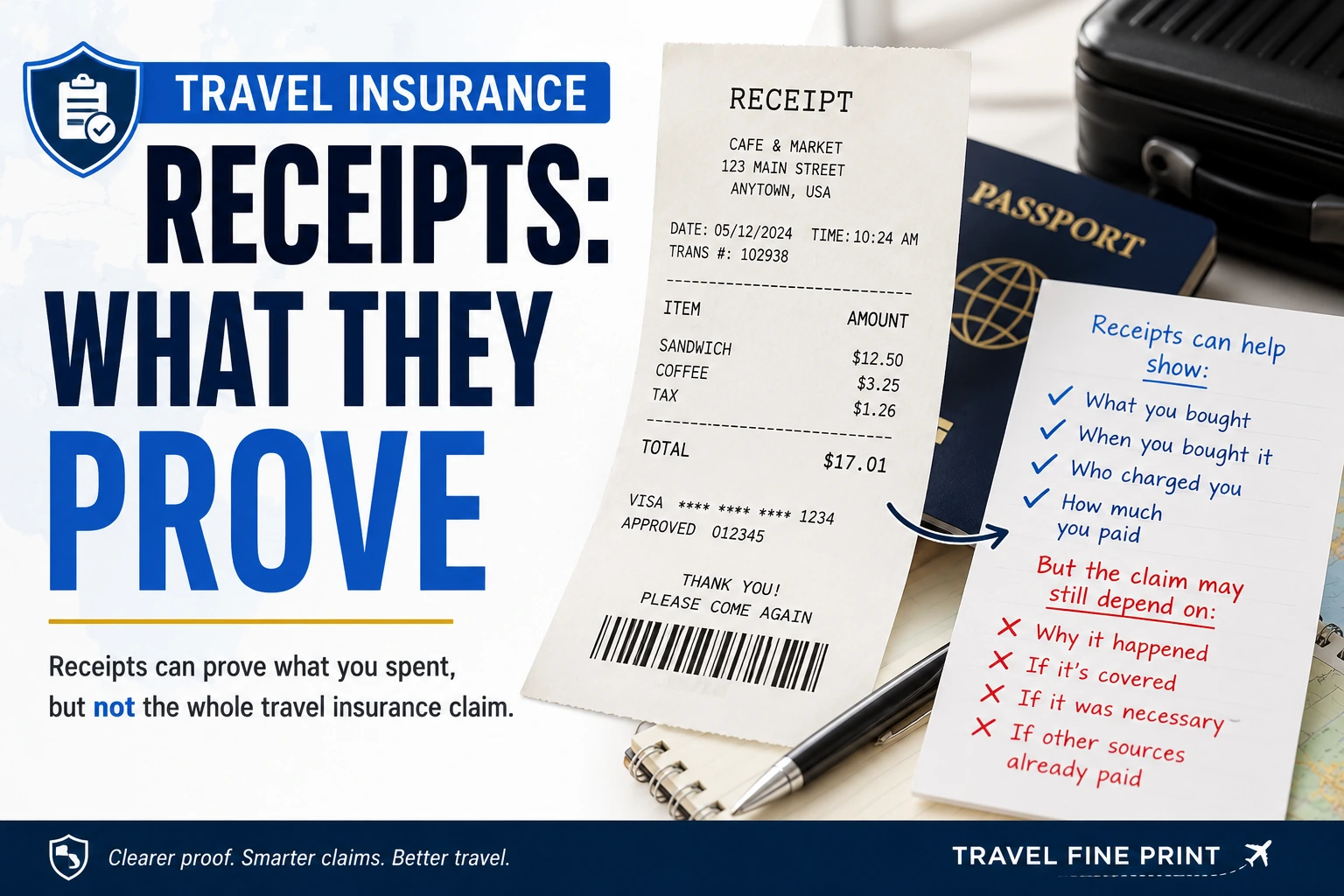
Receipts can help show what you bought, when you bought it, who charged you, and how much you paid. They are especially important for expenses such as meals, hotels, transportation, medical treatment, baggage replacement, or other out-of-pocket costs.
But a receipt does not automatically prove that the expense is covered. The insurer may still need documents showing why the expense happened, whether the reason fits the policy, whether the cost was necessary or reasonable, and whether any refund, voucher, airline compensation, hotel adjustment, or other reimbursement reduced the loss.
System Insight
A receipt usually proves spending, not the whole travel insurance claim.
- The purchase matters because the insurer needs to see what you bought, when you bought it, who charged you, and how much you paid.
- The reason matters because a receipt does not explain why the expense happened or whether the situation fits a covered reason.
- The connection matters because the receipt should tie back to the delay, cancellation, medical issue, baggage problem, or other claimed event.
- The unrecovered amount matters because refunds, vouchers, airline compensation, hotel credits, or provider reimbursements may reduce what the policy can pay.
What Travel Insurance Receipts Can and Cannot Prove
Receipts are useful because they give the claim reviewer a starting point. They help confirm that an expense was real, when it happened, and how much was paid.
But a receipt does not explain the full reason behind the expense.
That difference matters. A traveler may submit every receipt from a disrupted trip and still be asked for more documents because the insurer is not only verifying spending. It is also evaluating whether the expense connects to a covered reason, fits the benefit rules, and has not already been reimbursed somewhere else.
Use this distinction before you file:
Receipt Proof Check
What a Receipt Shows — and What It Leaves Out
A receipt can support a travel insurance claim, but it usually does not answer every question the insurer needs to evaluate.
What Receipts Can Help Prove
- What you bought, such as a hotel room, meal, taxi, medication, replacement item, or service.
- When the expense happened, which can matter for delay, interruption, medical, or baggage claims.
- Who charged you, including the airline, hotel, pharmacy, clinic, restaurant, rideshare, or retailer.
- How much you paid, especially when the receipt is itemized and matches your claim amount.
- Sometimes the payment method, if the receipt shows the card type or last four digits.
What Receipts May Not Prove
- Why the expense happened or whether it was caused by a covered event.
- Whether the policy covers the reason, delay length, medical situation, cancellation issue, or baggage problem.
- Whether the expense was necessary or reasonable under the policy’s rules.
- Whether another company already reimbursed you through a refund, voucher, credit, or compensation.
- Whether the amount fits the benefit limits, daily caps, exclusions, or documentation requirements.
A receipt is strongest when it is part of a proof trail, not when it stands alone.
For example, a meal receipt after a flight delay is more useful when it is paired with the flight delay notice, boarding pass, rebooking record, and any airline voucher details. A medical receipt is stronger when it is paired with a provider note, diagnosis or treatment record, and proof that the care happened during the covered trip.
The receipt answers “what did you spend?”
The rest of the documentation helps answer “why was that expense part of a covered loss?”
Why Itemized Receipts Are Stronger Than Card Statements
A credit card statement can show that money left your account, but it usually does not show enough detail to prove the expense itself.
That matters because many travel insurance claims are reviewed at the item level. The insurer may need to know whether the charge was for a covered expense, whether anything non-covered was included, and whether the amount matches the benefit being claimed.
For example, a card statement that says “Airport Restaurant — $86.42” may show that you paid a restaurant. It does not show how many people were included, what was purchased, whether alcohol was part of the charge, whether the meal happened during the covered delay window, or whether the airline already gave you meal vouchers.
An itemized receipt is stronger because it gives the reviewer more context. It can show the date, time, vendor, purchased items, taxes, fees, tip, and total amount. That does not guarantee approval, but it makes the receipt more useful as claim proof.
Receipt Detail Check
A Card Statement Proves Payment. An Itemized Receipt Proves More.
A card statement may help show that you paid a certain amount, but it often does not show what the charge included. That can be a problem when the insurer needs to separate eligible expenses from non-covered items.
Whenever possible, keep the itemized receipt, not just the card charge. The clearer the receipt, the easier it is to connect the expense to the claim category, policy limit, and covered travel problem.
When Receipts Usually Matter Most
Receipts tend to matter most when the claim involves reimbursement for money you spent out of pocket. That can include extra meals during a covered delay, a hotel stay caused by a covered disruption, transportation after a missed connection, medical treatment during a trip, replacement essentials after baggage delay, or prepaid trip costs that were not refunded after a covered cancellation.
The more direct the reimbursement request, the more important the receipt becomes.
But even then, the receipt is rarely the only document that matters. The insurer may still need proof of the travel problem that caused the expense. A receipt for a replacement shirt may be useful in a baggage delay claim, but the baggage delay report helps show why you needed replacement clothing in the first place.
A receipt for a hotel stay may support a travel delay claim, but the airline delay notice, boarding pass, and rebooking record help connect that hotel stay to the covered disruption.
In other words, receipts support the cost side of the claim. They usually need to be paired with documents that support the reason side.
Why the Insurer May Still Ask for More Proof
It can feel frustrating to submit receipts and then receive a request for additional documents. But that does not always mean the receipt was rejected. It may mean the receipt answered only one part of the claim.
A travel insurance claim usually has to connect several pieces together: the covered event, the timing, the expense, the policy benefit, and the amount that was not reimbursed by someone else.
For example, a taxi receipt may show that you paid for transportation. It may not show whether the taxi was needed because of a covered travel delay, missed connection, medical issue, or baggage problem.
A hotel receipt may show that you paid for an extra night. It may not show whether the airline offered lodging, whether the delay met the policy’s minimum time requirement, or whether the room cost was reasonable under the policy.
A medical receipt may show that treatment was paid for. It may not show the diagnosis, the date symptoms began, whether the treatment happened during the covered trip, or whether the expense should first go through another insurance plan.
That is why a strong receipt file usually includes more than receipts. It includes the documents that explain why those receipts exist.
The Missing Piece: Proof the Expense Was Not Recovered Elsewhere
One of the easiest details to overlook is whether another company already reduced the loss.
Travel insurance usually does not pay the same loss twice. If an airline refunded part of your ticket, issued a meal voucher, covered a hotel, or gave travel credit, that may affect the amount you can claim. The same can be true if a hotel refunded a prepaid stay, a cruise line issued future cruise credit, a tour operator applied a credit, or a credit card benefit reimbursed part of the expense.
That does not mean your claim automatically fails. It means the insurer may need to see what was refunded, credited, denied, or still unrecovered.
This is where travelers sometimes submit receipts but forget the offset documents. A receipt may show the original amount paid, but the insurer may still ask:
“How much of this loss did you actually still have after refunds, credits, vouchers, or compensation?”
That is why refund denial emails, cancellation confirmations, voucher notices, airline compensation records, hotel folios, and provider statements can matter just as much as receipts.
Traveler Risk
Receipts can prove you spent money, but not that the claim is payable.
A receipt may support the cost of an expense, but the insurer may still review the covered reason, timing, necessity, benefit limits, refund records, voucher details, airline compensation, hotel credits, and other reimbursements before deciding how much, if anything, is payable.
Check the Fine Print
Not Sure If Your Travel Insurance Receipt File Is Complete?
Use the Travel Fine Print Risk Checker to review the type of claim, the proof you have, and whether your receipts may need to be paired with delay notices, medical records, refund denials, baggage reports, or other supporting documents.
What to Do Before You Submit Receipts
Before you upload receipts to a travel insurance claim, organize them around the claim story. Do not only ask whether you have a receipt. Ask what each receipt helps prove.
Start with the event that caused the expense. Was there a flight delay, canceled trip, interrupted trip, medical issue, baggage delay, baggage loss, or another covered problem? Then match each receipt to that event.
A meal receipt after a flight delay should connect to the delayed flight. A hotel receipt after a missed connection should connect to the rebooking record. A replacement clothing receipt should connect to the baggage delay report. A medical receipt should connect to the treatment record or provider statement.
This does not mean every claim needs the same paperwork. It means the receipt should not be floating by itself. It should sit inside a proof file that explains why the expense happened, what it cost, and what amount was still your loss after any refunds or credits.
Action Step
Organize receipts around what the claim still needs to prove.
Before you submit a travel insurance claim, do not upload receipts as isolated files. Match each receipt to the event, timing, policy benefit, and unrecovered amount you are claiming.
Quick win: For each receipt, write one short note for yourself: “This expense happened because of ___.” If you cannot clearly fill in that blank, the insurer may need more proof before it can evaluate the claim.
Claim Proof Checklist
Receipts are only one part of the claim file.
Before you file, review what your travel insurance documents need to prove: what happened, why it happened, what it cost, and what amount was not recovered elsewhere.
Travel Fine Print Takeaway
Receipts prove spending, not the whole travel insurance claim.
A receipt can help show what you bought, when you bought it, who charged you, and how much you paid. But it may not prove why the expense happened, whether the reason was covered, whether the cost was necessary, or whether another source already reduced the loss.
The safest move is to connect each receipt to the covered event, claim timeline, policy benefit, and unrecovered amount before you submit the claim.
❓Frequently Asked Questions
These questions explain when receipts may be required for travel insurance, why itemized receipts are stronger, and what other proof may still be needed before a claim can be reviewed.
Does travel insurance require receipts?
Often, yes. Receipts are commonly required when you are asking for reimbursement of out-of-pocket expenses, prepaid trip costs, medical bills, baggage replacement items, meals, hotels, transportation, or other claimed costs. But the receipt may only prove what you spent. The insurer may still need proof of the covered reason, timing, eligibility, and unrecovered amount.
Is a credit card statement enough for a travel insurance claim?
Sometimes it may help, but it is usually weaker than an itemized receipt. A card statement may show that a payment was made, but it often does not show what was purchased, whether non-covered items were included, or whether the expense fits the policy’s benefit rules.
What should a travel insurance receipt show?
A stronger receipt usually shows the vendor, date, time, item or service purchased, taxes, fees, tip if applicable, and total amount paid. For some claims, the receipt should also line up with the claim timeline, such as a delay window, treatment date, baggage delay period, or cancellation date.
Can a travel insurance claim be denied even if I have receipts?
Yes. A claim can still be denied, delayed, or reduced if the receipts do not connect to a covered reason, if the expense is not eligible, if the timing does not fit the policy, if the cost exceeds benefit limits, or if another source already reimbursed part of the loss.
What if I lost a receipt for a travel insurance claim?
Ask the vendor for a duplicate itemized receipt if possible. You may also gather supporting proof such as a card statement, email confirmation, invoice, hotel folio, medical bill, provider statement, airline notice, or refund record. Whether that is enough depends on the policy, claim type, and documentation rules.
Bottom Line
Travel insurance receipts matter, but they are not magic approval documents.
A receipt can show that you spent money. It may show the date, vendor, amount, and sometimes the payment method. But the insurer may still need to understand why the expense happened, whether the reason was covered, whether the cost was necessary, and whether the loss was already reduced by a refund, voucher, credit, or compensation.
Before you file, organize your receipts as part of a larger proof file. The goal is not just to show that you paid. The goal is to show how each expense connects to a covered travel problem and what amount remained unrecovered.
Related Guides
Travel Insurance Claim Proof
- Travel Insurance Claim Proof: What Your Documents Need to Prove
What claim documents need to show. - What Is Proof of Loss for Travel Insurance? What Your Claim Needs to Show
How receipts fit into the larger proof needed to support a claim amount. - Do You Need an Airline Delay Letter for Travel Insurance?
When a delay letter helps — and what it does not prove.
Travel Insurance and Claim Problems
- Why Travel Insurance Claims Get Denied — And What to Check Next
Why real travel problems can still fail as claims. - Travel Insurance Claim Denied for Lack of Documentation? What to Check Next
Why receipts alone may not fix a documentation denial. - Does Travel Insurance Cover Passport Problems?
When passport issues may or may not qualify. - Does Travel Insurance Cover Forgetting Your Passport?
Why traveler mistakes are different from covered events.
Refunds and Booking Rules
- Do You Need Travel Insurance If Your Flight or Hotel Is Refundable?
Why refundable does not always mean fully protected.