
Denied Travel Insurance Claims
Travel Insurance Claim Denied? What to Check and Do Next
If your travel insurance did not pay, the first step is not to submit the same explanation again. It is to identify the exact policy requirement the insurer says your claim did not satisfy.
Some denials may be addressed with missing proof, a clearer timeline, or corrected claim information. Others are based on an uncovered reason, exclusion, eligibility rule, deadline, or expense the policy does not reimburse.
Before You Appeal or Resubmit
Find the point where the claim failed
- Read the denial reason. Identify the specific policy provision, missing condition, excluded expense, deadline, or proof issue cited by the insurer.
- Compare it with the policy. Review the covered reason, definition, exclusion, benefit limit, eligibility rule, and timing requirement that applies.
- Look for a correctable gap. Determine whether a missing record, incomplete timeline, provider statement, receipt, or claim-form error can address the denial.
- Choose the appropriate next step. Follow the policy’s appeal or resubmission instructions and preserve every deadline and written response.
More paperwork helps only when it answers the reason for denial. If the event itself is excluded or not covered, additional receipts alone may not change the outcome.
About this guidance: Travel Fine Print’s guidance draws on experience with travel-insurance benefits, claim documentation, airline and hotel disruptions, cancellations, refunds, credits, provider records, and the operational evidence used to establish a travel loss. Coverage decisions, appeal rights, filing procedures, and deadlines can vary by insurer, policy, benefit, jurisdiction, and individual circumstances, so verify the denial letter, full policy or certificate, claim and appeal instructions, applicable deadlines, and current guidance from the insurer or appropriate insurance regulator.
How It Works
Five Checks Determine Whether a Travel Insurance Claim Can Be Paid
The insurer does not review only whether something went wrong. The event, timing, traveler eligibility, expenses, and documentation must line up with the benefit and policy language that apply to the claim.
Why this matters: A travel disruption can be real, expensive, and well documented while still failing one policy check. A useful appeal identifies the failed check and provides evidence or policy language that directly addresses it.
Why Claims Get Denied
Most travel insurance denials do not happen because nothing went wrong. They happen because the situation does not meet the policy’s exact requirements.
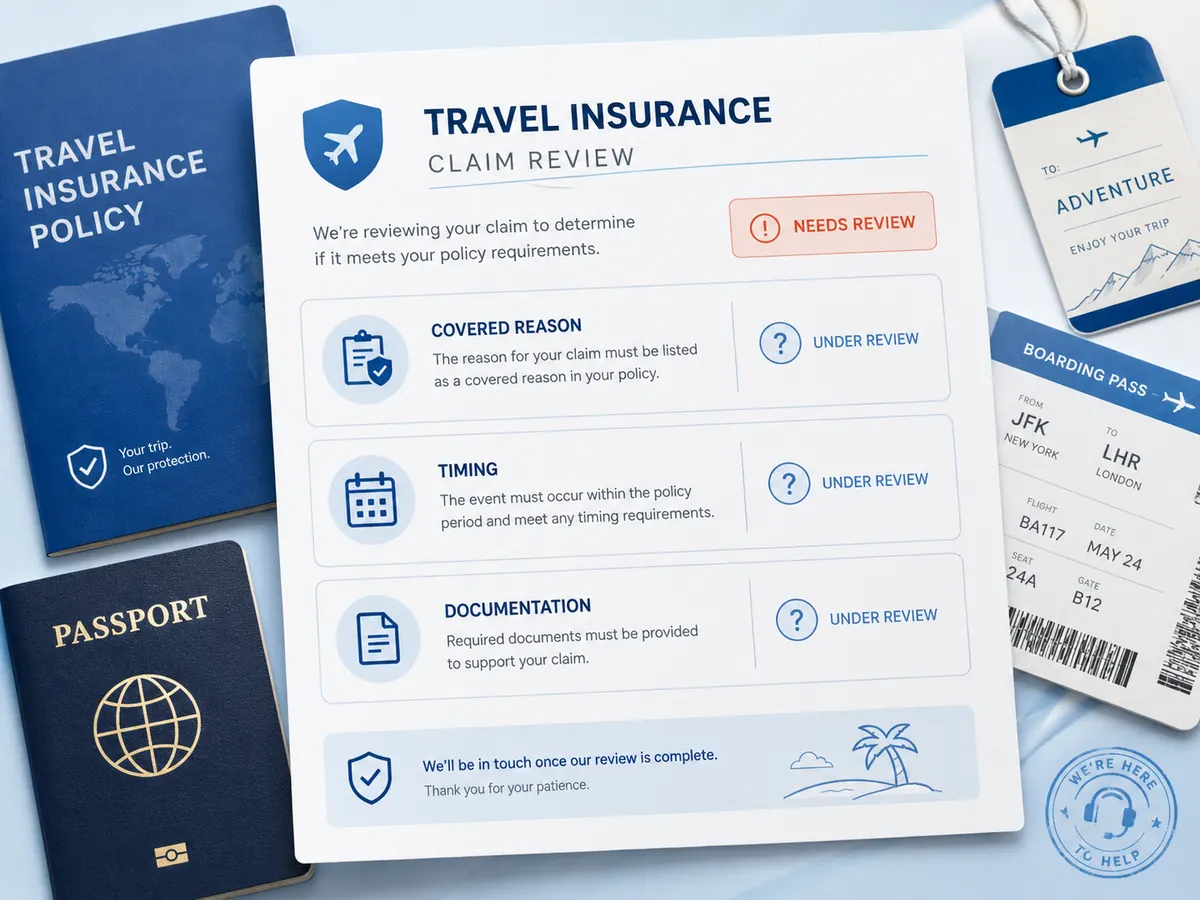
Coverage usually depends on a specific chain of things lining up: the reason must be covered, the event must happen during the eligible coverage period, the traveler must meet the policy conditions, and the claim must include the required proof.
That is why a serious travel problem can still lead to a denied claim. The insurer is not only asking whether the situation was frustrating or expensive. It is checking whether the claim qualifies under the policy.
Coverage Rules
What the Insurer Usually Checks
- The reason for the claim is listed as a covered reason.
- The situation meets the policy’s exact definition.
- The event happened during the eligible coverage period.
- The traveler met the policy’s eligibility requirements.
- The claim includes receipts, records, notices, or medical documentation.
- The expenses claimed are eligible under the policy.
If any part does not line up — reason, timing, eligibility, or documentation — the claim may be delayed, reduced, or denied.
Most travelers think of travel insurance as a safety net. But it does not work like general protection. It works like a contract with specific triggers.
Coverage is not based only on what happened. It is based on whether the problem qualifies.
How Travel Insurance Determines What’s Covered
Travel insurance is usually built around named covered events, not broad travel problems.
That means the policy does not ask only whether something went wrong. It asks whether the reason for the claim appears in the policy, meets the policy definition, happened during the eligible coverage period, and can be supported with the required proof.
A covered reason might include a qualifying illness, injury, severe weather disruption, airline cancellation under specific conditions, or another listed event. But even when a reason appears in the policy, the details still matter.
Important Distinction
Insurance Covers Definitions, Not Just Disruptions
A trip problem may feel serious, expensive, or unavoidable, but the insurer is reviewing whether the reason fits the policy definition.
If the reason, timing, eligibility, or documentation does not match the policy, the claim may still be denied even when the travel problem was real.
If any part does not align — the reason, the definition, the timing, or the proof — the claim may not move forward. That is why the claim process can feel stricter than travelers expect.
What Actually Happens When You File a Claim
When you file a travel insurance claim, the review is not based only on how serious the situation felt. The insurer compares your claim to the policy and checks whether the facts, timing, expenses, and documents line up.
That is why a claim can feel simple to the traveler but still become complicated during review. The insurer is looking for a match between the event and the contract.
Claim Review Process
How the Insurer Usually Reviews the Claim
You submit the claim
You provide receipts, confirmations, records, and an explanation of what happened. This is your version of the situation.
The insurer compares it to the policy
The claim is matched against the policy’s covered reasons, definitions, exclusions, and benefit limits.
Timing and eligibility are checked
The insurer reviews when the event happened, when coverage started, and whether the policy conditions were met.
Documentation is reviewed
Receipts, medical records, airline notices, cancellation proof, delay reports, or provider statements may be required.
The outcome is issued
Approved, delayed, reduced, or denied usually depends on how closely the claim lines up with the policy requirements.
A denied claim does not always mean the traveler did nothing wrong. It may mean the reason was not covered, the proof was incomplete, the timing did not qualify, or the expenses claimed were outside the policy.
Your Claim May Be Denied If You Cannot Document the Loss
Travel insurance claims are not decided only by what happened. They are also decided by what you can prove.
Even when the situation sounds covered, the insurer may ask for documentation showing the reason for the loss, the timing of the event, the amount you paid, what was non-refundable, what was refunded or credited, and why the expense was necessary.
That can include airline delay letters, medical records, receipts, cancellation confirmations, police reports, proof of payment, provider statements, baggage reports, refund records, or written documentation from the airline, hotel, tour operator, or other travel provider.
The problem is that many travelers do not collect this evidence while the issue is happening. They wait until after the trip, when it may be harder to get the right proof.
The fine print risk: a claim can fail not because the traveler is wrong, but because the paperwork does not prove the claim.
What Happens After You File
After the insurer reviews your claim, the outcome usually depends on how closely your situation lines up with the policy.
A claim may be approved, delayed, reduced, or denied. The difference often comes down to whether the covered reason, timing, eligibility rules, expenses, and documentation all match the policy requirements. The current page already explains that claim outcomes depend on alignment with policy requirements, not just what happened.
Claim Outcomes
Why a Claim May Be Approved, Delayed, Reduced, or Denied
The outcome is usually based on how well the claim matches the policy. A serious travel problem can still lead to a limited or denied claim if the covered reason, timing, expenses, or documentation do not line up.
Fully Covered
Approved Claim
- The event clearly matches a covered reason.
- Documentation supports the claim.
- Timing and eligibility conditions are met.
- Eligible reimbursement is processed.
Limited or Delayed
Partial Claim
- Some parts are covered, but others are excluded.
- Missing proof slows the review.
- Certain expenses are not eligible.
- Reimbursement may be reduced or delayed.
Not Covered
Denied Claim
- The reason does not match a covered event.
- Policy conditions are not met.
- Documentation does not prove eligibility.
- The situation falls outside policy definitions.
The outcome is not based only on what happened. It is based on how the situation fits the policy language and proof requirements.
This is why a denied claim can feel surprising. Travelers usually think in terms of what went wrong. Insurance companies review claims in terms of what qualifies.
What To Do If Your Travel Insurance Claim Is Denied
If your travel insurance claim is denied, do not start by assuming the decision is final.
Start with the denial letter. Look for the specific reason the insurer gave. The denial may point to an uncovered reason, missing documentation, a timing issue, an excluded expense, a policy deadline, or a condition that was not met.
Then compare that reason to the policy language.
The strongest next step depends on why the claim was denied. If the problem is missing proof, unclear documentation, or an incomplete timeline, you may be able to appeal or resubmit with stronger evidence. If the problem is that the reason itself is not covered, an appeal may be harder.
Before appealing, gather:
Your denial letter
The full policy or certificate of insurance
Receipts and proof of payment
Cancellation notices or provider statements
Medical records, delay notices, baggage reports, or other claim-specific proof
Any refund, credit, or reimbursement records
A short timeline explaining what happened and when
An appeal is strongest when it answers the exact reason for denial. Do not only restate that something went wrong. Show how the claim fits the policy, or show what documentation fixes the issue the insurer identified.
When Claims Are Most Likely to Be Denied
Claims are most often denied when the traveler’s expectations do not match the policy structure.
One common example is canceling for a personal reason, such as changing plans, a work conflict, general discomfort with travel, or deciding the trip no longer feels right. Those situations are usually not covered unless the policy includes a specific benefit such as Cancel For Any Reason, and even that coverage usually has limits.
Other common denial triggers include pre-existing condition rules, missing documentation, events that happened before coverage began, expenses that are excluded, or claims filed outside the required timeline.
That is why travel insurance can feel confusing. The traveler may focus on the disruption, while the insurer focuses on the policy definition.
Traveler Risk
“I Have Insurance, So I’m Covered” Is the Risky Assumption
Travel insurance does not cover every problem that feels serious. It covers specific events, under specific conditions, with specific proof. If your situation falls outside the policy definition, the claim may be denied even when the disruption was real and expensive.
The safest time to understand those limits is before you rely on the policy. Once a claim is denied, your next step is to identify whether the problem was the covered reason, timing, documentation, eligibility, or an excluded expense.
What To Do Before You Rely on Travel Insurance
The key is not just buying travel insurance. It is understanding what the policy actually covers before you need to use it.
Start by reviewing the covered reasons, not only the summary. Look at how the policy defines each covered situation, what conditions apply, what documentation is required, and whether timing rules could affect the claim.
If flexibility matters, check whether the policy includes Cancel For Any Reason coverage and what limits apply. If medical coverage matters, review pre-existing condition rules, purchase deadlines, and documentation requirements before assuming the policy will respond.
Before You Rely on Coverage
Check the Policy Before You Need to File
Before you rely on travel insurance, confirm what the policy actually covers, what it excludes, and what proof you would need if something goes wrong.
- Match your concern to a covered reason in the policy.
- Read the definition of that covered reason, not just the headline.
- Check timing rules, purchase deadlines, and coverage start dates.
- Review pre-existing condition rules if medical issues matter.
- Confirm whether Cancel For Any Reason coverage is included or excluded.
- Save receipts, confirmations, medical records, airline notices, and provider emails.
- Check claim deadlines and required forms before filing.
- Keep screenshots or copies of the policy language you are relying on.
The best time to understand your coverage is before the claim exists. Once something goes wrong, the policy language decides whether the situation qualifies.
Check the Fine Print
Not Sure Which Travel Rule Could Cost You Money?
Use the Travel Fine Print Risk Checker to see whether your biggest risk is the policy, price, documentation, refund rule, travel credit, third-party booking terms, or another fine-print issue that could affect your trip.
Why Insurance Works This Way
Travel insurance is designed to cover defined risks, not every possible travel problem.
That structure helps insurers decide which situations qualify, what documentation is required, and how much the policy may pay. It can feel restrictive when something real goes wrong, but it is also what makes the claim review process consistent.
This is why the policy language matters more than the general idea of “having insurance.” The policy decides which events are covered, which expenses qualify, what deadlines apply, and what proof is required.
The practical takeaway is simple: before relying on a policy, look for the exact reason you would need coverage and read how that reason is defined.
Travel Fine Print Takeaway
Travel insurance is only as useful as the covered reason that applies. Before you rely on a policy, find the exact situation you are worried about and check whether the policy defines it as covered.
❓Frequently Asked Questions
These questions cover why travel insurance claims get denied, what to check after a denial, and how documentation can affect an appeal or resubmission.
Why was my travel insurance claim denied?
A travel insurance claim is usually denied because the reason for the claim does not match a covered reason in the policy, the timing does not qualify, the expense is excluded, or the required documentation is missing or incomplete.
The insurer is not only checking whether something went wrong. It is checking whether the situation qualifies under the policy language.
What should I do if my travel insurance claim is denied?
Start by reading the denial letter carefully. Look for the specific reason the claim was denied, then compare that reason to the policy language.
If the denial was caused by missing or unclear documentation, you may be able to submit additional proof or appeal. If the denial happened because the reason itself is not covered, an appeal may be harder.
Can I appeal a denied travel insurance claim?
Yes, many travel insurance denials can be appealed. An appeal is strongest when you can provide missing documentation, clarify the timeline, correct an error, or show how the situation fits a covered reason.
If the denial is based on a clear exclusion or an uncovered reason, the appeal may be less likely to change the outcome.
Why wasn’t my statement of facts accepted for a travel insurance claim?
A statement of facts may explain what happened, but it may not be enough by itself to prove a covered loss. Travel insurance companies often need supporting documentation, such as receipts, cancellation notices, medical records, airline delay statements, provider emails, refund records, or proof that the expense was nonrefundable.
If your statement of facts was not accepted, check whether the insurer needed third-party proof, dates, amounts, medical documentation, delay records, or written confirmation from the airline, hotel, tour operator, or other provider.
Does travel insurance cover cancellations for any reason?
Standard travel insurance usually does not cover cancellations for any reason. It covers cancellations for specific covered reasons listed in the policy.
Cancel For Any Reason coverage is a separate benefit or upgrade when available, and it usually has purchase deadlines, reimbursement limits, and other conditions.
What documentation do I need for a travel insurance claim?
The documents depend on the claim type, but common proof includes receipts, booking confirmations, cancellation notices, medical records, airline delay statements, baggage reports, provider emails, and proof of payment.
The documentation should connect the event to a covered reason and show the amount you are claiming.
Does travel insurance cover everything unexpected?
No. Travel insurance does not cover every unexpected problem. It covers specific events under specific conditions.
A situation can feel urgent, expensive, or unavoidable and still fall outside the policy if it does not match a covered reason or required condition.
Bottom Line
Travel insurance claims usually do not get denied because the traveler imagined the problem.
They get denied because the claim does not match the policy closely enough.
A trip cancellation, missed flight, illness, weather issue, family emergency, or travel disruption may feel like something insurance should cover. But the insurer is checking the policy language: the covered reason, timing, eligibility rules, exclusions, expenses, and documentation.
That is why the most important step is not just buying a policy. It is understanding what qualifies before you rely on it.
If your claim was denied, read the denial reason carefully, compare it to the policy, and look for whether the issue was the covered reason, timing, documentation, or an exclusion. If the problem is missing proof, an appeal or resubmission may help. If the reason itself is not covered, the policy may leave you with fewer options.
Travel insurance can be valuable, but it works best when you understand the fine print before the claim exists. The current page already closes on the idea that coverage is about what qualifies, not just what happens, so this version keeps that point while adding clearer “what to check next” language.
Related Guides
If your travel insurance claim was denied, these guides can help you narrow whether the issue was the policy language, the proof you submitted, the refund trail, or the travel problem itself.
Travel Insurance Claim Problems
- Why Travel Insurance Claims Get Denied — And What to Check Next
Start here if you are not sure whether the issue was coverage, documentation, timing, or another claim rule. - Travel Insurance Claim Denied for Lack of Documentation? What to Check Next
How to identify the missing proof gap before you appeal or resubmit. - Does Travel Insurance Cover Flight Delays?
See when trip-delay benefits may reimburse meals, lodging, transportation, and other costs—and which waiting periods, limits, and claim requirements apply.
Claim Proof and Documentation
- What Documents Do You Need for a Travel Insurance Claim?
What proof to collect before filing. - What Is Proof of Loss for Travel Insurance? What Your Claim Needs to Show
Why missing proof of the loss itself can delay, reduce, or weaken a claim. - Does Travel Insurance Require Receipts? What They Do and Don’t Prove
Why claims can still fail even when you have proof of payment.
Refunds, Passports, and Booking Issues
- Do You Need Travel Insurance If Your Flight or Hotel Is Refundable?
Why refundable bookings may not protect the whole trip. - Does Travel Insurance Cover Passport Problems?
When passport issues may or may not be covered. - Does Travel Insurance Cover Forgetting Your Passport?
Why traveler mistakes are different from lost or stolen documents. - Why Some Travelers Are Denied Boarding — Even With a Valid Passport
Why valid documents can still fail travel checks.