
Your travel insurance claim was denied, and the reason sounds simple: missing documentation, insufficient proof, or lack of required paperwork.
That can feel frustrating because you may have already submitted documents. Maybe you uploaded receipts, emails, airline notices, medical paperwork, cancellation records, or screenshots. You may have proved that something happened — but the insurer still said the claim file was incomplete.
That is where many travelers get stuck.
A documentation denial does not always mean you had no proof. It may mean the proof did not answer the specific question the insurer needed to evaluate.
The real question is not just:
“What document did I forget?”
It is:
“What part of the claim did my documents fail to prove?”
This guide explains why a travel insurance claim may be denied for lack of documentation, how to identify the actual proof gap, and what to check before you appeal, resubmit, or assume the claim is over.
Quick Answer
What should you do if a travel insurance claim is denied for lack of documentation?
Start by reading the denial letter carefully and identifying what kind of proof was missing. The issue may be proof of the event, proof of the covered reason, proof of timing, proof of cost, proof that the expense was eligible, or proof that the loss was not refunded, credited, or reimbursed elsewhere.
Do not just send more documents at random. A stronger next step is to match the missing document request to the claim question it is supposed to answer, then appeal or resubmit with proof that directly closes that gap.
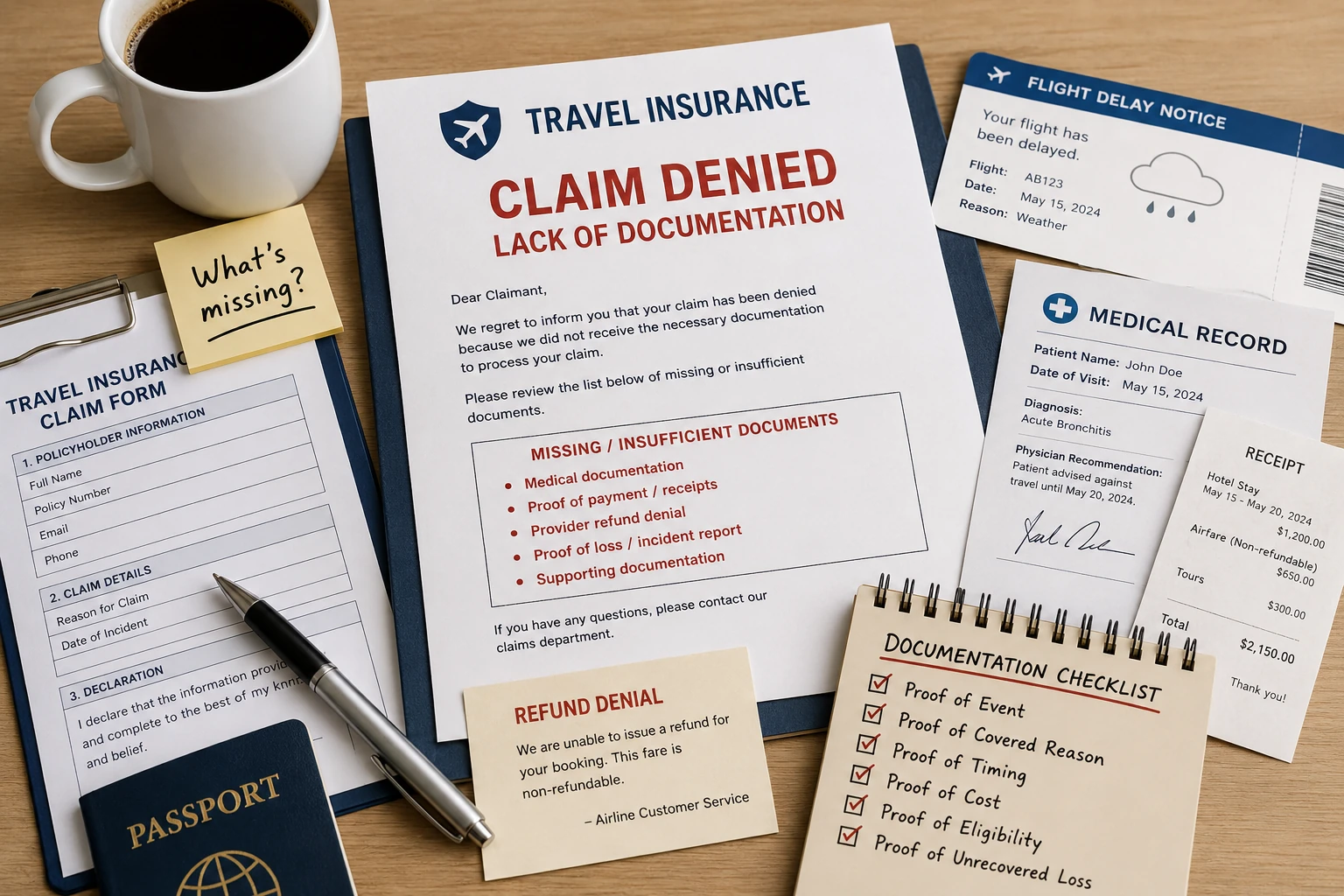
A denial for lack of documentation can sound like a basic paperwork issue. Sometimes it is. Maybe the insurer needed a receipt, a doctor’s note, a baggage report, or a carrier delay letter.
But sometimes the missing documentation is not one obvious file.
The insurer may be saying that the claim file does not yet prove the covered reason, the required timing, the non-refundable cost, the eligible expense, or the amount that remained after refunds, credits, vouchers, or compensation.
System Insight
A documentation denial is often a proof-gap problem, not just a missing-file problem.
- The event gap matters because the insurer may not have enough proof of what actually happened.
- The reason gap matters because not every travel problem is a covered reason under the policy.
- The timing gap matters because delays, cancellations, medical events, and losses may need to fit specific policy windows.
- The unrecovered-loss gap matters because the claim may need proof of what remained after refunds, credits, vouchers, compensation, or other reimbursements.
What Kind of Documentation Gap Caused the Denial?
Before you appeal, separate the denial into the type of proof that appears to be missing.
That is different from making a longer document pile. A claim reviewer may not need more pages. They may need one specific document that answers a specific claim question.
Use the framework below to identify where the claim file may have broken down.
Documentation Gap Check
Six Documentation Gaps That Can Lead to a Denial
A denied claim may not mean every document was missing. It may mean the documents did not prove the part of the claim the insurer needed to verify.
What happened?
The file may not prove the delay, cancellation, illness, injury, baggage issue, theft, interruption, or other claimed event.
Why did it happen?
The claim may show that something changed, but not the covered reason behind it.
When did it happen?
The file may not prove the delay length, cancellation date, treatment date, baggage delay window, or other timing requirement.
What did it cost?
The claim may not include itemized receipts, invoices, bills, prepaid trip costs, or other proof of financial loss.
Was the cost eligible?
The documents may not show that the expense fits the benefit rules, limits, necessity standard, or covered claim category.
What was unrecovered?
The file may not prove what remained after refunds, credits, vouchers, compensation, provider adjustments, or other reimbursements.
Why “Missing Documentation” Can Be Misleading
A denial letter may use broad wording like “missing documentation,” “insufficient documentation,” or “documentation not provided.”
That wording can make it sound as if the solution is simple: send more paperwork.
Sometimes that works. If the insurer asked for a specific document, such as an airline delay letter or a medical statement, the next step may be to get that exact document and submit it before the appeal deadline.
But other times, the denial is really pointing to a proof gap.
A receipt may show what you paid, but not why the expense happened. A cancellation email may show that a trip was canceled, but not whether the reason was covered. A doctor visit record may show treatment, but not whether the provider advised you not to travel. A flight delay notice may show the delay, but not whether the delay met the minimum time requirement or caused the expenses being claimed.
That is why the safest move is to translate the denial letter into a proof question.
Do not only ask:
“What document did they ask for?”
Also ask:
“What are they trying to verify?”
Check the Denial Letter Before You Appeal
Before writing an appeal or uploading more files, read the denial letter line by line.
Look for the exact reason given. The letter may reference missing documents, policy exclusions, covered reasons, benefit limits, deadlines, proof of payment, non-refundable costs, or reimbursement from another source.
Those details matter because an appeal should answer the denial reason directly.
If the letter says you did not provide proof of the cancellation reason, sending more receipts may not fix the problem. If it says you did not show non-refundable costs, sending another medical note may not fix the problem. If it says the airline provided compensation, you may need to show what was paid, what was credited, and what loss remained.
A stronger appeal does not just say, “Please review again.”
It says, in effect:
“Here is the specific missing proof, and here is how it connects to the claim.”
Traveler Risk
A documentation denial can become harder to fix if the appeal does not answer the exact proof gap.
If the claim was denied for missing or insufficient documentation, more paperwork is not always the answer. The appeal needs to address the specific issue the insurer says was not proven: the event, covered reason, timing, eligible cost, unrecovered amount, or another policy requirement.
Check the Fine Print
Not Sure What the Documentation Denial Really Means?
Use the Travel Fine Print Risk Checker to narrow whether the problem is missing proof, a covered-reason issue, a timing problem, a refund or credit issue, or another claim gap.
Before You Send More Documents
The Risk Checker can help you identify the type of claim issue, but the strongest next step is to organize the appeal around the denial reason.
Do not treat the appeal like a second claim dump.
If the denial letter says documentation was missing, build a small proof map. Write down the claim element, the document that supports it, and why that document answers the denial.
For example:
A flight delay claim may need the delay notice, but also receipts, boarding passes, and voucher records. A trip cancellation claim may need the cancellation reason, but also proof that the prepaid costs were non-refundable. A medical claim may need treatment records, but also itemized bills and proof of payment.
The goal is not just to upload more. The goal is to close the specific proof gap.
Action Step
Match the appeal documents to the missing proof.
Before appealing a documentation denial, identify what the insurer says was missing and submit documents that answer that specific claim question.
Quick win: For each new document, write one line for yourself: “This proves ___.” If the blank does not match the denial reason, the document may not help the appeal.
Claim Proof Checklist
Review what your documents need to prove.
Use the travel insurance claim proof guide to check whether your documents show what happened, why it happened, what it cost, and what was not recovered.
What If You Cannot Get the Missing Document?
Sometimes the missing document is easy to request. You may be able to get a duplicate receipt, an airline delay letter, an updated hotel folio, or a cancellation confirmation.
Other times, the document may be harder.
A doctor may not be willing to write a retroactive note. An airline may only provide a generic delay explanation. A hotel may say the rate was non-refundable but not issue a formal refund denial. A tour operator may respond slowly. A baggage report may not have been filed at the airport.
If you cannot get the exact document, do not ignore the request. Ask what alternative documentation may be acceptable. Then gather the strongest available proof and explain what each document shows.
That may include emails, screenshots, chat transcripts, invoices, statements, claim notes, provider responses, credit card records, or written confirmation that a supplier would not issue a refund or credit.
The weaker the document, the more important the explanation becomes.
Your goal is to make the proof gap understandable — and to show why the documents you do have answer the claim question as clearly as possible.
Travel Fine Print Takeaway
A documentation denial is not always the end of the claim.
A denied travel insurance claim may be fixable if the problem is missing or insufficient documentation. But the next step should not be random paperwork. It should be proof that answers the denial reason.
The safest move is to identify whether the denial involves the event, covered reason, timing, eligible cost, or unrecovered loss before you appeal.
❓Frequently Asked Questions
These questions explain what to check when a travel insurance claim is denied for missing or insufficient documentation.
What does it mean if my travel insurance claim was denied for lack of documentation?
It usually means the insurer says the claim file did not include enough proof to evaluate or approve the claim. That may involve proof of what happened, why it happened, when it happened, what it cost, whether the expense was eligible, or what amount was not refunded or reimbursed elsewhere.
Can I appeal a travel insurance documentation denial?
Usually, yes, but you should review the denial letter and appeal deadline first. A stronger appeal directly addresses the missing proof the insurer identified instead of sending unrelated documents or repeating the original claim.
What documents should I send after a documentation denial?
It depends on the reason for the denial. You may need receipts, proof of payment, airline delay letters, medical records, provider statements, baggage reports, refund denials, voucher records, cancellation confirmations, or proof that a prepaid cost was non-refundable.
What if I already submitted receipts?
Receipts may prove what you paid, but they may not prove the covered reason, timing, eligibility, or unrecovered loss. If the denial says documentation was insufficient, check whether the receipt needs to be paired with a delay notice, medical statement, cancellation proof, baggage report, or refund record.
What if I cannot get the exact document the insurer requested?
Contact the insurer or claims administrator and ask whether alternative documentation is acceptable. Then provide the strongest proof available and explain what each document shows. Keep copies of all requests, responses, uploads, and appeal submissions.
Bottom Line
A travel insurance claim denied for lack of documentation is not always a final answer.
Sometimes the claim really is missing a required form, receipt, medical note, airline letter, baggage report, or refund record. Other times, the documents were submitted but did not prove the specific claim issue the insurer needed to verify.
Before you appeal, identify the proof gap.
Did the claim file prove what happened? Did it prove why it happened? Did it prove the timing? Did it prove the cost? Did it prove the expense was eligible? Did it prove what amount was not refunded, credited, compensated, or reimbursed elsewhere?
The fine print is simple:
Do not just send more documents. Send the documents that answer the reason the claim was denied.
Related Guides
Keep this one tight because this article is a practical support page.
Travel Insurance Claim Proof
- Travel Insurance Claim Proof: What Your Documents Need to Prove
What claim documents need to show. - Proof of Loss for Travel Insurance Claims
How documents support the claim amount. - Does Travel Insurance Require Receipts? What They Do and Don’t Prove
Why receipts prove payment, not the whole claim. - Do You Need an Airline Delay Letter for Travel Insurance?
When a delay letter helps — and what it does not prove.
Travel Insurance and Claim Problems
- Why Travel Insurance Claims Get Denied — And What to Check Next
Why real travel problems can still fail as claims. - What Is Proof of Loss for Travel Insurance? What Your Claim Needs to Show
Why a claim may need more than receipts or event proof to show the actual loss. - Does Travel Insurance Cover Passport Problems?
When passport issues may or may not qualify. - Does Travel Insurance Cover Flight Delays?
See when trip-delay benefits may reimburse meals, lodging, transportation, and other costs—and which waiting periods, limits, and claim requirements apply.