
Your flight was delayed, canceled, or rebooked — and now you are trying to figure out what proof your travel insurance company may need.
A screenshot may show the flight was late. A boarding pass may show you were scheduled to travel. A receipt may show you paid for a hotel, meal, taxi, or other extra expense.
But those documents may not prove the full claim.
For many travel insurance claims, the insurer may want documentation from the airline showing what happened, when it happened, how long the delay lasted, and why the delay occurred. That document may be called an airline delay letter, delay verification, cancellation verification, flight disruption statement, or proof of delay.
The real question is not just:
“Can I prove my flight was delayed?”
It is:
“Can I prove the delay meets my policy’s requirements — and that my extra costs were eligible?”
This guide explains when an airline delay letter may help a travel insurance claim, what it may and may not prove, and what other documents you may still need before you file.
Quick Answer
Do you need an airline delay letter for travel insurance?
You may need an airline delay letter, delay verification, or cancellation statement if you are filing a travel insurance claim for a delayed, canceled, or disrupted flight. The letter may help prove the flight number, date, delay length, and official reason for the disruption.
But an airline delay letter may not be enough by itself. Your claim may also need boarding passes, receipts, rebooking records, proof of payment, refund or voucher documentation, and evidence that the delay meets your policy’s covered reason and minimum-time requirements.
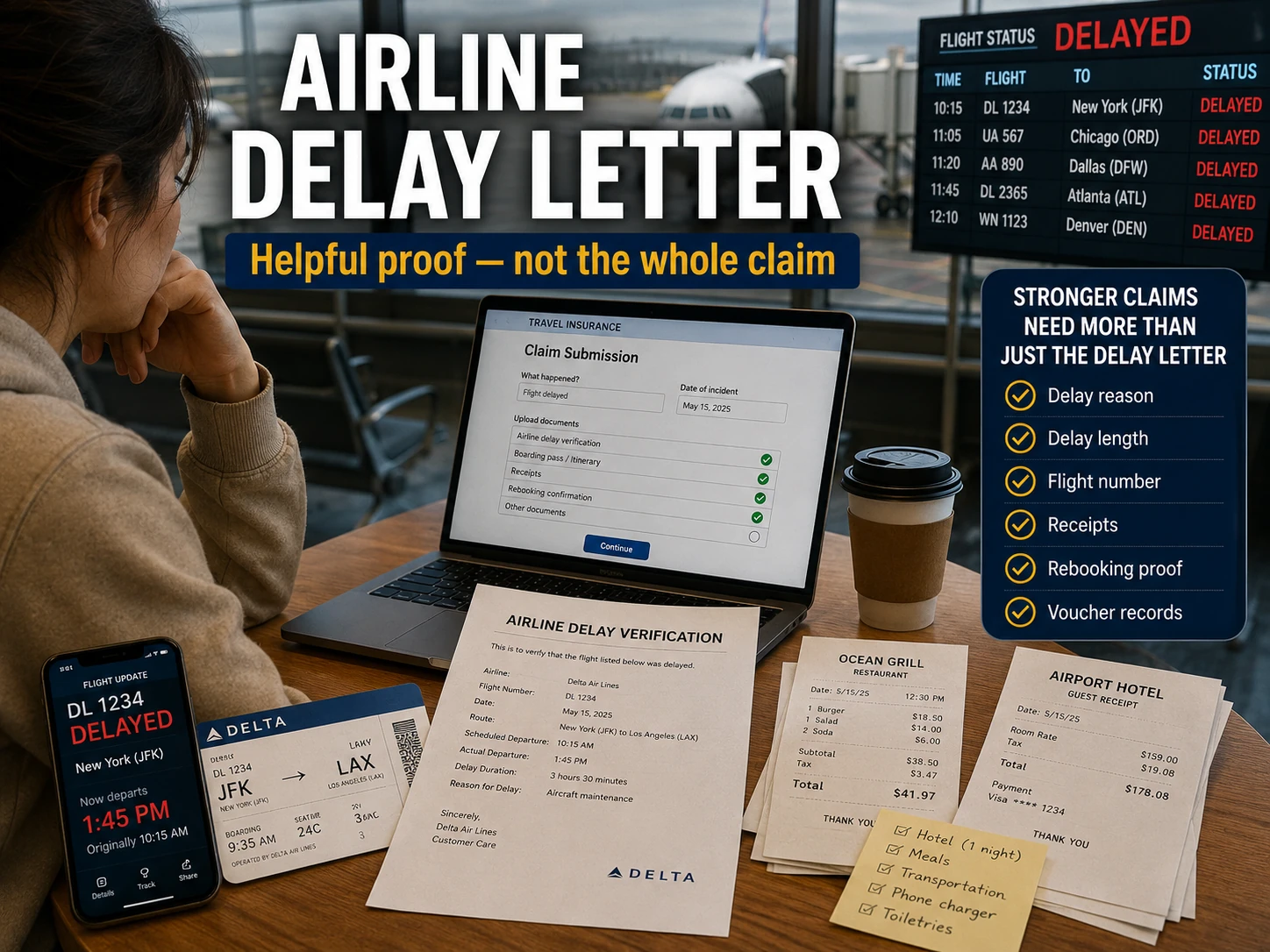
System Insight
An airline delay letter may prove the delay, but not the whole claim.
A delay letter can help show what happened to the flight, but travel insurance may still look at the policy’s covered reasons, minimum delay time, eligible expenses, reimbursement limits, and whether the airline already offered compensation, vouchers, refunds, or rebooking.
- The airline letter may support the flight disruption.
- Your policy decides whether that disruption qualifies.
- Your receipts help prove the extra expenses.
- Refund or voucher records help show what was still unrecovered.
What an Airline Delay Letter Can and Cannot Prove
An airline delay letter is useful because it comes from the source of the disruption.
It may confirm the affected flight, the date, the length of the delay, and the airline’s stated reason for the delay or cancellation. That can be much stronger than relying only on a screenshot, memory, or a general explanation.
But the letter usually does not prove everything the insurer needs to know.
It may not show whether your policy covers that reason, whether the delay met the minimum number of hours, whether your extra expenses were reasonable, or whether the airline already reimbursed part of the loss.
That is why the delay letter should be treated as one part of the claim file — not the entire claim.
Can Help Prove
What happened to the flight
- The affected flight number and date.
- Whether the flight was delayed, canceled, or disrupted.
- The airline’s stated reason for the delay.
- The approximate or official length of the delay.
- Whether the airline changed, rebooked, or canceled the itinerary.
May Not Prove
Whether the insurance claim qualifies
- Whether the delay reason is a covered reason in your policy.
- Whether the delay met the policy’s minimum-hour requirement.
- Whether hotel, meal, taxi, or other expenses were eligible or reasonable.
- Whether the airline already offered refunds, vouchers, or compensation.
- Whether prepaid costs were truly non-refundable or unrecovered.
How to Get an Airline Delay Letter
The best time to ask for an airline delay letter is while the disruption is still fresh.
If you are at the airport, start with the airline’s customer service desk, ticket counter, gate agent, or help desk. Ask whether they can provide written delay or cancellation verification for travel insurance.
Some airlines also offer online delay verification forms or cancellation confirmation portals. These may be easier to use after the trip, especially if the airline has a dedicated page for insurance documentation.
If there is no portal, contact the airline through customer service, chat, email, or the app and ask for written verification of the disruption.
Use clear language. Instead of asking only for “proof,” ask for delay or cancellation verification for a travel insurance claim. That helps the airline understand that you need something more official than a general flight status update.
If the airline will not provide a formal letter at the airport, save whatever written proof you can: app notifications, gate notices, emails, text alerts, rebooking confirmations, screenshots, boarding passes, and timestamps of airline conversations.
What to Ask the Airline to Include
A useful airline delay letter should be specific enough to support the claim.
When possible, ask the airline to include the flight number, travel date, scheduled departure or arrival time, actual departure or arrival time, length of delay, whether the flight was canceled or rebooked, and the airline’s stated reason for the disruption.
The reason matters because travel insurance policies may treat different causes differently. Weather, mechanical issues, crew availability, air traffic control, operational disruptions, and missed connections may not all be handled the same way under every policy.
The letter does not need to argue your insurance claim for you. It simply needs to document the flight disruption clearly.
A strong request might sound like this:
“Can you provide written delay or cancellation verification for travel insurance, including the flight number, date, length of delay, and the stated reason for the disruption?”
If the airline can only provide limited information, keep that too. Partial documentation is usually better than relying only on memory.
Ask for This
A simple delay verification request
Use clear wording so the airline knows you need written documentation for an insurance claim, not just a general flight status update.
If the Airline Will Not Give You a Letter
Sometimes an airline delay letter is easy to get. Other times, it is not.
The airline may direct you to an online form, tell you to contact customer service later, provide only a basic cancellation email, or refuse to give detailed cause information at the airport.
If that happens, save every piece of supporting proof you can collect while the disruption is happening. Keep airline emails, app notifications, screenshots, boarding passes, new itineraries, rebooking records, gate notices, chat transcripts, and any written message showing the flight status.
Those records may not be as strong as an official delay letter, but they can help support the timeline while you continue trying to get formal verification from the airline.
What Else You May Need Besides the Delay Letter
An airline delay letter can help prove the flight disruption, but it usually does not prove the whole insurance claim.
You may still need documents showing that you were scheduled to travel, what expenses you incurred, what the airline did or did not provide, and whether any amount was refunded, credited, reimbursed, or covered by another source.
That can include boarding passes, original itineraries, rebooking confirmations, hotel invoices, meal receipts, taxi or rideshare receipts, baggage receipts, airline voucher records, credit card statements, and emails showing refund or compensation decisions.
This matters because travel insurance may not reimburse every cost connected to a delay. The policy may have a minimum delay requirement, a daily benefit limit, a maximum reimbursement amount, and rules about what counts as a reasonable or eligible expense.
The delay letter helps answer:
“What happened to the flight?”
The rest of the claim file helps answer:
“What did the delay actually cost — and what amount was still unrecovered after airline help, refunds, credits, or vouchers?”
Traveler Risk
A delay letter may prove the flight was late, but not that your claim is payable.
The letter may support the delay, cancellation, or disruption, but the insurer may still review the covered reason, minimum delay time, eligible expenses, benefit limits, airline compensation, and refund or voucher records before deciding the claim.
Before You Submit the Claim
Once you have the airline delay letter or other flight verification, compare it to your policy before you submit the claim.
Look for the minimum delay requirement, covered reasons for travel delay, eligible expense categories, benefit limits, and whether the policy expects you to seek reimbursement from the airline first.
Then match your documents to those requirements.
If your policy requires a six-hour delay, make sure your proof shows the timing clearly. If you are claiming a hotel night, keep the hotel invoice and proof that the expense was necessary because of the delay. If the airline gave you meal vouchers, hotel accommodation, transportation, or another form of assistance, save that documentation too.
Action Step
Build the delay claim file before you leave the airport.
The easiest time to collect flight delay proof is while the disruption is happening. Save documents that show the flight issue, the official reason, the timing, your extra expenses, and any airline compensation or vouchers.
Quick win: Before you leave the airport, ask the airline: “Can I get written delay verification for travel insurance?”
Airline Compensation vs. Travel Insurance
An airline delay letter may help prove the flight disruption, but it does not decide whether the airline, the travel insurance company, or another source should pay.
That distinction matters.
If the airline gives you meal vouchers, hotel accommodation, transportation, a refund, or other compensation, your travel insurance claim may need to account for that. Insurance usually looks at the amount still unrecovered after airline assistance, refunds, credits, or other reimbursements.
This does not mean you should avoid accepting help from the airline. In many cases, airline assistance can reduce the immediate cost of the delay.
But it does mean you should document it clearly.
Save voucher records, hotel confirmations, rebooking emails, refund notices, credit notices, and any written explanation of what the airline did or did not provide.
The hidden question is not only:
“Was the flight delayed?”
It is:
“What cost was still unrecovered after the airline’s response?”
Check the Fine Print
Not Sure What Proof Your Delay Claim Needs?
Use the Travel Fine Print Risk Checker to narrow whether the issue is flight documentation, policy timing, airline compensation, refund rules, eligible expenses, or another travel fine-print problem.
Travel Fine Print Takeaway
A delay letter supports the claim, but it does not replace the claim file.
An airline delay letter may help prove what happened to the flight. Your full claim may still need receipts, boarding passes, rebooking records, refund or voucher documentation, and proof that the delay meets the policy’s covered reason and timing requirements.
❓Frequently Asked Questions
These questions explain how airline delay letters, flight disruption proof, and travel insurance documentation usually work together.
Do you need an airline delay letter for travel insurance?
You may need one if you are filing a claim for a delayed, canceled, or disrupted flight. An airline delay letter or verification can help prove the flight number, date, delay length, and official reason for the disruption. Your policy may still require other documents too.
How do you get an airline delay letter?
Start with the airline’s customer service desk, ticket counter, app, website, or customer support team. Some airlines have online delay or cancellation verification forms. Ask specifically for written delay or cancellation verification for travel insurance.
Is a screenshot enough proof of a flight delay?
A screenshot may help support the timeline, but it may not prove the official reason or full duration of the delay. Travel insurance may still ask for airline verification, boarding passes, rebooking records, receipts, and proof of unreimbursed expenses.
What should an airline delay letter include?
A useful letter should include the flight number, travel date, scheduled and actual departure or arrival time, length of delay, whether the flight was canceled or rebooked, and the airline’s stated reason for the disruption.
What else do you need for a travel insurance delay claim?
You may need boarding passes, original itineraries, rebooking confirmations, itemized receipts, proof of payment, airline voucher records, refund or compensation records, and policy documents showing the minimum delay time and eligible expenses.
Bottom Line
An airline delay letter can be useful proof for a travel insurance claim, but it is not always the whole claim.
The letter may help show what happened to the flight, how long the delay lasted, and why the airline says the disruption occurred. That can be stronger than relying only on a screenshot, memory, or a general flight-status update.
But travel insurance may still look at other pieces: whether the delay reason is covered, whether the delay met the policy’s minimum time requirement, whether the expenses were eligible, and whether the airline already provided vouchers, refunds, hotel accommodation, transportation, or other compensation.
The best approach is to treat the airline delay letter as one part of the claim file.
Before you leave the airport, ask for written delay or cancellation verification. Then save boarding passes, rebooking records, receipts, airline communications, voucher records, and any refund or compensation details.
The stronger your proof, the easier it is to show whether the delay claim fits the policy.
Related Guides
Keep this tight since it is a narrow support article.
Travel Insurance Claim Proof
- Travel Insurance Claim Proof: What Your Documents Need to Prove
Why claim documents need to show more than receipts. - What Is Proof of Loss for Travel Insurance? What Your Claim Needs to Show
Why a delay letter may prove the event, but not the full claim amount. - Does Travel Insurance Require Receipts? What They Do and Don’t Prove
Why delay expenses may need receipts plus proof of the covered disruption. - Why Travel Insurance Claims Get Denied — And What to Check Next
Why a claim may fail even when the travel problem was real. - Do You Need Travel Insurance If Your Flight or Hotel Is Refundable?
Why refundable bookings may not protect the whole trip.
Flight and Refund Problems
- Does Travel Insurance Cover Flight Delays?
See when trip-delay benefits may reimburse meals, lodging, transportation, and other costs—and which waiting periods, limits, and claim requirements apply. - What Happens If an Airline Changes Your Flight Without Asking?
What to check when an airline moves your itinerary. - Why Travel Refunds Take So Long
Why approved refunds may still take time.