
Travel Planning Resource
Travel Documents Checklist: What to Save, Verify, and Screenshot Before You Travel
The right travel documents are only the beginning. You also need to confirm that they meet the rules for your exact trip—and preserve the proof you may need if a booking, charge, delay, or claim is questioned.
Use this checklist to organize identification, entry requirements, reservation records, insurance documents, receipts, screenshots, and backup copies before the information becomes difficult to recover.
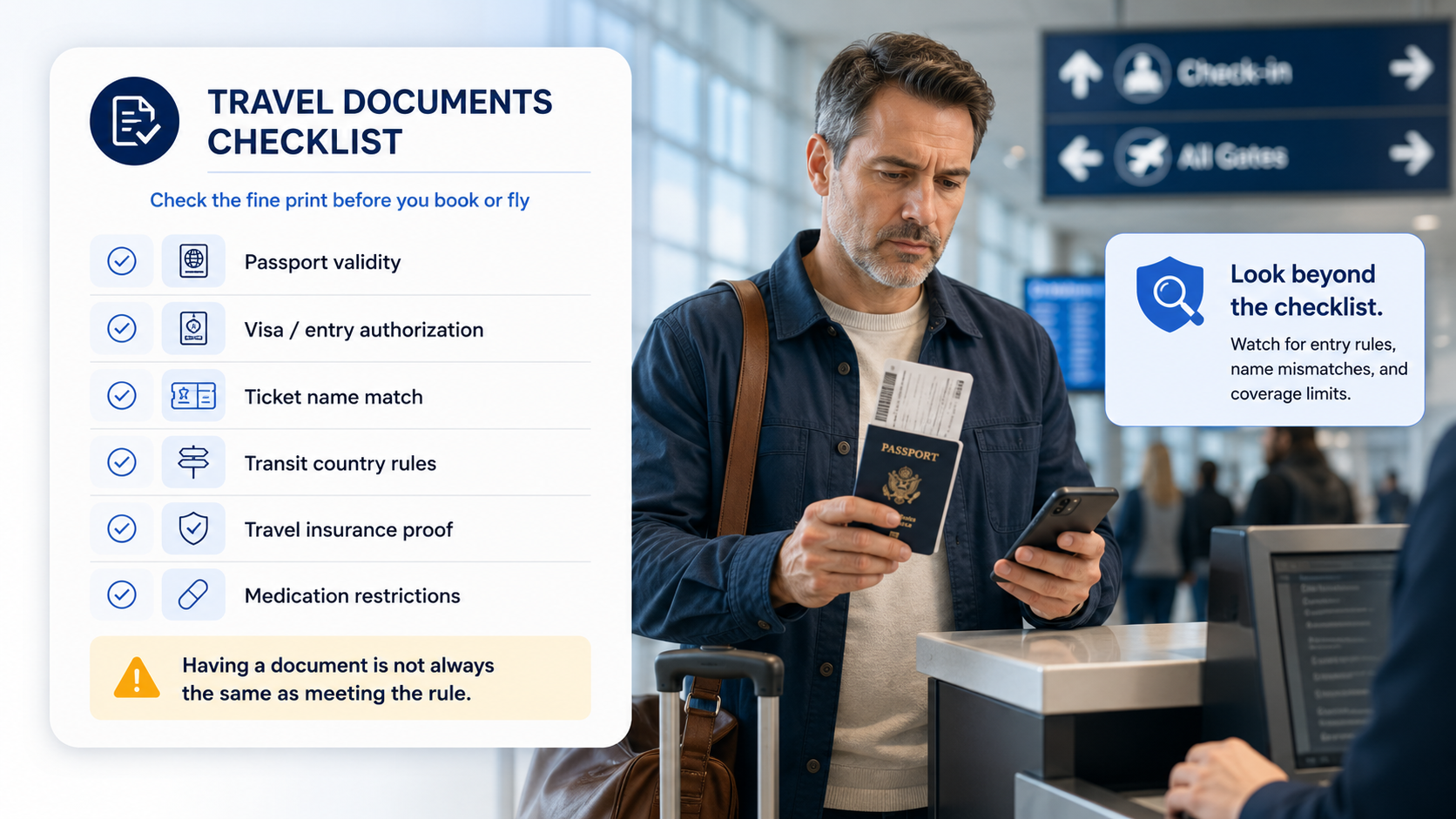
About this guidance: Travel Fine Print’s guidance draws on experience with airline and lodging reservations, traveler-document checks, booking records, fees, baggage documentation, payment disputes, and insurance claim procedures. Requirements can vary by destination, supplier, itinerary, booking channel, policy, jurisdiction, and individual circumstances, so verify current government and provider rules and retain the confirmations, terms, receipts, screenshots, and reports that apply to your trip.
How to Use This Checklist
Use it before you book, before you travel, and if something goes wrong.
This page is not just a packing list. It is a checklist for the documents, proof, screenshots, and booking details that can affect whether you can travel, check in, recover money, file a claim, or challenge a charge.
Before You Book
Check the rules before the money becomes harder to recover.
- Traveler names and document details
- Passport, visa, and transit rules
- Cancellation and refund terms
- Hotel fees, deposits, and pay-later charges
- Insurance exclusions and covered reasons
Before You Travel
Confirm what you need in hand before the trip starts.
- Accepted ID, passport, and entry documents
- Airline, hotel, cruise, and tour confirmations
- Medication documentation and insurance proof
- Carry-on essentials for baggage delays
- Digital and paper backup copies
If Something Goes Wrong
Save proof before the issue becomes harder to explain.
- Receipts, screenshots, and confirmation emails
- Baggage reports and delay notices
- Hotel folios and post-stay charges
- Refund denials and credit terms
- Insurance claim documents and provider messages
Travel Checklist Hub: What to Verify, Save, and Screenshot
Use this checklist as a map, not just a packing list. Open each card to see what to verify before booking, what to keep accessible while traveling, and what proof to save if a document, refund, baggage, hotel, insurance, or booking issue comes up.
Travel Documents Checklist
What to Verify First
Use this checklist as a map, not just a packing list. Open each card to see the essential checks, then jump to the section below if you need more context.
ID or Passport
Check the document needed for your trip type before you rely on the booking.
ID or Passport
Check the document needed for your trip type before you rely on the booking.
- For domestic trips, confirm the ID accepted by your airport or security authority.
- In the U.S., check REAL ID compliance or another TSA-accepted ID.
- For international trips, check passport validity beyond your travel dates.
- Review blank-page, damage, and traveler-specific passport rules.
- Compare the ID or passport name to the booking.
Visa or Entry Rule
Confirm whether the destination requires approval before you travel.
Visa or Entry Rule
Confirm whether the destination requires approval before you travel.
- Check visa, eVisa, ETA, tourist card, or entry authorization rules.
- Confirm whether proof of onward or return travel is required.
- Review health, vaccination, or travel insurance proof rules if applicable.
- Check rules by nationality, not just destination.
- Verify requirements before booking nonrefundable travel.
Name Match
Small name differences can become harder to fix after booking.
Name Match
Small name differences can become harder to fix after booking.
- Compare the booking name to the exact travel document.
- Watch for reversed names, missing surnames, and old profile data.
- Check maiden, married, hyphenated, and middle-name formats.
- Review visa, cruise, insurance, and loyalty-account records.
- Fix issues before the ticket or policy is issued when possible.
Transit Rules
Connections can create document rules before you reach the destination.
Transit Rules
Connections can create document rules before you reach the destination.
- Check visa or transit rules for every country your route touches.
- Look closely at overnight layovers and airport changes.
- Confirm whether you must collect and recheck bags.
- Review self-transfer and separate-ticket requirements.
- Check whether the airline must verify entry documents before boarding.
Airline, Baggage & Connections
Plan for what you need with you if checked luggage is delayed.
Airline, Baggage & Connections
Plan for what you need with you if checked luggage is delayed.
- Check whether flights are on one ticket or separate tickets.
- Confirm whether bags are checked through to the final destination.
- Keep medication, documents, chargers, and valuables in your carry-on.
- Pack basic toiletries and one change of clothes for delayed luggage.
- Save baggage reports and receipts for necessary purchases.
Hotel & Lodging Proof
Hotel proof can matter at check-in, checkout, or after the stay.
Hotel & Lodging Proof
Hotel proof can matter at check-in, checkout, or after the stay.
- Save confirmation numbers, prepaid receipts, and vouchers.
- Check the reservation name and payment-card requirement.
- Save cancellation deadlines, deposit rules, and late-arrival terms.
- Screenshot resort fees, destination fees, and mandatory charges.
- Keep third-party booking confirmations and hotel emails.
Cruise & Tour Documents
Providers may require documents beyond the destination rules.
Cruise & Tour Documents
Providers may require documents beyond the destination rules.
- Review cruise-line, tour-operator, and port-of-call rules.
- Check passport, birth certificate, visa, or insurance-proof requirements.
- Confirm waivers, medical forms, and emergency-contact forms.
- For minors, check consent forms and custody-document requirements.
- Verify rules before final payment.
Medication
Medicine that is routine at home may need documentation abroad.
Medication
Medicine that is routine at home may need documentation abroad.
- Keep medication in original prescription-labeled containers.
- Carry enough for the trip plus a small emergency buffer.
- Check controlled-substance and over-the-counter restrictions.
- Review rules for destination and transit countries.
- Bring prescription details or a doctor’s letter when appropriate.
Insurance Proof
Proof of insurance is not the same as proof a problem is covered.
Insurance Proof
Proof of insurance is not the same as proof a problem is covered.
- Carry the policy, coverage letter, and emergency assistance number.
- Check covered reasons, exclusions, and claim deadlines.
- Do not assume document mistakes are automatically covered.
- Review baggage-delay, trip-delay, and missed-connection benefits.
- Save receipts and proof if you need reimbursement later.
Copies & Proof
Copies and screenshots can help prove what you were shown.
Copies & Proof
Copies and screenshots can help prove what you were shown.
- Save digital and paper copies of key documents.
- Screenshot entry rules, cancellation terms, and fee disclosures.
- Keep receipts, baggage reports, claim numbers, and provider emails.
- Store backups somewhere separate from the originals.
- Do not rely on your phone as the only copy.
Important Distinction
Having a Document Is Not the Same as Having Proof That Works
A passport, ID, visa, insurance card, consent form, prescription label, hotel confirmation, airline itinerary, receipt, or screenshot only helps if it satisfies the rule that applies to your trip.
The fine print may depend on your airport, airline, destination, connection city, hotel, cruise itinerary, tour operator, traveler age, medication, booking channel, payment method, or insurance policy. The document matters — but the rule behind it matters more.
That distinction matters because a trip can look secure on paper while still having a hidden rule that affects whether you can board, enter, check in, recover a cost, dispute a charge, or prove what you were promised.
The safest approach is to think in three layers:
- What document do I need?
- What rule does that document need to satisfy?
- What proof should I save in case the rule is questioned later?
That is why this checklist starts with ID, passport, visa, name-match, and transit rules before moving into hotel proof, airline records, baggage documentation, medication, insurance, and backup copies.
ID, Passport, Visa, and Transit Rules Can Decide Whether You Can Use the Trip
The first document rule depends on the type of trip.
For a domestic trip, the issue is usually identification. In the U.S., travelers 18 and older should confirm whether their driver’s license or state ID is REAL ID-compliant or whether they need another TSA-accepted form of identification. A passport can also be used for domestic air travel, which can make it a useful backup if your state ID is not accepted.
For international trips, the document question changes. A passport may be required, but “valid” does not always mean valid enough. Some destinations require your passport to remain valid for several months beyond your travel dates. Others may require blank pages, visas, entry authorizations, proof of onward travel, or traveler-specific documents.
Transit rules can also matter before you ever reach your destination. A connection, overnight layover, airport change, self-transfer, or separate-ticket itinerary can trigger document requirements if you need to enter a country, collect bags, recheck luggage, or pass through immigration.
The goal is not just to bring identification. It is to confirm that the document works for the exact route, airline, destination, connection, and traveler.
↑ Back to travel documents checklist
Names, Bookings, and Travel Provider Records Need to Match the Traveler
A travel document problem is not always about missing paperwork.
Sometimes the problem is that the traveler’s name, ID, passport, booking record, hotel reservation, cruise document, insurance policy, or loyalty profile does not line up cleanly.
Before you pay, compare the traveler name on the booking screen with the document that person will use for travel. This matters for flights, hotels, cruises, tours, rental cars, travel insurance, visas, and entry authorizations.
Small formatting differences may not always cause a problem. But bigger mismatches can become harder to fix once a ticket, policy, cruise record, visa record, or prepaid booking is issued.
Pay close attention to:
- maiden names
- married names
- hyphenated names
- middle names
- missing surnames
- reversed first and last names
- old loyalty-profile details
- nicknames used during booking
- names copied from autofill or stored profiles
This matters most when the trip is international, nonrefundable, booked through a third party, tied to a cruise or tour, connected to a visa, or linked to an insurance policy.
The safest time to catch a name issue is before payment, before ticketing, and before a policy or travel record is issued.
Travel Fine Print Takeaway
Check the name before you pay. It is usually easier to fix a traveler-name issue before a ticket, hotel stay, cruise, visa, rental car booking, or insurance policy is issued than after the booking is locked in.
↑ Back to travel documents checklist
Airlines, Hotels, Cruises, and Tours: Proof You May Need in Hand
Airlines, Hotels, Cruises, and Tours: Proof You May Need in Hand
Not every travel document problem happens at passport control.
Sometimes the trip works on paper, but the provider rules create the problem. An airline may need proof for a baggage claim. A hotel may ask for the card used to book. A cruise line may require documents beyond the destination’s entry rules. A tour operator may require waivers, medical forms, insurance proof, or consent forms for minors.
That is why this checklist is not only about what to bring. It is also about what to save before you need it.
Keep the essentials accessible: airline itineraries, ticket numbers, hotel confirmations, prepaid vouchers, cruise or tour documents, baggage receipts, fee disclosures, cancellation terms, insurance details, medication documentation, and screenshots of anything that could become disputed later.
The goal is not to carry every document in paper form. The goal is to make sure the proof you may need is easy to access even if your bag is delayed, your phone battery dies, your hotel cannot find the reservation, or your provider asks for documentation after the trip.
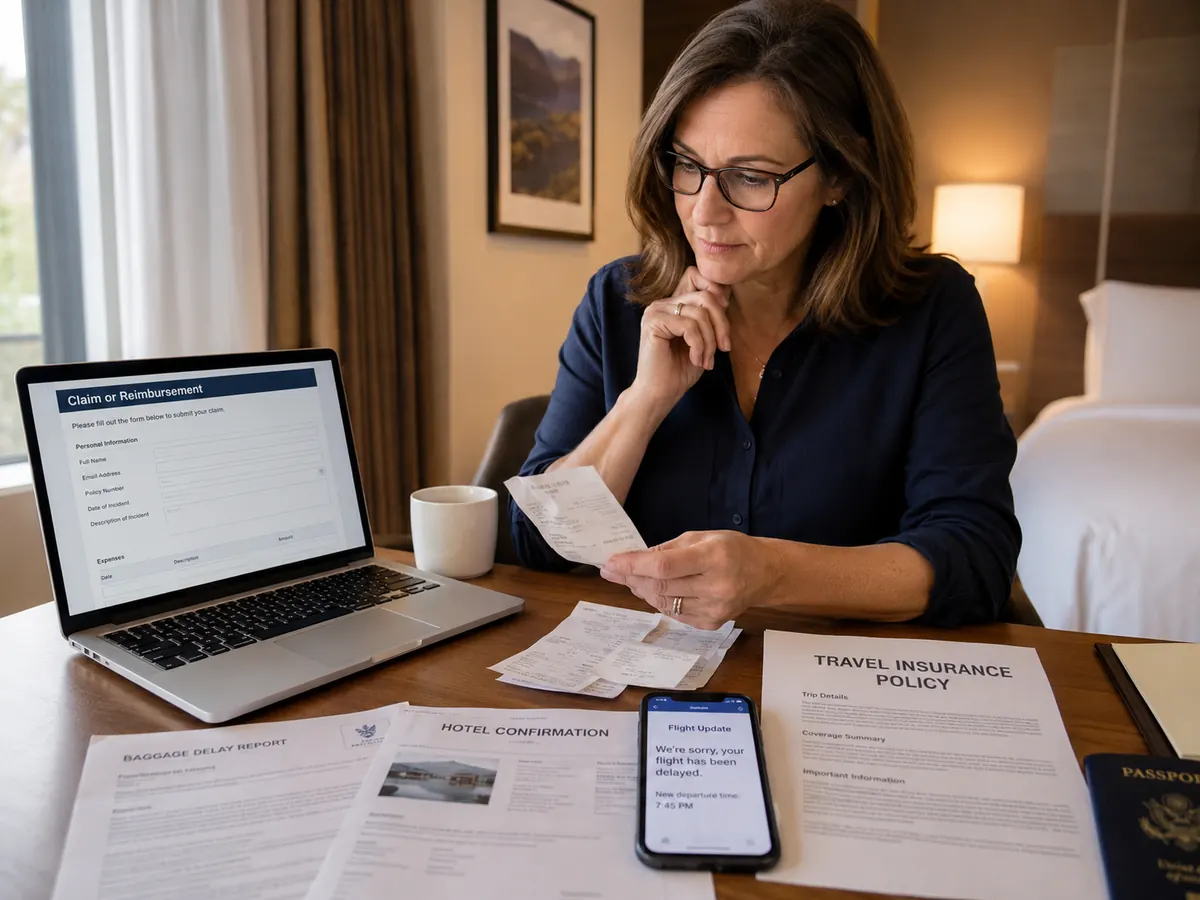
Hotel and Lodging Proof Can Matter at Check-In, Checkout, or After the Stay
Hotel documents are easy to overlook because they do not feel like “travel documents” in the same way a passport or ID does.
But lodging proof can matter when you check in, when the hotel places a hold on your card, when a prepaid booking is questioned, when a resort fee appears separately, when a deposit is kept on file, or when you need to challenge a charge after checkout.
Before you travel, save:
- confirmation number
- reservation name
- prepaid receipt or voucher
- cancellation deadline
- deposit or incidental-hold policy
- resort fee or destination fee disclosure
- late-arrival policy
- payment-card requirement
- third-party booking confirmation
- any hotel emails or chat messages
- screenshots showing what was included or excluded
If a charge appears later, the hotel folio and your original booking proof may matter more than the confirmation email alone.
Cruise and Tour Documents Can Add Rules Beyond the Destination
Cruises, tours, excursions, and group travel can come with provider rules that are separate from the basic destination requirements.
A destination may allow entry with one set of documents, while the cruise line, tour operator, excursion company, school group, or travel provider requires something more.
That may include:
- passports
- birth certificates
- visas
- insurance proof
- medical forms
- waivers
- emergency-contact forms
- consent forms for minors
- custody documentation
- vaccination or health documentation
- provider-specific boarding documents
This matters most when a child is traveling with one parent, grandparents, relatives, a school group, or an adult whose last name does not match the child’s documents.
Before final payment, check the provider’s document list directly. Do not rely only on general destination advice.
If you are also deciding between a private and shared tour, check the booking structure as carefully as the documents. Our Private Tour vs Group Tour guide explains how group capacity, per-person versus group pricing, transportation, admissions, and cancellation terms can change which option offers the better value.
↑ Back to travel documents checklist
Medication, Insurance, and Backup Copies Can Affect What Happens After a Problem Starts
Medication, insurance, and backup copies are easy to treat as separate checklist items.
In reality, they often work together after something goes wrong.
If a checked bag is delayed, your medication needs to be with you. If a medication is questioned while traveling, the prescription label, doctor’s letter, or original packaging may matter. If you file a claim, the insurance company may ask for receipts, confirmations, delay notices, baggage reports, provider emails, policy documents, or proof that the problem fits a covered reason.
That proof trail matters because many travel problems become paperwork problems.
A delayed bag, missed connection, denied reimbursement, hotel charge, canceled booking, medical issue, or insurance claim may require more than your word that something happened.
Keep the records that show:
- what you booked
- what you paid
- what you packed
- what was delayed, canceled, denied, or charged
- what the provider told you
- what receipts or reports support the issue
- what your policy says is covered
- what deadline applies to a claim or request
Medication deserves special attention because rules can change from country to country. A prescription or over-the-counter medicine that is routine at home may be restricted elsewhere, especially if it involves controlled substances, ADHD medication, sleeping pills, strong pain medication, injectables, syringes, cannabis-related products, or medical devices.
For international travel, it is usually safer to keep medication in its original prescription-labeled container instead of loose pills or unmarked organizers. If you take several medications, consider bringing only what you need for the trip plus a small emergency buffer, while leaving the rest safely at home.
Insurance proof also has limits. A coverage letter or policy card may show that you purchased insurance, but it does not prove that every document mistake, baggage delay, missed connection, medical issue, hotel charge, or cancellation reason is covered.
Before relying on a policy, check the covered reasons, exclusions, claim deadlines, required documentation, benefit limits, and whether the problem must be reported within a certain timeframe.
Travel Fine Print Takeaway
Insurance proof is not the same as claim proof. Carry the policy and emergency contact details, but also save the receipts, reports, screenshots, provider messages, and documentation you may need to show why the problem is covered.
Before You Book: Final Document Check
Before you pay for a nonrefundable flight, hotel, cruise, tour, rental car, package, or travel insurance policy, pause long enough to confirm the rules that could affect whether you can actually use the trip — or recover money if something goes wrong.
A booking confirmation is not the same as permission to board, enter, check in, receive reimbursement, dispute a charge, or file a successful claim.
The safest time to catch a document or proof issue is before the money becomes difficult to recover.
Before booking, ask yourself:
- Does the traveler name match the document, reservation, policy, or provider record?
- Does the passport, ID, visa, or entry authorization meet the actual rule?
- Are there transit, layover, baggage recheck, or separate-ticket issues?
- Have I saved the cancellation terms, refund rules, and fee disclosures?
- Do I understand hotel deposits, resort fees, destination fees, and pay-later charges?
- Do I have proof of what was included, excluded, prepaid, refundable, or non-refundable?
- Does insurance cover the problem I am worried about, or only certain listed reasons?
- Have I saved screenshots, receipts, confirmations, provider messages, and policy documents?
The goal is not to make travel feel complicated.
The goal is to catch small fine-print issues before they become expensive problems.
Action Step
Confirm the Rules and Save the Proof Before the Trip Is Locked In
Before relying on a booking, document, policy, or confirmation, check both sides of the issue: the rule that applies and the proof you may need if the rule is questioned later.
- Check accepted ID for domestic travel and passport rules for international travel.
- Confirm visa, eVisa, ETA, transit, and onward-ticket requirements.
- Compare the traveler name across tickets, IDs, passports, hotels, cruises, and insurance documents.
- Verify baggage-transfer rules and keep first-day essentials in your carry-on.
- Save hotel, cruise, tour, and third-party booking terms before departure.
- Screenshot refund rules, cancellation deadlines, fees, deposits, and pay-later charges.
- Keep medication in original labeled containers when traveling internationally.
- Read insurance exclusions before assuming a document, delay, baggage, or refund issue is covered.
- Save receipts, reports, confirmation emails, provider messages, and policy documents.
- Keep digital and paper backups somewhere separate from the originals.
Quick win: before you book anything expensive or nonrefundable, screenshot the rule you are relying on — not just the confirmation after payment.
Check Your Travel Fine Print Before You Rely on the Booking
Even after checking the obvious documents, some travel risks are easy to miss. The issue may be a document rule, booking restriction, refund policy, airline responsibility gap, hotel charge, baggage delay, or insurance limitation.
Check the Fine Print
Not sure which travel rule could cost you money?
Use the Travel Fine Print Risk Checker to narrow whether your biggest risk is a document issue, name mismatch, booking restriction, refund rule, airline policy, hotel charge, baggage problem, or insurance limitation.
❓Frequently Asked Questions
These questions cover the travel documents, booking proof, screenshots, and records that can matter before you book, before you fly, at check-in, or after something goes wrong.
What should be on a travel documents checklist?
A travel documents checklist should include accepted ID, passport rules, visa or entry authorization, ticket name match, hotel and lodging proof, airline and baggage details, cruise or tour documents, medication paperwork, travel insurance documents, child-travel consent forms, and backup copies.
A stronger checklist also includes proof: screenshots of booking terms, cancellation rules, refund policies, fee disclosures, confirmations, receipts, baggage reports, hotel folios, insurance claim documents, and provider messages.
What should I screenshot before booking travel?
Before booking, screenshot the price breakdown, cancellation policy, refund terms, baggage rules, resort fees, destination fees, deposit rules, pay-later charges, travel credit terms, and anything marked due at property, collected later, excluded, estimated, or non-refundable.
It also helps to save the traveler names, dates, room type, fare type, booking channel, confirmation screen, and any provider message that explains what is included or excluded.
Is a valid passport always enough for international travel?
Not always. A passport may be valid, but still not meet the rule for a specific destination, airline, cruise, tour, or connection. Some trips may require additional validity beyond your travel dates, blank pages, visas, entry authorizations, transit documents, or proof of onward travel.
Check the rule for your exact route, destination, nationality, traveler type, and booking method before relying on the passport alone.
Why does the traveler name need to match so closely?
The name on the ticket, passport, ID, visa, cruise record, hotel reservation, rental car booking, or insurance policy may need to match the traveler’s document closely enough for the provider to verify the person traveling.
Watch for maiden names, married names, hyphenated names, missing surnames, reversed names, nicknames, middle-name differences, and old names stored in loyalty profiles or autofill records.
What proof should I save for a hotel stay?
Save the confirmation number, reservation name, prepaid receipt or voucher, cancellation deadline, deposit rule, incidental-hold policy, resort fee or destination fee disclosure, late-arrival rule, payment-card requirement, and any third-party booking confirmation.
If a charge appears later, save the hotel folio, receipts, card statement, booking screenshots, and any hotel emails or chat messages explaining the charge.
Will travel insurance cover a document mistake?
Do not assume it will. Travel insurance depends on the policy, covered reasons, exclusions, claim deadlines, and documentation requirements.
Missing, expired, incorrect, or insufficient documents may not be covered unless the policy clearly includes that situation. Carry the policy and emergency contact details, but also save the proof you may need to support a claim.
What proof should I save if something goes wrong while traveling?
Save confirmations, receipts, screenshots, baggage reports, delay notices, claim numbers, hotel folios, provider emails, policy documents, refund denials, travel credit terms, and copies of the rules you relied on.
Those records can matter for refunds, insurance claims, credit card benefits, baggage reimbursement, hotel charge disputes, or later questions about what was promised before you booked.
Bottom Line
A travel documents checklist should do more than remind you to pack a passport, ID, insurance card, and confirmation email.
The bigger issue is whether each document, record, screenshot, or piece of proof actually works for the trip you booked.
Domestic flights, international entry rules, airline connections, hotel check-in, cruise documents, medication restrictions, baggage delays, refund disputes, post-stay charges, and insurance claims can all involve different proof requirements.
Before you book or fly, check the rule behind the document.
Make sure the name matches, the ID is accepted, the passport meets the destination rule, the visa or transit requirement is clear, the hotel or cruise terms are saved, and the proof you may need later is easy to access.
The goal is not to make travel feel more complicated.
It is to catch the small fine-print issues before they become expensive problems.
Related Guides
This checklist connects to the documents, booking proof, fees, refunds, insurance, and confirmation details travelers often need before and after a trip problem.
Travel Documents and Name Issues
- Does Travel Insurance Cover Passport Problems? — Helps travelers understand when passport problems may or may not be covered by insurance.
- Name Mismatch on a Boarding Pass or Passport: What Travelers Should Know — Useful when ticket names, IDs, passports, visas, or booking records may not match cleanly.
Booking Proof and Travel Charges
- Why the Checkout Price Isn’t Always the Final Travel Cost — Helps travelers understand why screenshots of fees, taxes, deposits, and pay-later charges matter.
- Can Hotels Charge You After Checkout? — Useful when travelers need hotel folios, receipts, confirmations, and proof to question a post-stay charge.
- Do You Get Hotel Deposits Back? What Travelers Should Know Before Booking — Helps travelers check deposit rules, incidental holds, refund terms, and hotel payment proof.
Flights, Connections, and Baggage
- Separate Ticket Connections: The Hidden Risk Most Travelers Miss — Explains why travelers may need proof of separate bookings, baggage rules, and connection responsibilities.
- What Happens If You Miss a Connecting Flight? — Helpful when rebooking, baggage routing, and proof of delay or misconnection become important.
Insurance, Refunds, and Claims
Airline Refund vs Travel Credit: What’s the Difference? — Useful when refund terms, credit rules, cancellation proof, and provider records affect what money comes back.
Travel Insurance Claim Proof: What Documents You May Need — A natural next step for travelers who need receipts, reports, screenshots, and documentation for reimbursement.