
Money Back vs Future Travel Value
Airline Refund vs Travel Credit: What’s the Difference?
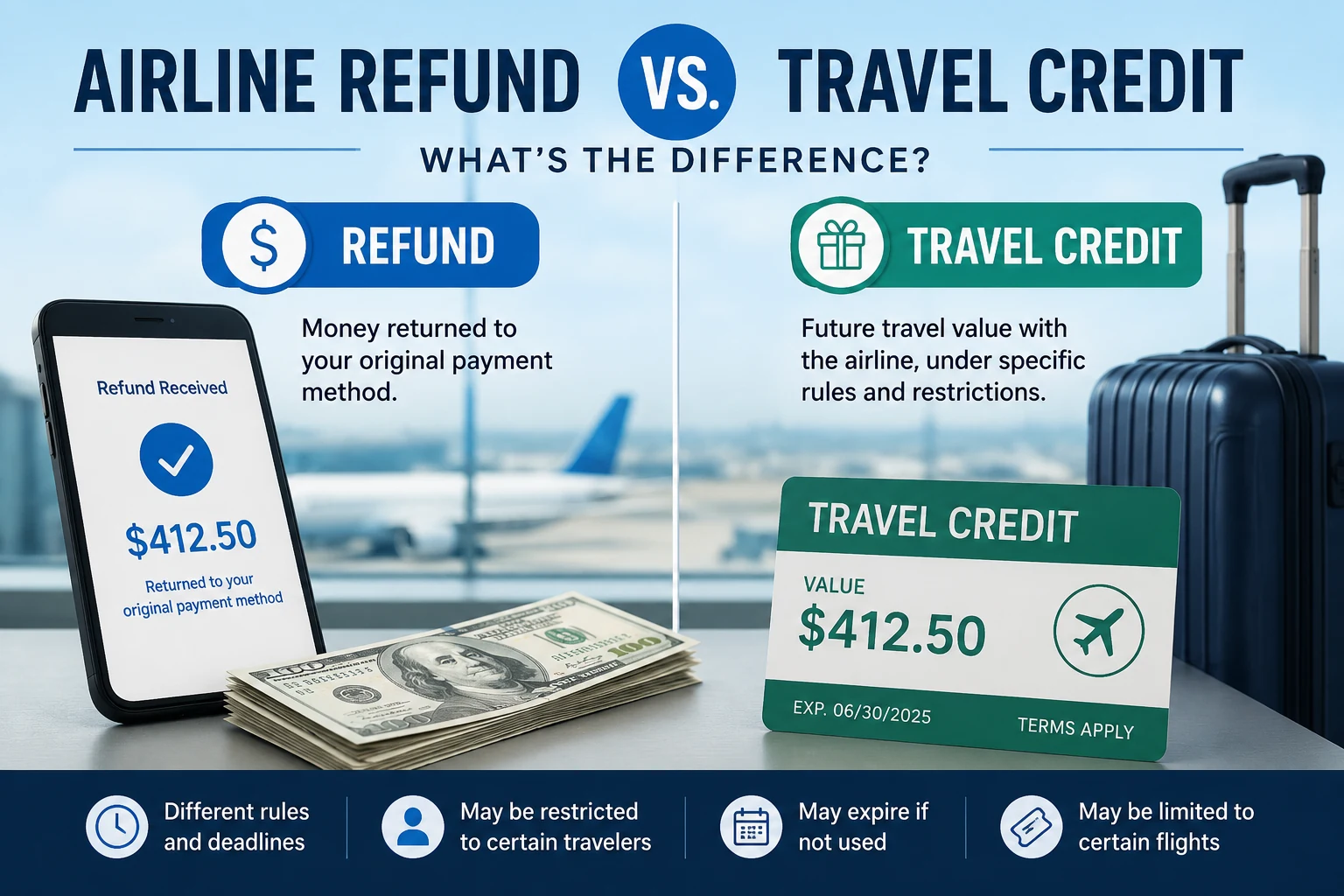
An airline refund returns money to the original payment method. An airline travel credit keeps the value available for a future booking, usually under restrictions set by the airline.
The same basic distinction also appears with hotels, cruise lines, vacation packages, and booking platforms: a refund restores control of the money, while a credit or voucher keeps the value inside the provider’s system. The exact rules can differ significantly.
About this guidance: Travel Fine Print’s guidance draws on experience with airline ticketing and fare rules, voluntary cancellations, provider-initiated changes, refunds, future-flight credits, hotel and cruise vouchers, vacation packages, booking platforms, and merchant-of-record responsibilities. Refund eligibility and credit restrictions can vary by provider, itinerary, fare or rate plan, cancellation reason, booking channel, jurisdiction, and individual circumstances, so verify the original booking terms, provider notices, credit or voucher rules, expiration language, eligible uses, and current refund information that applies to the transaction.
How It Works
Four Stages Determine Whether You Receive a Refund or Travel Credit
The same basic sequence can apply to an airline ticket, hotel stay, cruise, vacation package, or third-party booking. The outcome depends on what happened, the rules attached to the transaction, the remedy offered, and the conditions that remain after you accept it.
Trip Change
The process begins with who canceled or changed the booking, what service was affected, and whether the traveler or provider initiated the change.
Eligibility Check
The fare, rate, contract, provider rules, booking channel, and any applicable consumer protections determine whether money back, future value, rebooking, or another remedy may be available.
Remedy Offered
The provider may offer a refund, travel credit, voucher, rebooking, partial refund, or a combination. Similar dollar values do not necessarily provide the same flexibility.
Acceptance and Use
A credit or voucher may remain subject to expiration dates, traveler restrictions, eligible bookings, provider rules, price differences, taxes, fees, and the channel through which it must be redeemed.
Why this matters: Do not compare only the dollar amount. First determine what options are available, then compare how much control, time, flexibility, and usable future value each option provides.
A refund and a travel credit are different outcomes, but the choice between them does not begin with the offer shown on the screen.
It begins with what happened to the original trip, who canceled or changed it, and which fare, rate, provider, booking-channel, or consumer-protection rules apply. Those factors shape whether money back is available, whether only future-use value is offered, and what restrictions may follow.
Travel Fine Print takeaway: The dollar amount of a credit is only part of the decision. The real value depends on whether you can use it before the rules make it less useful.
What a Travel Credit or Voucher Actually Is
A travel credit or voucher is stored value for a future booking.
Instead of returning money to your original payment method, the airline, hotel, cruise line, or booking platform keeps the value in its system and lets you apply it later.
That can be useful if you already plan to travel again with the same company. But it also means the value may come with rules.
A credit may have limits on:
- expiration date
- traveler name
- booking channel
- fare type or room type
- route, destination, or brand
- blackout dates or excluded promotions
- whether taxes, fees, or add-ons are covered
That is why a credit is not just a delayed refund.
A refund gives the money back to you. A credit keeps the money connected to a future travel purchase.
A Credit Can Preserve Value Without Preserving Flexibility
A travel credit may protect some or all of the value from your original booking, but it usually does not give you the same flexibility as cash.
The value may still be locked to one airline, hotel brand, cruise line, booking site, traveler, expiration window, or type of future trip.
At first, a travel credit can feel like a fair substitute for a refund
You still have value, and you may still be able to use it later. The problem is that a credit usually comes with conditions.
It may expire before you are ready to travel. It may be tied to the original traveler. It may only work through the same booking channel. It may not cover taxes, fees, upgrades, baggage, seat assignments, or add-ons. And if prices rise, the credit may not cover the same trip you originally booked.
That is especially common with airline travel credits, where the rules can depend on the fare type, cancellation reason, traveler name, and whether the airline canceled the flight or you canceled voluntarily.
The value may be preserved — but the flexibility often is not.
A Credit Is Only Valuable If You Can Actually Use It
A travel credit may look like you kept the value of your trip, but restrictions can make that value harder to use than expected.
Before accepting one, check the expiration date, traveler rules, eligible bookings, booking channel, and whether the credit covers taxes, fees, upgrades, or add-ons.
Who Issues Travel Credits and Vouchers
Travel credits and vouchers are used across the travel industry, but airlines are one of the most common places travelers run into them.
You may receive a credit from:
- an airline
- a hotel or resort
- a cruise line
- an online travel agency
- a vacation package provider
- a tour operator
The basic idea is usually the same: the company keeps the value from your original booking and lets you apply it to a future trip.
But the rules can vary widely.
An airline credit may be tied to the passenger name, original ticket, fare rules, route, or booking deadline. A hotel or resort credit may be tied to a property, brand, stay dates, rate type, or future booking window. A booking platform credit may require you to rebook through the same site.
Before treating a credit like money, check where it can be used, who can use it, when it expires, and what it actually covers.
When a Refund Is Better Than a Travel Credit
A refund is usually better when flexibility matters more than staying with the same travel company.
Once the money returns to your original payment method, you can use it however you want — for another airline, another hotel, a different destination, or something that has nothing to do with travel.
A refund may be the better option if:
- you are not sure when you will travel again
- the credit expires soon
- the credit is tied to one traveler
- the new trip may cost more than the original booking
- the credit does not cover taxes, fees, upgrades, or add-ons
- you would rather book with a different company
- the provider canceled or significantly changed your trip
This is especially important with airline bookings. If an airline cancels or significantly changes your flight, the refund question may be different from a voluntary cancellation.
A credit can be useful, but when the rules are unclear, restrictive, or hard to use, cash is usually the stronger option.
When a Travel Credit Might Still Make Sense
A travel credit is not always a bad option.
It may make sense if you already know you will book with the same airline, hotel, cruise line, or travel company before the credit expires.
A credit may be reasonable when:
- you still want to take the trip later
- the expiration date gives you enough time
- the credit is easy to apply online
- the credit can be used for the same traveler and trip type
- the new booking price is similar to the original price
- a cash refund is not available under the booking terms
The key is to compare the credit to your actual travel plans.
If you know when, where, and how you will use it, a travel credit can preserve value. If the rules are hard to understand or your plans are uncertain, a refund is usually safer.
A credit works best when it is easy to use before it expires.
What to Check Before Accepting a Travel Credit
Before accepting a travel credit instead of a refund, make sure you understand how usable the credit really is.
- Expiration date: When does the credit expire, and does the deadline apply to booking, travel, or both?
- Traveler name: Can anyone use the credit, or is it tied to the original traveler?
- Booking channel: Do you have to rebook through the same airline, hotel, cruise line, travel agency, or website?
- Eligible bookings: Can it be used for any trip, or only certain fares, rates, routes, rooms, dates, or packages?
- Taxes, fees, and add-ons: Does the credit cover the full new booking, or only part of the base price?
- Refund option: Is a credit truly the only option, or could a refund still be available?
- Price changes: If the new fare, room rate, or package price is higher, will you have to pay the difference?
A travel credit should be judged by how easy it will be to use, not just by the dollar amount attached to it.
If the rules are unclear, ask for the terms in writing before accepting the credit.
Get the Credit Rules in Writing
Before accepting a travel credit, ask the provider to confirm the expiration date, traveler restrictions, booking rules, eligible uses, and whether taxes, fees, upgrades, or add-ons are covered.
A simple question helps: “Can you send me the full rules for using this credit before I accept it instead of a refund?”
❓Frequently Asked Questions
Airline refunds and travel credits are easy to confuse because both may come from a canceled, changed, or disrupted flight. These answers explain the practical difference between getting money back and keeping future-use value with airline rules attached.
What is the difference between an airline refund and a travel credit?
An airline refund returns money to your original payment method. An airline travel credit keeps the value with the airline for a future flight, usually with rules about expiration dates, passenger names, fare types, booking channels, taxes, fees, or eligible routes.
Is an airline travel credit the same as a refund?
No. A refund gives you the money back and lets you decide how to use it. An airline travel credit keeps the value inside the airline’s system, so you usually have to use it with that airline and follow the credit’s rules.
Which is better, an airline refund or travel credit?
A refund is usually better if you want flexibility, are unsure when you will travel again, or do not want to stay tied to the same airline. A travel credit may still make sense if you know you will fly with the same airline before the credit expires and the rules are easy to use.
Do airline travel credits expire?
Yes, many airline travel credits expire. The deadline may apply to when you must book, when you must travel, or both. Always check the expiration rule before accepting or relying on a credit.
Can I use an airline travel credit for any flight?
Not always. An airline travel credit may be limited to the original passenger, the same airline, certain fare types, eligible routes, specific booking channels, or a future trip before the expiration date. Some credits may not cover taxes, fees, baggage, seats, upgrades, or add-ons.
Can I choose a refund instead of an airline credit?
Sometimes. If you cancel a non-refundable ticket voluntarily, a credit may be the only option. But if the airline cancels the flight or significantly changes the schedule, a refund may still be available depending on the rules and the situation.
Are travel vouchers the same as travel credits?
They are similar, but not always identical. A travel credit is often tied to a canceled or changed booking. A voucher may be promotional, compensatory, or issued for service recovery. Either way, check the expiration date, eligible use, passenger restrictions, transfer rules, and whether taxes or fees are covered.
Bottom Line
A travel credit or voucher can preserve value, but it is not the same as getting your money back.
A refund returns money to your original payment method and gives you flexibility. A travel credit keeps the value inside the airline, hotel, cruise line, booking site, or travel provider’s system, usually with rules attached.
That does not mean a credit is always bad.
If you know you will travel again with the same provider before the credit expires, it may be useful. But if the credit is hard to use, tied to one traveler, limited to certain bookings, or unclear about taxes and fees, a refund may be the stronger option.
Before accepting a travel credit, look beyond the dollar amount.
Ask how long it lasts, who can use it, where it can be applied, what it covers, and whether you still have the right to request money back instead.
A credit can keep the value alive — but a refund gives you control.
Related Guides
Travel credits and vouchers are easier to evaluate when you compare them with the refund rules, cancellation terms, and booking conditions behind your trip. These related guides can help you understand when a credit may be reasonable — and when money back may matter more.