
You canceled a flight, hotel, tour, package, or travel booking and were told a refund was approved.
But the money still has not shown up.
That delay can feel confusing because a travel refund is not always one instant transaction. The airline, hotel, booking site, cruise line, tour operator, or travel insurer may approve the refund before the money actually appears on your card or bank account.
In between, the refund may still need to move through a payment processor, card network, bank, or third-party booking platform. In some cases, the delay is not a refund delay at all — it may be a travel credit, partial refund, card authorization hold, or manual review.
The real question is not just:
“Did they approve my refund?”
It is:
“Where is the refund in the process, and who controls the next step?”
This guide explains why travel refunds can take longer than expected, how approval differs from money posting to your account, when a delay is normal, and what to ask before you dispute the charge or start over with another request.
Quick Answer
Why do travel refunds take so long?
Travel refunds can take longer than expected because approval is not the same as the money reaching your account. After a refund is approved, it may still need to move through the travel provider, booking site, payment processor, card network, and your bank before it appears as available funds.
Delays are more common when a third-party booking site is involved, the refund needs manual review, the booking was partly used, the payment method is slower, or the provider issued a travel credit instead of a cash refund.
If the expected timeline has passed, ask for the refund date, refund amount, refund method, and any transaction or reference number before opening a dispute or starting a duplicate request.
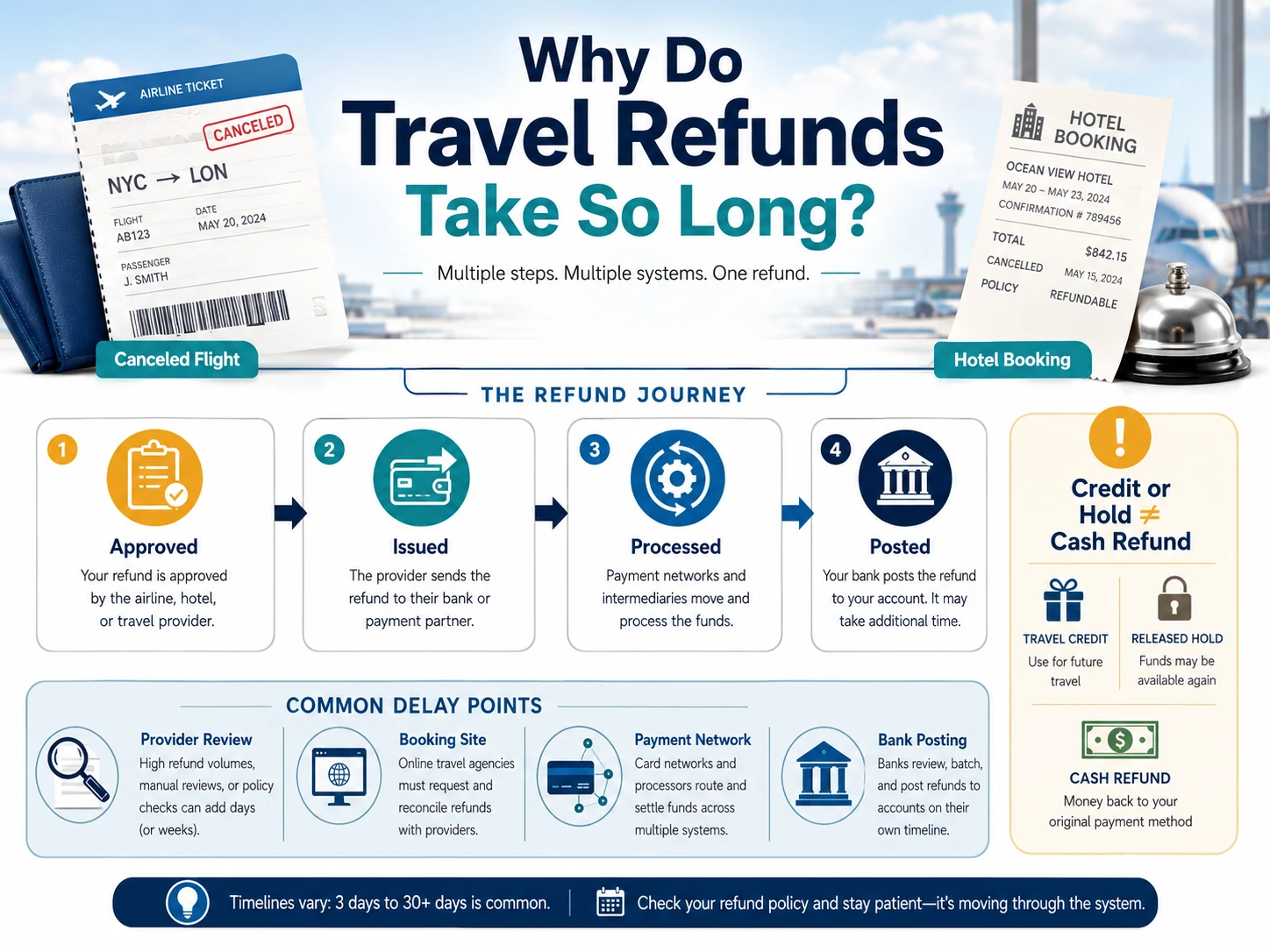
System Insight
“Approved,” “issued,” “posted,” and “credited” are different refund stages.
- Approved means the travel provider or booking site agreed that a refund should happen.
- Issued means the refund was sent into the payment system.
- Posted means your bank or card issuer has made the credit visible on your account.
- Credited may mean cash returned to your card, but it can also mean a travel credit or voucher depending on the terms.
- Hold released means a pending hotel or rental authorization may disappear instead of showing as a refund.
Refund Delay Diagnostic
Where Is Your Travel Refund Stuck?
A delayed travel refund can mean different things. The provider may still be reviewing the request, the refund may already be issued, the bank may not have posted it yet, or the value may have been returned as a credit instead of cash.
Provider Review
The Refund Is Not Approved Yet
The airline, hotel, tour company, cruise line, insurer, or booking site may still be checking the booking rules.
Manual Check
The Booking Needs Review
Partly used tickets, no-shows, penalties, credits, or exceptions can slow the refund before payment is released.
Middleman Delay
A Booking Site Is Involved
An OTA, travel app, portal, or package provider may need approval from the airline, hotel, or supplier first.
Payment Chain
The Bank Has Not Posted It
The provider may have issued the refund, but your card issuer or bank still has to make it visible.
Credit vs Cash
You Received Travel Credit
The value may have been returned as a voucher, credit, or future travel balance instead of money back.
Hold Release
It Was a Pending Hold
Hotel, rental car, or deposit authorizations may disappear from pending charges instead of posting as refunds.
The Refund Is Not Approved Yet
A travel refund may take longer because the provider has not actually approved it yet. This can happen with airlines, hotels, cruise lines, tour operators, travel insurers, or booking sites when they still need to confirm whether the booking qualifies for a refund.
Approval may depend on the fare rules, cancellation policy, refund request date, whether part of the trip was used, whether a no-show penalty applies, or whether the refund is being handled as an exception.
The important question to ask is not only, “Where is my money?” It is: “Has the refund actually been approved, or is the request still under review?”
↑ Back to refund delay diagnostic
The Booking Needs Manual Review
Some travel refunds take longer because the booking cannot be refunded automatically. A manual review may be needed when the trip was partly used, canceled close to departure, changed after booking, affected by a schedule change, tied to a travel credit, or handled under an exception request.
This is common with airline tickets, package bookings, insurance claims, group travel, cruises, tours, and third-party reservations where multiple rules may apply at the same time.
If manual review is involved, ask what still needs to be checked, whether any documentation is missing, and when the review is expected to be completed.
↑ Back to refund delay diagnostic
A Booking Site Is Involved
Refunds can take longer when you booked through an online travel agency, travel app, credit card travel portal, package provider, or other third-party platform.
In that situation, the company you paid may not be the same company providing the flight, hotel, rental car, cruise, or tour. The booking site may need approval from the airline, hotel, or supplier before it can process the refund back to your original payment method.
This is why travelers often get stuck between two answers: the provider says the booking site controls the refund, while the booking site says it is waiting on the provider.
When a third party is involved, ask who collected the payment, who approved the refund, who issued it, and whether there is a refund reference number or case number you can track.
↑ Back to refund delay diagnostic
The Bank Has Not Posted the Refund Yet
Sometimes the travel provider has already issued the refund, but your bank or card issuer has not posted it to your account yet.
This is one of the most confusing parts of refund timing. The airline, hotel, booking site, or travel company may say the refund was processed, but that does not always mean the credit is visible on your card statement immediately.
Once a refund enters the payment system, timing can depend on the card network, bank processing schedule, original payment method, weekends, holidays, and whether you used a credit card, debit card, prepaid card, digital wallet, or payment app.
If the provider says the refund was issued, ask for the refund date, amount, payment method, and reference number. Then contact your bank or card issuer if the expected posting window has passed.
↑ Back to refund delay diagnostic
You Received a Travel Credit Instead of Cash
Not every travel refund returns as money to your card. In some cases, the value may be issued as a travel credit, voucher, future booking credit, airline credit, hotel credit, or account balance.
This can happen because of the fare rules, cancellation policy, booking terms, travel provider policy, or the option selected during cancellation. The provider may describe the issue as “resolved” even though no cash refund appears on your bank statement.
Before assuming the refund is missing, check whether the provider issued a credit instead. Look in your airline account, booking site account, email confirmation, cancellation receipt, or travel wallet.
If you expected cash but received credit, ask whether the original booking terms allowed a cash refund or whether the credit was the only available refund option.
↑ Back to refund delay diagnostic
It Was a Pending Hold, Not a Refund
Some travel “refunds” are not refunds at all. They are pending holds or temporary authorizations that need to fall off your card.
This is especially common with hotels, rental cars, deposits, security holds, resort incidentals, and damage authorizations. The company may release the hold, but your bank may take additional time to remove the pending charge from your account.
A hold release may not show as a refund or credit. Instead, the pending transaction may simply disappear, or the final posted charge may be lower than the amount that was originally authorized.
If you are waiting on a hotel deposit, rental car hold, or incidental authorization, ask whether the charge was actually captured or whether it was only a temporary hold. That distinction changes what you should expect to see on your statement.
↑ Back to refund delay diagnostic
Traveler Risk
Acting too soon can create a second refund problem.
When a travel refund takes longer than expected, it is easy to assume the money is missing, the provider failed to process it, or your bank made a mistake. But if the refund is still under review, still moving through the payment chain, or already issued as a travel credit, the wrong next step can create more confusion.
Starting a duplicate refund request, disputing the charge too early, contacting the wrong company, or accepting a credit without understanding the terms can make the issue harder to unwind. The safer move is to identify where the refund is in the process before escalating.
Check the Fine Print
Not sure why your travel refund is delayed?
Use the Travel Fine Print Risk Checker to narrow whether the issue is a provider review, booking-site delay, bank posting delay, travel credit, partial refund, card hold, or another refund-path problem.
Once you know where the refund may be stuck, the next step is to gather the details that show whether the refund was only approved, actually issued, or already sent to your payment method.
Action Step
Ask for the refund details before escalating.
If your travel refund has not appeared yet, do not start with a dispute unless the timeline has clearly passed or the provider cannot confirm the refund was issued. Start by asking for the details that show where the refund is in the process.
- ✓Confirm whether the refund was approved or actually issued.
- ✓Ask for the refund issue date and expected posting window.
- ✓Confirm the refund amount and whether it is full, partial, or credit-based.
- ✓Ask whether the refund goes to the original payment method.
- ✓Request a refund reference number, case number, or transaction ID.
- ✓Check with your bank or card issuer only after the posting window has passed.
Quick win: Ask, “Has the refund been issued to my original payment method, and can you provide the date, amount, and reference number?”
Before You Escalate
Save the refund proof before the trail gets messy.
Use the travel documents checklist to keep your cancellation confirmation, refund approval, credit notice, payment record, case number, screenshots, and card statement organized before you follow up, dispute, or escalate.
When Should You Follow Up on a Travel Refund?
You should usually follow up when the stated refund timeline has passed, the provider cannot confirm the refund was issued, or the refund amount does not match what you were promised.
Before escalating, separate the delay from the decision. A refund that is still under review is different from a refund that was approved but not issued. A refund that was issued is different from one your bank has not posted yet.
Follow up with the travel provider or booking site if:
- they approved the refund but cannot confirm it was issued,
- the refund amount is different from what you expected,
- the refund was converted to a credit without clear explanation,
- the provider’s stated timeline has passed,
- the booking site says it is waiting on the airline, hotel, or supplier,
- or the bank cannot trace the refund without a transaction or reference number.
Follow up with your bank or card issuer if the provider can confirm the refund was issued, but the money still does not appear after the expected posting window.
A useful question is:
“Can you confirm whether the refund was approved, issued, or posted — and provide the date, amount, method, and reference number?”
Travel refund delays are frustrating because every company may use slightly different language. These FAQs focus on the timing, processing, credit, bank, and dispute questions travelers usually ask after a refund is expected but still missing.
Why do travel refunds take so long?
Travel refunds can take longer than expected because approval is not the same as the money reaching your account. The refund may still need to move through the travel provider, booking site, payment processor, card network, and bank before it appears.
How long do travel refunds usually take?
Some travel refunds appear within a few business days, while others can take longer depending on the provider, booking channel, payment method, manual review, and bank posting time. The most important first step is to confirm whether the refund was approved, issued, or still under review.
Why does my refund say processed but not appear on my card?
A refund can be processed by the travel company before your bank or card issuer posts the credit to your account. If the provider says the refund was issued, ask for the refund date, amount, payment method, and reference number so your bank can help trace it if the posting window has passed.
Can a booking site delay my travel refund?
Yes. If you booked through an online travel agency, travel app, credit card portal, or package provider, that company may need approval from the airline, hotel, or supplier before issuing your refund. Ask who collected the payment, who approved the refund, and who is responsible for sending the money back.
Did I get a travel credit instead of a refund?
Possibly. Some cancellations return value as a travel credit, voucher, airline credit, hotel credit, or future booking balance instead of cash. Check your cancellation email, travel account, booking site wallet, or provider account before assuming the refund is missing.
Should I dispute a delayed travel refund?
Not immediately. First confirm whether the refund was approved, actually issued, or still pending review. If the provider cannot prove the refund was issued, the promised timeline has clearly passed, or the final charge does not match the disclosed refund terms, then a card dispute may be worth considering.
Bottom Line
Travel refunds can take longer than expected because approval is only one part of the process.
A refund may still need to move through the travel provider, booking site, payment processor, card network, and bank before the money appears in your account. In other cases, the value may come back as a travel credit, partial refund, or released authorization hold instead of a visible cash refund.
The safest move is to confirm where the refund actually is:
- Was it approved?
- Was it issued?
- Was it posted?
- Was it returned as credit?
- Was it only a hold release?
Before disputing or starting a duplicate request, ask for the refund date, amount, method, and reference number. That information helps you know whether to wait, contact the booking site, call your bank, or escalate the issue.
Before You Book, Cancel, or Dispute
Avoid the fine print that turns a refund delay into weeks of confusion.
Travel refund problems often start when cancellation terms, payment paths, credits, booking sites, and bank timelines are not clear. Get the free 27 Travel Mistakes guide and learn what to check before a travel payment becomes harder to track.
- ✓Spot refund timing, processing delays, and credit-vs-cash confusion.
- ✓Know what proof to save before canceling, following up, or disputing.
- ✓Avoid assuming “approved” means money is already back on your card.
Get the free guide
Enter your email below and we’ll send the guide instantly.
Free guide. No spam. Just clearer travel decisions before you book, cancel, wait, or escalate.
Related Guides
Refunds, Credits, and Cancellation Problems
- Can I Get a Refund Instead of a Travel Credit?
Use this if the company offered a voucher, credit, or future travel balance instead of returning money to your card. - Do You Need an Airline Delay Letter for Travel Insurance?
Helpful if your refund or claim issue involves a delayed flight and you need proof from the airline before filing with travel insurance.
Hotel Refunds, Holds, and Charges
- Are Hotel Reservations Refundable? What Travelers Should Check Before Canceling
Use this if you still need to determine whether your hotel booking qualifies for a refund before canceling. - Hotel Deposit Meaning: What Travelers Should Know Before Booking
Helpful if the missing money may be a deposit, upfront charge, or hotel payment rather than a refund delay. - Why Hotels Put Pending Charges on Your Card
Use this if the issue may be a hotel authorization, incidental hold, or temporary pending charge. - Can a Hotel Charge You After Checkout?
Helpful if a hotel charge appeared after your stay and you are trying to understand whether it is valid or worth questioning.
Booking Sites and Payment Path Issues
- Booking Hotels Through Third-Party Sites: What Travelers Should Know
Helpful if the hotel says the booking site controls the refund or the booking site says it is waiting on the hotel. - Why the Price You See at Checkout Isn’t Always the Price You Pay
Use this if the refund issue started because taxes, fees, add-ons, or payment terms changed the final amount. - Why Did My Hotel Charge More Than the Booking Confirmation?
Helpful if the charge does not match the amount you expected and you need to compare confirmation, folio, and payment records.