
Are Non-Refundable Hotel Rates Worth It? When the Lower Price Is—and Isn’t—a Good Deal
A non-refundable hotel rate can save money, but the discount only matters if it is large enough to justify what you could lose when plans change.
The right choice depends on the actual dollar savings, the total booking cost at risk, how far ahead you are booking, and how many parts of the trip could still change.
Are Non-Refundable Hotel Rates Worth It?
A non-refundable hotel rate is worth considering only when your plans are firm and the savings are meaningful compared with the flexible rate. You are usually accepting stricter cancellation and change terms in exchange for a lower price.
Compare the actual dollar savings with the full amount you could lose. The lower rate is less attractive when the stay is expensive, booked far in advance, connected to flights or events, or dependent on other travelers.
Travel fine print: “Non-refundable” describes your refund rights, but it does not necessarily eliminate every change option. A rate may still permit a date change, credit, or limited exception—but only when that flexibility appears in the written terms.
About This Guidance: Travel Fine Print draws on firsthand experience with hotel reservations, rate structures, payment processing, booking channels, cancellation policies, and traveler billing issues to explain how non-refundable rates work in practice. This guidance focuses on the decision travelers face before booking: how much they are actually saving, what they may lose if plans change, and whether the restrictions attached to the lower rate are worth accepting.

How It Works
How a Lower Hotel Rate Shifts More of the Risk to You
A non-refundable rate is not simply a cheaper version of the same reservation. The discount is offered in exchange for greater payment certainty for the hotel and fewer options for the traveler.
Lower Price Offered
The hotel may discount the rate because the booking is less likely to be canceled without financial consequences.
Restrictions Attach
Cancellation, date-change, refund, credit, and no-show rules become part of the exact rate you accept.
Payment Is Secured
The full stay, a deposit, or another amount may be charged immediately or shortly after booking.
Changes Create Loss
If plans change, a refund, credit, or date adjustment may be unavailable unless the terms allow it or the hotel grants an exception.
Why this matters: The discount is what you receive upfront. The possibility of losing the booking cost is what you agree to carry afterward.
What Does Non-Refundable Mean When Booking a Hotel?
A non-refundable hotel rate generally means that some or all of the booking cost will not be returned if you cancel after the rate becomes binding.
Depending on the terms, the hotel or booking platform may charge the full stay immediately, collect a deposit, or process payment shortly after booking.
The label does not necessarily mean that every option disappears. Some non-refundable rates may still allow a date change, hotel credit, limited cancellation period, or another written exception. Other rates become fully restricted as soon as the reservation is confirmed.
Before booking, confirm:
- When payment will be collected
- How much becomes non-refundable
- Whether date changes are allowed
- Whether a credit may be offered
- What happens if you do not arrive
- Whether the hotel or booking platform controls changes
Only rely on flexibility that appears in the written rate terms.
Non-Refundable vs. Flexible Hotel Rates
The main difference is not simply the room price. It is how much financial risk you keep if the trip changes.
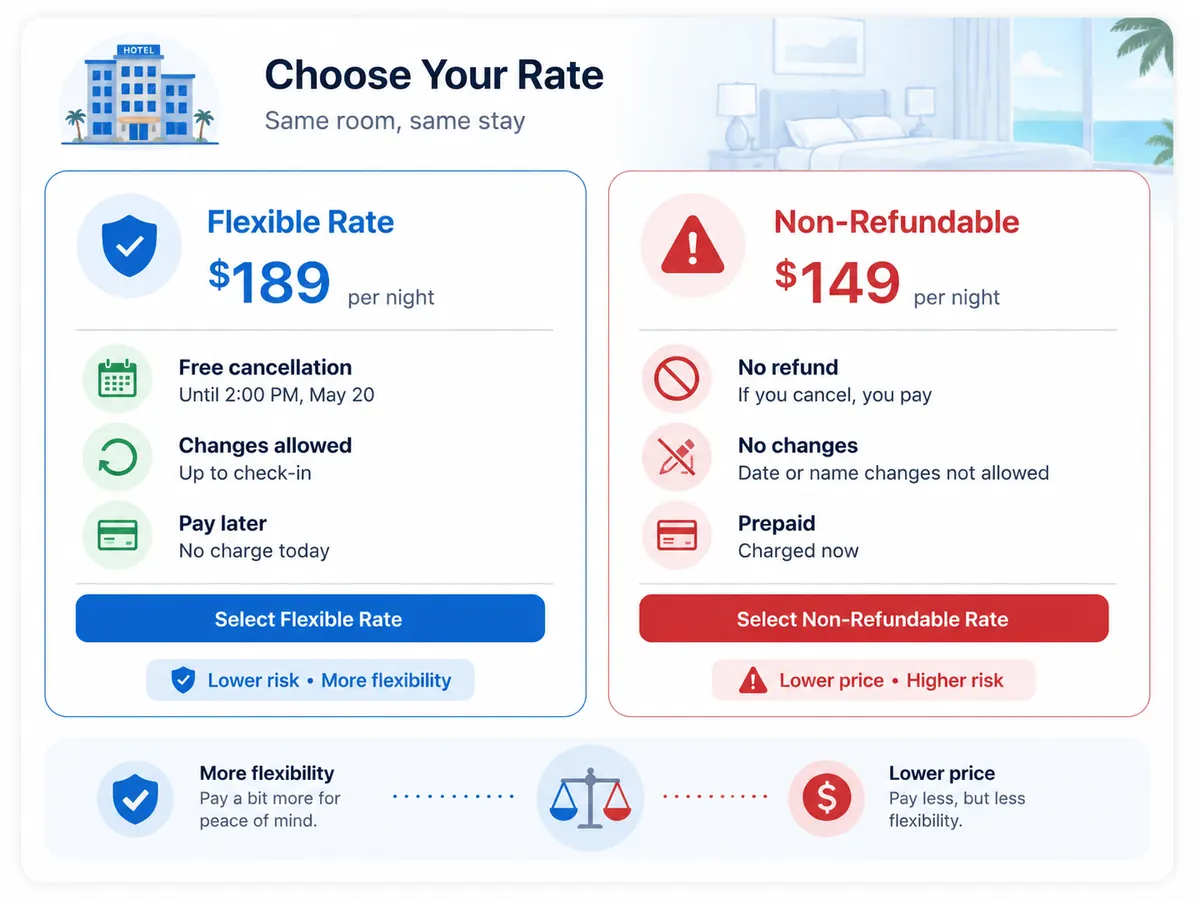
A non-refundable rate may reduce the upfront cost, but the booking can become expensive if you need to cancel, move the dates, shorten the stay, or miss the trip. A flexible rate usually costs more because it preserves options within a stated cancellation window.
Hotel Rate Comparison
Lower Price or More Flexibility?
Compare equivalent rooms and dates. The meaningful difference is what you save today versus what options remain if the trip changes later.
Lower Upfront Price
Non-Refundable Rate
- Usually costs less when booked
- May be charged immediately or soon after booking
- Cancellation may mean losing some or all of the payment
- Date changes may be restricted or unavailable
- Credits and exceptions are not guaranteed
Best fit: A short, highly certain trip when the savings are meaningful and the possible loss is affordable.
More Booking Control
Flexible Rate
- Usually carries a higher room price
- May allow cancellation within a defined window
- May offer easier date or stay changes
- Can reduce risk when other trip details are unsettled
- Still requires careful review of the cancellation deadline
Best fit: An expensive, distant, complicated, or uncertain trip where preserving flexibility may be worth the additional cost.
Compare dollars, not labels: Subtract the non-refundable price from the flexible price. That amount is what you are being paid, in effect, to accept the additional cancellation and change risk.
See whether the non-refundable savings are actually meaningful.
Compare the same hotel, room type, dates, total price, and cancellation terms before giving up flexibility for a lower rate.
Travel Fine Print may earn a commission if you book through this link, at no extra cost to you.
When Are Non-Refundable Hotel Rates Most Risky?
A non-refundable rate becomes harder to justify as the trip gains more dependencies. Booking far in advance, relying on flights or events, coordinating several travelers, or traveling during disruption-prone periods all increase the chance that you may be unable to use the room even though the hotel’s terms still apply.
The size of the possible loss matters too. A one-night stay booked for next week presents a different risk from a long, expensive stay booked several months ahead.
The more money and uncertainty involved, the more valuable flexibility may become.
A Disrupted Trip Does Not Automatically Cancel the Hotel’s Terms
A problem elsewhere in the trip may prevent you from using the hotel, but it does not necessarily require the property to refund a non-refundable reservation.
- A canceled flight may not change the hotel policy. The airline and hotel reservations usually operate under separate terms.
- An event cancellation may not create refund rights. The room can remain non-refundable even when the reason for the trip disappears.
- Personal circumstances may not qualify for an exception. Illness, work conflicts, or another traveler’s changed plans do not automatically override the rate rules.
- Travel insurance is conditional. Reimbursement depends on whether the reason is covered and whether the policy requirements are satisfied.
Judge the rate against the entire trip—not only the hotel. The more outside factors that could prevent the stay, the more carefully you should value flexibility.
How to Decide Whether a Non-Refundable Hotel Rate Is Worth It
Before booking, run the rate through a simple decision test. The goal is not to avoid every non-refundable option—it is to make sure the savings reasonably compensate you for the flexibility you are giving up.
Before You Book
Use the Non-Refundable Rate Test
Compare the exact non-refundable rate with the equivalent flexible option, then answer these four questions before committing.
Calculate the dollar difference between the two rates after taxes and required fees.
Confirm whether the full stay, one night, or another amount becomes non-refundable.
Consider flights, events, weather, work schedules, health, and other travelers—not only your preferred dates.
Look for date changes, credits, limited cancellation windows, or other options written into the rate terms.
Decision rule: Choose the non-refundable rate only when the savings are meaningful, the trip is highly certain, the potential loss is affordable, and the restrictions are clear.
Quick win: Save screenshots of both rate options and the cancellation terms before booking. That preserves the price comparison and the rules you accepted.
Compare both options before giving up flexibility.
Review available rates for the same hotel and dates. Compare the total dollar savings, cancellation deadline, payment timing, and amount that becomes non-refundable before choosing the lower price.
Use the four-part rate test: How much do you save, how much could you lose, how certain is the trip, and what flexibility remains under the exact terms?
Travel Fine Print may earn a commission if you book through this link, at no extra cost to you.
Hotel Rate Decisions
Frequently Asked Questions
These answers cover what non-refundable hotel rates mean, when the savings may be worthwhile, and which restrictions to check before booking.
What does non-refundable mean when booking a hotel?
A non-refundable rate usually means that some or all of the booking cost may be kept if you cancel, change plans, miss the stay, or do not meet the rate conditions.
Check the exact payment, cancellation, modification, credit, and no-show terms because restrictions can vary between hotels and rates.
Are non-refundable hotel rates worth it?
They can be worthwhile when the trip is highly certain and the savings are meaningful. The rate is less attractive when the discount is small, the stay is expensive, or several parts of the trip could still change.
Compare what you save with the full amount you could lose—not simply the percentage discount.
Are non-refundable hotel rates always cheaper?
No. They are often cheaper than flexible rates, but the difference may be small or may change according to the hotel, dates, demand, room type, and booking channel.
Compare equivalent rooms and dates after taxes and required fees so you know the real dollar savings.
Can you change the dates on a non-refundable hotel rate?
Sometimes, but a date change is not guaranteed. The hotel may permit a one-time change, require payment of a rate difference, charge a modification fee, or refuse the change entirely.
Any flexibility you need should be confirmed in the written terms before booking.
Can you get a refund on a non-refundable hotel booking?
Usually not when the rate has become fully non-refundable. A hotel may still offer a credit, date change, partial refund, or goodwill exception, but travelers should not treat those outcomes as guaranteed.
For steps to take after booking, see What Happens If You Cancel a Non-Refundable Hotel Booking?
When should I avoid a non-refundable hotel rate?
Be cautious when the stay is expensive, booked far in advance, connected to flights or an event, affected by seasonal weather, or dependent on several travelers.
A flexible rate may provide better value when the potential loss is large or the itinerary contains several uncertain parts.
Does travel insurance cover a non-refundable hotel booking?
It may cover the loss when the cancellation reason qualifies under the policy, but ordinary changes of plans are often not enough. Coverage depends on the purchased benefits, exclusions, timing, and required documentation.
Review the policy before relying on insurance to make a restricted hotel rate risk-free.
Bottom Line
Non-refundable hotel rates are not automatically bad deals. They are lower-priced reservations that shift more of the financial risk to you if the trip changes.
The right choice depends on four things: how much you are actually saving, how much could be lost, how certain the trip is, and whether any flexibility remains under the written terms.
A non-refundable rate can make sense for a short, highly certain trip when the discount is meaningful and the possible loss is affordable. A flexible rate may offer better value when the stay is expensive, booked far in advance, or tied to flights, events, weather, or other travelers.
Compare equivalent rates in dollars—not only by label or percentage. The cheaper option is only the better value when the savings reasonably justify the restrictions you are accepting.
Related Guides
If you are comparing non-refundable hotel rates, flexible rates, deposits, or cancellation risk, these related guides may also help:
Hotel Rates, Deposits, and Cancellation Risk
- Hotel Cancellation Policies Explained
Use this if you need to understand cancellation windows, penalty periods, refundable rates, and when a hotel may keep part or all of the booking cost. - Pay Now vs Pay at Hotel: Which Option Is Safer?
Helpful if you are deciding between a prepaid rate, pay-at-property booking, or a rate that gives you more control if plans change. - Do You Get Hotel Deposits Back? What Travelers Should Know
Use this if the booking requires a deposit and you are not sure whether it is refundable, partially refundable, or tied to the cancellation deadline.
Hotel Fees and Final Price Surprises
- Why the Price You See at Checkout Isn’t Always the Price You Pay
Helpful if the cheaper-looking rate changes once taxes, fees, deposits, add-ons, or payment timing are included. - Do You Have to Pay Hotel Destination Fees? What Travelers Should Know Before Booking
Use this if the room rate looks lower but destination fees, resort fees, or local charges may change the real cost. - Can Hotels Charge You After Checkout? What Travelers Should Know
Helpful if you are worried about delayed charges, deposits, incidentals, fees, or post-stay billing after a hotel booking.
Travel Insurance and Non-Refundable Bookings
- Why Travel Insurance Claims Get Denied — And What to Check Next
Use this before assuming travel insurance will reimburse a non-refundable hotel booking if you cancel. - Do You Need Travel Insurance If Your Flight or Hotel Is Refundable?
Helpful if you are comparing flexible bookings, refundable reservations, and whether insurance still adds protection.