
Carry-On and Gate-Check Rules
Can an Airline Force You to Check a Carry-On Bag?
Yes. Even a carry-on that meets the airline’s size rules can be taken at the gate if overhead bins fill up, the aircraft has limited storage, or boarding conditions require bags to be moved to the cargo hold.
The important distinction is why the bag is being checked and what happens next. A bag that violates the carry-on rules and a compliant bag checked because cabin space ran out may be handled differently.
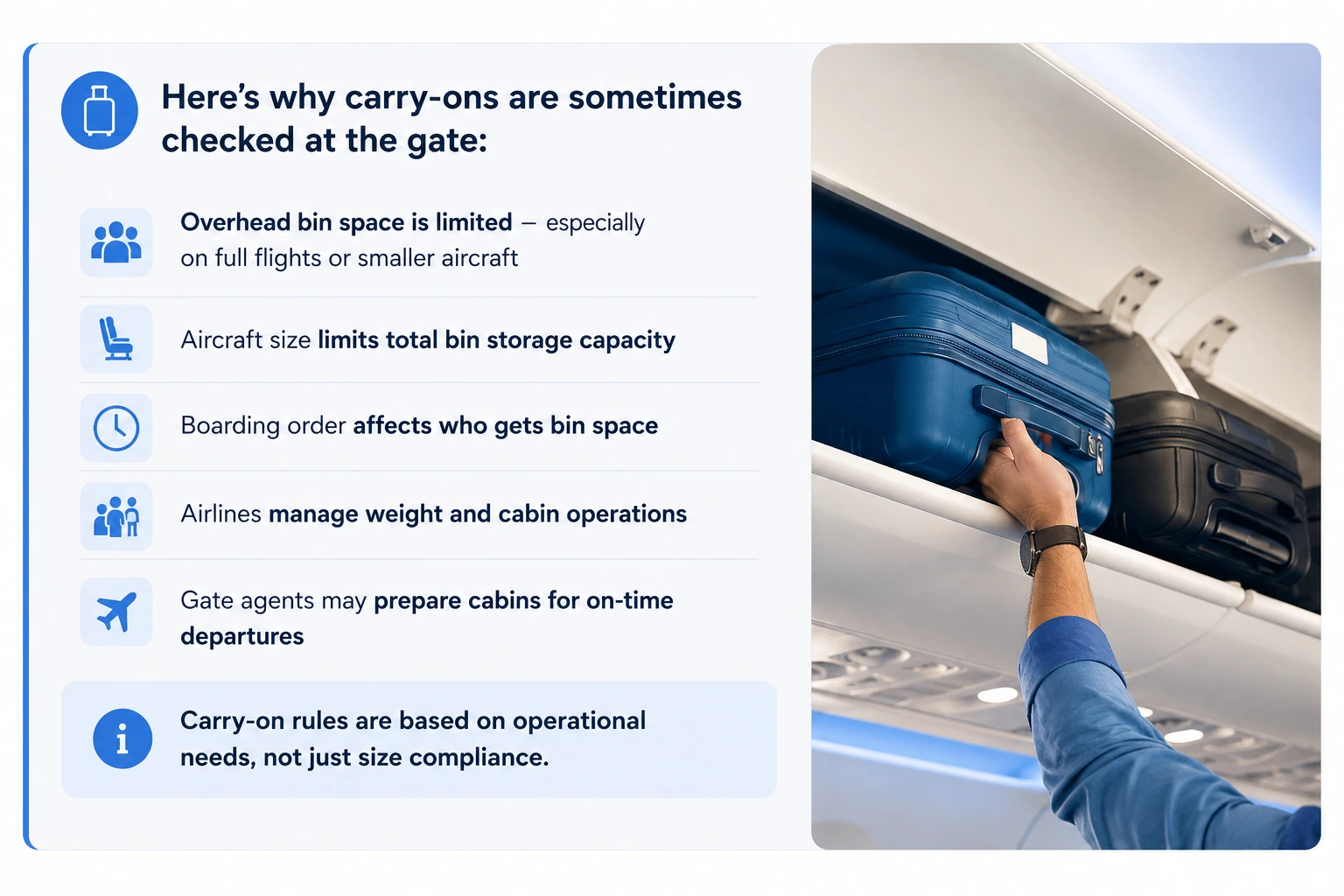
About This Guidance: Travel Fine Print examines carry-on rules from the operational side of boarding—not just the published bag dimensions. That includes how fare rules, aircraft storage, boarding order, gate-check procedures, crew instructions, and connection timing can determine whether a compliant bag actually stays in the cabin and what travelers should do if it does not.
How It Works
A Bag Can Qualify as a Carry-On and Still Be Checked at the Gate
Carry-on rules determine whether your bag is eligible to enter the cabin. They do not reserve overhead-bin space for that bag. Several other conditions can still determine whether it stays with you.
Why this matters: The published carry-on limit answers whether your bag qualifies. It does not answer whether there will still be cabin space for it when you board—or how the bag will be handled if there is not.
Why Airlines Force Carry-On Bags to Be Checked
Airlines usually force carry-on bags to be checked for one of three reasons: the bag does not meet the airline’s rules, the aircraft has limited cabin storage, or overhead bin space runs out before everyone boards.
Those are different problems.
If the bag is too large, too heavy, or exceeds the number of allowed items, the airline may require it to be checked because it does not qualify as a carry-on.
If the bag qualifies but the flight is full, the issue may be space rather than size. Overhead bins are shared across passengers, and airlines do not usually reserve a specific bin space for each traveler.
If you are on a smaller aircraft, the bag may fit on a larger plane but still not fit well in that aircraft’s cabin storage. That is especially common on regional jets or aircraft with smaller overhead bins.
This is why the experience can feel inconsistent. The same bag may stay with you on one flight and be gate-checked on another.
The rule is not only about the bag.
It is also about the aircraft, the flight load, the boarding process, and how much cabin space is left when you board.
Bag Handling
Carry-On vs Gate-Checked Bag vs Checked Bag
Where your bag is placed affects when you can access it, where you get it back, and what you should remove before handing it over.
Stays With You
Carry-on in the cabin
The bag goes in the overhead bin or under the seat. You keep access to it during the flight and take it with you when you leave the aircraft.
Taken at Boarding
Gate-checked carry-on
The bag is taken at the gate or aircraft door because of space, aircraft limits, or boarding conditions. It may be returned at the aircraft door or sent to baggage claim.
Standard Process
Checked luggage
The bag is checked at the counter or bag drop, processed through the baggage system, and usually collected at baggage claim after arrival.
Travel Fine Print check: A gate-checked carry-on is not always returned the same way on every flight. Before handing it over, ask whether it will come back at the aircraft door, jet bridge, gate area, or baggage claim.
When You’re Most Likely to Be Forced to Check a Bag
Not all flights result in gate-checked bags, but certain situations increase the likelihood.
More likely:
- Full flights with high passenger load
- Later boarding groups
- Smaller aircraft with limited overhead space
- Busy travel periods or peak routes
Less likely:
- Early boarding groups
- Flights with lower occupancy
- Larger aircraft with more storage capacity
- Minimal carry-on usage across passengers
Even when rules are followed, timing and boarding order play a major role.
Traveler Risk
Assuming your carry-on will stay with you can create bigger problems than the gate check itself.
A forced carry-on check is frustrating, but the real risk is losing access to items you needed in the cabin. Medications, passports, keys, wallets, laptops, chargers, lithium batteries, glasses, and connection documents should not be left inside a bag that may be placed in the cargo hold.
The risky assumption is thinking a compliant carry-on is guaranteed cabin access. Your bag may meet the size rules and still be checked if overhead bin space runs out, the aircraft is smaller, or the airline needs to manage boarding.
Check the Fine Print
Not sure which baggage rule could affect your trip?
Use the Travel Fine Print Risk Checker to narrow whether the issue is carry-on size, gate checking, baggage fees, boarding order, aircraft limits, airline policy, or another travel rule that could affect what happens to your bag.
What To Do
If you’re told to check your carry-on at the gate, you usually won’t have much time to decide—but a few quick steps can make a difference.
- Remove essential items immediately, including medications, valuables, electronics, and travel documents
- Ask how your bag will be handled, specifically whether it will be returned at the gate or sent to baggage claim
- Confirm the bag is properly tagged, especially if you have a tight connection
- Take note of your bag tag, in case you need to track or locate it later
- Be aware of connection timing, since gate-checked bags may affect short layovers
Unlike other travel situations, this is less about avoiding the rule and more about managing the outcome effectively in the moment.
What you do in the moment can affect how smoothly the rest of your trip goes.
Action Step
Prepare for the possibility that your carry-on may be checked at the gate.
You cannot always prevent a forced gate check, but you can reduce the disruption by keeping essentials separate, boarding prepared, and asking how the bag will be returned before you hand it over.
- Keep medications, documents, keys, and valuables in a personal item.
- Remove laptops, chargers, lithium batteries, glasses, and fragile items.
- Board as early as your ticket or boarding group allows.
- Use a bag that fits the airline’s carry-on size rules.
- Listen for gate-check announcements before boarding begins.
- Ask whether the bag will return at the aircraft door or baggage claim.
- Confirm the bag is tagged for the correct destination.
- Take a photo of the bag tag if you have a tight connection.
Quick win: Before boarding, move anything you cannot afford to lose access to into a smaller personal item that fits under the seat.
Before You Board
Keep the essentials out of any bag that could be checked.
Use the Travel Fine Print checklist to review documents, medications, electronics, valuables, baggage rules, connection timing, and other trip details before a last-minute gate check creates a bigger problem.
Why Airlines Use This Process
Airlines must balance passenger convenience with safety and operational efficiency.
Overhead bins have strict capacity limits, and exceeding them can delay boarding or create safety concerns. By shifting excess bags to the cargo hold, airlines keep the boarding process moving and ensure compliance with safety regulations.
In some cases, travelers pay for carry-on access or priority boarding, only to still have their bag checked.
This process allows flights to operate smoothly—even when passenger demand exceeds available cabin storage.
❓Frequently Asked Questions
These questions cover forced carry-on checks, gate-checked bags, overhead bin space, whether you can refuse, and what to remove before handing over your bag.
Can an airline force you to check a carry-on bag?
Yes. An airline can usually require you to check a carry-on bag if overhead bin space is full, the aircraft has limited storage, the bag does not meet the airline’s size or weight rules, or the crew needs to manage boarding safely.
A bag that meets carry-on size limits is eligible for cabin storage, but it is not guaranteed overhead bin space.
Can I refuse to gate-check my carry-on?
In most situations, refusing is not practical. If the airline determines that your bag must be checked because of space, size, aircraft limits, or crew instructions, you may need to comply in order to board.
You can ask whether there is any remaining cabin space, but you should remove essential items before handing over the bag.
Why do airlines make passengers gate-check carry-on bags?
Airlines gate-check carry-on bags when overhead bins fill up, the aircraft has smaller storage space, too many passengers bring carry-ons, or gate agents need to keep boarding moving.
This can happen even when your bag meets the size rules, especially on full flights or later boarding groups.
Is gate-checking a carry-on free?
When the airline requires you to check a carry-on because cabin space is unavailable, it is often handled without an added checked-bag fee. But airline policies can vary, especially if the bag is oversized, overweight, or exceeds your fare’s baggage allowance.
If there is any confusion, ask whether the bag is being checked because of space or because it violates the carry-on rules.
Where do I pick up a gate-checked carry-on?
It depends on the airline, aircraft, airport, and type of gate check. Some gate-checked bags are returned at the aircraft door, jet bridge, or gate area. Others are sent to baggage claim.
Before handing over the bag, ask where you will get it back, especially if you have a tight connection.
What should I remove before gate-checking a carry-on?
Remove medications, travel documents, keys, wallets, electronics, chargers, lithium batteries, glasses, fragile items, valuables, and anything you may need during the flight or during a connection.
The safest approach is to keep these items in a smaller personal item that fits under the seat.
How can I reduce the chance of being forced to check my carry-on?
Board as early as your ticket allows, use a bag that fits the airline’s size rules, avoid overpacking, and keep essentials in a personal item.
These steps reduce the risk, but they do not guarantee cabin space if the flight is full, the aircraft is smaller, or bins fill before you board.
❓Frequently Asked Questions
Bottom Line
An airline can usually force you to check a carry-on bag if overhead bin space runs out, the aircraft has limited storage, or the bag does not meet the airline’s carry-on rules.
The frustrating part is that your bag can follow the size rules and still be taken at the gate.
That is because carry-on eligibility is not the same as guaranteed cabin space. Overhead bins are shared, boarding order matters, aircraft size matters, and full flights can run out of room before every passenger boards.
You may not be able to prevent every forced gate check, but you can control what happens next.
Keep medications, travel documents, keys, wallets, electronics, chargers, lithium batteries, valuables, and anything needed during the flight in a smaller personal item. Before handing over your carry-on, ask whether the bag will be returned at the aircraft door, gate area, jet bridge, or baggage claim.
A gate-checked bag is usually a space-management issue, not a sign that you broke the rules.
But if your essentials are still inside that bag, a small boarding inconvenience can quickly become a bigger travel problem.
Related Guides
If you were forced to check a carry-on bag, had luggage sent to baggage claim, or are trying to understand how airline baggage rules can affect the rest of your trip, these related guides may also help:
Carry-On, Checked Bag, and Connection Risks
- Why Checked Bags Add Risk on Separate Tickets
Use this if your gate-checked carry-on could affect a self-transfer, separate-ticket connection, baggage claim pickup, or recheck timing. - Separate Ticket Connections: The Hidden Risk Most Travelers Miss
Helpful if a checked or gate-checked bag creates extra risk because your next flight is on a separate reservation. - What Happens If You Miss a Connecting Flight?
Use this if a baggage delay, gate-checked bag, or short layover could affect your next flight.
Airline Fees and Booking Rules
- Carry-On Size, Weight, and Fee Rules
Learn how fare type, operating-airline rules, bag dimensions, weight limits, and fee timing determine whether a carry-on is included and accepted. - Airline Fees Explained: What Travelers Should Check Before Booking
Helpful if your fare limits carry-ons, checked bags, boarding order, seat selection, or other services that may cost extra. - Advance Seat Selection Fees: Why Airlines Charge Extra to Choose a Seat
Use this if boarding order, fare type, or seat-selection choices may affect your ability to board early or find overhead bin space.
Travel Insurance and Baggage Problems
- Why Travel Insurance Claims Get Denied — And What to Check Next
Use this before assuming travel insurance will cover a delayed, damaged, missing, or gate-checked bag issue. - What Documents Do You Need for a Travel Insurance Claim?
Helpful if your bag is delayed, damaged, or mishandled and you need proof for a claim.