
Airlines overbook flights on purpose, and that can feel confusing when you already paid for a confirmed ticket.
You may have selected a seat, checked in, arrived at the gate, and still hear the airline asking for volunteers because the flight has more passengers than seats.
That is where many travelers get stuck.
Overbooking does not always mean the airline made a mistake. Airlines often sell more tickets than available seats because they expect some passengers not to show up, cancel, misconnect, or change plans before departure.
The real question is not just:
“Why did the airline sell too many tickets?”
It is:
“What happens if more passengers show up than the airline expected?”
This guide explains why airlines overbook flights, how overbooking is different from an oversold flight, what happens when there are not enough seats, and what travelers should know before assuming a confirmed ticket fully guarantees boarding.
Quick Answer
Why do airlines overbook flights?
Airlines overbook flights because they expect some passengers not to show up for the flights they booked. By selling more tickets than available seats, airlines try to keep planes full and reduce the revenue lost when seats would otherwise leave empty.
Most overbooked flights still board normally because enough travelers cancel, miss the flight, misconnect, or change plans. The problem starts when more passengers show up than expected. That is when the airline may ask for volunteers, offer compensation, rebook travelers, or deny boarding if there are not enough seats.
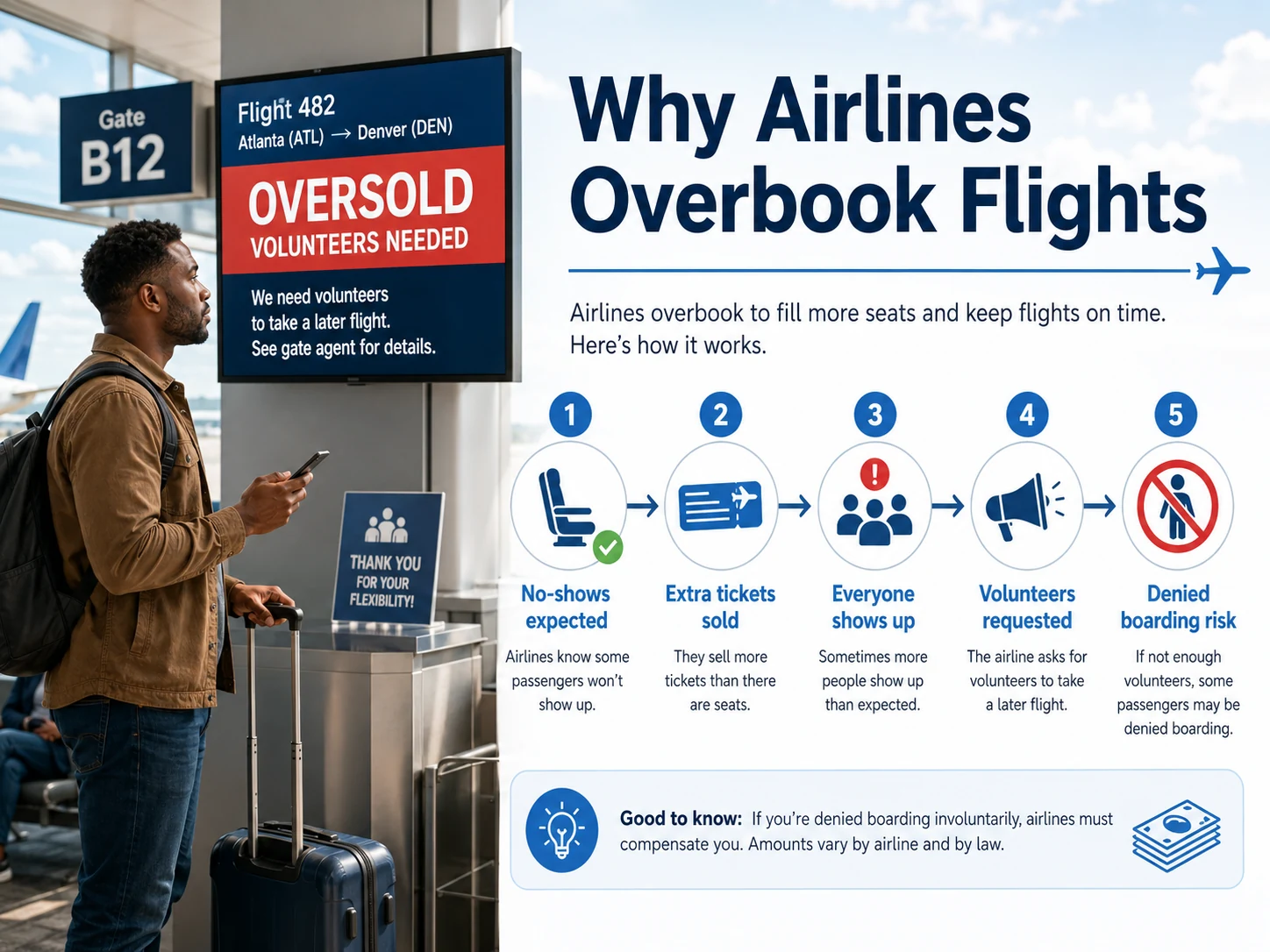
System Insight
Overbooking is based on probability, but travelers feel the impact when the prediction is wrong.
- The no-show estimate matters because airlines expect some passengers to cancel, misconnect, miss the flight, or not board.
- The empty-seat risk matters because an unsold or unused seat loses value once the aircraft departs.
- The oversold moment matters because problems usually start when more passengers show up than the airline expected.
- The boarding outcome matters because volunteers, rebooking, compensation, or denied boarding may come into play only when there are not enough seats.
Why Overbooking Does Not Always Create a Problem
Airlines can overbook a flight without anyone noticing.
That happens when enough passengers cancel, miss the flight, misconnect, change plans, or fail to board. In that situation, the flight may have been overbooked in the reservation system, but every passenger who actually shows up can still get a seat.
The problem starts when the airline’s prediction is wrong.
If more passengers arrive ready to fly than there are seats on the aircraft, the flight becomes oversold. That is when the airline may need to ask for volunteers, move passengers to later flights, or deny boarding if there are not enough volunteers.
So the issue is not just that the airline sold extra tickets.
The issue is whether the extra ticket sales create a real seat shortage at boarding.
Overbooked vs Oversold Flights
How It Works
Overbooked vs Oversold Flights
Airlines do not treat every full flight the same way. The important distinction is whether the flight was simply overbooked in the system or actually oversold at the gate.
The airline sold more tickets than seats.
The airline expected some passengers not to show up, so it sold extra tickets to reduce the chance of empty seats.
- Usually based on no-show predictions
- May not affect travelers at all
- Most passengers may still board normally
More passengers showed up than seats available.
This is when the overbooking creates a real boarding problem and the airline has to resolve the seat shortage.
- Volunteers may be requested
- Travelers may be rebooked
- Involuntary denied boarding may happen
Quick rule: overbooking is the airline’s prediction strategy. Oversold is the gate problem travelers actually experience.
Is Airline Overbooking Legal?
Airline overbooking may feel like the airline sold something it did not actually have.
But in the United States, overbooking itself is generally allowed.
The important distinction is what happens when the overbooking creates a real boarding problem. If more passengers show up than there are seats, the airline cannot simply ignore the issue. It has to resolve the oversold flight before departure.
That usually starts with asking for volunteers.
A volunteer is someone willing to give up their seat in exchange for something the airline offers, such as a later flight, a travel voucher, cash, miles, meal support, hotel assistance, or another incentive.
If not enough passengers volunteer, the airline may deny boarding to some travelers involuntarily.
That is when passenger protection rules may apply.
The key point is this:
Overbooking may be allowed, but involuntary denied boarding is not supposed to be handled casually.
If you are bumped against your will, ask the airline whether the flight was oversold, whether you were denied boarding involuntarily, what compensation applies, and whether you can receive the explanation in writing.
Travel Fine Print Takeaway
Overbooking being allowed does not mean travelers have no rights. The real issue is what happens when the flight becomes oversold and the airline does not have enough seats for everyone who showed up.
What Happens If Everyone Shows Up?
Most of the time, overbooking works quietly in the background.
The airline sold extra tickets, but enough passengers canceled, missed the flight, misconnected, or changed plans before departure. Everyone who arrives ready to board still gets a seat.
But sometimes the prediction is wrong.
If everyone shows up — or more passengers show up than expected — the airline has to solve the seat shortage before the flight leaves.
That process usually follows this pattern:
- The airline identifies that the flight is oversold.
- Gate agents ask for volunteers willing to take a later flight.
- The airline may increase the offer if not enough people volunteer.
- Volunteers may receive compensation, rebooking, vouchers, miles, meals, hotel support, or other incentives depending on the situation.
- If not enough people volunteer, the airline may deny boarding involuntarily to some passengers.
This is the moment travelers usually describe as being “bumped.”
But not every passenger moved from an oversold flight is treated the same way.
There is a major difference between volunteering to give up your seat and being denied boarding against your will. Voluntary offers are negotiated with the airline. Involuntary denied boarding may trigger specific passenger rights and compensation rules.
Boarding Outcome
Volunteering vs Being Denied Boarding
When a flight is oversold, the outcome can depend on whether you choose to give up your seat or the airline denies boarding against your will.
You agree to take a later flight.
You choose to give up your seat in exchange for whatever offer you accept from the airline.
- Offer may include vouchers, cash, miles, meals, or hotel support
- Terms can vary by airline and situation
- You should understand restrictions before accepting
The airline denies boarding.
You did not agree to give up your seat, but the airline does not allow you to board because there are not enough seats.
- Passenger rights rules may apply
- Compensation may be owed depending on the situation
- Ask for the airline’s written explanation of your rights
Quick rule: accepting an offer voluntarily is different from being bumped against your will. Know which one is happening before you agree to anything.
Who Gets Bumped on an Overbooked Flight?
Airlines do not usually choose passengers at random when an oversold flight still does not have enough seats.
Each airline has its own boarding priority rules for deciding who may be denied boarding if there are not enough volunteers.
Those rules can consider factors such as:
- check-in time
- whether you have a seat assignment
- fare type
- frequent flyer status
- boarding group
- whether you are traveling alone or in a group
- special assistance needs
- operational or safety requirements
This is why travelers sometimes hear advice to check in early or choose a seat in advance. Those steps do not guarantee you will avoid being bumped, but they may reduce risk on a full or oversold flight.
A seat assignment may help, but it is not a guarantee if the flight is oversold and the airline applies its denied boarding priority rules.
The safest assumption is this:
If the flight is oversold, the airline’s boarding priority rules matter more than how unfair the situation feels.
Ask the airline what rule was used, whether you were denied boarding involuntarily, and whether you are entitled to written information about your rights.
Traveler Risk
Assuming a confirmed ticket guarantees boarding can leave you unprepared.
The risky assumption is thinking a confirmed ticket means overbooking cannot affect you.
In reality, a confirmed reservation does not always mean there will be enough seats if the flight becomes oversold and more passengers show up than the airline expected.
If the airline starts asking for volunteers, slow down before accepting an offer. Confirm the replacement flight, compensation form, voucher restrictions, meal or hotel support, baggage handling, and whether you are volunteering or being denied boarding involuntarily.
Check the Fine Print
Not sure what an overbooked flight means for your seat?
Use the Travel Fine Print Risk Checker to narrow whether your issue is an overbooked flight, oversold flight, voluntary bumping offer, denied boarding, compensation question, rebooking problem, or checked bag concern.
If the gate agent starts asking for volunteers, slow down before accepting the first offer. Ask what replacement flight you would receive, whether the offer is cash, credit, voucher, or miles, and what happens if the new flight is much later or overnight.
Action Step
Confirm the Full Offer Before Giving Up Your Seat
If the airline asks for volunteers, do not focus only on the dollar amount. Make sure you understand the replacement flight, compensation form, restrictions, and what happens if the delay becomes longer than expected.
Quick win: Before accepting, ask, “Can you confirm the exact flight I’ll be moved to and whether this offer is cash, credit, voucher, or miles?”
Before You Accept an Offer
Save the Details Before Giving Up Your Seat
An overbooking offer is easier to evaluate when you can compare the replacement flight, compensation type, restrictions, hotel or meal support, checked bag handling, and written airline terms. Use the Travel Documents Checklist to keep screenshots, boarding passes, offers, rebooking details, and receipts organized before the situation becomes harder to prove.
This article explains why airlines overbook flights. If the airline actually denies boarding or asks you to give up your seat, the next question is what the airline may owe you. That is where the bumped-flight compensation guide is more useful because voluntary offers and involuntary denied boarding are handled differently.
Travel Fine Print Takeaway
Airline overbooking is usually invisible until the flight becomes oversold. The traveler problem starts when more passengers show up than there are seats. That is when volunteers, rebooking, vouchers, denied boarding, and compensation questions can become part of the trip.
❓Frequently Asked Questions
These questions can help you understand why airlines overbook flights, what happens when a flight becomes oversold, and how volunteering differs from being denied boarding involuntarily.
Why do airlines overbook flights?
Airlines overbook flights because they expect some passengers not to show up. By selling more tickets than available seats, airlines try to keep planes full and avoid losing revenue from empty seats at departure.
Most of the time, enough travelers cancel, miss the flight, misconnect, or change plans, so the flight boards normally. The problem starts when more passengers show up than the airline expected.
Is it legal for airlines to overbook flights?
In many places, including the United States, airline overbooking is generally allowed. The key issue is what happens if the flight becomes oversold and there are not enough seats for everyone who shows up.
If travelers are denied boarding involuntarily because of an oversold flight, passenger protection rules may apply depending on the route, timing, airline, and replacement flight offered.
What happens if nobody volunteers on an overbooked flight?
If not enough passengers volunteer, the airline may deny boarding to some travelers involuntarily. That means the airline does not allow certain passengers to board because there are not enough seats.
If this happens, ask whether you are being denied boarding because the flight is oversold, what replacement flight is being offered, and what written rights or compensation information applies.
Does a seat assignment stop you from being bumped?
A seat assignment may reduce risk, but it does not fully guarantee boarding. If a flight is oversold, the airline may still apply its denied boarding priority rules.
Those rules can consider check-in time, fare type, loyalty status, operational needs, whether you have a seat assignment, and other factors. Choosing a seat is helpful, but it is not the same as a boarding guarantee.
Who gets bumped when a flight is oversold?
Airlines usually follow their own denied boarding priority rules. These may consider factors such as check-in time, seat assignment, fare type, frequent flyer status, boarding group, special assistance needs, and operational requirements.
This is why checking in early, choosing a seat, and arriving at the gate on time can matter, even though none of those steps fully eliminates overbooking risk.
Do you get compensated if a flight is overbooked?
Compensation depends on what actually happens. If you volunteer to give up your seat, the compensation is based on the offer you accept from the airline.
If you are denied boarding involuntarily because the flight is oversold, passenger protection rules may apply depending on the route, timing, airline, and replacement flight offered.
Bottom Line
Airlines overbook flights because they expect some passengers not to show up.
Most of the time, that prediction works quietly in the background. Enough travelers cancel, miss the flight, misconnect, or change plans, and everyone who arrives ready to board gets a seat.
The traveler problem starts when the prediction is wrong and the flight becomes oversold.
That is when the airline may ask for volunteers, increase the offer, move passengers to later flights, or deny boarding involuntarily if there are not enough seats.
The key is to separate the situation clearly:
- Overbooked means the airline sold extra tickets.
- Oversold means there are not enough seats for everyone who showed up.
- Volunteering means you accepted the airline’s offer.
- Involuntary denied boarding means the airline did not let you board even though you did not agree to give up your seat.
Before accepting an offer or walking away from the gate, confirm what is happening, what replacement flight you are getting, what compensation form is being offered, and whether you are volunteering or being denied boarding involuntarily.
Related Guides
Overbooking can lead to denied boarding, rebooking, vouchers, missed flights, or refund questions. These guides help travelers understand what to check next without repeating the same issue from different angles.
Denied Boarding and Overbooking Outcomes
- Bumped From a Flight? When Airlines Owe You Compensation — Use this if an overbooked or oversold flight leads to a voluntary bumping offer or involuntary denied boarding.
Missed Flights and Rebooking Risk
- What Happens If You Miss Your Flight? — Explains no-show rules, ticket value, and how missing one flight can affect the rest of an itinerary.
Refunds, Credits, and Ticket Value
- Airline Refund vs Travel Credit: What’s the Difference? — Helps travelers understand why cash refunds, travel credits, vouchers, and rebooking offers are not the same thing.
Documentation and Claims
- Travel Insurance Claim Proof: What Documents You May Need — Useful if an overbooking disruption leads to out-of-pocket costs, missed plans, or a later reimbursement claim.