
Travel Fine Print Tool
Travel Fine Print Risk Checker™: Find the Booking Rule That Could Cost You Money
A travel booking can look straightforward while an important fee, deadline, restriction, responsibility, or proof requirement remains difficult to connect to the trip in front of you.
Answer a few questions to identify which part of the booking deserves the closest review before you pay, cancel, change, file a claim, or travel. The checker helps narrow the issue without labeling the entire trip good or bad.
How to Use the Checker
Turn a broad concern into a specific review
- Use the exact booking. Answer based on the price, rate, fare, policy, provider, and documents connected to your trip.
- Do not guess through uncertainty. Treat a rule hidden behind a link or missing from the confirmation as unclear.
- Follow the result area. Review the price, refund, hotel, flight, document, booking-channel, insurance, or proof issue identified.
- Verify and preserve the rule. Save the applicable terms, confirmations, screenshots, receipts, and provider messages.
The result identifies where to investigate first. It is not a final price calculation, coverage decision, legal conclusion, or guarantee that the booking is safe.
About this guidance: Travel Fine Print’s Risk Checker draws on experience with airline and hotel reservations, third-party booking channels, fare and rate rules, mandatory fees, deposits and card holds, cancellation terms, refunds and credits, travel disruptions, document checks, and insurance claim procedures. Results are educational screening guidance, and the rules that control an outcome can vary by supplier, destination, contract, fare, rate plan, policy, booking channel, jurisdiction, and individual circumstances. Verify the exact checkout terms, confirmation, applicable provider rules, current government requirements, insurance policy, receipts, screenshots, and written communications connected to your trip.
Travel Fine Print Tool
Travel Fine Print Risk Checker™
Answer a few questions to see whether your biggest risk is the final price, refund rule, hotel charge, airline disruption, document issue, booking channel, insurance claim, or proof gap.
This tool is for general travel education only. It does not decide whether a booking is good or bad, and it does not replace reviewing the exact terms shown by the airline, hotel, cruise line, booking site, insurance company, or travel provider.
What the Tool Looks For
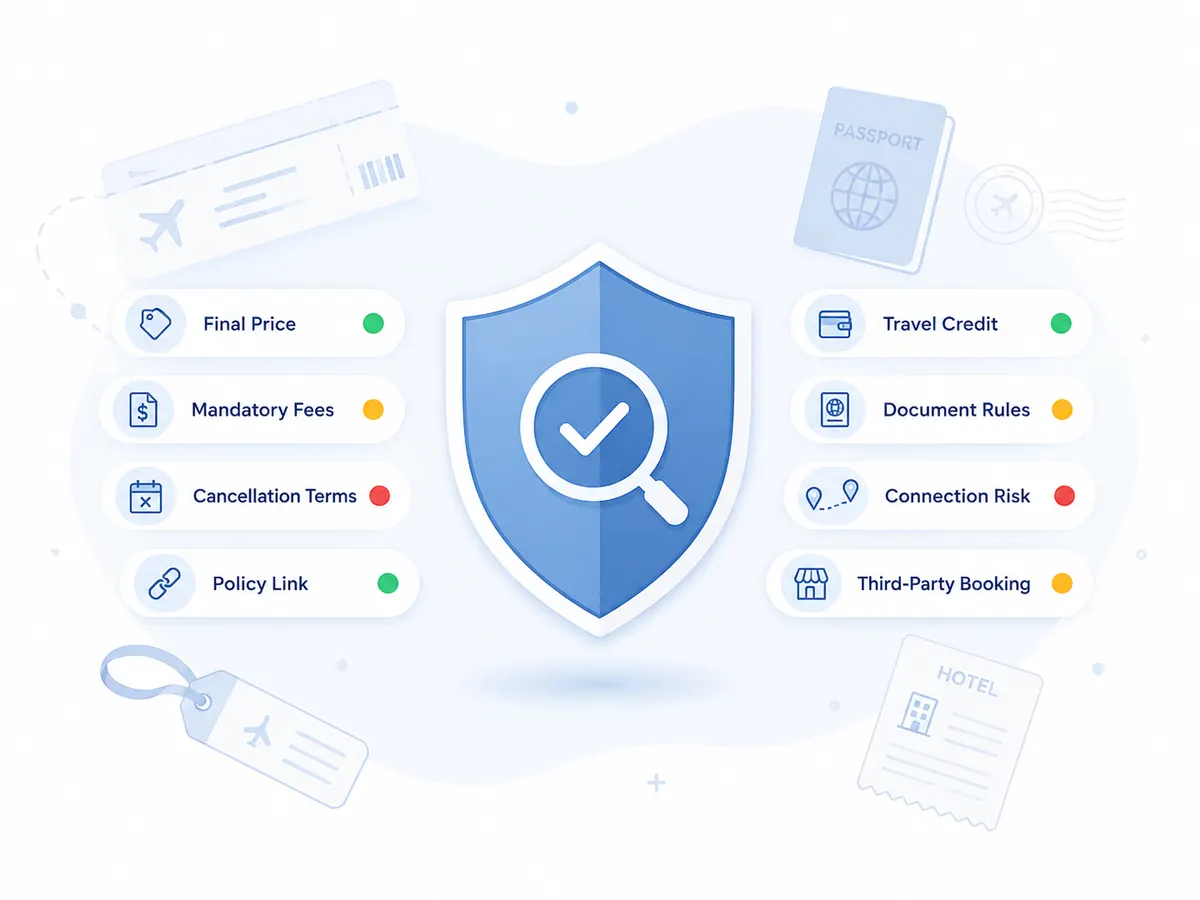
The Risk Checker sorts travel fine print into practical risk areas.
Travel problems usually do not come from one single rule. They often come from the way a price, policy, document, provider responsibility, or proof requirement is applied later. The checker helps you identify which area deserves the closest review before you pay, cancel, change, or travel.
Price & Fee Risk
The advertised price, checkout total, and final travel cost may not match once taxes, resort fees, baggage, seats, deposits, pay-later charges, or local fees are included.
Refund & Credit Risk
Cancellation penalties, non-refundable rates, travel credits, partial refunds, vouchers, expiration dates, and rebooking limits can reduce how much value comes back.
Hotel Charge Risk
Hotel deposits, incidental holds, resort fees, destination fees, payment-card rules, local taxes, late-arrival terms, and post-checkout charges can create surprise costs.
Flight Disruption Risk
Delays, missed connections, separate tickets, baggage delays, weather disruptions, basic economy rules, standby limits, and rebooking restrictions may affect your options.
Document & Proof Risk
Passport validity, visas, transit rules, name mismatches, medication paperwork, minor-travel consent, screenshots, receipts, and claim proof can matter later.
Booking Channel Risk
Third-party bookings, general terms pages, unclear provider responsibility, vague policy links, and platform-specific refund rules can make problems harder to resolve.
Why the Result Matters
The Risk Checker is not meant to scare you away from travel.
It is meant to tell you where to slow down.
If your result points to price risk, review the full cost before comparing options.
If it points to refund risk, check what happens if plans change.
If it points to hotel charge risk, save the booking proof and fee disclosures.
If it points to flight disruption risk, check rebooking, baggage, and connection rules.
If it points to document or proof risk, verify the rule and save screenshots.
If it points to booking channel risk, confirm who controls changes, refunds, and support.
The goal is not to review every travel rule in the world.
The goal is to know which rule could matter most for the trip in front of you.
Why “Disclosed” Does Not Always Mean Clear
Many travel companies technically disclose important rules.
But that does not always mean the rule is easy to understand, easy to find, or clearly connected to the booking in front of you.
A traveler may see a short checkout summary that says “free cancellation,” “deposit required,” “terms apply,” “taxes and fees may apply,” “basic fare,” “resort fee,” “travel credit,” or “special offer.”
The problem is that the actual rule may sit behind a link, inside a long policy page, in a hotel-specific disclosure, in a fare rule, in a cruise contract, in a travel insurance policy, or in a third-party booking site’s terms.
That is where fine print risk increases.
The issue is not always that the rule is missing.
The issue is that the traveler has to assemble the answer from several pieces.
That can happen when:
- the checkout page gives only a short policy summary
- the fee is disclosed separately from the main price
- the refund rule is hidden behind a link
- the cancellation deadline does not show the time zone
- the policy is general instead of booking-specific
- a promotion has rules separate from the standard terms
- a third-party booking site and travel provider both have policies
- a credit or voucher has restrictions that are not obvious upfront
- the confirmation email does not repeat the rule clearly
- the provider can point to a disclosure, but the traveler could reasonably miss how it applied
The clearest bookings do not just give you access to the terms.
They show which terms apply to the booking in front of you.
Important Distinction
Disclosed Is Not Always the Same as Clear
A travel rule may exist somewhere in the booking path, but that does not always mean the traveler can easily tell how it applies to the exact trip, fare, hotel, room type, credit, policy, or provider they are using.
The real risk increases when the traveler has to piece together the answer from a checkout note, linked policy, general terms page, confirmation email, third-party booking rule, and provider-specific condition before knowing what will actually happen.
What To Check When a Travel Rule Is Unclear
When a travel term is unclear, do not stop at the headline.
Look for the exact rule that answers the situation you care about.
For example:
- If the page says free cancellation, check the deadline, penalty, time zone, and refund method.
- If the page says deposit required, check whether the deposit is refundable, transferable, or kept as future credit.
- If the page says taxes and fees may apply, check which charges are mandatory and when they are collected.
- If the page says travel credit, check expiration dates, traveler restrictions, rebooking rules, and whether cash refund rights are affected.
- If the page says terms apply, open the terms before you pay.
- If the page says pay at property, check what is due now versus what the hotel may collect later.
- If the booking is through a third party, check both the platform’s rules and the travel provider’s rules.
- If insurance is involved, check covered reasons, exclusions, claim deadlines, and proof requirements.
The goal is not to read every legal sentence.
The goal is to find the rule that answers:
“What happens if this specific trip changes, costs more, gets disrupted, or needs to be proven later?”
Action Step
Find the Exact Rule That Applies to Your Booking
Before relying on a travel offer, look for the rule that answers your specific situation. A general policy is useful, but the booking-specific rule is what usually matters if something changes later.
Quick win: before you pay, ask yourself: “Could I prove the exact price, policy, deadline, fee, or promise if this becomes a dispute later?”
❓Frequently Asked Questions
These questions explain what the Travel Fine Print Risk Checker™ can and cannot tell you before you rely on a booking, cancellation policy, travel credit, fee disclosure, or travel document requirement.
Is the Travel Fine Print Risk Checker™ a travel fee calculator?
No. The Travel Fine Print Risk Checker™ does not calculate the exact final cost of a trip. It helps identify where hidden fees, unclear policies, weak disclosures, or booking restrictions may be most likely to appear.
The result is a screening tool, not a final price estimate.
Does a low-risk result mean my booking is safe?
Not necessarily. A low-risk result means fewer warning signs were selected, but you should still review the final checkout total, cancellation terms, deposit rules, linked policies, and confirmation email before relying on the booking.
A booking can look low-risk and still contain an important deadline, fee, document rule, or condition.
Why does the tool ask whether the terms are specific to my booking?
Because fine print is often technically disclosed but difficult to apply. A general terms page may not clearly explain what applies to your exact hotel, fare, room type, package, promotion, travel credit, or booking channel.
The risk increases when you have to figure out which rule applies instead of seeing it clearly before payment.
What should I do if the travel terms are unclear?
Do not rely only on the headline claim. Look for the exact rule that answers your situation, save screenshots of the checkout terms, and contact the provider before booking if the policy still is not clear.
Focus on the practical question: what happens if you cancel, change, arrive late, miss a connection, need to use a credit, or need to prove what was promised?
Is booking direct always safer than using a third-party site?
Not always, but direct bookings can be easier to manage because the provider usually controls the reservation. With third-party bookings, refunds, changes, credits, and customer service may depend on both the provider’s rules and the booking site’s terms.
That can make it harder to know who has authority to fix a problem.
Should I still read the terms if I use this tool?
Yes. The tool helps you identify which part of the fine print deserves the closest attention. It does not replace the actual booking terms.
Before paying, changing, canceling, or traveling, review the policy shown at checkout and save a copy of the final terms whenever possible.
Bottom Line
Travel fine print is not always hidden in the sense that it is missing. Often, the rule exists somewhere — inside a linked policy, a checkout note, a general terms page, or a confirmation email — but it is not clearly connected to the booking in front of you.
That is where travelers get caught.
The Travel Fine Print Risk Checker™ is designed to help you spot the part of the booking that deserves the closest review before you pay, cancel, change, or travel.
Before relying on any travel offer, look for three things:
- the real final price,
- the exact rule that applies to your booking,
- what happens if your plans change.
The safest booking is not always the cheapest or the most flexible-sounding. It is the one where the price, policy, and terms are clear before you commit.
❓Frequently Asked Questions
These questions explain what the Travel Fine Print Risk Checker can and cannot tell you before you rely on a booking, cancellation policy, travel credit, hotel fee, airline rule, insurance policy, or document requirement.
What does the Travel Fine Print Risk Checker do?
The Travel Fine Print Risk Checker helps you identify which part of a booking may deserve closer review before it costs you money. It screens for warning signs around price and fees, refunds and credits, hotel charges, flight disruptions, documents, booking channels, insurance, and proof gaps.
It does not decide whether a booking is good or bad. It points you toward the rule, charge, policy, or proof issue you should review more carefully.
Is the Risk Checker a travel fee calculator?
No. The Risk Checker does not calculate the exact final cost of a trip or tell you the exact amount you may owe later.
Instead, it helps you spot where extra costs may appear, such as resort fees, destination fees, baggage fees, seat fees, deposits, local taxes, pay-later charges, hotel holds, or post-stay adjustments.
Does a low-risk result mean my booking is safe?
Not necessarily. A lower-risk result means fewer warning signs were selected, but you should still review the final price, cancellation terms, refund rules, deposit policy, document requirements, provider responsibility, and confirmation email before relying on the booking.
A booking can look low-risk and still contain an important deadline, fee, restriction, name mismatch, document rule, or insurance exclusion.
Why does the tool ask whether the terms are specific to my booking?
Because travel fine print is often disclosed in a way that is technically available but not clearly connected to the booking in front of you.
A general terms page may not clearly explain what applies to your exact hotel, fare, room type, cruise, package, promotion, travel credit, insurance policy, or booking channel. The risk increases when you have to assemble the answer from several different links or documents.
What should I do if my result shows price or fee risk?
Compare the search price, checkout total, and full trip cost before booking. Look for anything marked due at property, paid locally, collected later, optional, estimated, excluded, or not included in the main total.
Save screenshots of the full price breakdown, fee disclosures, confirmation email, receipts, and any language explaining taxes, deposits, resort fees, destination fees, baggage fees, seat fees, or pay-later charges.
What should I do if my result shows refund or credit risk?
Find the exact cancellation deadline, penalty, refund method, and time zone before you cancel, change, or accept a travel credit.
Check whether money comes back as cash, credit, voucher value, or future-use balance. Also review expiration dates, traveler restrictions, rebooking limits, fare or rate differences, and whether accepting a credit affects any cash refund option.
What proof should I save after using the Risk Checker?
Save screenshots of the specific rule, price, policy, fee, deadline, credit term, document requirement, or provider message that applies to your booking.
It also helps to keep confirmations, receipts, hotel folios, baggage reports, delay notices, insurance policy documents, cancellation notices, refund calculations, claim numbers, and emails from the airline, hotel, booking site, insurer, cruise line, or travel provider.
Should I still read the travel terms after using the tool?
Yes. The Risk Checker helps you identify which part of the fine print deserves the closest attention, but it does not replace the actual terms shown by the airline, hotel, cruise line, booking site, insurance company, or travel provider.
Before paying, canceling, changing, filing a claim, or traveling, review the exact terms and save a copy whenever possible.
Bottom Line
Travel fine print is not always hidden because it is missing.
Often, the rule exists somewhere — inside a checkout note, linked policy, general terms page, hotel disclosure, fare rule, travel credit condition, insurance policy, or confirmation email — but it is not clearly connected to the booking in front of you.
That is where travelers get caught.
The Travel Fine Print Risk Checker is designed to help you slow down and identify which part of the booking deserves the closest review before you pay, cancel, change, file a claim, or travel.
Before relying on any travel offer, look for three things:
- the real final price
- the exact rule that applies to your booking
- the proof you may need if that rule is questioned later
The safest booking is not always the cheapest or the most flexible-sounding.
It is the one where the price, policy, responsibility, and proof requirements are clear before you commit.
Related Guides
Use these guides to review the specific fine-print issue your Risk Checker result pointed to.
Price, Fees, and Checkout Totals
- Why the Checkout Price Isn’t Always the Final Travel Cost — Helps travelers understand why the price shown before payment may not include every required fee, tax, deposit, or pay-later charge.
- Hidden Travel Fees Explained — A broader guide to the extra costs that can make a trip more expensive than expected.
Refunds, Credits, and Cancellation Rules
- Airline Refund vs Travel Credit: What’s the Difference? — Helps travelers understand whether value may come back as cash, credit, voucher value, or future-use balance.
- Can You Get Money Back From a Non-Refundable Flight? — Useful when the issue is a restrictive fare, cancellation penalty, or non-refundable airline booking.
- Why Did I Only Get a Partial Travel Refund? — Helps travelers understand deductions, retained fees, travel credits, taxes, add-ons, and refund breakdowns.
Hotels, Deposits, and Post-Stay Charges
- Do You Get Hotel Deposits Back? What Travelers Should Know Before Booking — Helps travelers check deposit rules, incidental holds, refund terms, and hotel payment proof.
- Can Hotels Charge You After Checkout? — Useful when a hotel folio, post-stay adjustment, damage claim, or unexpected charge needs to be reviewed.
- Hotel Resort Fees Explained: What They Are and When You Have to Pay — Helps travelers understand required property fees that may be separated from the room rate.
Flights, Connections, and Disruptions
- What Happens If You Miss a Connecting Flight? — Helps travelers understand rebooking, same-ticket protection, separate-ticket risk, and baggage routing after a missed connection.
- Separate Ticket Connections: The Hidden Risk Most Travelers Miss — Useful when the issue is connection responsibility, baggage recheck, or self-transfer risk.
- Do Airlines Compensate You for Delayed Flights? — Helps travelers understand when airline delay support, reimbursement, or documentation may matter.
Documents, Insurance, and Proof
- Travel Documents Checklist: What to Save, Verify, and Screenshot Before You Travel — The main checklist for documents, confirmations, receipts, screenshots, policies, and proof.
- Travel Insurance Claim Proof: What Documents You May Need — Helps travelers understand what receipts, reports, confirmations, and provider records may support a claim.
- Name Mismatch on a Boarding Pass or Passport: What Travelers Should Know — Useful when traveler names, IDs, passports, visas, tickets, or booking records may not match cleanly.