
Flights & Connection Protection
Self-Transfer Flights: Are Separate Tickets Worth the Risk?
When a flight listing says “self-transfer,” you’re buying an itinerary where you’re responsible for making the connection yourself. The cheaper fare can make sense, but first check what you’ll spend getting between flights and what happens if you miss the second one.
The decision: Compare the total cost of an itinerary with a self-transfer against a protected connection. If the savings are small or the onward flight would be hard to replace, favor the itinerary with confirmed connection protection.
About This Guidance
Part of our Flights & Airlines guidance. This guide compares ticket structure, total cost and missed-connection protection. Confirm the terms of your specific itinerary with the airline or seller.
Quick Answer
What does self-transfer mean on a flight booking?
A self-transfer is a connection you manage yourself, usually between flights issued on separate tickets. For example, you might buy Miami to London and London to Rome as separate tickets, even if a travel site shows both flights together. In London, you may need to collect your bag, check in again or change terminals.
If the first flight is late and you miss the second, you may have to arrange and pay for a replacement unless a guarantee or policy covers that disruption. Already booked and running late?
The Decision in 30 Seconds
Which flight should you book?
| What you find | How to decide |
|---|---|
| Same airport, a generous buffer and several onward flights | Consider the cheaper itinerary if the savings are meaningful and a backup flight would be affordable. |
| A terminal or airport change, new check-in or border clearance | Price the extra steps and work backward from the onward cutoff. If you cannot verify a workable transfer, choose another itinerary. |
| The onward flight is the last of the day or hard to replace | Favor a confirmed protected connection or consider an overnight buffer if your arrival plans allow one. |
| The fare difference is small after extras | If the schedules work, favor the itinerary with confirmed connection protection. |
Ticket Structure
Who protects the connection if the first flight runs late?
Airline-protected connection
The airline or seller confirms the flights are sold together as a protected itinerary. Ask who arranges rebooking after a covered disruption. Check meals, lodging or compensation separately because each has its own eligibility rules.
Separate tickets you buy yourself
Each flight has its own terms. Even if the same airline operates both, ask what help is available if you miss the onward flight. For example, British Airways’ flight connection guidance explains that a traveler on separate tickets may need to buy another ticket.
Self-transfer with a seller guarantee
The seller may offer help under its own terms. For example, Trip.com’s self-transfer package terms describe separately issued tickets and assistance for certain disruptions. Verify that your offer includes the guarantee and check what you must do before booking anything yourself.
Ask this before paying
“If my first flight is delayed and I miss the onward flight, who will rebook me, and what would I have to pay?” Save the answer and any written terms with your confirmation.
The Real Price
How do you compare the two fares fairly?
Add the costs you expect to pay on each itinerary. Include baggage fees across the whole trip, rides between airports and any hotel you need to make the schedule work. Price a backup flight separately so you know what a missed connection could cost.
Example: A $90 fare gap becomes $10
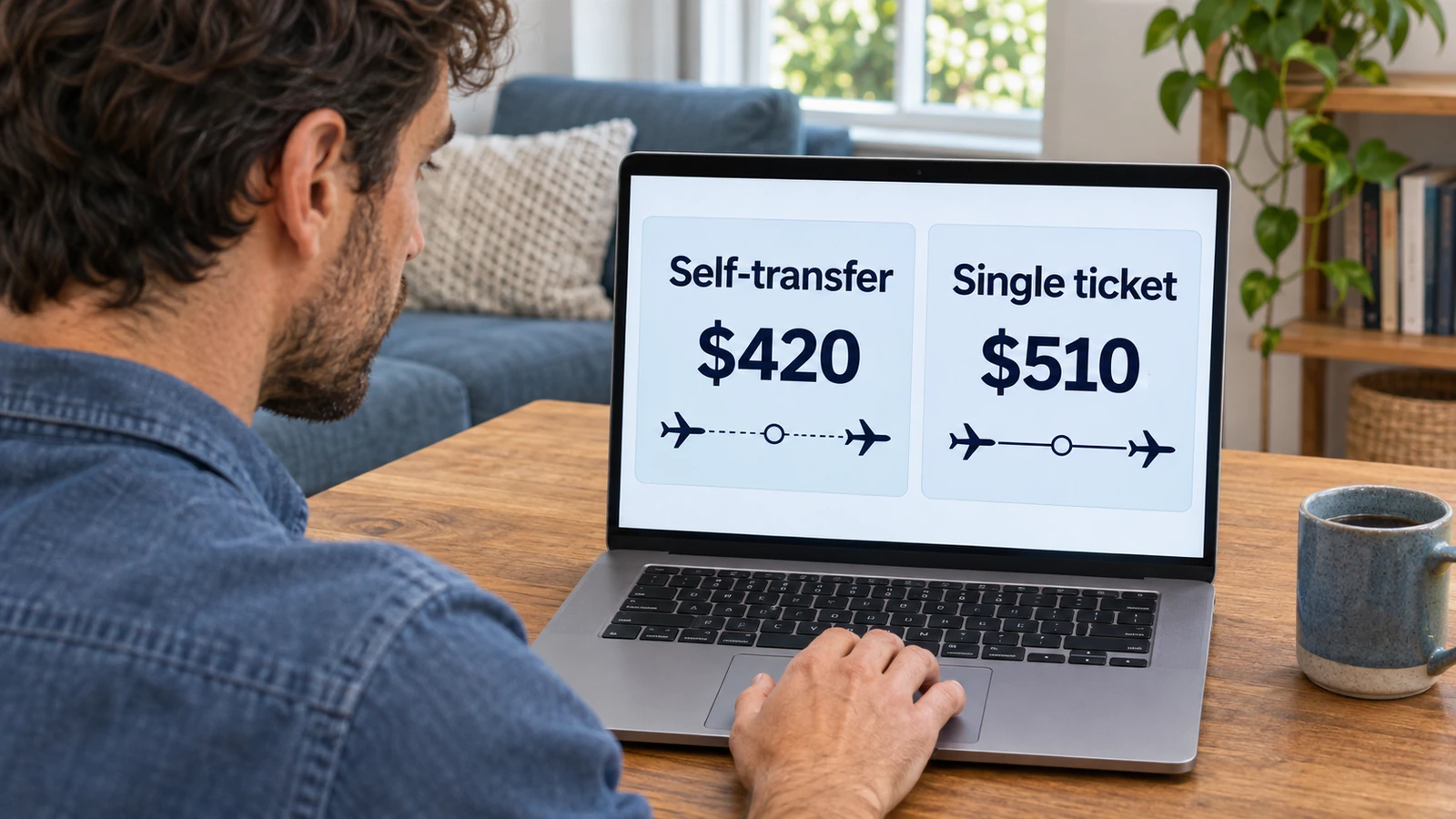
A self-transfer fare is $420. A confirmed protected itinerary for the same route is $510. If the self-transfer requires $45 in additional bag fees and a $35 airport transfer, it costs $500 before any disruption. The remaining savings are $10.
If missing the onward flight could leave you buying a new ticket, decide whether that $10 is enough to take on the risk. These prices are illustrative.
If the itinerary only works with an overnight stop, price a hotel near the departure airport and add the ride to the total. Check when the hotel shuttle starts if you have an early departure.

Before You Commit
Can you complete the self-transfer before the next cutoff?
Check airport codes and terminals
Confirm where the first flight arrives and the next one departs. For an airport change, price transport between airports and allow for waiting, traffic and reaching the onward check-in area.
Work backward from the earliest deadline
Use the relevant check-in, bag-drop and boarding cutoffs. Include deplaning, any required screening and enough margin for a late arrival. Use the short layover guide to assess the timing for your route.
Confirm baggage and entry requirements
If you have to reclaim a bag or travel between airports, you may need to enter the country. Verify entry or transit requirements with the relevant government authority for your passport and route. For baggage handling, see when you need to collect and recheck bags.
Identify a backup you can actually use
Find the next suitable flight and check whether it would get you there in time. If you compare trip insurance policies, check whether a missed connection on separately booked flights qualifies, and read the covered causes, delay requirements and exclusions.

Already Booked?
What should you do if your self-transfer is at risk?
Contact the onward airline or ticket seller before the applicable cutoff. Ask whether you can move the second flight and whether missing it would affect any later flights on that ticket. If your booking includes a seller guarantee, follow its contact and approval instructions before paying for a replacement.
Once you know what help is available, check replacement flights. If you need to wait overnight and no room is being arranged for you, check rooms available tonight near the correct airport. Save delay notices, messages and itemized receipts, and use the missed connecting flight guide for the next steps.
The Fine Print That Matters
Check what the booking actually promises.
One checkout can issue separate tickets
Look for self-transfer or separate-ticket wording in the offer. If the ticket structure is unclear, ask the seller how the connection is protected before paying.
Check both directions
The outbound and return journeys can have different ticket arrangements. Review each connection you’re relying on, including flights added separately with points.
Seller guarantees have procedures
Save the support channel, reporting deadline and reimbursement limits. Keep the guarantee terms with your booking confirmations.
Compare the fare rules on each ticket
Check whether you could move the onward flight if your plans change. Look at the change fee, any fare difference and the deadline to make the change.
My Take
I’d look at what I could miss at the destination.
A missed onward flight is easier to absorb when my first evening is open and there’s another flight later that day. If I’m catching a cruise, I’d also price arriving a day earlier. Even a protected connection may get me there later than I need.
TFP Recommendation
Choose the fare that fits the risk you can take.
The Recommendation
Choose an itinerary with a self-transfer when the savings justify the extra work and you have an affordable backup. For a tight schedule or an onward flight with few alternatives, choose a confirmed protected connection.
Your Next Step
Smarter travel, straight to your inbox
Booking choices, hidden costs, travel rules and useful fine print — explained clearly.
Before You Go
Keep both bookings and your backup plan handy.
Save the confirmations, onward cutoff, transfer instructions and support contacts offline. Keep any written guarantee with those details so you know who to call if plans change.

Rechecking Bags on a Connection
Check where your bags are tagged and when you have to collect them.
Check your baggage plan →Short Layover Risks
Work through the terminal changes, queues and deadlines that can shorten a connection.
Review the timing →Missed Connecting Flight
See what to do when the gate closes or your next flight is already gone.
Review recovery options →Travel Insurance Claim Proof
Know which receipts, delay records and written responses may be useful for a claim.
Save the right records →FAQ
Self-transfer flights and separate tickets
How do I spot a self-transfer before booking?
Open the itinerary details and look for “self-transfer,” “separate tickets” or instructions to check in again. If the listing is unclear, ask the seller how the flights will be ticketed and who will help if you miss the connection.
Is a self-transfer protected if both flights are on the same airline?
Using the same airline doesn’t automatically protect two separately purchased flights. Ask the airline what it will do if a delay on the first ticket causes you to miss the next flight.
Does traveling with only a carry-on make a self-transfer less risky?
It can remove the need to collect and recheck a bag if it stays with you. You still need time for any terminal change, document check, security screening and boarding, and the connection terms still apply.
Free Travel Guide
Avoid the travel mistakes that can cost you money, flexibility, or time.
Get 27 Travel Mistakes That Cost Travelers Thousands — a practical guide to booking mistakes, hidden costs, travel rules and decisions worth understanding before they become a problem.
- Spot booking details that are easy to overlook
- Understand where hidden costs can appear
- Recognize when a cheaper option comes with a tradeoff
- Make travel decisions with fewer surprises
You’ll also receive occasional practical guidance from Travel Fine Print on booking choices, hidden costs, travel rules and the fine print worth understanding. Unsubscribe anytime.