
Checked Bags and Connecting Flights
Do You Have to Recheck Bags on a Connecting Flight?
Your checked bag may transfer automatically to the next flight—or you may need to collect it, recheck it, clear security again, and still reach the next airline before its deadlines.
The answer depends on where the bag is tagged, whether the flights are on one ticket or separate tickets, which airlines are involved, and whether the airport requires you to reclaim the bag during the connection.
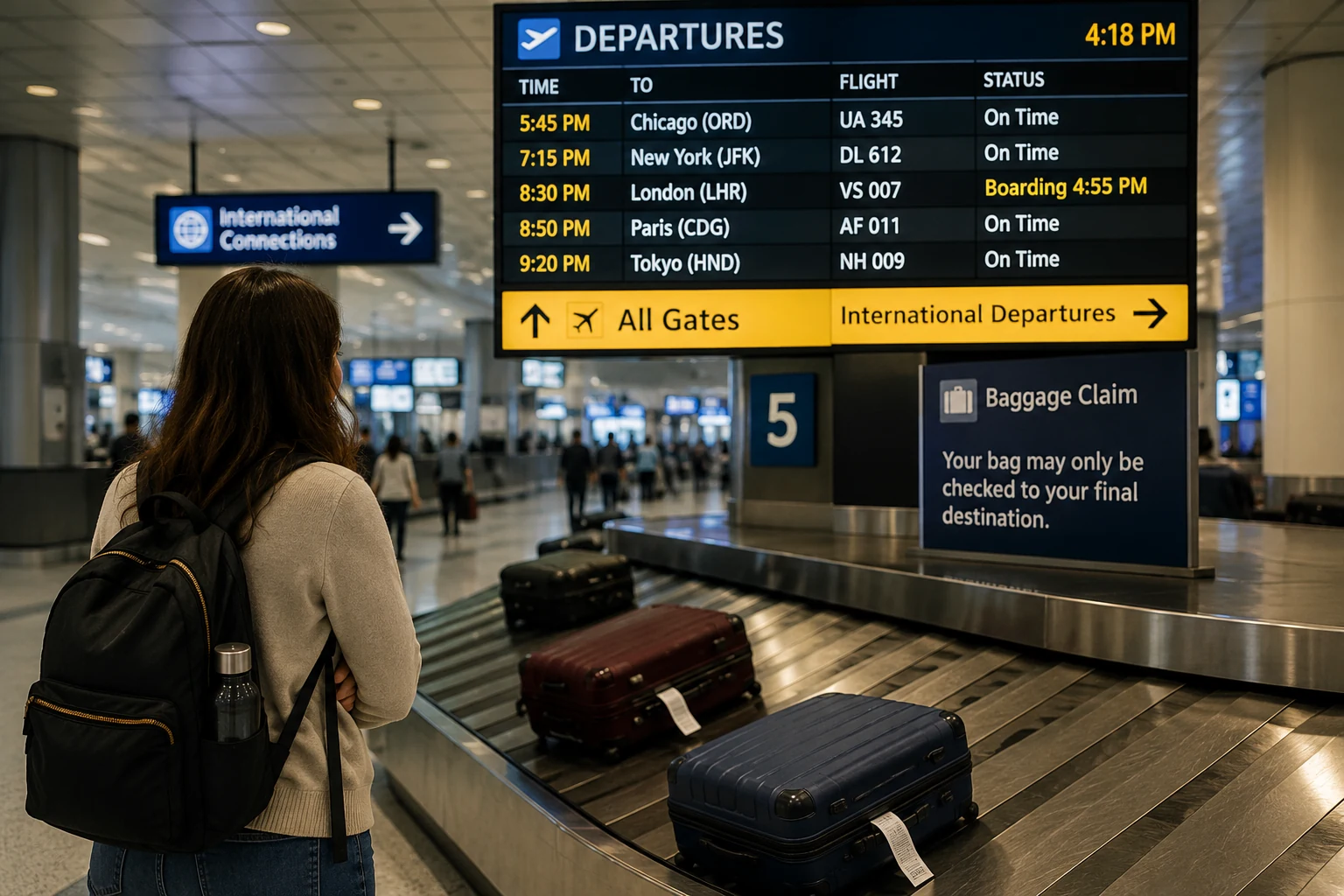
About This Guidance: Travel Fine Print focuses on the operational details that can turn a normal connection into a missed flight: where the bag is tagged, whether the flights are on one ticket or separate tickets, whether the airlines can transfer baggage between each other, and whether you can still meet the next airline’s check-in and bag-drop deadlines if you have to reclaim the bag.
Start Here
Which Separate-Ticket Baggage Problem Are You Facing?
Separate tickets can create different baggage problems depending on whether the airline can through-check your bag, whether you need to recheck it yourself, and whether your connection is domestic-to-international.
Scenario 1
The airline says it can through-check the bag
Your first airline may be able to tag the bag to your final destination, but that does not always protect the connection.
Jump to this situation →
Scenario 2
You may need to recheck the bag yourself
Your bag may only be tagged to the connecting airport, which means baggage claim, recheck, and security all over again.
Jump to this situation →
Scenario 3
Domestic flight before international flight
A domestic-to-international connection can add bag-drop deadlines, terminal changes, document checks, and security lines.
Jump to this situation →
Scenario 4
Your bag is delayed on the first ticket
A slow bag can make you miss the second airline’s check-in, bag-drop, or boarding deadline.
Jump to this situation →
Why Separate Tickets Create More Baggage Risk
Many travelers assume their checked bag will follow the same path they do.
But airlines usually manage baggage based on the ticket and reservation record — not on what looks like one logical trip to the traveler.
That distinction matters.
When flights are booked together on one ticket, the airlines generally treat the trip as one connected itinerary. The baggage system, connection timing, and rebooking responsibility are usually tied together.
Separate tickets can change that relationship.
Instead of one connected itinerary, the airlines may see:
- one completed flight
- one unrelated future flight
- two different reservation records
- two separate baggage responsibilities
That is why checked bags create more risk on separate-ticket trips, especially when the connection is tight, the airlines are different, the next flight is international, or the first flight is delayed.
How It Works
A Baggage Transfer Is Not the Same as a Protected Connection
Your first airline may be able to send the bag to your final destination even when the flights are on separate tickets. That solves the baggage-transfer problem, but it does not necessarily make the two flights one protected itinerary.
Why this matters: Getting the bag transferred is only one part of the connection. You still need to know whether the second flight is protected if the first flight—or the baggage process—does not go as planned.
Baggage Comparison
Same Ticket vs Separate Ticket
The biggest difference is not only whether your bag transfers. It is who becomes responsible when the connection starts breaking down.
One Ticket
Connected itinerary
- Bags are more likely to transfer automatically
- The airlines recognize the connection
- Missed connections may trigger rebooking support
- Minimum connection rules are built into the itinerary
What this means: The airlines are more likely to treat the trip as one continuous journey.
Separate Tickets
Separate baggage responsibility
- You may need to reclaim and recheck bags
- The second airline may not protect the connection
- Bag delays can create missed check-in deadlines
- Responsibility may shift back to the traveler
What this means: Even when the flights appear connected, the airlines may treat them as unrelated trips.
This is why separate-ticket baggage problems usually become much more stressful during international travel or tight airport connections.
What Happens If the Airline Can Through-Check the Bag?
Sometimes the first airline may be able to tag your checked bag all the way to your final destination, even if the flights are on separate tickets.
That can happen when the airlines have an interline baggage agreement, belong to the same alliance, use compatible systems, or allow the check-in agent to add the second reservation manually.
But this is not something to assume.
You should ask at the first check-in counter:
“Can this bag be checked through to my final destination even though these are separate tickets?”
Then look at the bag tag before the luggage goes away.
If your final destination is Miami, the tag should show MIA.
If your international destination is Tokyo, the tag should show HND or NRT, depending on the airport.
The destination code on the tag matters more than what the agent says casually. If the tag only shows the connecting airport, that is where the airline expects the bag journey to end.
Travel Fine Print Takeaway
A through-checked bag does not automatically mean your separate-ticket connection is protected. Always confirm the final destination code printed on the bag tag before leaving the counter.
What Happens If You Need to Recheck the Bag Yourself?
If your bag is only tagged to the connecting airport, the airline is not automatically moving it to your next flight. You may need to leave the normal connection path and handle the transfer yourself.
That usually means waiting at baggage claim, collecting the bag, going to the next airline’s check-in counter, rechecking the bag, clearing security again, and getting to the next gate before boarding closes.
This can take much longer than a normal gate-to-gate connection. A layover that looks safe on the schedule may become risky once baggage claim, check-in lines, bag-drop deadlines, terminal changes, and security are added.
The biggest risk is not just inconvenience. If you do not reach the second airline’s check-in, bag-drop, or boarding cutoff in time, the airline may treat you as late for that separate flight.
Before booking separate tickets with checked bags, ask yourself whether the connection still works if the first flight lands late, the bag takes 30 to 45 minutes to appear, and you have to restart the airport process before the second flight.
Quick check: If the bag tag ends at the connecting airport, plan as if you are starting the next flight from scratch.
Airport Flow
What Rechecking a Bag Can Actually Involve
On separate tickets, rechecking a bag can mean leaving the normal connection path and starting part of the airport process again.
Step 1
Land
Arrive at the connecting airport on the first ticket.
Step 2
Claim Bag
Wait at baggage claim if the bag was only tagged to this airport.
Step 3
Recheck
Go to the next airline’s counter before its bag-drop cutoff.
Step 4
Clear Security
Pass through security again and reach the international gate.
This is why separate-ticket connections need more time than normal connections. You may not be connecting inside the airline system — you may be rebuilding the trip at the airport.
Why Domestic-to-International Connections Are Especially Risky
A domestic-to-international separate-ticket connection can be more stressful than it looks because the baggage issue is only one part of the problem.
You are not just asking whether your bag will move from one plane to another.
You are also dealing with:
- baggage claim wait time
- the second airline’s check-in and bag-drop deadlines
- possible terminal changes
- security lines
- passport/document checks
- international boarding cutoffs
- limited rebooking protection if the first flight is late
This is where travelers get caught. A connection that looks comfortable on a flight search site may not be realistic once you add baggage claim and recheck time.
Important Distinction
The Risk Is Not Just Whether the Bag Transfers
On a domestic-to-international separate-ticket connection, the bigger issue is whether you can complete every airport step before the second airline stops accepting bags or closes boarding. Even if your first flight lands “on time,” baggage claim, terminal changes, document checks, and security can shrink the connection fast.
What Happens If Your Bag Is Delayed on the First Ticket?
This is the scenario travelers worry about most — and for good reason.
If your checked bag does not arrive quickly after the domestic flight, the second airline may not wait for you. It may not matter that your first flight was late, that the baggage carousel was delayed, or that you were trying to make an international connection.
On separate tickets, the second airline may see only one thing:
You did not check in, drop your bag, or reach the gate on time for that airline’s flight.
That can create several problems at once:
- your checked bag may still be with the first airline
- the second airline may close bag drop before you arrive
- your international ticket may be marked as a no-show
- your return or onward flights on that second ticket could be affected
- rebooking may require buying a new ticket or paying change fees
This is why separate-ticket baggage risk is really a timing risk. The bag does not have to be permanently lost to cause a major problem. It only has to arrive too late.
Traveler Risk
A Slow Bag Can Make You Miss the Second Ticket
The dangerous assumption is that a delayed checked bag is only a baggage problem. On separate tickets, it can become a missed-flight problem. If the second airline closes check-in or bag drop before you arrive, it may treat you as late for that separate flight, even if the delay started with the first airline.
How Much Connection Time Do You Need?
There is no perfect layover length that works for every separate-ticket baggage connection.
The safer question is:
“How much time would I need if the first flight lands late, the bag takes a while, the terminal is far away, and the second airline has a strict bag-drop deadline?”
For separate-ticket connections with checked bags, build in more time than you would for a normal connection. Domestic-to-international trips may need even more cushion because you may have to restart the check-in process for the international airline.
Before booking, check:
- the first flight’s arrival terminal
- the second airline’s departure terminal
- baggage claim location
- whether you must leave security
- the second airline’s check-in deadline
- the second airline’s checked-bag cutoff
- whether passport or document verification is required
- whether the airport is known for long security lines
A three-hour connection can sound comfortable when you are only changing gates. It can feel very different if you are waiting at baggage claim, walking to another terminal, standing in a check-in line, and clearing security again.
What to Ask Before You Check the Bag
Before you hand over your luggage, ask the first airline a very specific question:
“Can this bag be checked all the way to my final destination even though these are separate tickets?”
Then show both reservations.
Do not rely only on the fact that the airlines are partners, in the same alliance, or listed together in a travel app. The check-in agent needs to be able to process the baggage tag correctly at that airport for that trip.
If the agent says yes, check the bag tag before leaving the counter.
Look for:
- the final airport code
- the correct passenger name
- the correct flight sequence
- any short-check or transfer notes
- whether the tag ends at the connecting airport instead
If the tag only shows the connecting airport, assume you will need to claim and recheck the bag there.
Action Step
Confirm the Bag Tag Before It Disappears
Check whether the tag shows your true final airport, not just the connecting airport.
Ask what happens if the first flight or checked bag arrives late.
Photograph the bag tag and keep the claim receipt until the trip is complete.
Know the second airline’s bag-drop deadline before booking a tight connection.
If the tag is wrong, do not wait until the connecting airport to find out. Ask the agent to correct it or plan to reclaim and recheck the bag yourself.
Before You Book or Fly
Check the documents and trip details before one missing item becomes expensive.
Use the Travel Documents Checklist to review your ID, passport, visa needs, insurance proof, baggage backup, confirmations, and screenshots before a small missing detail disrupts the trip.
Should You Avoid Checked Bags on Separate Tickets?
If the connection is tight, the airlines are different, or the second flight is international, carry-on only can reduce a lot of risk.
That does not mean checked bags are always a mistake. Sometimes they are necessary. You may be traveling for a long trip, carrying items that cannot go through security, or using a fare that includes checked luggage.
But on separate tickets, every checked bag adds another dependency.
You are not only depending on the first flight arriving. You are depending on the bag being unloaded quickly, reaching the carousel, being accepted by the next airline, and making it through the second airline’s baggage system in time.
Carry-on only may help you:
- avoid baggage claim delays
- reduce missed bag-drop risk
- reach the second airline faster
- keep essentials with you if plans change
- avoid waiting for a delayed bag before an international departure
Before relying on carry-on only, check both airlines’ size, weight, and personal item rules. A bag that is allowed on the domestic airline may be too large or too heavy for the international carrier.
When Separate Tickets May Still Be Worth It
Separate tickets are not automatically a bad idea.
Travelers sometimes use them because:
- the price is significantly lower
- award flights are easier to find separately
- international routes are unavailable on one ticket
- positioning flights are needed for points bookings
- budget airlines do not partner with major carriers
- travelers want more control over each segment
The problem is not that separate tickets exist.
The problem is when travelers treat them like a protected airline connection without understanding what changes behind the scenes.
Separate tickets can work well when:
- the layover is long
- the airport is familiar
- you are traveling carry-on only
- the airlines can through-check bags
- you are comfortable handling disruptions yourself
- you build in an overnight buffer before the international departure
The risk increases when:
- the connection is short
- checked bags are involved
- weather or delays are likely
- the airport is large or unfamiliar
- the flights involve different terminals
- security, customs, or document checks must be repeated
- the second ticket is expensive or difficult to replace
Travel Fine Print Takeaway
Separate tickets can work, but they require a different mindset. You are not just booking flights — you are managing the baggage transfer, connection time, and backup plan yourself.
❓Frequently Asked Questions
Separate-ticket baggage rules can feel confusing because the flights look connected to you, but airlines may treat them as different trips.
Do you always have to recheck bags on separate tickets?
Not always. Some airlines may through-check bags across separate tickets, especially with partner airlines or alliance connections. But this is not guaranteed, and many travelers still need to reclaim and recheck luggage themselves.
Will the airline automatically transfer my bag to the second flight?
You should never assume this. Always ask at check-in and verify the destination airport code printed on the bag tag before leaving the counter.
What happens if my checked bag is delayed and I miss the second flight?
On separate tickets, the second airline may still treat you as a no-show even if the baggage delay started with the first airline. That can lead to rebooking costs, lost ticket value, or canceled onward segments.
Are separate tickets riskier for international flights?
Usually, yes. Domestic-to-international connections often involve stricter bag-drop deadlines, document checks, terminal changes, and longer security or immigration processes.
Is carry-on only safer for separate-ticket trips?
Often, yes. Traveling without checked bags can reduce baggage claim delays and make it easier to move between terminals or airlines during tight connections. Just confirm both airlines’ carry-on size and weight rules first.
How can I tell if my bag was checked to the final destination?
Look at the destination code on the bag tag. If your final destination is Tokyo, for example, the tag should show HND or NRT rather than the connecting airport.
Bottom Line
Separate tickets can save money, unlock award flights, or make a complicated route possible.
But checked bags make separate tickets riskier.
Your bag may only be checked to the end of the first reservation. If that happens, you may need to claim it, recheck it with the second airline, clear security again, and still meet the international airline’s deadlines.
Before booking, check whether the first airline can through-check your bag, how much time the airport process realistically needs, and whether the savings are worth the risk of handling the connection your
Related Guides
If you are trying to understand checked bags, separate tickets, missed connections, or risky layovers, these related guides may help:
Separate Tickets and Missed Connections
- Missed Connection on Separate Tickets: Is the Airline Responsible?
Learn why airlines may not protect the second flight when two flights were booked as separate tickets. - What Happens If You Miss a Flight?
See how missed flights, no-shows, skipped segments, and return-flight risks can affect the rest of your itinerary. - Short Layovers: When a Connection Is Too Risky
Use this before booking tight connections, airport changes, checked bags, or self-transfer itineraries.
Baggage and Airport Transfer Risks
- Carry-On Forced Check: What Travelers Should Know Before Boarding
Learn why a carry-on may be gate-checked and how that can create problems on tight or separate-ticket connections. - Carry-On Size, Weight, and Fee Rules
Learn how fare type, operating-airline rules, bag dimensions, weight limits, and fee timing determine whether a carry-on is included and accepted.
Airline Responsibility and Rebooking
- Why Airlines Don’t Rebook You on Earlier or Better Flights
Learn why airline rebooking options may be limited by fare rules, seat availability, ticket type, airport control, and what the airline is actually required to offer. - Are Airlines Responsible for Weather Delays?
Understand when airlines may help with rebooking and when compensation or extra support may be limited. - What Happens If an Airline Changes Your Flight?
See how schedule changes can affect connections, rebooking options, and trip timing.
Booking and Price Tradeoffs
- Why the Price You See at Checkout Isn’t Always the Price You Pay
Compare how taxes, fees, add-ons, baggage charges, and booking rules can change the final cost of a trip. - Booking Flights Through Third-Party Sites
See how booking channels can affect support, changes, refunds, rebooking, and who helps when something goes wrong.