
Your flight was delayed, canceled, or disrupted, and the airline rebooked you — just not on the earlier flight you found.
That can feel frustrating because the better option may be visible in the app, on the airline website, or on a flight search site. Maybe it leaves sooner. Maybe it is nonstop. Maybe it avoids a bad connection. From the traveler side, it can look like a simple switch.
That is where many travelers get stuck.
An earlier flight showing online does not always mean the airline can move your disrupted ticket to that flight for free. The seat may not be available for your fare class, outside the airline’s rebooking inventory, blocked by same-day change or standby rules, or on another airline the carrier is not willing to use.
The real question is not just:
“Is there an earlier flight?”
It is:
“Is that earlier flight available to my ticket under the airline’s rebooking rules?”
This guide explains why airlines do not always rebook travelers on the fastest or earliest flight, why better options may appear available but still not be offered, and what to ask before accepting a rebooking that does not work for your trip.
Quick Answer
Why didn’t the airline rebook me on an earlier flight?
The airline may not have rebooked you on an earlier flight because that flight was full, unavailable to your fare class, restricted by your ticket type, outside the airline’s rebooking inventory, or only available under standby or same-day change rules.
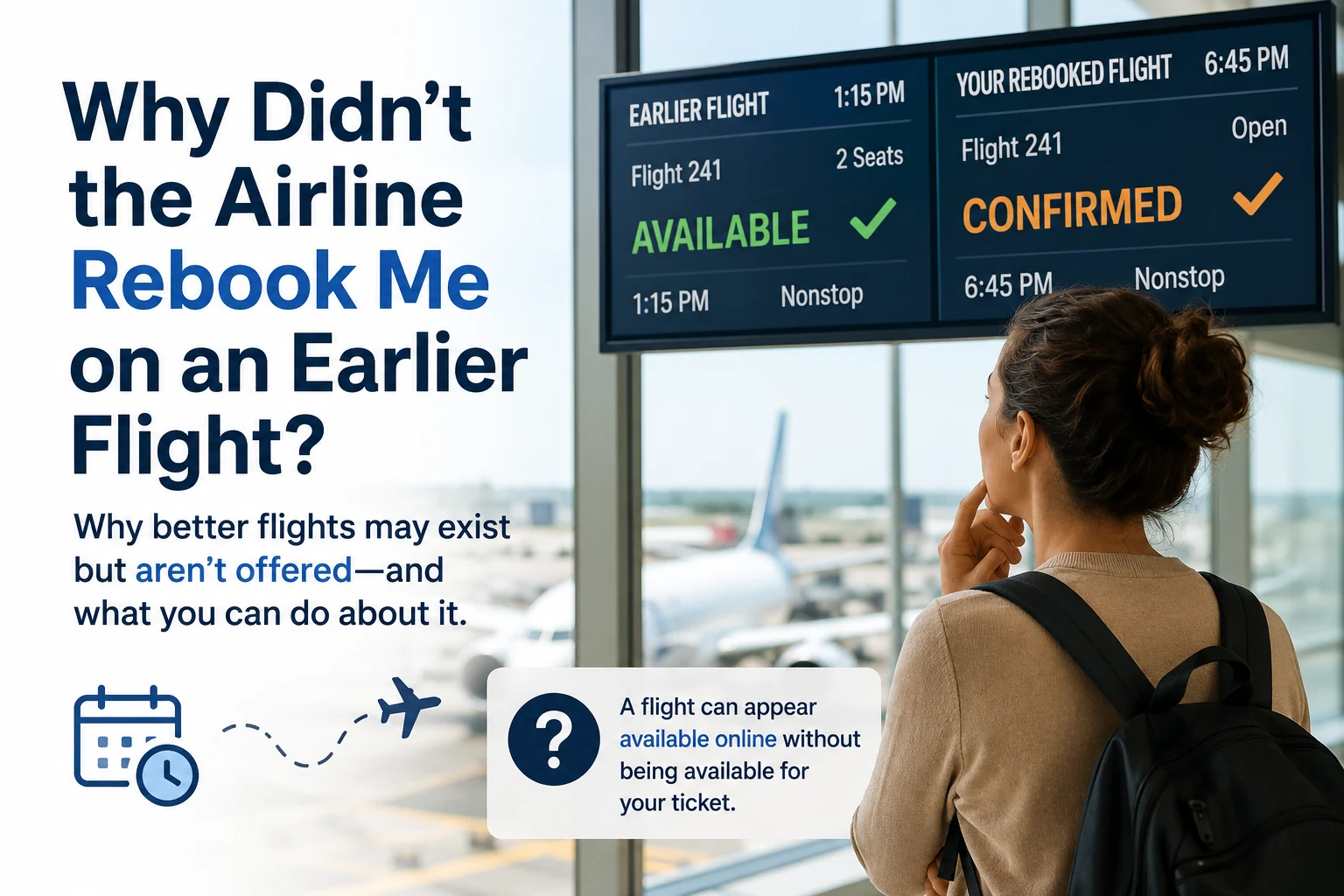
A flight can appear available online without being available for your disrupted ticket. Airlines usually rebook within their own system first, and better flights may not be offered unless you ask the right questions or an agent has authority to make a manual change.
System Insight
An earlier flight can be visible online without being available to your disrupted ticket.
- Inventory matters because an airline may not release every open-looking seat for disruption rebooking.
- Fare class matters because your original ticket may limit which replacement seats the system can use.
- Airline control matters because carriers usually try their own flights before considering partners or other airlines.
- Timing matters because earlier flights often fill quickly during delays, cancellations, and missed connections.
Why Earlier Flights May Not Be Offered
An earlier flight may look available, but that does not always mean it is available for your disrupted ticket.
Airline rebooking is not the same as shopping for a new ticket. A flight search result may show that seats are for sale, but the airline’s rebooking system may not allow your ticket to move into those seats without a fare difference, manual override, standby approval, or a different rule applying.
The earlier flight may be blocked because:
- the flight is already full
- only higher-priced fare classes remain
- your ticket type does not allow that change
- the airline is prioritizing its own inventory
- the seat is available for sale but not for disruption rebooking
- partner or other-airline options are not being offered
- same-day standby rules apply instead of confirmed rebooking
That is why asking “Are there seats?” is not always enough.
A better question is:
“Is that earlier flight available for my ticket under the current rebooking rules?”
Why It Happens
Why Better Flights May Not Be Offered
A better flight can exist without being available to your disrupted ticket. These are the most common reasons an earlier or faster option may not be offered automatically.
The earlier flight may be full.
Earlier flights often fill first during delays, cancellations, and missed connections, especially when many passengers are being rebooked at once.
The seat may not match your ticket.
A flight may show seats for sale, but those seats may not be open to your original fare class, ticket type, or rebooking authority.
The airline may protect its own seats.
Airlines usually try to rebook passengers within their own system first before using partner airlines or other carriers.
The option may be standby, not confirmed.
Some earlier flights may only be available through same-day standby rules instead of confirmed rebooking.
A fare difference may apply.
If the airline treats the change as voluntary or outside its disruption rules, the earlier flight may require a fare difference or change conditions.
The agent may see fewer options.
Agents often follow system-generated rebooking choices and may need a manual review or supervisor help to look beyond the first options.
Quick rule: visible online does not always mean available for free rebooking. Ask whether the earlier flight is available to your specific ticket under the current disruption rules.
Can the Airline Rebook You on Another Airline?
Sometimes, but not always.
Travelers often assume that if another airline has an earlier flight, their airline should move them to that option. In practice, that depends on the airline, the disruption, the ticket, available seats, and whether the carrier is willing or able to use another airline for rebooking.
Airlines usually try their own flights first because those seats are easier to control. Partner or other-airline options may be considered in some situations, especially when the disruption is significant and the airline has limited options of its own.
But another airline showing seats for sale does not automatically mean your airline can move you there.
The airline may say no because:
- it has seats available on a later flight of its own
- the other airline is not a partner
- the fare class is not available for rebooking
- the disruption does not qualify for other-airline protection
- the option requires a supervisor or manual review
- the airline’s policy limits when it will use another carrier
If you see a better option on another airline, ask directly:
“Can you check whether you can rebook me on this flight under your disruption policy?”
That is stronger than simply saying, “I found a better flight.”
Traveler Risk
Assuming the airline searched every better option can leave you stuck with a bad rebooking.
The risky assumption is thinking the airline automatically checked every earlier flight, partner airline, nonstop route, and standby option before assigning your new itinerary.
In reality, the rebooking you receive may be based on system defaults, fare rules, available inventory, agent tools, and airline policy. Better options may exist, but they may not appear automatically or may require you to ask more specifically.
If the rebooking does not work for your trip, ask whether an earlier flight, standby option, partner airline, different route, or manual review is available before accepting the new itinerary as final.
Check the Fine Print
Not sure whether the airline gave you the best rebooking option?
Use the Travel Fine Print Risk Checker to narrow whether your issue is an earlier-flight rebooking problem, missed connection risk, delay disruption, fare-class restriction, standby question, or refund vs rebooking decision.
What To Ask Before Accepting the Rebooking
If the rebooking you received does not work for your trip, do not just ask whether there is “anything earlier.”
Ask what is actually blocking the earlier flight.
A flight can be visible online for sale but still unavailable for your disrupted ticket. The issue may be seat inventory, fare class, standby rules, same-day change limits, partner-airline policy, or the airline’s disruption rebooking rules.
Ask the airline:
- Is the earlier flight available for confirmed rebooking, or only standby?
- Are there seats available in a fare class my ticket can use?
- Would a fare difference apply?
- Can you check alternate routings through another city?
- Can you check partner airlines or another carrier under your disruption policy?
- Does my ticket type or fare rule prevent the change?
- If I accept this rebooking, do I lose refund, credit, standby, or later-change options?
- What happens to my checked bag if I move to a different flight?
The more specific your question, the more likely you are to find out whether the earlier flight is truly unavailable — or just not being offered automatically.
Action Step
Ask What Is Blocking the Earlier Flight
Before accepting a bad rebooking as final, ask the airline to explain why the earlier or better flight cannot be used for your specific ticket.
Quick win: Ask, “Can you tell me what specifically prevents moving me to flight ___ — no seats, fare class, standby rules, partner policy, or fare difference?”
Before You Accept the Rebooking
Save the Rebooking Details Before Options Disappear
A rebooking problem is easier to challenge when you can show the flight you were given, the earlier option you found, the airline’s explanation, and what you asked for before accepting. Use the Travel Documents Checklist to keep screenshots, app messages, boarding passes, delay notices, rebooking confirmations, and receipts organized.
Travel Fine Print Takeaway
An earlier flight being visible does not mean it is available to your ticket. The real issue is whether that flight is open under the airline’s rebooking rules, your fare class, disruption policy, standby rules, partner access, and available inventory.
❓Frequently Asked Questions
These questions can help you understand why an airline may not move you to an earlier flight, even when that flight appears available online.
Why didn’t the airline rebook me on an earlier flight?
The earlier flight may have been full, unavailable to your fare class, restricted by your ticket type, or outside the airline’s disruption rebooking inventory.
A flight can appear available for sale online without being available as a free or confirmed rebooking option for your specific ticket.
Can an airline put me on an earlier flight after a delay or cancellation?
Sometimes. If there is eligible space and the airline’s rules allow it, an agent may be able to move you to an earlier flight.
But the earlier flight may be treated as standby, same-day change, a fare-difference option, or a manual exception rather than an automatic rebooking.
Why does the flight show seats available if the airline says I cannot move to it?
Public availability does not always match rebooking availability. The airline may be selling seats in fare classes that are not available to your ticket, or the flight may require a higher fare, standby process, or manual override.
Ask whether the flight is available for confirmed rebooking under your current disruption rules, not just whether seats are for sale.
Do airlines have to rebook me on another airline?
Not always. Airlines usually try to rebook passengers on their own flights first. Partner or other-airline rebooking may depend on the airline’s policy, the cause of the disruption, available seats, and whether the situation qualifies for that type of protection.
If you find a better flight on another airline, ask whether the carrier can rebook you on that flight under its disruption policy.
Can I ask for a different flight than the one the airline assigned?
Yes. You can ask for a different flight, alternate routing, standby option, partner airline, or manual review.
The airline may still say no if the flight is full, restricted by fare class, unavailable for rebooking, or outside the airline’s policy. But asking specifically can sometimes uncover options that were not offered automatically.
Bottom Line
Airlines do not always rebook travelers on the earliest or fastest flight.
That does not always mean the airline ignored a better option. The earlier flight may be full, unavailable to your fare class, restricted by your ticket type, blocked by standby rules, or outside the airline’s disruption rebooking inventory.
The key distinction is this:
- Visible online does not always mean available to your ticket.
- Seats for sale are not always the same as seats available for free rebooking.
- Earlier flights may require standby, same-day change, fare difference, or manual review.
- Other airlines may not be used unless the carrier’s policy allows it.
If the rebooking you receive does not work for your trip, ask what specifically prevents the earlier option. The answer may help you decide whether to request a manual review, ask about standby, check partner airlines, push for a different route, or consider whether a refund or travel credit makes more sense.
The goal is not just to find a better flight.
It is to find out whether the better flight is actually available under the rules attached to your ticket.
Related Guides
Rebooking problems often overlap with missed connections, delays, cancellations, refund choices, and ticket restrictions. These guides can help travelers understand what to check next when the airline’s first rebooking option does not work.
Flight Disruptions and Rebooking
- What Happens If You Miss a Connecting Flight? — Helpful if a delay, cancellation, or poor rebooking causes a missed onward flight.
- Do Airlines Compensate You for Delayed Flights? — Explains the difference between compensation, refunds, rebooking, meals, hotels, and delay assistance.
Refunds, Credits, and Ticket Rules
- Airline Refund vs Travel Credit: What’s the Difference? — Helps travelers understand when accepting a rebooking or credit may affect control over their money.
- Non-Refundable Flights: What Travelers Should Know Before Booking — Explains how fare rules can affect changes, credits, refunds, and ticket value.
Documentation and Claim Support
- Travel Insurance Claim Proof: What Documents You May Need — Useful if a rebooking problem creates extra costs and the traveler needs proof for insurance, credit card benefits, or reimbursement.