
A bag marketed as a “carry-on” is not automatically permitted on every flight. It can still create a problem because it exceeds the airline’s dimensions, weighs too much, does not qualify as a personal item, or is not included with the fare you purchased.
There is no single carry-on size or weight limit that applies to every airline. TSA directs travelers to check with the airline because cabin-bag dimensions vary, while federal guidance notes that the number, size, and weight of permitted carry-on items can depend on the carrier.
The fine print becomes especially important with basic, light, saver, and low-cost fares. A ticket may include only a personal item, charge separately for a full-size carry-on, or impose stricter limits than the traveler expects. Even when a carry-on is included, meeting the published rules establishes eligibility—not a guarantee that overhead-bin space will remain available during boarding.
Before flying, you need to confirm four things:
- How many cabin items your fare includes
- The permitted size of the carry-on and personal item
- Whether the airline enforces a weight limit
- How much you may pay if the bag is added late or rejected at the airport
This guide explains how carry-on and personal-item rules work, where fees usually appear, what happens when a bag exceeds the limit, and what to verify for every flight segment before leaving for the airport.
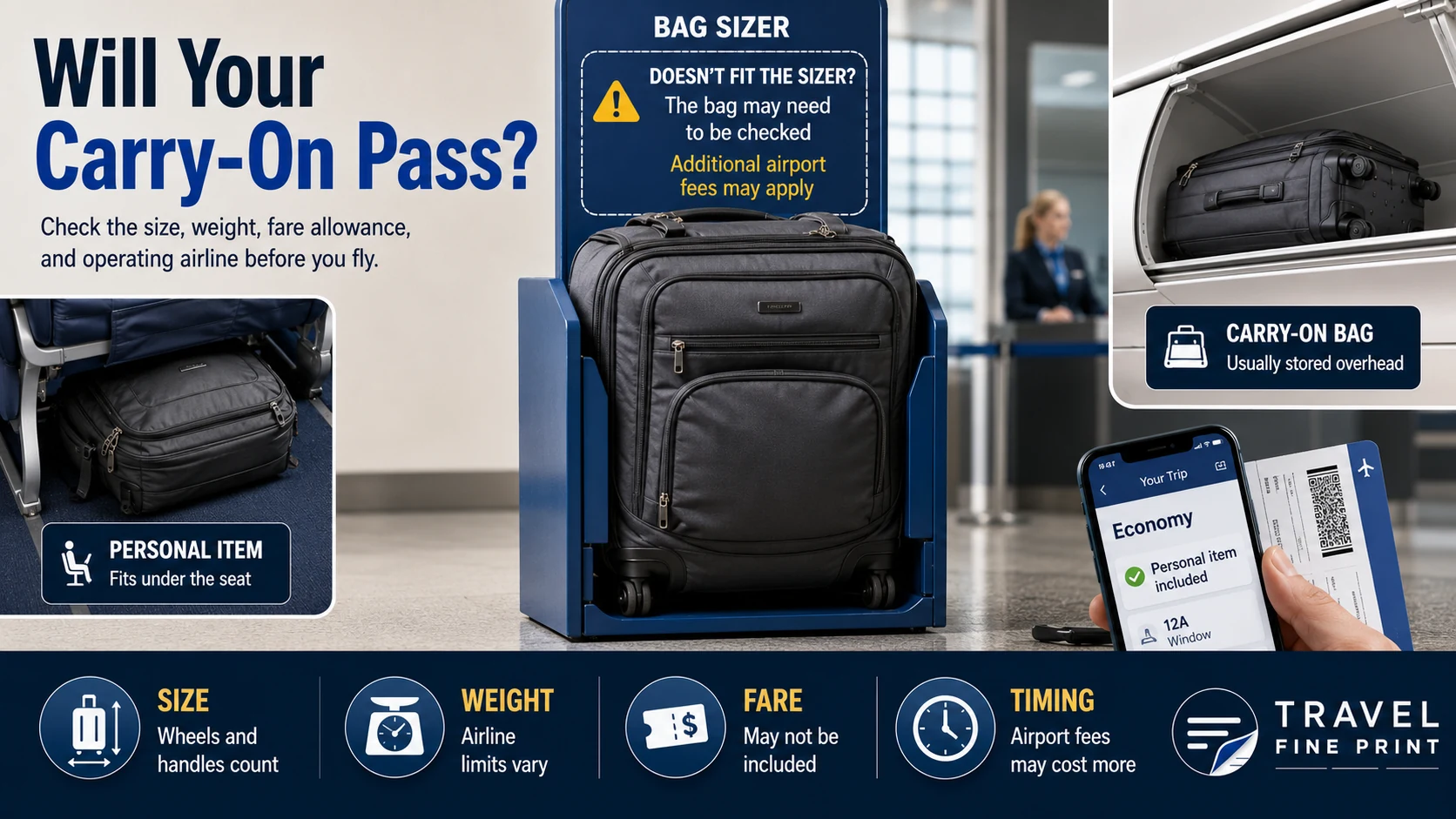
Carry-On vs Personal Item: What Is the Difference?
Airlines generally distinguish between a larger carry-on bag intended for the overhead bin and a smaller personal item intended to fit beneath the seat. However, the exact dimensions, weight limits, included allowance, and eligible fare types are set by the airline—not by TSA.
Carry-On Bag
Usually stored in the overhead bin
- Usually the larger of the two permitted cabin items.
- Must comply with the airline’s published dimensions and any applicable weight limit.
- May be included with the fare, sold as an add-on, or excluded from some lower fare types.
- Qualifying for cabin use does not guarantee that overhead-bin space will remain available.
Personal Item
Usually stored beneath the seat
- Usually smaller than a full-size carry-on bag.
- Common examples include a small backpack, purse, laptop bag, or compact tote.
- Must fit within the airline’s personal-item limit and beneath the seat in front of you.
- May be the only free cabin item included with a basic, light, saver, or low-cost fare.
How Should You Measure a Carry-On Bag?
Measure the bag after it is fully packed. Airlines generally evaluate the bag in the condition presented at check-in or the gate—not the smaller dimensions shown when it is empty, compressed, or unexpanded.
Check the airline’s published dimensions, then measure the bag from its widest and tallest exterior points. Do not rely only on the manufacturer’s “carry-on approved” description.
Include Wheels and Handles
Measure from the bottom of the wheels to the highest fixed handle or edge. Retractable handles should be fully lowered, but their housing still counts.
Measure the Widest Packed Point
Exterior pockets, straps, bulging fabric, and anything attached to the bag can increase its width or depth beyond the listed shell dimensions.
Weigh the Finished Bag
Use the total packed weight. A bag that meets the size limit may still be rejected or charged if the airline enforces a separate cabin-bag weight limit.
What Travelers Often See in Practice
Airlines do not measure every carry-on bag on every flight. A bag that looks reasonably close to the permitted size may pass without being questioned.
Enforcement is more likely:
- At the check-in counter when a bag appears oversized
- Before the TSA checkpoint when a carrier screens bags early
- Near the gate while passengers are lining up to board
- When the flight is expected to be full
- On budget carriers that closely distinguish free personal items from paid carry-ons
Budget carriers may check more actively because a bag that exceeds the free allowance can create an additional charge. That fee may also be higher when the problem is discovered at the airport rather than handled online.
The practical issue is inconsistency. A bag may pass several times and still be measured on the next trip. The published allowance—not what happened on a previous flight—is the safest standard to follow.
How It Works
Four Checks Determine Whether Your Bag Can Travel in the Cabin
Security screening and cabin-bag approval are separate. A bag that may pass through TSA still has to satisfy the airline’s fare, operating-carrier, packed-bag, and day-of-travel requirements.
Fare Allowance
The ticket determines whether you receive a personal item, a full-size carry-on, both items, or neither without an additional charge.
Operating Airline
The carrier operating each segment sets the applicable dimensions, weight limit, item count, and cabin-bag rules for that flight.
Packed Condition
The bag is evaluated as presented, including wheels, fixed handles, exterior pockets, attached items, bulging sides, and expanded sections.
Flight Conditions
Even a compliant bag may be checked because of aircraft size, limited overhead-bin space, weight-and-balance needs, or another operational condition.
Why this matters: Passing one check does not guarantee the final outcome. A bag may be allowed through security but excluded by the fare, rejected under the operating airline’s limits, or checked later for operational reasons.
Is a Carry-On Included With Your Fare?
Do not assume that every airline ticket includes both a personal item and a full-size carry-on bag.
The allowance can depend on the airline, route, fare type, cabin, loyalty status, and any benefits attached to the traveler’s credit card. A basic, light, saver, or low-cost fare may include only the smaller item that fits beneath the seat, while a higher fare may include an overhead-bin carry-on.
Review the baggage allowance during booking and again on the final confirmation. The U.S. Department of Transportation advises travelers to check the airline’s limits on the size, weight, and number of carry-on bags because there is no single federal standard.
Personal Item and Carry-On
The fare includes both the smaller under-seat item and a qualifying bag for the overhead bin.
Still verify: size, weight, item count, and operating-airline rules.
Personal Item Only
The fare includes only the smaller bag that fits beneath the seat. A full-size carry-on may be excluded.
Common mistake: assuming “one free bag” means an overhead-bin suitcase.
Carry-On Sold Separately
The traveler may need to add and pay for the overhead-bin bag during booking or before departure.
Check the timing: the charge may be different when purchased later or handled at the airport.
When Can Carry-On Fees Become More Expensive?
A carry-on charge may depend not only on the airline and fare, but also on when the bag is added. Some carriers price the bag differently during booking, after ticket purchase, at airport check-in, or at the gate.
During Booking
This is often the easiest point to compare the fare, baggage allowance, and total trip cost before payment.
After Ticket Purchase
The traveler may still be able to add the bag online, but the price may differ from the amount offered during booking.
At the Airport or Gate
A bag discovered to be excluded, oversized, or too heavy may trigger a higher fee and may need to be checked.
What Happens If Your Carry-On Is Too Large or Too Heavy?
A bag that exceeds the airline’s size, weight, or item-count limit may no longer qualify for cabin use. What happens next depends on the airline, airport, fare, and how late the problem is discovered.
If the bag does not fit the airline’s sizer or exceeds a published weight limit, the traveler may have only a few practical options—especially when the issue is discovered close to boarding.
Repack the Bag
The traveler may be able to remove items, compress an exterior pocket, or move permitted belongings into another bag. This depends on time, space, and the airline employee allowing the traveler to try again.
Pay for a Different Allowance
When the fare excludes a full-size carry-on, the airline may require the traveler to purchase the appropriate bag allowance—when that option is still available.
Check the Bag
An oversized or overweight cabin bag may need to travel as checked baggage, subject to the airline’s applicable fees, restrictions, and checked-bag rules.
Traveler Risk
A Carry-On Problem Discovered at the Airport Leaves You With the Fewest Options
If a bag is excluded from the fare, exceeds the permitted dimensions, or violates a weight limit, discovering the problem at check-in or the gate may mean paying a higher fee, checking the bag, or repacking under time pressure.
The cost is not the only risk. Late enforcement may also delay boarding and force you to reorganize valuables, medications, electronics, documents, or other belongings you intended to keep with you.
Check Before You Fly
Not Sure Whether Your Carry-On Is Really Included?
Use the Travel Fine Print Risk Checker to review fare restrictions, baggage allowances, operating-airline rules, possible airport fees, and other details that could change what you pay or bring onboard.
Which Carry-On Rules Apply on a Connecting or Codeshare Trip?
When an itinerary includes more than one airline, check the baggage rules for the airline operating each flight segment—not only the airline that sold the ticket.
A flight may display one airline’s name during booking but be operated by another carrier. That operating airline provides the aircraft and applies the cabin-bag rules for that segment.
- Find the “operated by” language. Review the itinerary and confirmation for every flight.
- Compare each operating carrier’s limits. Check the permitted dimensions, weight, personal-item allowance, number of items, and applicable fees.
- Pack to the strictest rule on the itinerary. A bag accepted on the first flight may create a problem on a later segment with a smaller allowance or different aircraft.
Important distinction: The airline selling the ticket and the airline operating the flight may not be the same company. Plan around the most restrictive carry-on rule that applies anywhere on the trip.
The U.S. Department of Transportation advises travelers to check the carry-on limits for every airline and aircraft used on the trip; review its guidance for avoiding baggage problems
Action Step
Verify Your Carry-On Before Leaving for the Airport
Check the allowance attached to the exact ticket—not only the airline’s general baggage page. Complete these steps after packing, when the bag is at its actual travel size and weight.
Before You Fly
Save the Carry-On Rules Before You Leave for the Airport
Use the Travel Documents Checklist to review baggage limits, fare allowances, operating-airline rules, confirmation screenshots, valuables, medications, electronics, and other details before a bag problem interrupts the trip.
Travel Fine Print Takeaway
Treat the published allowance as the rule—even when enforcement looks inconsistent. Check what the fare includes, measure and weigh the fully packed bag, review every operating airline, and compare fees before arriving at the airport. A bag that was accepted before is not automatically approved for the next flight.
Frequently Asked Questions
Is there one standard carry-on size for every airline?
No. Airlines establish their own limits for carry-on dimensions, weight, and number of permitted items. A suitcase that qualifies on one airline may exceed the allowance on another, so check the operating carrier for every flight segment.
Do wheels and handles count toward carry-on dimensions?
Travelers should measure the bag from its widest and tallest exterior points, including wheels, fixed handles, exterior pockets, and any expanded section. The packed bag must fit within the airline’s published limit or bag sizer.
Does a personal item allowance include a full-size carry-on?
Not necessarily. A personal item is usually the smaller bag intended to fit beneath the seat. Some basic, light, saver, and low-cost fares include only that item and require an additional payment for an overhead-bin carry-on.
Can an airline charge more for a carry-on at the airport?
Depending on the airline and fare, the price may vary based on whether the bag is added during booking, after purchase, at check-in, or at the gate. Waiting until the airport may leave the traveler with fewer options and a higher charge.
Which carry-on rules apply on a codeshare flight?
Check the baggage rules for the airline operating each flight segment—not only the airline that sold the ticket. When multiple carriers are involved, packing to the strictest applicable limit reduces the risk of a problem during a connection.
Can an airline check a carry-on even when it meets the rules?
Yes. A compliant bag may still be checked because of limited overhead-bin space, aircraft size, weight-and-balance needs, or other operational conditions. That separate situation is explained in Why Airlines Sometimes Force You to Check a Carry-On .
Bottom Line
A carry-on is permitted only when it fits both the allowance attached to the fare and the operating airline’s size, weight, and item-count rules.
Check the fully packed bag, review every flight segment, and compare baggage fees before arriving at the airport. Do not rely on a manufacturer’s “carry-on approved” label or the fact that the bag passed without inspection on a previous trip.
Related Guides
These guides help travelers understand how baggage rules, fare types, boarding conditions, and airline add-ons can affect the final cost and handling of a flight.
Carry-On and Checked-Bag Issues
- Can an Airline Force You to Check a Carry-On Bag?
Learn why a compliant carry-on may still be checked because of limited overhead-bin space, aircraft size, or boarding conditions. - Do You Have to Recheck Bags on a Connecting Flight?
Understand when checked luggage must be collected and rechecked, especially on separate tickets or international connections.
Airline Fares and Extra Charges
- How Airline Ticket Pricing Works: Fares, Fees and Rules
Compare fare types, restrictions, and included benefits before choosing the lowest advertised airfare. - Advance Seat Selection Fees: Why Airlines Charge Extra
See how seat-selection charges can combine with baggage fees and other add-ons to change the final flight price.