
You check in for your flight and notice the name on your boarding pass, airline ticket, passport, or ID does not match exactly.
Maybe your middle name is missing. Maybe your ticket has a middle initial instead of the full middle name. Maybe your first name is shortened, your last name is hyphenated differently, or your passport uses a name that does not match the booking.
That small difference can suddenly feel like a much bigger problem.
Airlines do not only check whether you paid for the ticket. They also check whether the name on the booking matches the traveler’s government ID closely enough for security, immigration, and passenger verification systems.
The real question is not just:
“Is this obviously me?”
It is:
“Will the airline, airport security, or travel document system treat this as the same traveler?”
This guide explains what can happen if your boarding pass or ticket name does not match your passport or ID, when middle names and small typos may matter, and what to do before you get to the airport.
Quick Answer
What Happens If Your Boarding Pass Name Doesn’t Match Your Passport or ID?
If the name on your boarding pass or airline ticket does not match your passport or government ID closely enough, you may be delayed at check-in, sent to an airline agent, required to correct or reissue the ticket, or denied boarding.
Small differences like a missing middle name, middle initial, spacing, hyphen, or suffix may be less serious than a wrong first name, wrong last name, maiden-name issue, or completely different traveler name. But the outcome depends on the airline, route, destination, timing, and whether the system can verify that the ticket and ID belong to the same traveler.
For international travel, the safest approach is to make the ticket match the passport as closely as possible before departure. If you notice a mismatch, contact the airline or booking site before check-in instead of waiting until you reach the airport.
Does the Name on Your Ticket Have to Match Your Passport Exactly?
For international travel, your airline ticket should match your passport as closely as possible. Passport checks, security screening, immigration systems, and airline verification rules can be less forgiving than travelers expect.
For domestic flights, minor differences may be handled more flexibly, especially when the first and last name clearly match your government ID. But that does not mean every mismatch is safe. A typo, missing name, nickname, swapped name order, or old last name can still create problems if the airline or security system cannot verify the traveler.
The safest rule is simple: enter your name exactly as it appears on the ID or passport you will use for travel. If you discover a mismatch, ask the airline or booking site whether the ticket needs a correction before departure.
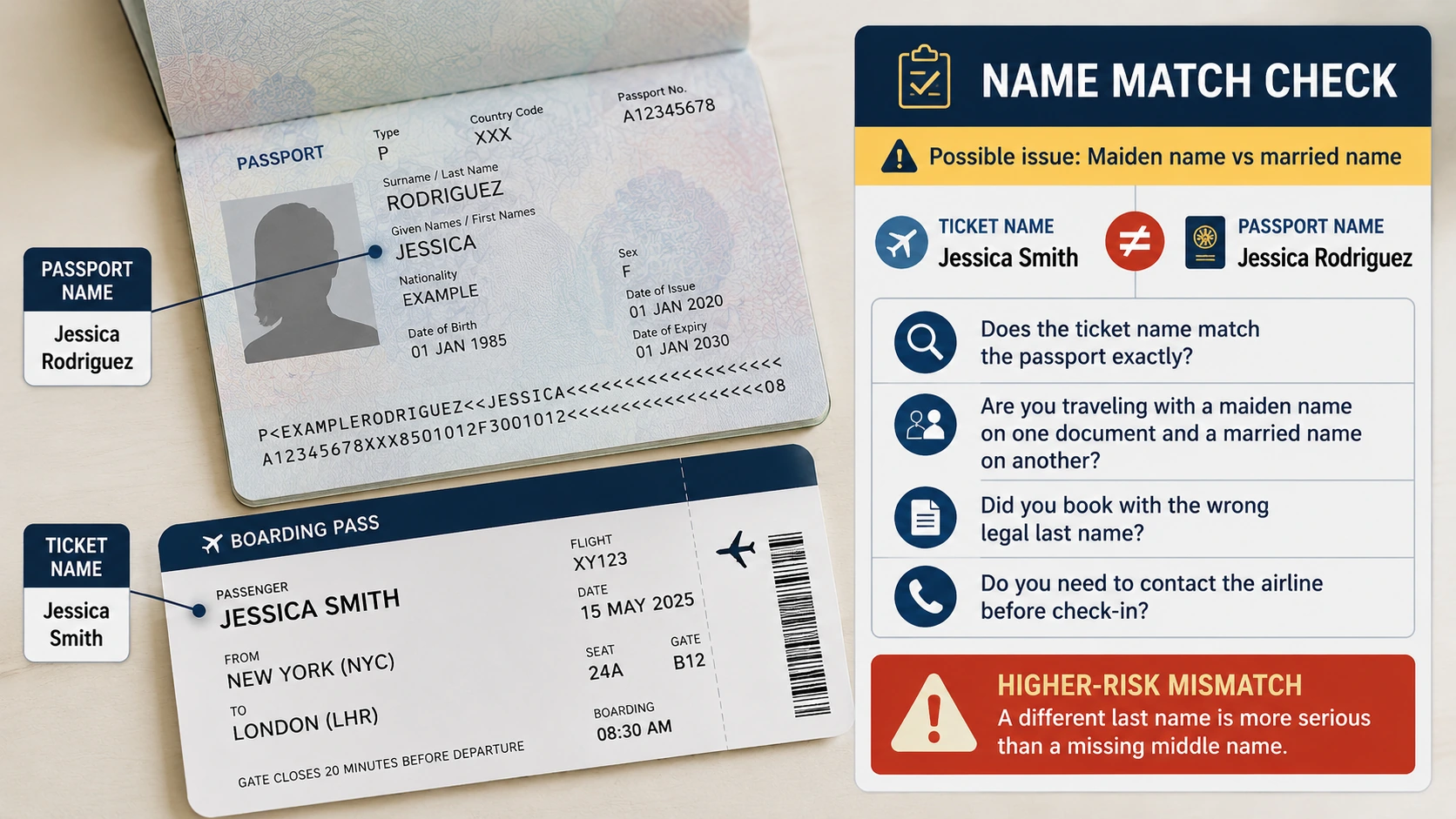
Most travelers assume airlines will “use common sense” with minor name differences.
But this isn’t about spelling — it’s about systems that require exact matches.
To understand why small mistakes can have big consequences, you need to look at how passenger verification actually works.
Name Match Check
Which Type of Name Mismatch Do You Have?
Not every name mismatch creates the same risk. The outcome depends on the type of mismatch, whether you are flying domestically or internationally, and how much time you have to correct the ticket before departure.
Often Lower Risk
Formatting or Middle Name Issue
- Missing middle name
- Middle initial instead of full middle name
- Hyphen, space, apostrophe, or suffix difference
- First and last name otherwise match the ID
What to do: Check with the airline before travel, especially for international flights. These issues may be accepted in some cases, but you should not assume they are harmless.
Needs Attention
Typo, Nickname, or Name Order Problem
- One-letter or spelling mistake
- Nickname instead of legal first name
- First and last names reversed
- Partial name missing from the ticket
What to do: Contact the airline or booking site as soon as possible. A correction may be easier before online check-in, airport check-in, or ticket reissue deadlines.
High Risk
Different Legal Name or Wrong Traveler
- Maiden name on ticket, married name on passport
- Different last name without documentation
- Completely wrong first or last name
- Ticket appears to belong to another traveler
What to do: Do not wait until the airport. Ask the airline what documentation, correction, reissue, or new ticket is required before departure.
Quick check: If the mismatch changes who the ticket appears to belong to, treat it as urgent. If it only changes formatting, still confirm the airline’s rule before relying on it.
What Actually Happens (At the Airport)
You arrive, check in, and everything seems normal at first.
Sometimes, the issue doesn’t appear until your ID is scanned at security or the gate.
At that moment, the system tries to match your ticketed name with your identification. If there’s a mismatch, one of three things happens:
First, the agent may attempt a correction — but this depends on the airline’s policy, how severe the mismatch is, and how close you are to departure.
If the system allows it, they might reissue your ticket with the corrected name. This can involve fees, fare differences, or delays. If the system doesn’t allow changes — or time runs out — you may be denied boarding entirely. In some cases, you’ll need to purchase a new ticket on the spot.
What feels like a minor typo quickly becomes a full travel disruption.
Name Match Status
When a name mismatch becomes a problem
Not every name issue creates the same result. The outcome depends less on how small the mistake looks and more on whether the airline, security system, or destination rule can verify the traveler.
Usually Fixable
Minor Mismatch
- Small typo of one or two letters.
- Missing or extra middle name.
- Formatting difference such as spacing or hyphenation.
- May be corrected before departure.
- Sometimes fixable at the airport.
Typical outcome: delay or inconvenience, not usually denied boarding.
At Risk
Moderate Mismatch
- Nickname instead of full legal name.
- First and last names swapped.
- Partial name missing.
- May require ticket correction or reissue.
- Timing and airline flexibility matter.
Typical outcome: depends on timing, route, and whether the airline can correct the record.
Boarding Risk
Major Mismatch
- Different last name or completely incorrect name.
- Name does not match the ID at all.
- System cannot verify identity.
- No same-day correction may be available.
- A new ticket may be required.
Typical outcome: treated as a different traveler, which can lead to denied boarding.
The difference between boarding and denial is not always how small the mistake looks. It is how the system classifies the mismatch.
Name mismatches are not the only document issue airlines check for; physical damage can also create problems if the passport cannot be clearly verified, scanned, or accepted as valid for travel.
When Name Mismatches Are Most Likely to Cause Problems
Name mismatches don’t cause issues on their own — they become a problem when they collide with timing, systems, and stricter verification environments.
One of the biggest risk multipliers is booking through third-party sites. Autofill errors, saved profiles, or mismatched traveler details can introduce small discrepancies that go unnoticed until the airport.
International travel raises the stakes significantly. Passport matching is stricter, and systems are less forgiving. A missing middle name or slight variation that might pass domestically can trigger a failure internationally.
Timing is another major factor. If you discover the issue early, airlines may have options to correct it. But as departure approaches, those options shrink — and at the airport, they’re often limited to whatever the system allows in real time.
There’s also a higher risk for travelers with complex or inconsistent naming formats — hyphenated names, multiple last names, suffixes, or cultural naming variations. These increase the chance that your booking doesn’t perfectly align with your ID.
Finally, issues tend to surface at the worst possible moment — security or the gate — when there’s the least time to fix them. In many cases, airlines treat this as a passenger error rather than an airline issue.
A small mismatch becomes a real problem when it shows up late, on an international trip, or inside a system that won’t allow changes.
Traveler Risk
“If it’s close enough, they’ll let me fly” is the risky assumption.
Airlines are not only judging whether your name looks close to your ID. They are relying on systems that may require the ticketed name, travel document, and security record to match clearly enough for identity verification.
If the system cannot confidently match the traveler, the issue may be treated as a failed identity check rather than a small mistake.
It is not a judgment call at the gate. It is a system approval problem.
Before You Book or Fly
Check the Travel Documents Fine Print
Make sure your ID, passport, hotel proof, insurance documents, baggage backup, and trip records are ready before a small missing detail becomes expensive.
What To Do If Your Name Doesn’t Match
The key isn’t just fixing the mistake — it’s understanding how much leverage you still have based on timing.
If you catch a name issue shortly after booking, your options are at their strongest. Many airlines allow minor corrections within a limited window, and changes are more likely to be processed without fees or reissuing complications.
Once you’re closer to departure, flexibility drops sharply. At that point, even small corrections may require canceling and rebooking — often at a higher fare.
If you’re already at the airport, your goal shifts from “fixing it” to getting cleared by the system in time. That means working directly with a staffed agent, not kiosks, and understanding that not all issues can be resolved same-day.
For international trips, there’s no gray area — your ticket should match your passport exactly. This isn’t where airlines make exceptions.
Name mismatches are just one of several reasons travelers can be denied boarding before departure.
The smartest move is prevention: always enter your name exactly as it appears on your government ID, even if it feels redundant or overly precise.
Your options don’t just depend on the mistake — they depend on when you catch it.
Action Step
What to do at the airport if your ticket name does not match your ID.
If you notice a name mismatch at the airport, do not rely on a kiosk or wait until boarding. Go directly to a staffed check-in counter so the airline can review whether a same-day correction, ticket reissue, or manual review is possible.
- Go to a staffed check-in counter immediately.
- Tell the agent there is a name mismatch before it gets flagged later.
- Ask whether same-day name correction or ticket reissue is possible.
- Have your government ID and booking confirmation ready.
- Be prepared for a correction fee, fare difference, or reissue if required.
- Allow extra time because name issues can take longer than standard check-in.
At the airport, your biggest advantage is time. Once boarding starts, your options can narrow quickly.
Before You Book or Fly
Check the name, passport, ID, and booking details before a small mismatch becomes a boarding problem.
Use the Travel Documents Checklist to review your ticket name, passport or ID, visa needs, insurance proof, confirmations, screenshots, and backup documents before check-in.
Why Airlines Enforce This So Strictly
Airlines aren’t just checking IDs — they’re complying with security regulations that require accurate passenger data.
If they allow a mismatch and something goes wrong, they can face fines, penalties, or compliance issues.
This is why policies often seem rigid.
It’s not about customer service flexibility — it’s about regulatory accountability.
❓Frequently Asked Questions
These questions cover boarding pass, airline ticket, passport, and ID name mismatches, including middle names, domestic flights, international trips, and what to do if you notice the problem close to departure.
Does my boarding pass name have to match my passport?
For international travel, the name on your boarding pass or airline ticket should match your passport as closely as possible. A mismatch can create problems at check-in, security, immigration, or the gate if the airline or travel system cannot verify that the ticket and passport belong to the same traveler.
Will TSA let you fly if your ticket does not match your ID exactly?
It depends on the type of mismatch and how the system verifies your identity. Minor formatting issues may be handled differently from a wrong first name, wrong last name, or name that appears to belong to another traveler. Do not rely on airport discretion if you can correct the ticket before travel.
Is it okay if my boarding pass does not have my middle name but my passport does?
A missing middle name is often less serious than a wrong first or last name, but it can still cause questions depending on the airline, route, destination, and system rules. For international travel, the safest approach is to ask the airline whether the ticket should be corrected before departure.
Can I fly if my name is slightly misspelled on the ticket?
Sometimes, but you should not assume it will be accepted. A one-letter typo may be fixable before travel, while a larger spelling issue may require a ticket correction or reissue. Contact the airline or booking site as soon as you notice the mistake.
What if my ticket has my maiden name but my passport has my married name?
This can be a higher-risk mismatch because the ticket and passport may appear to belong to different legal names. Contact the airline before travel. You may need a name correction, ticket reissue, legal name-change documentation, or a new ticket depending on the airline’s policy and timing.
Does a name mismatch matter on domestic flights?
Yes, though domestic flights may sometimes be less strict than international travel. The name on your ticket should still match the government ID you plan to show. A small typo or missing middle name may not always stop you, but a larger mismatch can delay check-in or create boarding risk.
Can I fix a ticket name error at the airport?
Sometimes, but it is risky to wait. At the airport, your options depend on the airline, the type of mismatch, ticket rules, departure time, and whether the system allows a correction or reissue. If you notice the problem before travel, contact the airline or booking site before you check in.
Can I change the passport details after buying a plane ticket?
Passport details and ticketed names are not always handled the same way. Some passport information may be updated in the airline profile or passenger details, but the ticketed traveler name may require a formal correction or reissue. Ask the airline what can be updated without changing the ticket.
What happens if I am denied boarding because of a name mismatch?
If the airline treats the issue as a failed identity or documentation check, you may need a ticket correction, reissue, or new booking. Airlines may not treat this like an airline-caused disruption because the ticket did not match the required traveler information.
Bottom Line
A name mismatch isn’t a small mistake — it’s a breakdown between your identity and the system that’s supposed to verify it.
Travelers think in terms of “close enough.”
Airlines operate in terms of exact matches.
And when those two don’t align, the system doesn’t pause to figure it out — it moves on without you.
Small details matter in air travel — and ensuring your name matches exactly can prevent costly disruptions before your trip even begins.
In air travel, your name isn’t just a detail — it’s your clearance to board.
If you want to avoid the ones that cost people flights, money, and entire trip.
Related Guides
If you are trying to avoid boarding problems caused by name mismatches, passport issues, or travel document mistakes, these guides may also help:
Passport and Travel Document Problems
- Travel Documents Checklist
Use this before you fly to review your passport, ID, visa needs, insurance proof, booking confirmations, screenshots, and backup documents. - Bad Passport Photo Travel Problems
Learn why passport photo problems, manual review, and identity verification issues can create travel delays even when the passport is technically valid. - Passport Card vs Passport Book: What Travelers Should Know
Review which passport document works for different types of travel before relying on the wrong document.
Denied Boarding and Airport Check-In Risks
- Denied Boarding Compensation: What Airlines May Owe If You’re Bumped
Use this if you are trying to understand denied boarding, airline bumping, and when compensation may or may not apply. - What Happens If You Miss Your Flight?
Learn what can happen if a check-in, document, or name issue causes you to miss departure. - Why Airlines Don’t Rebook You on Earlier or Better Flights
Review why airline rebooking options may be limited once a ticket, check-in, or passenger record problem appears.
Booking Details and Ticket Problems
- Booking Flights Through Third-Party Sites
See how travel agencies, OTAs, booking portals, saved profiles, and passenger-detail errors can make ticket corrections more complicated. - Airline Refund vs Travel Credit: What’s the Difference?
Use this if a ticket problem leads to cancellation, rebooking, refund questions, or airline credit instead of cash. - Why Travel Prices Are Different on Different Websites
Learn why the same trip can show different prices, rules, fees, and booking paths depending on where you buy.
Passport Timing and Pre-Trip Planning
- Are Passport Expediting Services Worth It?
Review when passport timing becomes urgent and whether paying for faster processing may make sense. - Does Travel Insurance Cover Forgetting Your Passport?
Learn why travel insurance may not cover traveler mistakes, missing documents, or preventable passport issues.