
You bought travel insurance, so it is natural to wonder whether it protects you if a passport problem threatens your trip.
Maybe your passport was lost. Maybe it was stolen. Maybe it is damaged. Maybe it expires too soon. Maybe your renewal has not arrived. Or maybe the name on your ticket does not match your passport exactly.
Those situations can all affect travel, but travel insurance does not treat them the same way.
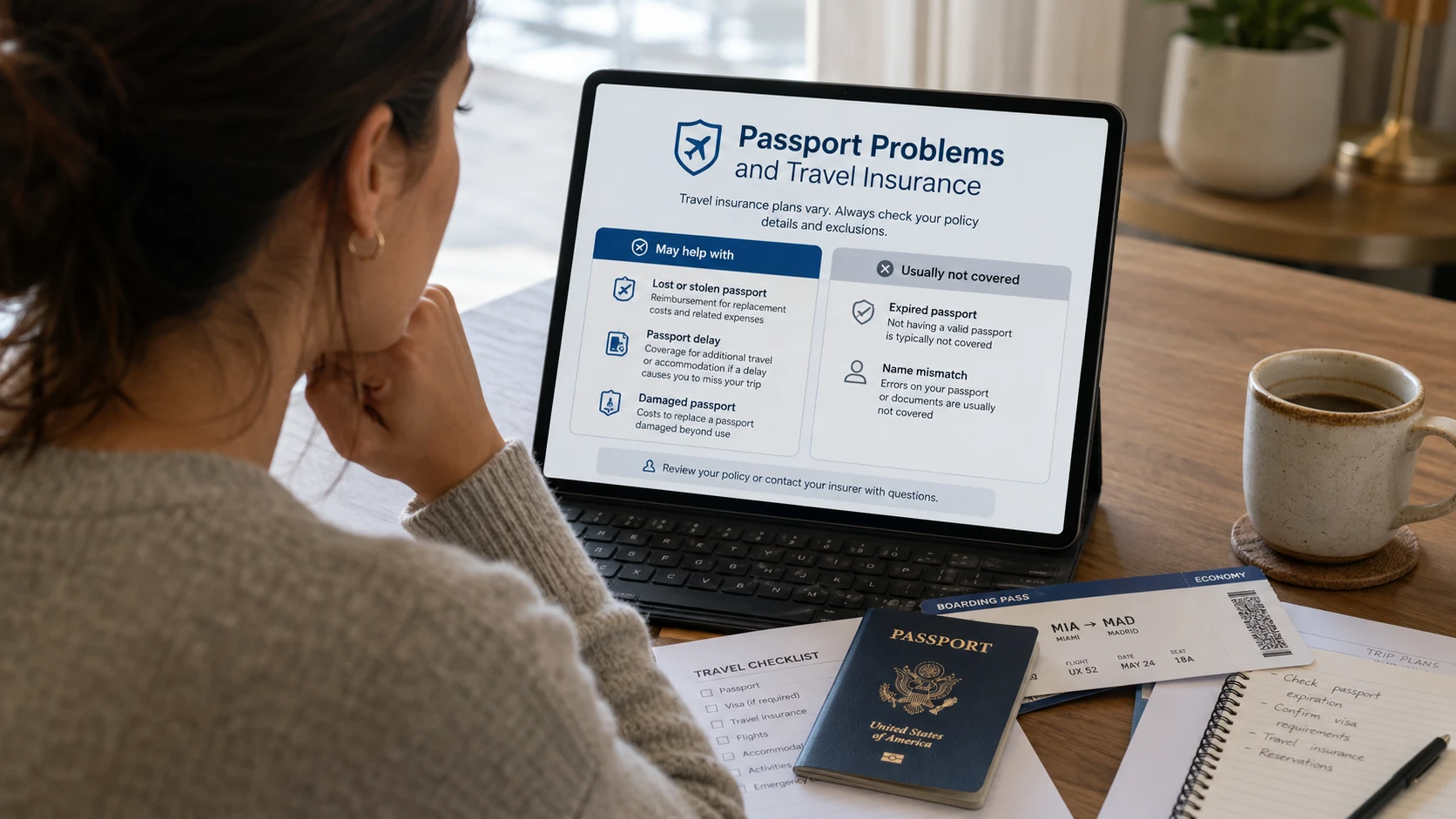
Some passport problems may trigger coverage or emergency assistance, especially if your passport is lost or stolen during a trip or stolen before departure and properly documented. But other problems are usually treated as preventable document issues — like expired passports, passport processing delays, missing validity requirements, missing visas, damaged documents you should have replaced, or ticket-name mismatches.
The real question is not just:
“Does travel insurance cover passport problems?”
It is:
“What kind of passport problem happened, when did it happen, was it documented, and does the policy list it as a covered reason?”
This guide explains when travel insurance may help with passport problems, when it usually will not, how name mismatches fit into the issue, and what to check before relying on insurance to protect your trip.
Quick Answer
Does Travel Insurance Cover Passport Problems?
Travel insurance may cover some passport problems, but it usually does not cover every document issue that stops you from traveling. Lost or stolen passports may qualify for assistance, travel delay, trip interruption, or cancellation benefits depending on the policy and timing. Passport delays, expired passports, passports that do not arrive in time, missing validity requirements, missing visas, and ticket-name mismatches are usually harder to cover.
The key is whether the passport problem is a covered event under your policy. A stolen passport with a police report is different from discovering that your passport expires too soon, your renewal is delayed, your destination requires six months of validity, or your airline ticket does not match your passport name.
System Insight
Insurance covers covered events, not every passport problem.
- A lost or stolen passport may trigger emergency assistance, replacement-document help, or certain delay/interruption benefits depending on the policy.
- An expired passport or delayed renewal is usually treated as a document-readiness problem, not a covered trip cancellation reason.
- Passport validity, visa rules, and name matching are usually traveler responsibilities that should be checked before departure.
- The claim depends on the policy language, timing, documentation, and covered reason — not just the fact that a passport issue affected the trip.
Travel insurance is most useful when the passport problem is sudden, documented, and listed as a covered reason — not when the problem could have been checked before travel.
Not Every Passport Problem Is Treated the Same Way
Before relying on travel insurance, identify what kind of document problem you are dealing with. A stolen passport is different from an expired passport, a delayed renewal, a missing visa, or a ticket name that does not match your passport.
Lost or Stolen Passport
Insurance may provide assistance or reimbursement if the loss or theft is covered, documented, and happens within the policy terms.
Expired Passport
An expired passport or one that does not meet destination validity rules is usually treated as a traveler responsibility.
Passport Delay
If a passport renewal or new passport does not arrive in time, standard travel insurance usually does not treat that as a covered cancellation reason.
Visa or Name Issue
Missing visas, entry-rule mistakes, or airline ticket names that do not match your passport are usually harder to treat as insurance claims.
The dividing line is usually whether the passport problem happened unexpectedly or whether it was something the traveler was expected to verify before departure.
What Passport Problems Travel Insurance May Cover
Travel insurance is most likely to help when the passport problem is sudden, documented, and tied to a covered event in the policy.
The clearest example is a lost or stolen passport during a trip. In that situation, travel insurance may provide emergency assistance, help you contact the nearest embassy or consulate, or reimburse certain costs connected to replacement documents, travel delay, or trip interruption if the policy allows it.
A stolen passport before departure may also create possible coverage under some policies, especially if the theft is documented quickly and prevents the trip from going forward. In that situation, the documentation matters. A police report, proof of the theft, trip receipts, and communication with the insurer may all become important.
Some policies may also help if a covered passport problem causes a delay during the trip. For example, if you cannot leave as scheduled because your passport was stolen and you are waiting for emergency travel documents, the policy may help with certain extra lodging, transportation, or rebooking costs if those benefits apply.
The key word is covered. Travel insurance does not usually cover a passport problem just because it is stressful or expensive. The issue has to fit the policy’s covered reasons, timing rules, documentation requirements, and benefit limits.
Traveler Risk
Assuming insurance covers every document problem can leave you with no backup plan.
The risky assumption is thinking “I bought travel insurance” means every passport, visa, or ticket-name problem is protected. Many document problems are treated as traveler responsibility, especially when they could have been checked before departure.
Before relying on a policy, confirm whether the issue is a covered event. A stolen passport with documentation is different from an expired passport, delayed renewal, missing visa, six-month validity problem, damaged passport, or ticket-name mismatch.
Check the Fine Print
Not Sure Whether Your Document Problem Is Covered?
Use the Travel Fine Print Risk Checker to narrow whether the issue is a passport problem, visa rule, name mismatch, denied boarding risk, insurance claim concern, or another travel-document issue.
What Passport Problems Are Usually Not Covered
Travel insurance is usually much weaker when the passport problem could have been checked or corrected before travel.
An expired passport is one of the clearest examples. If your passport is expired before departure, or if it expires too soon for your destination’s entry rules, insurance usually will not treat that as a surprise event. The same issue can apply to countries that require several months of passport validity beyond your travel dates.
A passport renewal delay is also risky. If your passport does not arrive in time, standard travel insurance may not cover cancellation just because the document was delayed in processing. That is different from a passport being stolen or lost during a trip.
A missing visa or entry authorization is usually another preventable document issue. If a country requires a visa, eTA, ETA, tourist card, or other entry approval, insurance usually will not fix the cost of missing that requirement unless the policy has very specific language that applies.
A ticket-name mismatch can also create problems. If your airline ticket does not match your passport or government-issued ID, travel insurance usually will not treat that as a covered event by itself. It is generally considered a booking accuracy or documentation issue, which is why ticket names, passport names, middle names, spelling, and suffixes should be checked before departure.
A damaged passport can fall into a gray area. If the damage happened suddenly during the trip, the policy may offer some help depending on the coverage. But if the passport was already damaged before travel, an airline or border officer may refuse it, and insurance may treat the problem as preventable.
What to Check Before Buying or Relying on Travel Insurance
Before you assume travel insurance will protect you from a passport problem, check the policy language around covered reasons, travel delay, trip interruption, baggage and personal effects, replacement documents, and emergency assistance.
Do not stop at the marketing summary. Look for the actual benefit wording and exclusions. A policy may offer help if a passport is lost or stolen during the trip, but still exclude passport delays, expired documents, missing visas, or traveler errors.
Also check when the problem happened. A passport stolen during a trip may be treated differently from a passport that expired before departure. A passport damaged during travel may be different from one that was already damaged when you left home.
If the issue involves a name mismatch, passport validity rule, or missing visa, insurance may not be the best protection. In those cases, the safer move is prevention: confirm the document requirements before booking, compare the ticket name to the passport, and check the entry rules for every country on the itinerary.
The most useful question is:
“Does this policy list my passport issue as a covered reason, and what proof would I need if it happens?”
Action Step
Check the document issue before you rely on insurance.
Before you buy a policy or assume you are protected, identify the exact passport or document problem and compare it to the policy’s covered reasons.
Quick win: If the issue could have been checked before departure, treat insurance as secondary. Fix the document problem first.
Before You Book or Fly
Check the Passport Details Before Insurance Becomes the Backup Plan
Use the Travel Fine Print checklist to review passport validity, ticket names, visa rules, entry requirements, insurance documents, and proof you may need before a document issue turns into a denied boarding or claim problem.
What Proof You May Need for a Passport-Related Claim
If the passport problem may be covered, documentation becomes critical.
Start saving proof immediately. Waiting until after the trip can make it harder to show what happened, when it happened, and what extra costs were caused by the passport issue.
For a stolen passport, you may need a police report, embassy or consulate records, proof of replacement-document costs, receipts for extra lodging or transportation, and written confirmation of any flight changes caused by the issue.
For a lost passport during a trip, keep records showing when the loss was discovered, who you contacted, what replacement steps you took, and what extra costs were caused by the delay.
If the issue affects your flights, save the airline’s written explanation, rebooking receipts, cancellation notices, boarding denial details, and any communication showing why you could not travel as scheduled.
For document problems that are less likely to be covered — such as expired passports, delayed renewals, missing visas, or name mismatches — documentation may still help you understand what happened, but it may not create coverage if the policy does not list the issue as a covered reason.
The safest approach is to contact the insurer as soon as the problem occurs and ask:
“What documents do I need to provide for this specific passport issue, and which benefit would this claim fall under?”
Travel Fine Print Takeaway
Passport coverage depends on the cause, not just the consequence.
Travel insurance may help if your passport is lost or stolen and the situation fits a covered benefit. But it usually is not a safety net for expired passports, delayed renewals, missing visas, destination validity rules, damaged documents you should have replaced, or airline tickets that do not match your passport name.
The safest move is to check the document problem before you travel, then read the policy language to see whether that specific issue is actually covered.
❓Frequently Asked Questions
These questions explain when travel insurance may help with passport problems, when document issues are usually the traveler’s responsibility, and why name mismatches, expired passports, and passport delays are different from lost or stolen passport events.
Does travel insurance cover a lost passport?
It may, depending on the policy and when the passport was lost. Some policies may provide emergency assistance, replacement-document help, or reimbursement for certain extra costs if the loss fits a covered benefit. You will usually need documentation showing what happened and what costs were caused by the delay.
Does travel insurance cover a stolen passport before a trip?
It may be possible under some policies if the theft is documented and prevents you from traveling. A police report, proof of the stolen passport, trip receipts, and communication with the insurer may be required. Do not assume coverage unless the policy lists the situation as a covered reason.
Does travel insurance cover an expired passport?
Usually not. An expired passport is generally treated as a traveler responsibility, not a sudden covered event. The same may apply if your passport is technically valid but does not meet a destination’s entry-validity rule.
Does travel insurance cover a passport renewal delay?
Usually not under standard policies. If your passport renewal or new passport does not arrive in time, many insurers treat that as a passport-processing or document-readiness issue rather than a covered cancellation reason. Some specialized policies or add-ons may be different, so check the actual policy language.
Does travel insurance cover a ticket name that does not match my passport?
Usually not by itself. A name mismatch is typically treated as a booking or documentation error. If your ticket name does not match your passport or ID, the safer move is to contact the airline or booking provider before travel and correct the issue if possible.
Bottom Line
Travel insurance may help with some passport problems, especially when a passport is lost or stolen and the situation fits a covered benefit. But it usually is not a safety net for every document problem that can stop a trip.
Expired passports, delayed renewals, missing visas, destination validity rules, damaged documents, and ticket-name mismatches are usually different from sudden covered events. Those issues are often treated as traveler responsibility because they can usually be checked before departure.
Before relying on insurance, identify the exact passport issue, read the covered reasons, and confirm what proof the insurer would require. The better protection is to catch passport, visa, and ticket-name problems before travel insurance becomes your only backup plan.
Related Guides
Made a Name Mistake on Your Ticket? Airlines May Not Fix It
Learn why a ticket-name mismatch can create boarding problems and why insurance usually is not the best protection for a preventable booking error.
Can You Travel With a Damaged Passport?
Understand when passport damage can become a boarding or entry problem, even if the passport has not expired.
Why Some Travelers Are Denied Boarding — Even With a Valid Passport
Review the document, name, visa, and destination-rule issues that can stop travel before you reach the border.
Why Some Countries Require 6 Months of Passport Validity
See why a passport can be technically valid but still not valid enough for your destination.
Why Travel Insurance Claims Get Denied — And What to Check Next
Learn how covered reasons, exclusions, documentation, timing, and policy wording affect whether a claim is paid.