
A plane can still be sitting at the gate, but that does not always mean you can still board.
Airlines close boarding before the scheduled departure time. Once the boarding cutoff passes, the flight may be closed in the system, the passenger list may be finalized, and a late-arriving traveler may be treated as a no-show.
That can create a bigger problem than simply missing one flight.
If your ticket includes other flights on the same itinerary, missing one segment can put the rest of the trip at risk. That issue is different from whether your connection time was long enough; this guide focuses on what happens after boarding has already closed.
The real question is not just:
“Has the plane left yet?”
It is:
“Has boarding closed, and has the airline marked me as a no-show?”
This guide explains what happens if you miss the boarding cutoff, why the plane can still be at the gate even though you cannot board, and what to do immediately to protect the rest of your trip.
⚡ Quick Answer
What happens if you miss the boarding cutoff?
If you miss the boarding cutoff, you may not be allowed to board even if the plane is still at the gate. Airlines usually close boarding before departure so they can finalize the passenger list, close the aircraft door, complete required checks, and depart on time.
Once boarding closes, you may be marked as a no-show. If your flights are on the same ticket, that can put later flights, return flights, or the rest of your itinerary at risk. Go to the gate agent, airline service desk, or airline app immediately and ask what rebooking, standby, credit, or same-day options are available.
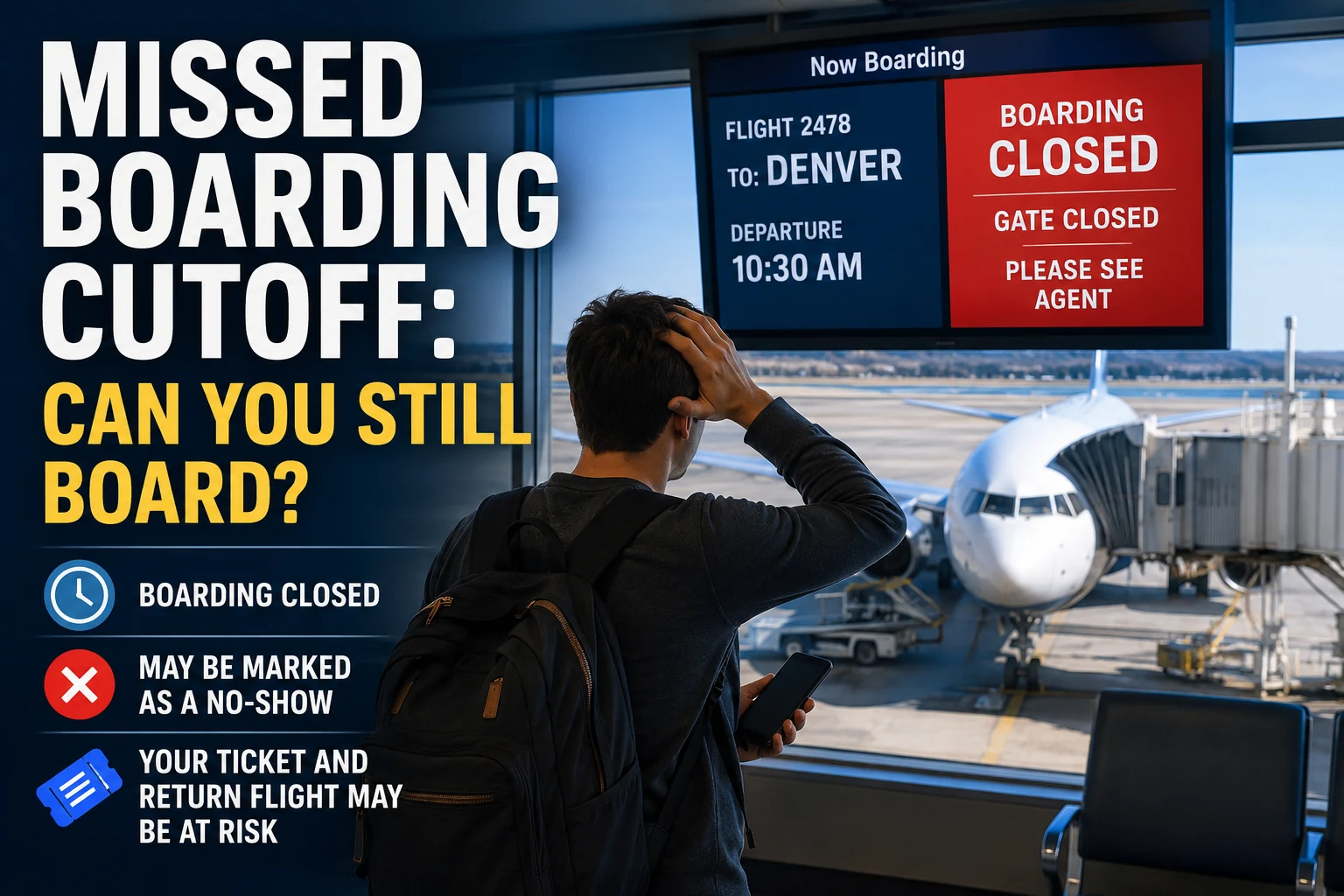
System Insight
The plane being at the gate does not mean boarding is still open.
- Departure time is not the real deadline because boarding usually closes before the aircraft is scheduled to leave.
- Gate status matters because the flight may already be closed in the airline system even if the aircraft has not moved.
- No-show status matters because missing one segment can affect the rest of the ticket.
- Speed matters because the faster you contact the airline, the better chance you have of preserving rebooking, standby, credit, or same-day options.
Departure Time Is Not the Same as the Boarding Cutoff
Most travelers think of the scheduled departure time as the deadline.
Airlines do not always treat it that way.
Boarding usually closes before departure. That gives the airline time to finalize the passenger list, handle required checks, close the aircraft door, coordinate with the crew, and prepare the flight to leave on time.
By the time a traveler reaches the gate, the plane may still be visible, but the flight may already be closed.
Boarding Timeline
Departure Time vs Boarding Cutoff vs No-Show
These three moments are not the same. The published departure time is what travelers notice, but the boarding cutoff is often the deadline that determines whether you can still get on the aircraft.
The Scheduled Time the Flight Leaves
This is the time printed on your itinerary, but it is not the last moment you can reach the gate. Airlines usually need boarding completed before this point.
The Real Gate Deadline
This is when boarding closes. After this point, the passenger list may be finalized, the seat may be released, and the aircraft may be prepared for departure.
The Ticket Status Can Change
If you miss the cutoff, the airline may treat you as a no-show. That can affect rebooking options and may put remaining flights on the same ticket at risk.
Quick rule: do not plan around the moment the plane leaves. Plan around the moment boarding closes.
What To Do Immediately If Boarding Has Closed
If boarding has closed, do not leave the airport and do not assume the trip is over.
Go directly to the gate agent, airline service desk, or airline app and ask what options are available. Depending on the airline, timing, ticket type, and reason you were late, you may be offered standby, same-day rebooking, a confirmed later flight, a fare-difference option, or limited credit.
The most important thing is to act before the ticket is treated as fully abandoned.
Ask the airline:
- whether you have already been marked as a no-show
- whether your return or remaining flights are still active
- whether you can be protected on a later flight
- whether same-day standby or rebooking is available
- whether checked bags are already loaded or need to be rerouted
- whether any fare difference, fee, or credit rule applies
- whether the airline can document the reason you missed boarding or the option they offered.
Some travelers refer to a “flat tire rule,” meaning an airline may try to help if you arrive shortly after missing a flight. But this is not a guaranteed passenger right, and it may depend on the airline, airport, agent, fare type, timing, and available seats.
Why You May Not Be Allowed to Board Even If the Plane Is Still There
Once boarding closes, the issue is no longer just whether the aircraft is physically present.
The flight may already be closed in the airline system. The gate agent may no longer be able to add passengers, the passenger count may be finalized, and the aircraft door may be ready to close or already closed.
That is why “but the plane is still here” does not always change the outcome.
From the airline’s perspective, the flight has moved from boarding to departure processing. At that point, reopening boarding can affect safety procedures, on-time departure, baggage handling, crew coordination, and the finalized passenger list.
The closer the flight is to departure, the less flexibility the gate may have.
How No-Show Status Can Affect the Rest of Your Ticket
Missing the boarding cutoff can become more serious when your flights are on the same itinerary.
Airline tickets are generally expected to be flown in order. If you miss one segment, the airline may treat the itinerary as broken. That can put later flights on the same ticket at risk, including remaining outbound segments or a return flight.
This page is not about whether your connection time was long enough. If your missed boarding cutoff happened during a connection, the key issue here is what happens after boarding has already closed.
Ask the airline to confirm whether the rest of your ticket is still active before you make any assumptions.
Gate Status Outcomes
Still Boarding vs Closing vs Closed
The difference between “almost too late” and “too late” can be small. Once boarding status changes, the airline’s options may change quickly.
You May Still Be Processed Normally
If boarding is open, the gate can usually scan your boarding pass and let you board, assuming no other issue applies.
You Are at Risk
If boarding is ending, the gate may be preparing to close the flight. A small delay can push you into missed cutoff status.
You May Not Be Added Back
Once boarding closes, the passenger list may be finalized and the flight may be closed in the system, even if the plane is still present.
Your Ticket May Be Affected
If the airline marks you as a no-show, rebooking, credit, standby, and remaining itinerary options may depend on the fare rules and airline policy.
Quick rule: the key question is not whether you can still see the plane. The key question is whether boarding is still open in the airline’s system.
Traveler Risk
Treating departure time as the real deadline can cost you the flight.
The risky assumption is thinking you still have time because the plane has not departed yet.
In reality, boarding may already be closed, the passenger list may be finalized, and your ticket may be moving toward no-show status. That can affect more than the flight in front of you.
If you are late to the gate, act immediately. Ask whether boarding is closed, whether you have been marked as a no-show, and whether the rest of your itinerary is still active.
Not Sure What To Do After Boarding Closes?
Missing the boarding cutoff can create a confusing mix of timing, ticket status, rebooking rules, standby options, checked bag handling, and no-show risk.
The faster you identify which issue applies, the easier it is to ask the airline the right questions.
Check the Fine Print
Not sure what missed boarding means for your ticket?
Use the Travel Fine Print Risk Checker to narrow whether your issue is a missed boarding cutoff, no-show status, rebooking problem, remaining itinerary risk, checked bag issue, or airline support question.
What To Ask the Airline Right Away
If boarding has closed, your goal is not to argue about whether the plane is still there.
Your goal is to find out what the airline system shows now, what options are still available, and whether the rest of your ticket can be protected.
Action Step
Ask the airline to protect the rest of your trip before you leave the airport.
If you miss the boarding cutoff, get clarity immediately. The right question is not only whether you can still board. It is whether your ticket, return, bags, credit, and rebooking options are still active.
- Ask whether boarding is closed or whether the flight is still accepting passengers.
- Ask whether you have already been marked as a no-show.
- Confirm whether your remaining flights or return flight are still active.
- Ask whether you can be protected on the next available flight.
- Check whether same-day standby or confirmed rebooking is available.
- Ask whether a fare difference, fee, or new ticket purchase is required.
- Confirm what happens to any checked bags already accepted by the airline.
- Save screenshots of the app, gate status, rebooking options, and airline messages.
Quick win: do not walk away from the gate or airport until you know whether the rest of your itinerary is still protected.
Before You Leave the Gate
Even if the first agent says there is nothing they can do, make sure you understand what has already happened to your ticket.
The most important thing is to document the timing, the airline’s response, and whether the rest of your itinerary is still active. If you later need to dispute a charge, request credit, file a claim, or explain what happened, those details matter.
Before You Walk Away
Save proof of what happened at the gate.
Use the Travel Documents Checklist to save screenshots, boarding pass details, gate status, rebooking messages, checked bag updates, airline responses, and remaining itinerary details before you leave the airport.
When Missing Boarding Is Most Likely to Hurt the Rest of Your Trip
Missing the boarding cutoff is most risky when the missed flight is part of a larger ticket.
That can include an outbound flight with a return attached, a multi-segment itinerary, or a trip where checked bags were already accepted. The more the airline system has to unwind, the more important it is to confirm what remains active.
This is also why you should avoid guessing based on what the app shows at first glance. Airline apps can lag, rebooking options can change, and a ticket that still appears visible may still need agent action to protect the rest of the trip.
Travel Fine Print Takeaway
The plane being at the gate does not mean boarding is still open. Once the boarding cutoff passes, you may be treated as a no-show, and the rest of your ticket may be affected. If you miss boarding, contact the airline immediately and confirm whether your remaining flights, rebooking options, checked bags, and ticket value are still protected.
❓Frequently Asked Questions
These questions explain what can happen after a missed boarding cutoff, why the plane may still be at the gate, and what to ask the airline before leaving the airport.
Can you still board if the plane is still at the gate?
Not always. The plane may still be at the gate, but boarding can already be closed in the airline system. Once that happens, the passenger list may be finalized and the gate may no longer be able to add you back.
If this happens, speak with the gate agent or airline service desk immediately instead of assuming you can still board.
What happens if I miss the boarding cutoff?
If you miss the boarding cutoff, the airline may treat you as a no-show. Your seat may be released, the flight may be closed, and your options may shift from boarding the flight to rebooking, standby, credit, or buying a new ticket.
The exact outcome depends on the airline, fare type, ticket status, timing, and available seats.
Can missing boarding cancel my return flight?
It can. If your flights are on the same ticket, missing one segment may affect later flights on the itinerary, including a return flight. Airlines generally expect ticket segments to be flown in order.
Before leaving the airport, ask the airline whether your remaining flights are still active.
Will the airline rebook me if I miss boarding?
Maybe. Some airlines may offer standby, same-day rebooking, a later confirmed flight, a credit option, or a fare-difference option. Others may require a new ticket, especially if the fare rules are restrictive or the ticket has already been marked as a no-show.
Ask the airline what options are available before the rest of your itinerary is affected.
Is there a two-hour or flat tire rule if I miss boarding?
Sometimes travelers refer to a “two-hour rule” or “flat tire rule,” meaning an airline may try to help if you arrive shortly after missing a flight. But this is not a guaranteed passenger right. It may depend on the airline, fare type, airport, timing, agent discretion, and available seats. The safest move is to contact the airline immediately and ask about standby, same-day rebooking, fare difference, credit, or next-flight options before leaving the airport.
Whether the airline helps may depend on the carrier, airport, agent, fare type, timing, and available seats.
What should I do first if boarding has closed?
Go directly to the gate agent, airline service desk, or airline app. Ask whether you have been marked as a no-show, whether your remaining flights are still active, and whether rebooking, standby, same-day change, credit, or checked bag options are available.
Do not leave the airport until you understand what happened to the rest of your ticket.
Bottom Line
A missed boarding cutoff is not the same as arriving after the plane leaves.
You may be able to see the aircraft, but boarding may already be closed in the airline system. Once that happens, the passenger list may be finalized, the aircraft may be in departure processing, and you may no longer be allowed to board.
The bigger risk is what happens next.
If you are marked as a no-show, the impact may extend beyond the flight in front of you. Remaining flights on the same ticket, including a return flight, may be affected depending on the airline, fare rules, and ticket status.
Do not focus only on whether the plane is still at the gate.
Focus on whether boarding is still open, whether you have been marked as a no-show, and whether the rest of your itinerary is still protected.
If you miss the boarding cutoff, act immediately. Speak with the airline, confirm your ticket status, ask about rebooking or standby, and save proof of what the airline tells you before leaving the airport.
Related Guides
If you are trying to understand what happens after a missed boarding cutoff, these related guides can help you separate gate timing, missed-flight rules, refunds, credits, and airline support options.
Missed Flights and Airline Disruptions
- What Happens If You Miss Your Flight?
A broader guide to missed flights, rebooking options, no-show rules, and what to do after missing a flight. - Do Airlines Compensate You for Delays?
Helpful if a delay caused you to miss boarding and you need to understand the difference between airline support, compensation, and rebooking. - Flight Canceled: Refund or Credit?
Use this if the airline cancels or significantly changes your flight and you need to know whether a refund or credit may apply.
Refunds, Credits, and Ticket Value
- Airline Refund vs Travel Credit: What’s the Difference?
Helpful if the airline offers a credit instead of cash after a missed flight, missed boarding cutoff, or rebooking issue. - Non-Refundable Flights: What Travelers Should Know Before Booking
Use this if your missed boarding issue involves a restrictive fare, airline credit, change limits, or possible loss of ticket value. - Why the Checkout Price Isn’t Always the Final Travel Cost
Helpful if rebooking creates new costs, fare differences, baggage fees, seat charges, or other expenses after the original ticket was purchased.
Travel Documents and Proof
- Travel Insurance Claim Denied for Lack of Documentation
Helpful if you may need proof of what happened at the gate, when boarding closed, or how the airline handled your missed boarding issue. - Travel Insurance Claim Proof: What Documents You May Need
Helpful if you need records showing when boarding closed, what the airline offered, or how the missed boarding issue affected your trip.