
Separate-Ticket Connection Risk
Missed Connection on Separate Tickets: Is the Airline Responsible?
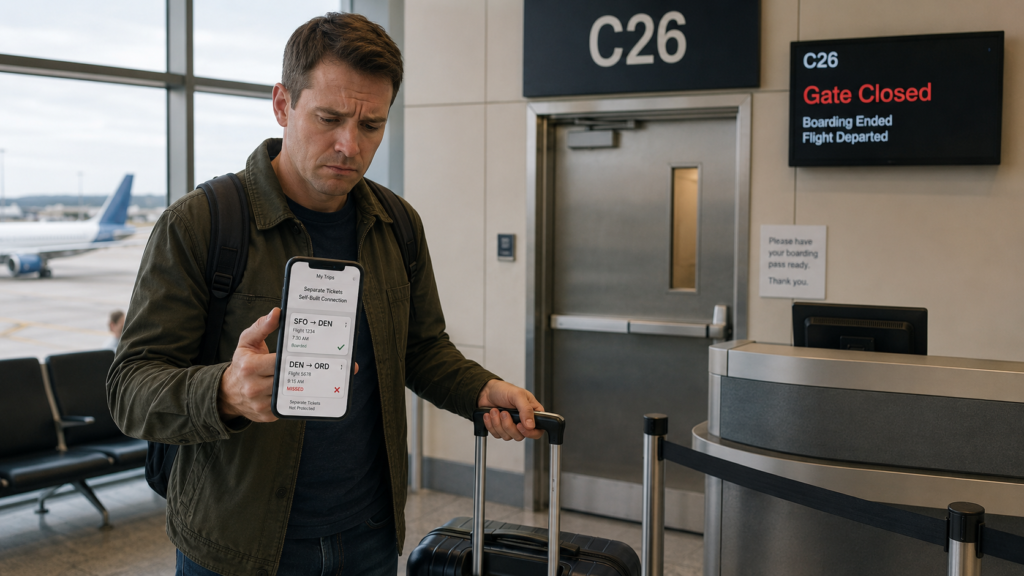
Two flights can look like one connecting trip but still be treated as separate journeys by the airline.
If the first flight is delayed and you miss the second, the airline may not be required to protect or rebook the second ticket—even when both flights are on the same airline.
What Determines Your Protection
Check how the connection was actually built
- Ticket structure. Flights issued together are more likely to be treated as one protected itinerary than flights issued on separate tickets.
- Second-flight deadlines. A separate ticket may have its own check-in, bag-drop, boarding, and no-show rules.
- Baggage and transfer steps. You may need to collect bags, recheck them, change terminals, or clear security or immigration before the next flight.
- Airline assistance. An airline may choose to help with a separate-ticket misconnection, but that is not the same as having a protected connection.
The airline name is not the deciding factor. Two flights on the same airline can still be separate tickets with different missed-connection consequences.
About this guidance: Travel Fine Print reviews airline booking structures, ticket rules, connection protection, baggage requirements, and the operational consequences travelers can face when separate reservations are combined into one trip. This guidance focuses on the details that can determine whether a missed connection is protected, whether an airline is required to rebook you, and what costs or responsibilities may shift back to the traveler.

How It Works
Four Details Determine Whether a Connection Is Protected
A connection can look seamless on your itinerary while being treated very differently behind the scenes. The key issue is whether the flights are part of one protected journey or separate bookings with separate obligations.
Ticket Structure
Flights issued together are generally treated differently from flights booked and ticketed separately, even when the same airline operates both.
Connection Protection
On a protected itinerary, the airline may be responsible for getting you to your destination after a disruption. Separate tickets may not carry that same protection.
Transfer Requirements
Separate tickets can require you to collect baggage, recheck it, clear security or immigration, change terminals, and meet a new set of check-in deadlines.
Missed-Flight Consequences
If the first flight causes you to miss the second, the later ticket may be treated as a no-show and you may need to pay for another flight yourself.
Why this matters: The flights appearing together in an app, confirmation email, or travel plan does not necessarily mean the airline considers them one protected connection.
Why Separate Tickets May Not Be Protected
Separate tickets may not be protected because the airline system may treat each flight as a separate trip. Even if the flights are on the same airline, the second ticket may have its own check-in deadline, boarding cutoff, baggage rules, and no-show consequences.
That means a delay on the first ticket does not automatically require the airline to protect the second ticket. The airline may still choose to help, especially if both flights are on the same airline, but that is different from the protection you usually get when the flights are issued as one connected itinerary.
The key question is whether the flights were ticketed together, not whether they appeared together in your plans.
When a connection is missed, the most important detail is not always which airline caused the delay. It is how the flights were ticketed.
Use the comparison below to identify whether your trip was likely protected or self-built before deciding what the airline may owe you.
Same Ticket
- Flights are linked under one itinerary
- The airline can usually see the full trip
- Missed connections are more likely to trigger rebooking help
- Baggage is more likely to transfer automatically
Separate Tickets
- Flights are booked as separate reservations
- The airline may treat the second flight as a separate trip, even if it is the same airline
- A missed connection may be treated as your responsibility
- You may need to collect and recheck baggage yourself
What If the Next Available Flight Is Tomorrow?
A missed separate-ticket connection can become more expensive when the next usable flight is not until the following day. In addition to replacing or changing the second ticket, you may also need to arrange an overnight stay near the airport.
Do not assume the airline that delayed your first flight will automatically pay for the hotel. Ask what assistance is being offered before you book, but if the connection was not protected, the cost of the room may initially fall to you.
If you pay for a hotel yourself, keep the itemized receipt along with any written information showing the delay, missed connection, and airline response. Those records may matter if you later seek reimbursement through the airline, travel insurance, or a credit-card travel benefit.
TFP Recommended Next Step
If You’re Stranded Overnight, Compare Nearby Airport Hotels
If the airline is not providing accommodations and your next flight is not until tomorrow, you may need to arrange the room yourself. Compare nearby airport hotels, current rates, and available options before deciding where to stay.
Compare airport-area hotels and current rates
Are Airlines Responsible for Missed Connections on Separate Tickets?
When flights are booked on separate tickets, the airline may not treat you as a protected connecting passenger.
This can happen even when both flights are on the same airline. The issue is not only whether the airline name is the same. The issue is whether the flights were issued as one connected itinerary or as separate tickets.
From the airline’s perspective, a separate second ticket may be treated as its own trip. If you do not arrive for check-in, boarding, baggage drop, or departure on time, the airline may treat you as a no-show rather than a delayed connecting passenger.
That is the key difference between a protected connection and a self-built connection. A trip can look connected in your plans but still be treated as separate bookings by the airline system.
A protected connection depends on how the flights were ticketed, not just whether they appear back-to-back or involve the same airline. If the flights were issued separately, the airline may treat each ticket as its own trip.
This is why the same delay can lead to different outcomes. On one ticket, the airline may help protect the rest of your trip. On separate tickets, the airline may say the missed flight is your responsibility.
What Happens If You Miss the Second Flight?
Missing the second flight does not always lead to the same outcome. The result usually depends on whether the flights were booked as one protected itinerary or as separate tickets.
Separate tickets do not always mean different airlines. You can have separate tickets on the same airline, especially when using points, booking award space, combining one-way fares, or piecing together a route that was not available as one itinerary.
That distinction matters.
If the flights were booked on one ticket, the airline can usually see the full itinerary and may rebook you to your final destination when a delay causes the missed connection. The exact help depends on the airline, route, fare rules, and reason for the delay.
If the flights were booked separately, the second flight may still be treated as its own trip. Even if both flights are on the same airline, the airline may not be required to protect the second ticket the same way it would protect a true connecting itinerary.
That can mean:
- You may be marked as a no-show.
- Your ticket may lose value.
- You may need to buy a new ticket at the current price.
- The airline may not provide meals, hotel coverage, or compensation.
- Your bags may not be automatically transferred to the next flight.
Same-airline separate tickets may give you a better chance of getting help, especially if you allowed a long buffer and the airline can see both reservations. But that is different from having a protected connection.
The financial risk is not just missing the flight. It is having to fix the trip at the last minute after the airline says the connection was not protected.
Separate tickets can still be risky even when both flights are on the same airline. The airline may be more likely to help, but separate ticket numbers usually do not provide the same protection as one connected itinerary.
The next question is whether passenger rights change depending on where the trip starts. U.S., European, and international rules can affect delay compensation, but they do not automatically turn separate tickets into a protected connection.
Do Passenger Rights Protect Separate-Ticket Connections?
Passenger rights can vary depending on where your flight departs, which airline operates the flight, and what caused the delay.
But separate tickets add another layer.
If your flights are on one protected itinerary, a missed connection caused by a delay may trigger rebooking help. In some regions, such as the European Union or the United Kingdom, compensation may also apply if the delay meets certain rules and was within the airline’s control.
If your flights are on separate tickets, those protections may be harder to rely on. The first airline may only be responsible for the delayed flight it operated. The second airline may say your missed departure was tied to a separate booking that it did not control.
So the key question is not only where your trip started. It is whether the missed connection was part of a protected itinerary.
Quick Check: Which Situation Applies?
- Same ticket + airline-caused delay: You are more likely to be rebooked, and compensation may apply in some regions.
- Separate tickets + missed second flight: You are usually more exposed, even if the delay was outside your control.
- Same airline but separate tickets: Help may be more likely, but protection is not guaranteed.
- Weather, air traffic control, or airport disruption: Compensation is less likely, though rebooking may still be offered on protected itineraries.
- U.S. departure: Expect policy-based assistance more than automatic compensation.
This section keeps the point without turning into a passenger-rights article.
Why Separate Tickets Are Not Treated Like One Trip
Airlines manage connections based on how the flights were issued, not just how the trip looks to the traveler.
When flights are booked on one ticket, the itinerary is linked. The airline system can usually see the full route, connection timing, ticket rules, and final destination. That is what gives the trip a stronger chance of being treated as a protected connection.
Separate tickets can break that link.
Even if the flights are on the same airline, each ticket may have its own rules, fare conditions, check-in requirements, and no-show consequences. The airline may be able to see both reservations, but that does not always mean it has to protect the second flight if the first one is delayed.
This often happens when travelers use points, combine paid and award tickets, book one-way fares, add positioning flights, or build a route that was not available as one itinerary.
The airline name is not the only thing that matters. Two flights on the same airline can still be separate tickets if they were issued separately. That can affect rebooking, baggage handling, check-in, and missed-connection protection.
The risk is not the same in every separate-ticket situation. Some setups are much safer than others, especially when you build in enough time and avoid baggage complications.
When Separate Tickets Are Riskiest
Separate tickets are not equally risky in every situation.
Some travelers use separate tickets carefully and still reduce the risk. Others accidentally create a fragile connection without realizing it. The difference usually comes down to time, baggage, airport complexity, airline flexibility, and whether the second ticket has strict no-show rules.
Separate tickets are riskier when:
- The layover is short or close to the minimum connection time.
- The flights are on different airlines that do not coordinate with each other.
- You need to change terminals or airports.
- You have checked bags that must be collected and rechecked.
- The connection involves immigration, customs, or another security screening.
- The second ticket is a basic economy, award, or restricted fare with limited flexibility.
- The second flight is the last flight of the day.
- You are traveling during weather-prone or high-delay periods.
Separate tickets are less risky when:
- You allow a long buffer between flights.
- Both flights are on the same airline or partner airlines.
- You travel with carry-on bags only.
- You avoid tight international connections.
- You choose airports where transfers are simpler.
- You have a backup flight option later the same day.
- The second ticket has some flexibility or same-day change options.
A same-airline separate ticket with a 3–4 hour buffer may be much less risky than two unrelated airlines with a 60-minute connection. But it is still not the same as a protected itinerary.
If separate tickets are unavoidable, reduce the risk before you book. Choose a longer layover, avoid checked bags when possible, stay with the same airline when it makes sense, and confirm whether the airline can link or note the reservations.
What To Do Before or After Booking Separate Tickets
Separate tickets are easiest to manage before you buy them, but there are still steps you can take if you already booked.
First, check whether the flights are truly separate. Look for separate ticket numbers, separate confirmation numbers, separate receipts, or bookings made through different channels. A trip can appear together in an app but still be issued as separate tickets.
Before travel, check:
- Whether the flights can be booked on one ticket instead. Even if it costs more, the added protection may be worth it.
- How much buffer time you really have. Do not rely only on scheduled arrival and departure times.
- Whether checked bags need to be collected and rechecked. This can turn a reasonable layover into a risky one.
- Whether the connection involves customs, immigration, terminal changes, or security screening.
- Whether both flights are on the same airline. This may make help more likely, but it does not automatically create a protected connection.
- Whether the second ticket has flexible change rules.
- Whether there is a later backup flight. If the second flight is the last flight of the day, the risk is higher.
If you already booked separate tickets, contact the airline before departure and ask whether the reservations can be linked, noted, or viewed together. Also confirm baggage handling and the check-in or bag-drop cutoff for the second flight.
If a delay begins, contact the airline before the second flight closes. Same-airline separate tickets may be easier to discuss with an agent, especially if both reservations can be viewed or noted together.
Linking or noting separate reservations may help an agent understand your trip, but it usually does not turn separate tickets into one protected itinerary. Treat it as a helpful backup step, not a guarantee.
Even careful planning cannot remove every risk. But it can help you avoid the most expensive separate-ticket mistakes: short layovers, checked-bag surprises, last-flight-of-the-day exposure, and assuming the airline must protect a trip it did not ticket as one itinerary.
❓Frequently Asked Questions
Separate-ticket connections can be confusing because the flights may look connected to you, but airlines may treat them as separate trips. These questions address the most common missed-connection risks.
Is an airline responsible if I miss a connection on separate tickets?
Usually, no. If the flights were booked on separate tickets, the airline may not be required to protect, rebook, or compensate you after a missed connection. The second flight may be treated as a separate trip.
Are separate tickets protected if both flights are on the same airline?
Not always. Same-airline separate tickets may give you a better chance of getting help, especially if the airline can see both reservations. But they usually do not provide the same protection as one connected itinerary.
Can the airline rebook me if I miss a separate-ticket connection?
The airline may choose to help, but it may not be required to rebook you for free. Help is more likely when both flights are on the same airline, you allowed a reasonable buffer, and you contact the airline before the second flight closes.
Do separate tickets always mean different airlines?
No. Separate tickets can be on the same airline. This often happens when using points, booking award space, combining one-way fares, or building a route that was not available as one itinerary.
Will my bags transfer automatically on separate tickets?
Not necessarily. With separate tickets, you may need to collect your checked bags, check in again, recheck the bags, and go back through security. Confirm this before travel.
How much time should I allow between separate-ticket flights?
There is no single safe amount of time. A longer buffer is safer, especially for international flights, checked bags, terminal changes, or airports with frequent delays.
Can I ask the airline to link separate reservations?
Yes, and it is often worth asking. The airline may be able to note or associate the reservations, but this usually does not turn separate tickets into one protected itinerary.
Bottom Line
Separate tickets can sometimes save money, unlock better routing, or make points bookings possible. But they also change who carries the risk if a connection is missed.
The key issue is not whether the flights appear connected, use the same airline, or show up together in your travel plans. The key issue is whether they were issued as one protected itinerary.
If your flights are on separate tickets, the airline may still choose to help, especially when both flights are on the same airline and you allowed a long buffer. But that is not the same as having guaranteed missed-connection protection.
Before booking separate tickets, compare the savings or points value against the real downside: missed flights, no-show rules, baggage problems, and the cost of buying a replacement ticket at the last minute.
Related Guides
Missed Flights and Connection Problems
- What Happens If You Miss a Flight?
Learn how missed flights, no-shows, skipped segments, and return-flight risks can affect the rest of your itinerary. - What Happens If an Airline Changes Your Flight?
See how schedule changes can affect connections, rebooking options, and trip timing. - Short Layovers: When a Connection Is Too Risky
Use this before booking tight connections, airport changes, checked bags, or self-transfer itineraries.
Airline Responsibility and Rebooking
- Are Airlines Responsible for Weather Delays?
Understand when airlines may help with rebooking and when compensation or extra support may be limited. - Why Airlines Don’t Rebook You on Earlier or Better Flights
Learn why airline rebooking options may be limited by fare rules, seat availability, ticket type, airport control, and what the airline is actually required to offer.
Refunds, Credits, and Travel Insurance
- Airline Refund vs Travel Credit: What’s the Difference?
See why a refund and a credit do not give you the same control after a disrupted trip. - Does Travel Insurance Cover Flight Delays?
See when trip-delay benefits may reimburse meals, lodging, transportation, and other costs—and which waiting periods, limits, and claim requirements apply. - Travel Insurance Claim Proof: What Your Documents Need to Prove
Use this if you may need to document a delay, missed connection, extra cost, or unrecovered loss.