
You booked the cheaper hotel rate because the price looked better.
Then your plans changed.
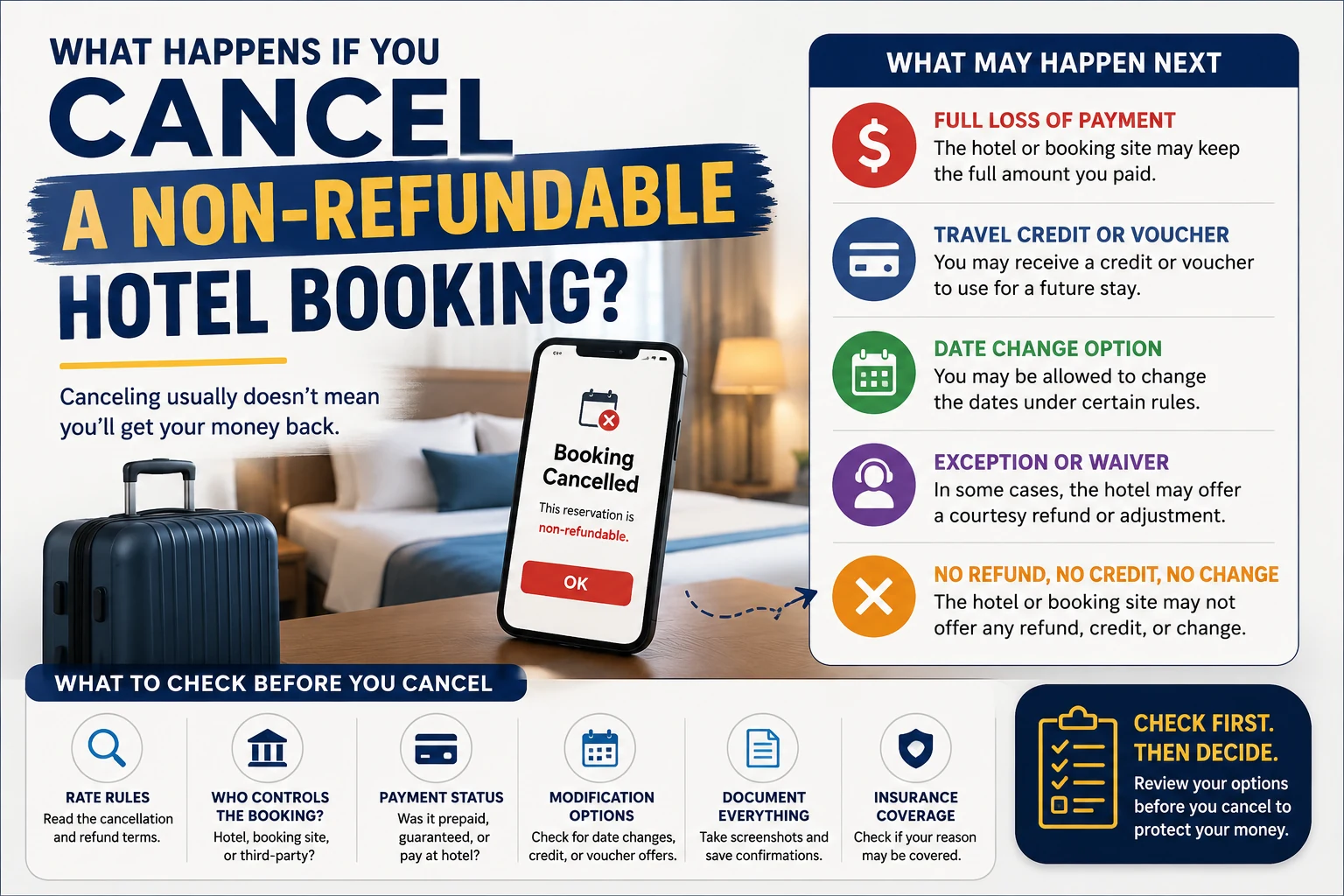
Now the question is not just whether you can cancel. It is what happens after you cancel — and whether canceling leaves you with any refund, credit, date-change option, or exception request.
With a non-refundable hotel booking, canceling usually does not create a new refund decision. It usually triggers the rules that were already attached to the reservation when you booked.
That does not always mean you have zero options. In some cases, you may still be able to ask for a date change, travel credit, waiver, or goodwill exception.
But you should not assume one will be offered.
This guide explains what usually happens when you cancel a non-refundable hotel booking, when you may still have options, and what to check before giving up the reservation.
What happens if you cancel a non-refundable hotel booking?
In most cases, canceling a non-refundable hotel booking means you lose the amount tied to that rate. Canceling usually releases the room, but it does not automatically reverse the charge.
That does not always mean you have no options. Before canceling, check whether the booking allows a date change, travel credit, waiver, or manual exception. The best option may be to modify the reservation instead of canceling it outright.
System Insight
Canceling does not restart the refund decision.
- The rate rules matter because the refund outcome is usually attached to the booking before you cancel.
- Canceling releases the room, but it does not automatically reverse a prepaid charge or non-refundable penalty.
- Timing may not change the result because canceling early does not always override non-refundable terms.
- Modification options matter because a date change, credit, or exception request may preserve value before the reservation is fully canceled.
What to check before you cancel
Before canceling a non-refundable hotel booking, check the pieces that decide whether you lose everything, recover value, or still have room to ask for help.
Rate rules
Look for the exact cancellation, refund, modification, and no-show language attached to your reservation.
Payment status
Check whether the booking was prepaid, deposit-based, guaranteed by card, or scheduled to charge later.
Booking channel
Find out whether the hotel, brand, travel agent, or third-party platform controls the reservation and money.
Modification options
Before canceling, check whether the system allows a date change, credit, or rebooking option.
Exception path
If the rules say no refund, you are asking for discretion — not exercising a guaranteed right.
Insurance coverage
Travel insurance may help only if your cancellation reason is covered and properly documented.
Check the Rate Rules First
The first thing to check is the exact cancellation language attached to your reservation.
Do not rely only on the phrase “non-refundable.” Look for the specific terms that explain what happens if you cancel, modify, miss the stay, or fail to arrive by the required time.
The most important details are usually:
- whether the booking is fully non-refundable after confirmation
- whether only part of the booking is non-refundable
- whether date changes are allowed
- whether a credit may be issued instead of a refund
- whether a no-show penalty is different from a cancellation penalty
- whether taxes, fees, or deposits are handled differently
If the rules say the booking is non-refundable once confirmed, canceling early may not change the outcome. The system may simply apply the rule and keep the amount paid.
Quick check: Save a screenshot of the cancellation terms before canceling. Once the reservation is canceled, the original rules may be harder to access.
Check Whether the Booking Was Already Charged
Payment status matters because not every non-refundable booking is handled the same way.
Some hotel bookings are prepaid immediately. Some only require a deposit. Some are guaranteed by a card but charged closer to arrival. Others are collected by a booking platform instead of the hotel.
Before canceling, check:
- whether your card was already charged
- whether the charge came from the hotel or a booking site
- whether the payment was a deposit, full prepayment, or authorization hold
- whether the confirmation says “pay now,” “pay at property,” or “prepaid”
- whether any taxes or fees are refundable separately
If the booking was already prepaid, cancellation may only release the room. It may not send the money back unless the rate rules allow it.
If the booking was not charged yet, do not assume you are safe. A non-refundable reservation may still be charged later if you cancel after the penalty period or fail to show up.
Quick check: Compare your confirmation email with your card statement so you know who actually collected the payment.
Find Out Who Controls the Booking
Before asking for a refund, credit, or exception, figure out who controls the reservation.
If you booked directly with the hotel or hotel brand, the property or brand support team may have more ability to review the booking, offer a date change, or approve a goodwill exception.
If you booked through a third-party site, the hotel may not control the money or the cancellation rules. The hotel might see the reservation, but still tell you to contact the booking platform.
Check:
- where you made the booking
- who sent the confirmation email
- who charged your card
- whether the hotel sees the booking as prepaid or third-party
- whether the platform has its own cancellation terms
This matters because the person you call first may not be the person who can actually approve anything.
If the hotel says the booking site controls the reservation, ask the platform whether it can contact the hotel on your behalf. If the platform says the hotel must approve the exception, ask them to document that request.
Quick check: The party that collected the payment usually has the most control over the refund process.
Look for Modification Options Before Canceling
Before canceling a non-refundable hotel booking, check whether you can modify it instead.
This is one of the most important steps because canceling may close the reservation, while modifying may preserve some value.
Look for options such as:
- changing the arrival date
- moving the reservation to a future stay
- accepting a hotel credit
- paying a rate difference for new dates
- switching to another room type
- requesting a one-time courtesy change
Some hotels will say no to a cash refund but may still allow a date change. That is why asking only “Can I get my money back?” may limit the conversation too early.
A better first question is:
“Before I cancel, can you check whether this reservation can be changed, credited, or moved to another date?”
If a date change is possible, confirm whether the new stay must be completed by a certain deadline and whether you will owe any rate difference.
Quick check: If the website gives you both “cancel” and “modify” options, check “modify” first.
Know When You Are Asking for an Exception
If the booking terms say the reservation is non-refundable, then a refund request is usually not a standard policy request. It is an exception request.
That distinction matters.
A policy request means the rules already allow the outcome. An exception request means you are asking the hotel or booking site to override the rule.
Exceptions are more likely when:
- you booked directly with the hotel
- you contact the hotel before the arrival date
- you ask for a date change instead of cash back
- you have documentation for an emergency or disruption
- you are a loyalty member or repeat guest
- the hotel has enough time to resell the room
- the rate rules allow limited discretion
Even then, approval is not guaranteed.
When asking, keep the message simple and realistic:
“I understand this was booked under a non-refundable rate. Before I cancel and lose the full amount, could you check whether a date change, credit, or one-time exception is possible?”
This framing works better than demanding a refund because it recognizes the rule while still asking whether another option exists.
Quick check: If the answer is no, ask whether that applies to refunds only or also to date changes and credits.
Check Whether Travel Insurance Applies
Travel insurance may help with a non-refundable hotel booking, but only if your cancellation reason is covered by the policy.
Most travel insurance does not reimburse every reason a traveler cancels. A change of plans, work conflict, preference change, or cheaper alternative may not qualify unless your policy includes a benefit that applies.
Before assuming insurance will pay, check:
- whether hotel costs are included in the policy
- whether your reason is a covered reason
- whether you bought the policy before the issue occurred
- whether documentation is required
- whether the hotel cost was actually non-refundable
- whether Cancel For Any Reason coverage applies, if purchased
You may need proof of payment, the cancellation confirmation, the hotel’s denial or non-refundable terms, and documentation supporting the reason for cancellation.
Travel insurance can help in the right situation, but it is not the same as booking a refundable hotel rate.
Quick check: Do not cancel without saving proof that the booking was non-refundable. Your insurer may ask for it later.
Travel Fine Print Takeaway
Before you cancel, check whether the booking can be changed instead. With a non-refundable hotel reservation, a date change, credit, or exception request may preserve more value than canceling first and asking questions later.
At this point, the issue is not whether the rate was a good deal when you booked it. The issue is what happens next if you cancel.
That is where many travelers make the costly mistake: they cancel first, then try to recover the value afterward.
With a non-refundable hotel booking, the order matters.
Canceling too quickly can close off better options
If you cancel first and ask questions later, the reservation may be closed under the original non-refundable terms. Before canceling, check whether a date change, credit, or exception request is possible. Once the booking is canceled, the hotel or platform may have less flexibility to help.
Check the Fine Print
Not Sure What Happens If You Cancel?
Use the Travel Fine Print Risk Checker to review the booking type, payment status, cancellation terms, and booking channel before you cancel, dispute the charge, or assume the money is gone.
Do this before canceling a non-refundable hotel booking
Before you click cancel, gather the information that determines whether you lose the full amount or still have another path.
- Read the cancellation and no-show terms in your confirmation.
- Check whether the booking allows date changes.
- Look for credit, waiver, or exception language.
- Confirm who charged your card.
- Contact the hotel before canceling if you booked direct.
- Contact the booking platform if it controls the reservation.
- Ask about modification before requesting a refund.
- Save screenshots of the terms and any cancellation screen.
Quick win: Ask about a date change or credit before canceling. You may preserve value that a completed cancellation would otherwise erase.
Before You Cancel
Save the Booking Terms Before They Disappear
Keep screenshots of the rate rules, cancellation terms, payment receipt, modification options, and any hotel or booking-site messages before you cancel, dispute the charge, or assume the money is gone.
Why Proof Matters Before You Cancel
Once a non-refundable hotel booking is canceled, the details can become harder to prove.
The cancellation screen may disappear. The rate rules may no longer display the same way. The booking site may show only the final cancellation status instead of the full terms you agreed to when you booked.
That matters if you later need to ask for a credit, dispute a charge, file a travel insurance claim, or show that you tried to modify the reservation before canceling.
Before canceling, save anything that shows:
- the rate was non-refundable
- the payment was already charged or guaranteed
- the cancellation deadline
- any date-change or credit option
- who controlled the booking
- the cancellation confirmation
- any messages from the hotel or booking site
This does not guarantee you will get money back. But it gives you a clearer record if you need to challenge the outcome, request an exception, or prove the booking terms later.
The goal is simple: do not cancel first and try to reconstruct the fine print afterward.
❓Frequently Asked Questions
These questions explain what usually happens after canceling a non-refundable hotel booking, whether early cancellation helps, and when a credit, date change, exception, or insurance claim may still be possible.
Can I get a refund if I cancel a non-refundable hotel booking early?
Usually, no. Canceling early does not automatically change the rate rules. If the booking was non-refundable once confirmed, the hotel or booking site may keep the payment even if you cancel well before arrival. Acting early may still help if you are asking for a date change, credit, waiver, or exception before the reservation is fully canceled.
What happens if I cancel a non-refundable hotel reservation?
Canceling usually releases the room, but it does not automatically reverse the charge. The hotel or booking platform will normally apply the cancellation terms attached to the rate you booked. Depending on the reservation, you may lose the full amount, be offered a credit, be allowed to change dates, or be told that no refund or modification is available.
Is it better to cancel or just not show up?
Canceling is usually better than doing nothing. A no-show may be treated as a forfeited stay, and it can reduce your chance of requesting a credit, date change, or goodwill adjustment later. Before canceling, check whether the booking can be modified.
Can the hotel override a non-refundable policy?
Sometimes, but it is discretionary. If the rate is truly non-refundable, the hotel may not be required to refund the booking. However, it may still offer a date change, credit, partial refund, or waiver in limited situations. If you are asking for help, frame the request around available options rather than demanding a refund first.
Why does the hotel say I need to contact the booking site?
If you booked through a third-party platform, the hotel may not control the payment or cancellation terms. In that case, the booking site may need to process the cancellation, request hotel approval, or explain the refund decision. Check who sent the confirmation, who charged your card, and whether the hotel sees the reservation as prepaid, direct, or third-party.
Does travel insurance cover non-refundable hotel cancellations?
Only if your cancellation reason is covered by the policy. Travel insurance may require documentation, proof that the hotel cost was non-refundable, and evidence that you canceled for a covered reason. Simple changes of plans, preference changes, or work conflicts are often not covered unless the policy includes a specific benefit that applies.
Should I ask for a refund or a date change first?
If the booking is clearly non-refundable, asking for a date change or credit first may be more effective than demanding cash back. Some hotels are more willing to preserve value than reverse the charge completely. A useful question is: “Before I cancel, can you check whether this reservation can be changed, credited, or moved to another date?”
Bottom Line
Canceling a non-refundable hotel booking usually does not trigger a refund. It usually triggers the rules that were attached to the reservation when you booked.
That may mean losing the full amount, but not always. Depending on how you booked, who controls the payment, and what the rate rules allow, you may still be able to ask for a date change, travel credit, waiver, or goodwill exception.
Before canceling, check the terms, identify who controls the booking, and look for modification options first.
The key question is not only:
“Can I cancel?”
It is:
“What happens after I cancel — and do I have any way to recover value before I give up the reservation?”
Related Guides
If you are canceling or trying to recover value from a non-refundable hotel booking, these guides can help you understand the related cancellation rules, payment issues, documentation needs, and insurance limits that may affect what happens next.
Hotel Cancellation and Refund Rules
- Hotel Cancellation Policies Explained
Use this to understand cancellation windows, penalty periods, refundable rates, partial refunds, and when a hotel may keep part or all of the booking cost. - Hotel No-Show Charges Explained
Helpful if you missed the stay or are deciding whether canceling is better than simply not showing up. - Are Non-Refundable Hotel Rates Worth It?
Use this before booking if you are deciding whether the cheaper non-refundable rate is worth the risk.
Hotel Payments, Deposits, and Charges
- Pay Now vs Pay at Hotel: Which Option Is Safer?
Helpful if you are comparing prepaid hotel rates, pay-at-property bookings, and how payment timing affects your options later. - Do You Get Hotel Deposits Back? What Travelers Should Know
Use this if your booking involved a deposit and you need to know whether it is refundable, partially refundable, or tied to the cancellation deadline. - Can Hotels Charge You After Checkout? What Travelers Should Know
Helpful if you are worried about delayed charges, cancellation penalties, incidentals, or post-stay billing.
Travel Insurance and Documentation
- Why Travel Insurance Claims Get Denied — And What to Check Next
Use this before assuming travel insurance will reimburse a non-refundable hotel booking. - Do You Need Travel Insurance If Your Flight or Hotel Is Refundable?
Helpful if you are comparing refundable bookings, non-refundable bookings, and whether insurance still adds protection. - What Documents Do You Need for a Travel Insurance Claim?
Use this if you may need proof of payment, cancellation terms, receipts, denial messages, or documentation showing why the booking was non-refundable.