
A flight looks affordable. A hotel seems like a deal. A vacation package appears to fit the budget.
Then the total starts climbing.
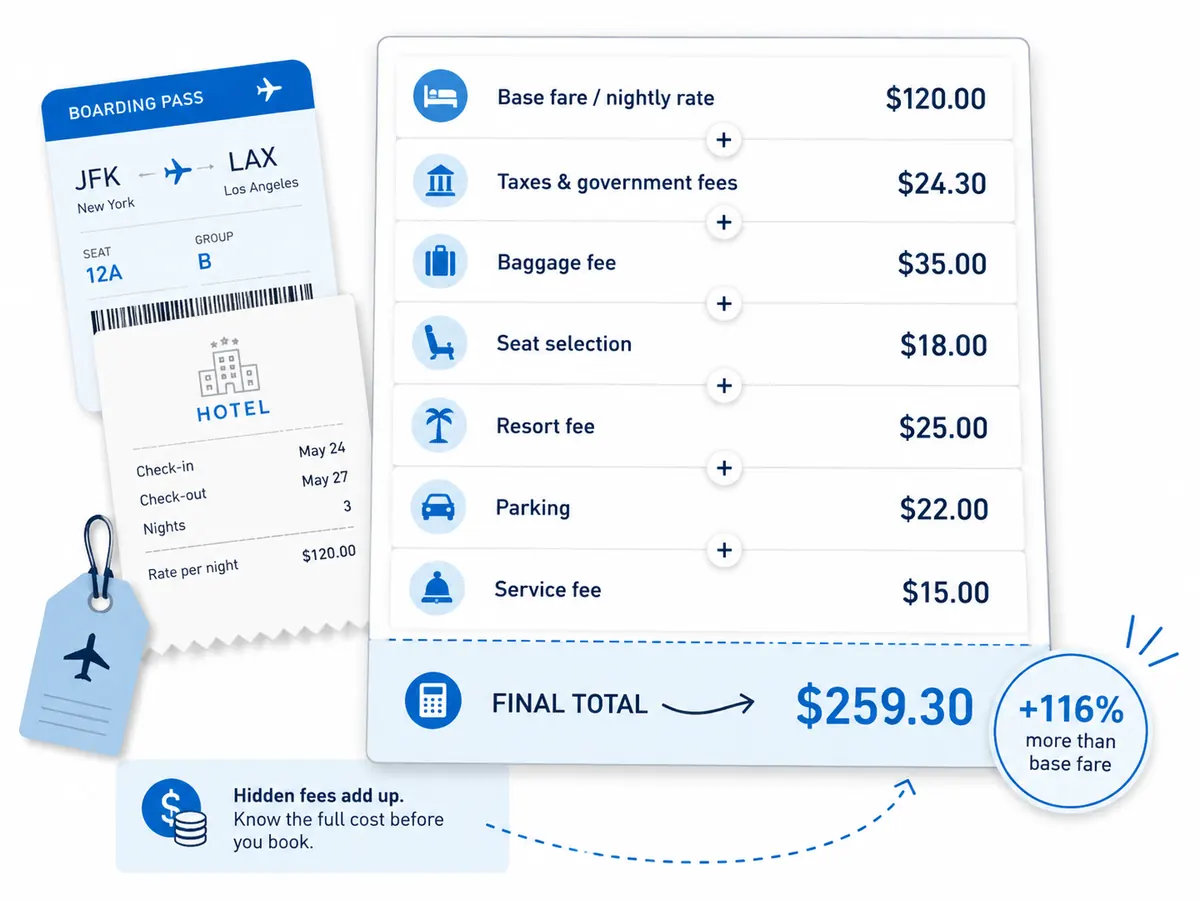
Baggage charges, seat selection fees, resort fees, destination fees, parking fees, service charges, cleaning fees, booking fees, taxes, payment fees, and other add-ons may appear during checkout, after you choose options, or even when you arrive.
The problem is not always that these fees are completely hidden. Often, they are delayed, separated from the first price you saw, or disclosed in a way that makes the trip look cheaper than it really is.
That is why the real question is not just:
“What are hidden travel fees?”
It is:
“Where do extra travel costs show up — and what can I check before booking?”
This guide explains common hidden travel fees, why booking sites and hotels may show costs in stages, and how to spot the charges that can inflate your final trip cost before you commit.
Quick Answer
What Are Hidden Travel Fees?
Hidden travel fees are extra costs that make a trip more expensive than the first price you saw. They may include baggage fees, seat selection fees, resort fees, destination fees, parking charges, cleaning fees, booking fees, service charges, taxes, payment fees, currency conversion costs, or other add-ons revealed during checkout, after booking, or at the property.
The best way to avoid surprise travel fees is to compare the final price, not the starting price. Check the full checkout total, required fees, optional add-ons, hotel policies, baggage rules, rental car extras, and payment or currency charges before you book.
A fee does not have to be completely hidden to surprise you. It may simply appear later, be separated from the first price, or be disclosed in a place travelers often miss.
Hidden travel fees usually do not appear all at once. They are often added in layers as you move from search results to checkout, then from booking confirmation to the airport, hotel, rental counter, or destination.
That is why the first price you see can feel very different from the final cost you actually pay.
The safest way to compare travel prices is to look for the full cost before you commit.
What to compare
Look beyond the starting price. Check required fees, optional add-ons, taxes, property charges, payment fees, and anything that may appear later because of how you travel.
How to Spot Hidden Fees Before Booking
The easiest way to spot hidden travel fees is to compare the final total, not the first price shown in search results.
Before booking, click far enough into the checkout path to see required fees, taxes, service charges, optional add-ons, baggage costs, hotel fees, rental car extras, and payment-related charges.
Also check whether any costs are collected later at the hotel, airport, rental counter, or destination. A booking can look cheaper upfront if part of the cost is delayed until after you have already chosen it.
Tour and charter bookings can create the same problem when fuel, crew, marina charges, gratuities, or other required costs sit outside the first price shown. Our Miami Private Boat vs Sightseeing Cruise comparison shows how those extras can change the real group-cost decision.
How Hidden Travel Fees Show Up During Booking
Travel fees usually do not appear all at once.
The first price often shows the base cost: the airfare, nightly hotel rate, vacation package price, or rental rate. That starting number helps travelers compare options quickly, but it may not include every charge that affects the final cost.
As you move through the booking path, more costs can appear. Some are required, such as taxes, resort fees, destination fees, cleaning fees, service charges, or platform fees. Others depend on your choices, such as bags, seats, upgrades, rental car extras, parking, or payment method.
Rental cars can become especially difficult to compare for a larger group because the cheapest-looking vehicle may not be the setup the group actually needs. Our One Passenger Van vs Two Rental Cars comparison shows how a second rental can duplicate costs across the entire trip—and when one larger vehicle becomes worth pricing instead.
That is why a trip can look affordable at first and feel more expensive by checkout. The price did not always change. In many cases, the full cost became visible later.
Fee Reveal Pattern
Where Extra Travel Costs Usually Appear
Hidden travel fees are easiest to miss when they appear after you have already started comparing, choosing, or committing to a booking.
Search Stage
Starting Price
You may see a base fare, nightly rate, rental rate, or package price before every required or optional charge is included.
Watch for: prices that exclude bags, seats, resort fees, parking, taxes, or platform fees.
Checkout Stage
Added Costs
Taxes, service fees, booking fees, cleaning fees, add-ons, upgrades, and payment-related charges may appear closer to payment.
Watch for: fees that appear only after you select dates, rooms, flights, or extras.
Travel Stage
Later Charges
Some costs appear at the airport, hotel, rental counter, destination, or on your card statement after the booking is already made.
Watch for: baggage changes, parking, resort fees, incidental holds, tolls, fuel, or currency conversion.
The safest comparison is the final total, not the first price. If one provider shows more fees upfront and another reveals them later, the cheaper-looking option may not actually be cheaper.
When Hidden Fees Are Most Likely to Increase Your Total
Hidden travel fees usually create the biggest surprise when the first price looks complete enough to trust.
That often happens when you are comparing options quickly, choosing the lowest visible price, booking a basic fare, using a third-party site, or assuming that anything not shown upfront must be optional.
The issue is not only the fee itself. It is when the fee appears and whether you still have a realistic chance to compare, change, or cancel before paying.
“If It’s Not Included, It Must Be Optional”
That is the assumption that causes many travelers to underestimate the real cost of a trip.
If a fee is not included in the first price, it may feel optional. But in travel pricing, some required fees are simply delayed. Resort fees, destination fees, taxes, service charges, cleaning fees, booking fees, and property-level charges may still apply even if they were not part of the number you noticed first.
Traveler Risk
Not Shown Upfront Does Not Always Mean Optional
Some travel fees are mandatory even when they appear late. A fee may be disclosed in checkout, linked terms, hotel policies, property rules, or payment screens instead of appearing in the first price you compare. By the time you see it, you may already feel committed to the booking.
Most travelers think incomplete pricing happens by accident.
But travel pricing is often structured in separate pieces. Those pieces may be revealed at different points: search results, fare selection, checkout, confirmation, airport check-in, or hotel arrival.
That is why it helps to treat the first price as a starting point — not the final answer.
System Insight
Hidden travel fees are often delayed, not completely invisible.
- The first price is often incomplete because search results may show a base fare, nightly rate, rental rate, or package price before every fee is included.
- Checkout reveals more of the cost because booking fees, service charges, taxes, add-ons, cleaning fees, baggage fees, and seat fees may appear later in the path.
- Some costs are collected after booking because hotels, rental counters, airports, or destination providers may charge fees at arrival, pickup, check-in, checkout, or after the stay.
- The final total matters most because the cheaper-looking option may only be cheaper before required fees, optional choices, property charges, and payment costs are included.
What To Do Before You Book
The goal is not to eliminate every travel fee. Some fees are required, and some optional costs may be worth paying.
The goal is to understand the full cost before you commit.
Start by comparing the final price, not the first price. Click far enough into the booking path to see taxes, mandatory fees, add-ons, hotel charges, booking fees, and anything that may be paid later.
Before You Pay
How to Spot Hidden Travel Fees Before Booking
Before booking, slow down long enough to compare the full cost, not just the price that appeared first in search results.
- Click through to the final checkout screen before comparing prices.
- Check baggage, carry-on, seat selection, and upgrade costs before choosing a flight.
- Look for resort fees, destination fees, parking fees, and taxes on hotel bookings.
- Review service, booking, cleaning, or platform fees on third-party sites.
- Check rental car insurance, toll, refueling, and additional-driver charges.
- Watch for foreign transaction fees or dynamic currency conversion abroad.
- Make key selections before booking when later changes may cost more.
- Save screenshots of the final total and fee disclosures before paying.
The best comparison is the final total, not the first price. If one option shows more fees upfront and another reveals them later, the cheaper-looking choice may not actually be cheaper.
The safest response is not to assume the fee is optional. It is to check whether the charge is required, when it appears, and whether the final total still makes the booking worth it.
Once you start comparing travel prices this way, hidden fees become easier to spot. You are no longer asking only, “Which option looks cheapest?” You are asking, “Which option shows me the most complete cost before I commit?”
Why Travel Pricing Is Structured This Way
That can make pricing more flexible, but it also makes comparison harder.
The same problem can distort the choice between an organized tour and planning the trip yourself. A tour may bundle transportation, hotels, sightseeing and some meals into one price, while independent travel spreads those costs across separate bookings. Our Guided Tour vs Independent Travel Cost comparison shows how to reconstruct both options before deciding which one is actually cheaper.
The issue is not only what you pay. It is when you see the cost and whether you still have a fair chance to compare your options before committing.
Organized tours create the same kind of booking-channel comparison. You may find the same operator and departure through a marketplace and on the operator’s own website, but the price, benefits, support, and booking protections may not be identical. If you’re considering an organized trip, see our TourRadar review: booking through TourRadar vs. direct for what to compare before choosing where to book.
Travel Fine Print Takeaway
The first price is often designed for comparison. The final price is what matters for your budget. Before booking, compare the total cost after required fees, add-ons, taxes, property charges, and payment costs are included.
Once you understand that travel pricing is often built in pieces, the goal becomes simpler: slow down long enough to identify which pieces are missing before you pay.
❓Frequently Asked Questions
These questions explain where hidden travel fees usually appear, why booking sites and hotels may reveal extra charges later, and what travelers should check before committing to a trip.
What are hidden travel fees?
Hidden travel fees are extra costs that make a trip more expensive than the first price you saw. They may include baggage fees, seat selection fees, resort fees, destination fees, parking charges, cleaning fees, booking fees, service charges, taxes, currency conversion costs, payment fees, or other add-ons.
Some fees are optional, but others may be required and simply disclosed later in the booking process.
How do you spot hidden fees before booking?
Compare the final total, not the starting price. Click far enough into the booking path to see required fees, taxes, service charges, baggage costs, hotel fees, rental car extras, payment fees, and optional add-ons before deciding which option is cheaper.
Why do booking sites show extra charges at checkout?
Booking sites may show a starting price first, then add taxes, service fees, platform fees, cleaning fees, hotel fees, or optional extras later in the checkout path. Sometimes the extra charges are disclosed, but they are separated from the first price travelers use to compare options.
What hidden fees appear in hotel bookings?
Hotel bookings may include resort fees, destination fees, parking charges, local taxes, occupancy fees, service charges, cleaning fees, deposits, incidental holds, early check-in fees, late checkout fees, upgrade charges, or paid amenity requests.
Some hotel costs appear during checkout, while others may be collected at the property or charged after checkout.
Are hidden travel fees the same as taxes?
Not always. Taxes are often required government or local charges, while hidden travel fees may include provider fees, platform fees, resort fees, service charges, add-ons, payment fees, or optional extras. Taxes can still surprise travelers if they are not included in the first price shown.
Are booking fees and service fees mandatory?
Sometimes. A booking fee or service fee may be mandatory if it is required by the booking platform, provider, hotel, rental company, or travel seller. Other fees may depend on your choices, such as add-ons, upgrades, bags, seats, parking, or payment method.
Why does the final travel price increase after I choose options?
The final price may increase because optional choices and required charges are added after the starting price. Bags, seats, room upgrades, rental car extras, hotel fees, cleaning fees, taxes, payment charges, and currency conversion costs can all change the total before you pay.
Can hidden fees appear after booking?
Yes. Some fees may appear after booking, at the airport, at hotel check-in, at the rental car counter, at checkout, or on your card statement after travel. This can include baggage changes, parking, resort fees, incidental holds, tolls, fuel charges, damage fees, or currency conversion costs.
Bottom Line
Hidden travel fees are not always hidden because they are missing.
Often, they are hidden because they appear later than the first price you compared.
A flight, hotel, rental car, vacation package, or booking site may start with a base price that looks attractive. Then the total becomes more complete as baggage fees, seat charges, resort fees, parking, service fees, taxes, cleaning fees, payment costs, or other add-ons appear.
The risk is not just that fees exist. The risk is that they show up after you have already chosen the option that looked cheapest.
Before you book, compare the final total, not the first price. Look for required fees, optional add-ons, property-level charges, payment fees, and anything that may appear later because of how you travel.
The earlier you identify the full cost, the more control you have over what the trip actually costs.
Related Guides
If you are trying to understand why travel costs increase before, during, or after booking, these guides may also help:
If you are trying to understand why travel costs increase before, during, or after booking, these guides may also help:
Hotel Fees and Final Price Problems
- Why the Price You See at Checkout Isn’t Always the Price You Pay
Compare how taxes, fees, deposits, add-ons, payment rules, and later charges can change the final trip cost. - Do You Have to Pay Hotel Destination Fees? What Travelers Should Know Before Booking
Learn why destination fees may still apply even when the nightly rate looks lower. - Hotel Resort Fees Explained: What Travelers Should Know Before Booking
Review how resort fees work, when they appear, and why they may be charged separately from the room rate. - Hotel Taxes and Fees Explained
See why local taxes, occupancy fees, required charges, and property-level costs can change the final amount due. - Why Did My Hotel Charge More Than the Booking Confirmation?
Use this if the amount charged by the hotel is higher than the price you expected from the booking page.
Hotel Holds, Deposits, and Later Charges
- Hotel Incidental Holds Explained
Learn why hotels may place temporary card holds for possible extras, even when the room is already paid. - Do You Get Hotel Deposits Back? What Travelers Should Know
Review when a hotel deposit may be refunded, applied to the stay, released, or kept. - Can Hotels Charge You After Checkout? What Travelers Should Know
Understand why hotels may charge after departure for parking, resort fees, damage claims, minibar use, or billing corrections. - What to Check If a Hotel Charged You Twice
Use this if a hotel hold, deposit, final bill, or duplicate-looking transaction appears more than once.
Booking Sites and Payment Timing
- Booking Hotels Through Third-Party Sites
See how OTAs, travel apps, booking platforms, merchant-of-record rules, and support layers can affect final charges and refunds. - Pay Now vs Pay at Hotel: Which Option Is Safer?
Compare how prepaid rates, pay-at-hotel bookings, deposits, holds, and refund timing affect your risk. - What Does Pay at Property Mean When Booking a Hotel?
Learn why a pay-at-property booking may still involve holds, deposits, taxes, fees, or card verification before checkout.
Refunds and Price Surprises
- Why Travel Refunds Take So Long
Learn why refunds can take longer when airlines, hotels, booking sites, banks, or card processors are involved. - Airline Refund vs Travel Credit: What’s the Difference?
Compare cash refunds, airline credits, vouchers, expiration rules, and booking restrictions. - Why Travel Prices Are Different on Different Websites
Understand why the same trip can show different prices depending on inventory, timing, fees, booking channels, and display rules.