
Hotel Fee Guide
Hotel Resort & Destination Fees Explained: What You Really Pay
A hotel may call it a resort fee, destination fee, amenity fee, property fee, facility fee, or something else. The name can change, but the important questions stay the same: is the charge mandatory, how much does it change the real cost of the stay, and was it clear before you booked?
The decision: Is this mandatory hotel fee part of the real price—and was it clear enough before booking for you to compare the hotel fairly?
About This Guidance
This guide focuses on mandatory hotel-imposed charges such as resort fees, destination fees, amenity fees, property fees, and similar charges that can change the real price of a stay.
On This Page
- Quick Answer
- The Decision in 30 Seconds
- What These Fees Actually Are
- Why Hotels Charge Them Separately
- Three Ways These Fees Show Up
- Mandatory Does Not Always Mean Clearly Disclosed
- When You Should Question the Fee
- The Real Price Test
- Can You Avoid Resort or Destination Fees?
- What to Save Before Booking
- The Fine Print That Matters
- TFP Recommendation
- Before You Go
- FAQ

The nightly rate can look attractive until mandatory hotel fees and taxes are added to the booking total.
Quick Answer
Resort and destination fees are usually part of the real hotel price.
Hotel resort and destination fees are usually mandatory charges added to the room rate. You may still have to pay them even if you do not use the amenities they supposedly cover.
The name matters less than three things: whether the fee is required, whether it was included in the price you used to compare hotels, and whether another booking path could include, waive, or reduce it.
For U.S. short-term lodging: since May 12, 2025, the FTC’s Rule on Unfair or Deceptive Fees generally requires sellers to display the total price upfront with mandatory fees included. Government taxes and genuinely optional add-ons may still be shown separately, subject to the rule’s disclosure requirements.
TFP rule: If a hotel fee is mandatory, count it as part of the stay cost before deciding whether the room is actually a good deal.
The Decision in 30 Seconds
What does the fee mean for your booking?
| Situation | What it means |
|---|---|
| Fee clearly disclosed before booking | The hotel will usually treat it as part of the required stay cost. |
| Fee appears only later | Disclosure becomes the issue. Compare what you were shown before booking with what the hotel is charging now. |
| Fee is mandatory but you will not use the amenities | The charge usually still applies because it is tied to the room or rate, not individual usage. |
| Another rate, package, or benefit waives it | Compare the full totals. The higher-looking rate may actually cost less overall. |
If you are still choosing a hotel, review the full price and property-fee details attached to the available room offers before comparing nightly rates.
What the Fee Is
Different name, same pricing question
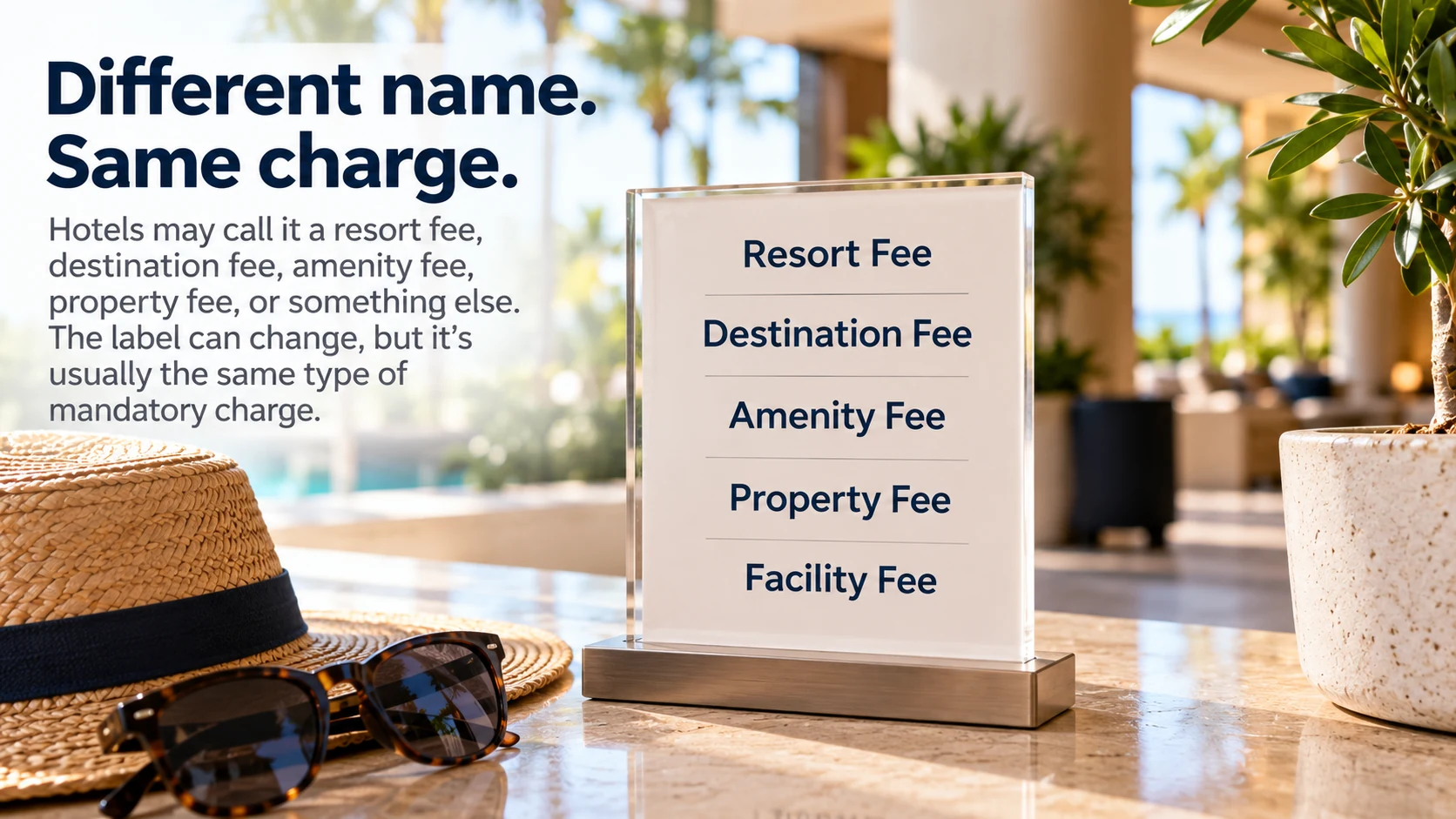
Hotels use several labels for mandatory property-level charges. Common names include resort fee, destination fee, amenity fee, property fee, facility fee, urban fee, and experience fee.
The wording may suggest that the charge pays for Wi-Fi, pool access, beach chairs, fitness facilities, bottled water, local transportation, business-center access, or other property benefits. But if the fee is mandatory, it usually applies whether or not you personally use those services.
The useful distinction
If the fee is mandatory and applies regardless of usage, treat it as part of the room’s real price. The label matters less than the structure of the charge.
For a broader explanation of how hotel-imposed fees differ from government taxes and other charges, see Hotel Taxes and Fees Explained.
Why It Matters
Why hotels still itemize resort and destination fees
Hotels may still break out a resort, destination, amenity, or property fee as a separate line item even when it is included in the total price shown for the stay. The separate line can explain what portion of the total the property attributes to bundled amenities or services.
For U.S. short-term lodging, mandatory fees generally must now be included in the upfront total price under the FTC’s fee rule. The fee itself is not banned; the key change is that a required fee should not be withheld from the price used to market the stay.
On international booking paths, older confirmations, or displays that do not follow the U.S. rule, you may still encounter a lower base rate followed by a mandatory fee later. That is why the safest comparison remains the full stay total.
When comparing similar properties, compare the complete stay totals instead of the first nightly rates you see.
How the Fee Shows Up
Three hotel-fee situations that do not work the same way
The most important difference is not whether a property uses the words “resort fee” or “destination fee.” It is how the fee is handled in the booking path.
1. Fee itemized separately
The mandatory fee may appear as its own line even when it is included in the displayed total, or it may be identified as an amount collected at the property. Check whether it is charged per night, per room, or per stay and whether taxes apply to the fee.
2. Fee built into a package or bundled rate
The hotel may offer a rate where the fee is included or offset. Compare the full bundled total with the separate-fee option rather than assuming the package is automatically better.
3. Fee waived or reduced
Certain award stays, loyalty benefits, corporate rates, group rates, packages, or promotions may remove or reduce the fee. The waiver should be confirmed as part of the booking.
The fee is rarely solved at the front desk.
It is usually avoided, included, reduced, or waived through the booking terms before you arrive.
If you are deciding between rates, look at the full rate details and mandatory property charges for each option, not just the room price.
Disclosure
Mandatory does not always mean clearly disclosed.
A hotel fee can be mandatory and still raise a legitimate concern if the charge was not clear before you committed to the reservation.
A fee shown prominently in the booking total before payment is different from a fee that appears for the first time at check-in, after a prepaid reservation, after points or a free-night certificate have been committed, or after the cancellation deadline has passed. At that point, changing hotels may no longer be practical.
The key question
Did you have a fair chance to see the full mandatory price before you booked?
For U.S. short-term lodging, the FTC says businesses that advertise a price must generally show the total price upfront with mandatory charges included. The rule covers hotels as well as third-party platforms, resellers, and travel agents. See the FTC’s current fee-rule guidance.
The strongest comparison is between what the booking page showed before you confirmed the reservation and what the hotel later charged or listed as due.
When to Question It
A fee is more worth questioning when the problem is disclosure, accuracy, or availability.
Simply disliking a mandatory fee is usually not the strongest argument. The better question is whether the charge matches what you were shown and what the booking terms required.
It was not clearly shown before booking
Ask where the mandatory fee appeared before you confirmed the reservation.
The amount does not match the confirmation
Compare the original fee disclosure with the amount now being charged.
The fee was charged twice
Check whether the online total already included it before the property collected it again.
The listed amenities were unavailable
This does not guarantee a refund, but it gives you a specific basis for asking the property to review the fee.
Your rate or benefit says the fee should be waived
Show the hotel the booking language, loyalty benefit, package term, or other written waiver.
If you are already at check-in: refusing a fee the hotel treats as mandatory can create practical problems without necessarily removing the charge. A stronger approach is to ask where the fee was disclosed, request a waiver or correction based on a specific issue, and preserve the documentation before escalating.
The Real Price Test
Compare the full stay cost, not the headline rate.
A mandatory hotel fee does not have to be hidden to distort a price comparison. It only has to sit outside the nightly rate you used to decide which hotel looked cheaper.
Use the complete price
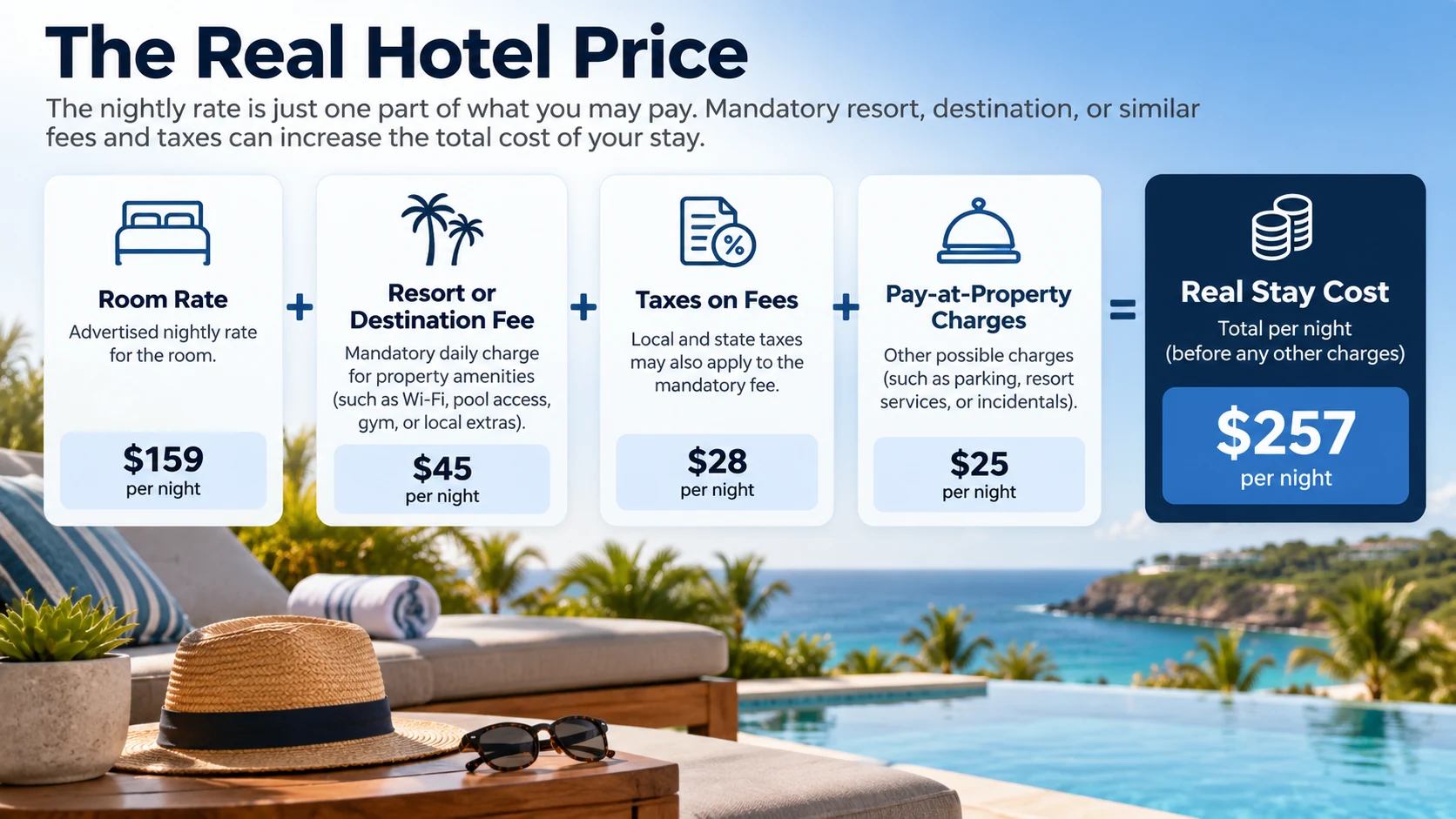
Room rate + mandatory hotel fee + taxes on the fee + other required property charges = the cost you should use to compare the stay.
This matters even more on multi-night stays because a daily fee compounds. A $45 mandatory fee adds $135 to a three-night stay and $225 to a five-night stay before any taxes that may apply to the fee.
Before choosing the lower-looking option, review the total price and any charges marked due at the property.
Avoiding or Reducing the Fee
Can you avoid hotel resort or destination fees?
Sometimes—but usually through the way the reservation is booked, not by refusing the fee after arrival.
Award stays
Some loyalty programs or properties waive resort fees on qualifying points bookings.
Elite or membership benefits
Certain status levels may include a fee waiver or credit, depending on the program and property.
Corporate or group rates
Negotiated rates may include, reduce, or waive property-level fees.
Packages or promotional rates
The fee may be bundled, offset by a credit, or included in the package price.
The important detail: if the booking confirmation shows the fee as required and your rate does not include a waiver, the hotel may treat the charge as part of the stay cost.
Points, free nights, portals, and third-party bookings can still carry the fee.
A resort or destination fee may still apply when the room is booked with points, a free-night certificate, a package, a credit-card travel portal, or a third-party site. Check whether the fee is included, waived, or collected separately at the property before you confirm.
A useful question before booking is: “Will this mandatory hotel fee be charged separately at the property, or is it already included in the total price shown here?”
What to Save
Keep the proof that shows what you were told before booking.
If a mandatory fee later becomes a dispute, the strongest evidence is usually the booking path itself.
Final checkout screen
Save the total price and any line showing mandatory fees or charges due at the property.
Hotel confirmation
Keep the rate, dates, room type, fee disclosure, and payment terms.
Taxes-and-fees breakdown
Save any expanded details that separate government taxes from hotel-imposed fees.
Final folio and card charge
These show what the property actually collected and whether it matches the booking.
A useful question to ask
“Can you show me where this fee was disclosed before I confirmed the reservation?”
Screenshots are especially useful because booking displays can change and may be difficult to recreate later. They also help when the hotel’s own site and a third-party booking site presented the same property fee differently.
If you booked through a third party, remember that responsibility can be split: the hotel may control the fee itself while the booking platform controls how that fee was displayed to you. If the amount was hidden, duplicated, or different from the confirmation, contact the party responsible for the mismatch and keep the response in writing.
If payment timing is part of the confusion, see Pay Now vs. Pay at Hotel.
The Fine Print That Matters
The fee label is only the beginning.
The same charge may have different names
Resort fee, destination fee, amenity fee, property fee, facility fee, and similar labels can describe the same basic pricing structure.
Mandatory fees are not usage-based
Skipping the pool, gym, Wi-Fi, or other listed amenities usually does not remove a required charge.
Mandatory does not automatically mean clearly disclosed
A valid charge can still be frustrating if it was difficult to see before you committed to the booking.
In the U.S., mandatory lodging fees generally belong in the upfront total
The FTC’s fee rule does not ban resort or destination fees, but it generally requires covered sellers to include mandatory charges in the total price displayed upfront.
Taxes may apply to the fee
The nightly fee can increase the stay cost by more than its face amount if local taxes also apply.
Different booking paths can produce different totals
A rate that includes, offsets, or waives the fee may be a better value even when its base room price looks higher.
The best time to solve the fee problem is before booking
Once a required fee is attached to the reservation, the front desk may have little discretion to remove it.
My Take
I would not compare hotels using the nightly rate alone.
If one hotel adds a mandatory resort or destination fee and another includes more of the real price upfront, the headline rates are not directly comparable.
I would add the mandatory fee, any taxes on it, and other required property charges before deciding which stay is actually cheaper.
The lowest advertised rate is not necessarily the lowest real hotel price.
TFP Recommendation
Use the full stay cost to choose the hotel.
The Recommendation
Compare the total you are actually expected to pay—not the nightly rate that first caught your attention.
Include the room rate, mandatory resort or destination fee, taxes, other required property charges, and any rate-specific waiver or package inclusion. Then compare cancellation terms so the cheaper-looking option does not cost more if your plans change.
Your Next Step
Use your actual booking situation to decide what to do now.
Smarter travel, straight to your inbox
Booking choices, hidden costs, travel rules and useful fine print — explained clearly.
Before You Go
Put the mandatory fee in context with the rest of the hotel price.
These related guides help separate hotel-imposed fees from taxes, understand when money is collected, and identify which company controls the booking.

Hotel Taxes and Fees Explained
Separate government taxes, hotel-imposed fees, surcharges, and charges collected later at the property.
Understand the full price →Pay Now vs. Pay at Hotel
See how payment timing changes what is collected online and what may still be due at the property.
Compare payment timing →Hotel Deposits
Understand the difference between a deposit, temporary hold, prepayment, and refundable hotel charge.
Follow the money →Booking Hotels Through Third-Party Sites
Understand how the booking channel can affect price display, payment responsibility, changes, and refunds.
Understand the booking relationship →FAQ
Hotel resort and destination fees: common questions
What is a hotel resort fee?
A hotel resort fee is usually a mandatory charge added to the room rate. Hotels may describe it as covering amenities such as Wi-Fi, pool access, beach chairs, fitness facilities, bottled water, local transportation, or other property benefits.
Is a destination fee the same as a resort fee?
They can work in essentially the same way. City hotels and destination-area properties may use labels such as destination fee, amenity fee, facility fee, urban fee, property fee, or experience fee instead of resort fee.
Are hotel resort fees mandatory?
Usually, yes, when the fee is attached to the room, rate, or property policy. If it was clearly disclosed as mandatory before booking, the hotel will generally treat it as part of the stay cost.
Can I refuse to pay a resort fee if I do not use the amenities?
Usually not. Mandatory resort and destination fees are generally not based on individual usage. The hotel may still charge the fee even if you do not use the pool, gym, Wi-Fi, shuttle, or other listed benefits.
Can resort or destination fees be waived?
Sometimes. Certain award stays, loyalty benefits, corporate or group rates, promotional packages, negotiated rates, or other booking paths may include, reduce, or waive the fee. Confirm the waiver before booking.
Why do hotels charge these fees separately?
Separating part of the stay cost from the base room rate can make the headline nightly price look more competitive. That is why travelers should compare the full stay cost rather than relying on the first nightly rate shown.
What if the fee was not disclosed before booking?
Ask the hotel to show where the fee appeared before you confirmed the reservation. Compare that with your checkout screenshot, confirmation, rate details, and hotel folio. A fee that appeared only later gives you a more specific basis for asking the property or booking site to review the charge.
Can award stays or elite status waive resort fees?
They can in some programs or at some properties, but the rule varies. Do not assume the waiver applies. Check the program terms and booking confirmation for your exact stay.
Do resort or destination fees apply on points, free nights, or third-party bookings?
They can. A mandatory property fee may still apply to a points stay, free-night certificate, package, credit-card travel portal booking, or third-party reservation unless the specific rate or program waives or includes it. Check the booking terms before confirming.
Are resort fees illegal in the United States?
No. The current federal rule does not ban resort or destination fees. For covered U.S. short-term lodging sales, it generally requires mandatory fees to be included in the total price displayed upfront, while certain charges such as government taxes may be disclosed separately before payment.
Are resort fees included in the hotel price?
Sometimes. A booking page may include the mandatory fee in the displayed total, show it separately, or state that it will be collected at the property. Check the full price breakdown before booking.
What should I save if I want to question a hotel fee?
Save the final checkout screen, hotel confirmation, fee breakdown, rate terms, screenshots, hotel folio, card charge, and any written communication showing what you were told before booking.
Free Travel Guide
Avoid the travel mistakes that can cost you money, flexibility, or time.
Get 27 Travel Mistakes That Cost Travelers Thousands — a practical guide to booking mistakes, hidden costs, travel rules and decisions worth understanding before they become a problem.
- Spot booking details that are easy to overlook
- Understand where hidden costs can appear
- Recognize when a cheaper option comes with a tradeoff
- Make travel decisions with fewer surprises
You’ll also receive occasional practical guidance from Travel Fine Print on booking choices, hidden costs, travel rules and the fine print worth understanding. Unsubscribe anytime.