
A passport card can save a first-time adult applicant $100 compared with a passport book.
At current State Department fees, a first-time adult pays $65 for a passport card, $165 for a passport book, or $195 for both. The card may look like the obvious budget choice—but that $100 savings comes with one major tradeoff: a passport card cannot be used for international air travel.
A passport card can be used at eligible land border crossings and sea ports of entry when entering the United States from Canada, Mexico, Bermuda, and certain Caribbean countries. But it will not help if a cruise interruption, medical emergency, missed sailing, or other change requires you to fly home from another country.
The real question is not simply:
“Which passport costs less?”
It is:
“Which document covers both the trip I planned and the travel problem I may not expect?”
This guide compares the passport card and passport book, explains when the $100 savings may be reasonable, and shows why some travelers may be better protected by the book—or by applying for both.
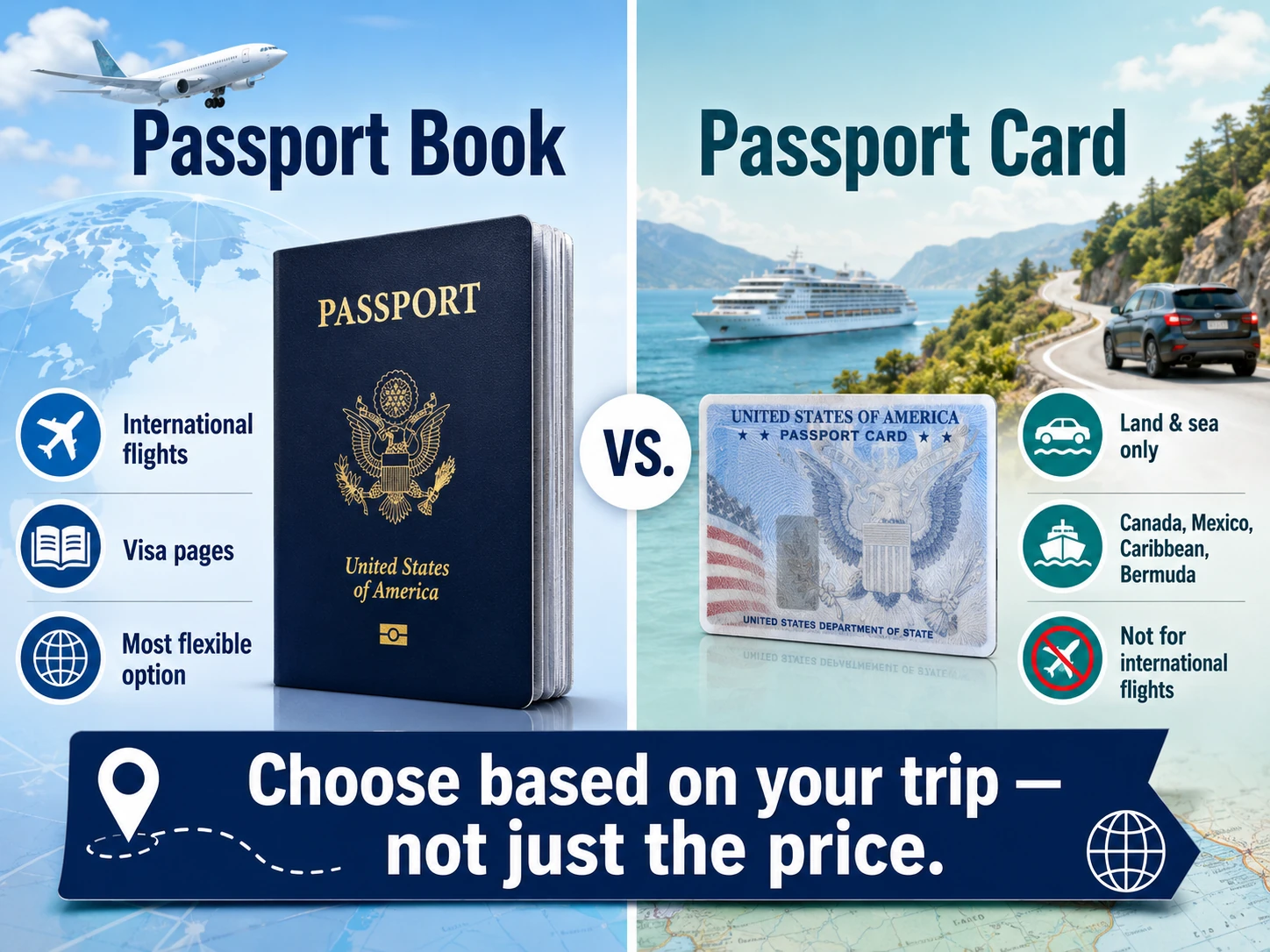
System Insight
The $100 Savings Comes With a Much Larger Travel Limitation
- A first-time adult passport card costs $65, compared with $165 for a passport book.
- The passport card cannot be used for international air travel, even when traveling to Canada, Mexico, Bermuda, or the Caribbean.
- The passport book supports international air travel and includes pages for visas and entry stamps.
- A first-time adult applying for a passport book can add the card for $30 more—$195 for both instead of $165 for the book alone.
For the official travel uses and limitations of each document, review the State Department passport card and book comparison.
Side-by-Side Comparison — Reviewed July 2026
Passport Book vs Passport Card
The two documents have the same validity period, but their permitted travel uses and costs are substantially different.
| Feature | Passport Book | Passport Card |
|---|---|---|
| International air travel | Yes | No |
| International land travel | Yes, subject to destination entry requirements | Limited to eligible land border crossings |
| International sea travel | Yes, subject to itinerary and destination rules | Limited to eligible sea ports of entry from Canada, Mexico, Bermuda, and certain Caribbean countries |
| Visa pages | Yes | No |
| Adult first-time cost | $165 | $65 |
| Adult renewal cost | $130 | $30 |
| Adult validity | 10 years | 10 years |
| Validity for children under 16 | 5 years | 5 years |
| Domestic REAL ID alternative | Yes | Yes |
| Size | Traditional passport booklet | Approximately the size of a credit card |
Government fees and travel-document rules can change. Destination, cruise-line, and itinerary requirements may be more restrictive, so verify the current rules before applying or traveling.
Which Passport Option Fits Your Travel Plans?
The right document depends on the most demanding part of your itinerary—not simply the type of travel you expect to take most often.
Choose the Passport Book When:
- You are flying internationally.
- Your trip could require an international flight home.
- You are visiting a destination that requires visa or entry-stamp pages.
- You want one document that works for international travel by air, land, or sea, subject to destination rules.
- You do not want your future travel options limited to the passport card’s eligible routes.
A passport book is the practical first choice for most international travelers because it covers international air travel. A passport card does not.
The Passport Card May Be Enough When:
- Your travel is limited to eligible land border crossings with Canada or Mexico.
- You are entering the United States through an eligible sea port from Canada, Mexico, Bermuda, or certain Caribbean destinations.
- You frequently cross a land border and value a wallet-sized document.
- You want a federal identification document that can also be used for domestic air travel.
- You already have a passport book and want the card as a convenient secondary document.
The card makes the most sense when your travel pattern is narrow, predictable, and fully covered by its permitted uses. It should not be treated as a cheaper substitute for a passport book when international air travel is a realistic possibility.
Simple decision rule: If any part of the trip—or a reasonably possible backup plan—depends on an international flight, the passport card is not enough.
Cruise Travel Fine Print
The Passport Card May Cover the Cruise—But Not the Flight Home
A passport card or other approved documents may be accepted for some eligible cruise itineraries. But meeting the requirements for the sailing does not guarantee that you have the document needed if the trip is interrupted.
The Trip You Planned
The original cruise may allow limited documentation.
Some closed-loop cruises that begin and end at the same U.S. port may permit a passport card or other approved citizenship and identification documents, depending on the itinerary, destinations, and cruise-line rules.
The Problem You Did Not Plan
An international flight home requires a passport book.
The passport card cannot be used to board an international flight. That limitation becomes important if you must leave the cruise early or return home from a foreign port.
- A medical emergency
- Missing the ship
- A family emergency at home
- A mechanical or itinerary disruption
Cruise lines and destination authorities may require a passport book even when another document might otherwise satisfy U.S. reentry rules. Verify the requirements for the exact cruise before traveling.
Traveler Risk
A $100 Savings Can Create a 10-Year Travel Limitation
Passport books and passport cards issued to adults are generally valid for 10 years. That means the $100 first-time price difference works out to about $10 per year over the document’s validity period.
The passport card may still be the right choice for limited land or sea travel. But if you expect even one international flight during those 10 years, you will still need to obtain a passport book before that trip.
The risk is not that the passport card is an invalid document. It is assuming that the word “passport” means the card provides the same travel access as the book.
Check the Fine Print
Not Sure Whether the Passport Card Covers Your Trip?
Use the Travel Fine Print Risk Checker to identify whether international flights, cruise disruptions, destination rules, visa requirements, border crossings, or missing travel documents deserve closer review before you apply or travel.
Do You Need Both a Passport Book and Passport Card?
Most travelers do not need both documents. If your priority is international travel flexibility, the passport book should come first.
Getting both may make sense when you:
- Fly internationally but also cross the Canadian or Mexican border frequently by land.
- Regularly take eligible cruises or enter through qualifying sea ports.
- Want a wallet-sized federal ID for domestic use while keeping your passport book secured.
- Prefer having the card available for the limited travel situations it covers.
For a first-time adult applicant, the current total is $165 for the passport book or $195 for both. That means adding the card during the same application costs $30 more than applying for the book alone.
That extra $30 can be worthwhile for frequent border travelers, but the card does not provide additional international air-travel protection. You would still need the passport book to board an international flight.
Practical decision: Get the book first for broad international travel. Add the card when its convenience for land crossings, eligible sea entry, or wallet-sized identification has a real use in your travel routine.
Passport Card vs REAL ID: They Solve Different Problems
A passport card is accepted by TSA as an alternative to a state-issued REAL ID for domestic flights. A passport book can also be used instead of a REAL ID-compliant driver’s license.
But REAL ID acceptance does not expand the passport card’s international travel authority.
- REAL ID is a federal identification standard used for purposes such as boarding domestic commercial flights.
- A passport card is both federal identification and a limited-use passport document.
- A passport book is the broader document required for most international air travel.
The passport card’s usefulness at a domestic TSA checkpoint does not mean it can be used to board an international flight. It remains restricted to eligible land and sea travel.
The key distinction: A passport card may replace the need to show a REAL ID at the airport, but it does not replace a passport book when the trip crosses an international border by air.
Action Step
Choose the Document for the Most Restrictive Part of Your Trip
Do not base the decision only on your planned departure. Check whether any realistic part of the trip—or a backup plan—could require the broader authority of a passport book.
Before You Travel
Check the Documents Before the Airline or Cruise Line Does
Use the Travel Documents Checklist to review passport validity, destination requirements, visas, ticket names, cruise documents, insurance records, confirmations, and backup copies before a missing detail interrupts the trip.
Travel Fine Print Takeaway
Choose the document that covers the most demanding possibility—not merely the easiest version of the trip. A passport card can be practical for eligible land and sea travel, but it does not provide international air-travel access. When a future trip, cruise disruption, or emergency return could require an international flight, the passport book is the more useful first priority.
❓Frequently Asked Questions
What is the main difference between a passport card and passport book?
A passport book can be used for international air travel and contains pages for visas and entry stamps. A passport card is a wallet-sized document intended for eligible land and sea entry from Canada, Mexico, Bermuda, and certain Caribbean countries. It cannot be used for international flights.
Can I fly to Canada, Mexico, or the Caribbean with a passport card?
No. The passport card is not valid for international air travel, including flights to Canada, Mexico, Bermuda, or the Caribbean. International travelers generally need a passport book when crossing the border by air.
Is a passport card enough for a cruise?
It may be accepted for some eligible cruise itineraries, depending on the cruise line, ports, and destination rules. However, the card cannot be used if an emergency, missed sailing, or other disruption requires you to fly home internationally. A passport book provides the stronger backup.
Should I apply for both a passport book and passport card?
Applying for both may make sense if you want the book for international flights and the wallet-sized card for frequent land-border crossings, eligible sea entry, or domestic identification. Travelers who do not expect to use the card’s limited conveniences may need only the passport book.
Can a passport card be used instead of a REAL ID-compliant driver’s license?
A valid U.S. passport card can be used for domestic air travel as an alternative to a REAL ID-compliant state identification card. That does not make it valid for international air travel.
Bottom Line
The passport card is not simply a smaller, cheaper passport book. It is a different document with much narrower travel authority.
For limited land crossings, eligible sea entry, or wallet-sized federal identification, the card can be practical. But when choosing only one document, the passport book is the safer default for most travelers because it supports international air travel and provides broader flexibility when plans change.
The decision comes down to how you expect to travel:
Choose the card for a specific limited use. Choose the book for broader travel capability.
Related Guides
These guides help travelers confirm that their passport is valid, acceptable, and ready for the exact itinerary before a document problem interrupts the trip.
Passport Validity and Condition
-
Why Some Countries Require 6 Months of Passport Validity
Understand why a passport can create an entry or boarding problem before it officially expires. -
Can You Travel With a Damaged Passport? What to Know Before You Fly
Learn when water damage, torn pages, peeling covers, or other wear may make a passport unacceptable.
Boarding and Entry Requirements
-
Why Some Travelers Are Denied Boarding—Even With a Valid Passport
See why a valid passport may still fail an airline, destination, visa, transit, or itinerary requirement.
Passport Services and Protection
-
Are Passport Expediting Services Worth It? What to Know Before You Pay
Compare official expedited processing, urgent passport agency appointments, and private passport companies. -
Does Travel Insurance Cover Passport Problems?
Learn when insurance may help with a lost or stolen passport and when document readiness remains the traveler’s responsibility.