
Short layovers often look like the best option when you are booking a flight.
They reduce total travel time, minimize waiting around the airport, and can make an itinerary look more efficient in search results. The airline or booking site may show the connection as valid, which makes it feel safe enough to book.
But a short layover being allowed is not the same as a short layover being reliable.
A tight connection may meet the airline’s minimum connection time, but real travel conditions can quickly reduce the time you actually have. A late arrival, long taxi time, gate change, airport layout, security checkpoint, immigration line, checked-bag transfer, or early boarding cutoff can turn a valid connection into a missed one.
The real question is not just:
“Is this layover allowed?”
It is:
“Does this layover give me enough margin if anything goes wrong?”
This guide explains how short layovers work, when they are risky, what minimum connection time really means, and what to check before booking a tight connection.
Quick Answer
Are short layovers risky?
Short layovers can be risky because they leave little margin for delays, airport logistics, boarding cutoffs, baggage transfers, security, immigration, or terminal changes. A connection may be valid under airline rules, but that does not mean it is comfortable or reliable in real travel conditions.
A short layover is usually safer when both flights are on the same ticket, the airport is small or familiar, the connection is domestic, gates are close, and there are later flights available if you miss the connection.
Before booking a tight connection, check the airport layout, minimum connection time, boarding cutoff, checked-bag risk, immigration or security requirements, on-time history, and whether your flights are protected on one ticket or exposed on separate tickets.
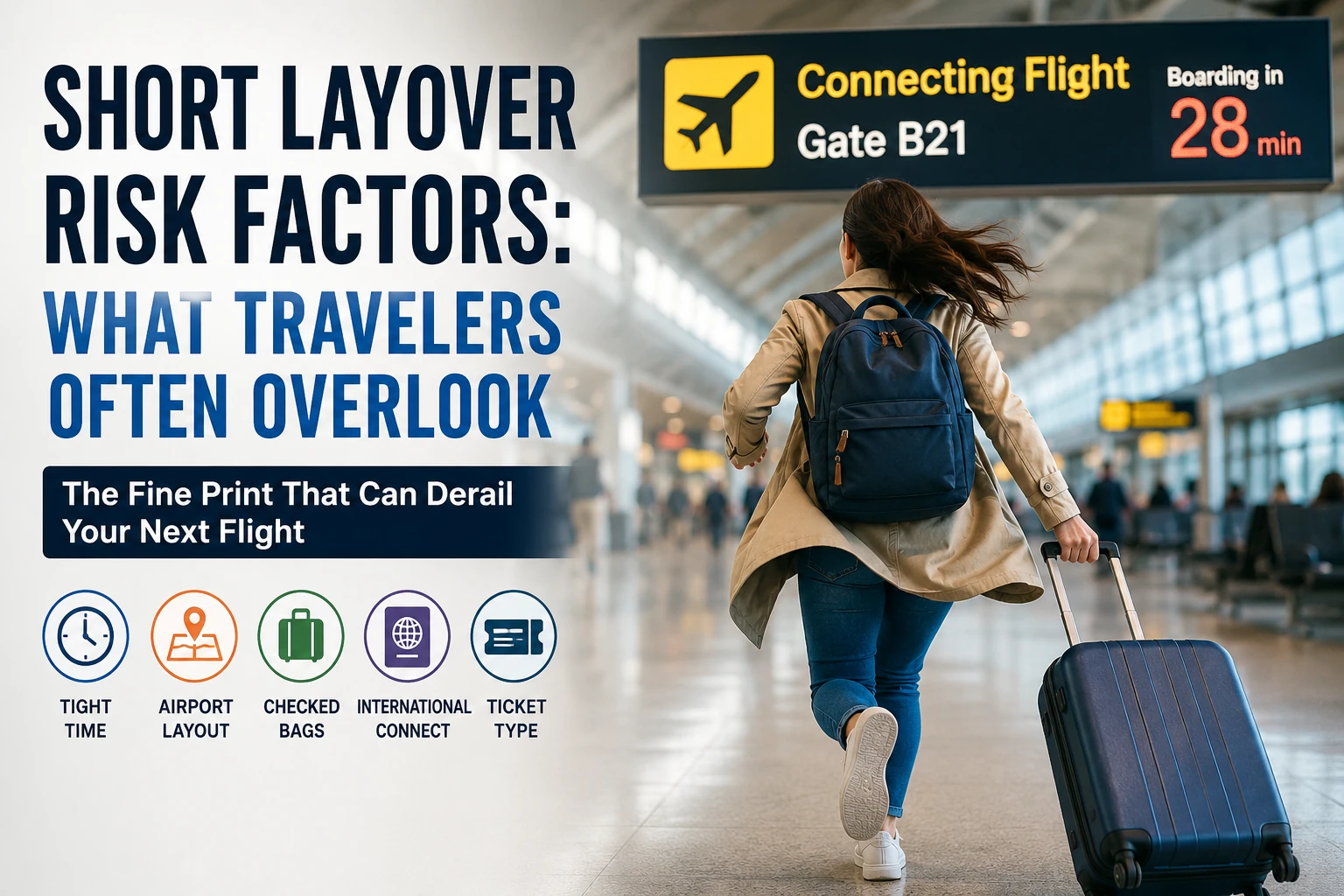
System Insight
A valid short layover is not always a safe short layover.
- Minimum connection time means the airline can sell the itinerary, not that the transfer will feel comfortable.
- Arrival time is not the same as the time you step off the plane.
- Boarding cutoff reduces the usable connection window because gates close before departure.
- Airport layout can add walking time, train transfers, terminal changes, or security checks.
- Ticket structure matters because separate tickets are much riskier than protected connections on one itinerary.
Connection Risk Check
What Makes a Short Layover Riskier?
A short layover is not risky for only one reason. The danger usually comes from several small factors stacking together: delay risk, airport layout, boarding cutoffs, baggage transfer, immigration, security, and whether your flights are protected on one ticket.
Airline Rule
Minimum Connection Time
The itinerary may be valid because it meets the airline’s minimum, but that does not mean it has much buffer.
Real Clock
Usable Connection Time
Your actual transfer time starts after deplaning and shrinks again when boarding closes before departure.
Airport Factor
Airport Layout
Large terminals, gate changes, trains, buses, and long walks can turn a valid connection into a rushed one.
Route Type
Domestic vs International
International connections may involve immigration, customs, security, or document checks that a domestic transfer may not.
Bag Risk
Checked Bags
Your bag may need to make the same tight transfer you do, and some routes require baggage claim and recheck.
Protection
Same Ticket vs Separate Tickets
A short layover on one protected itinerary is very different from a self-made connection on separate tickets.
A short layover is not automatically a bad choice.
The key is whether the connection gives you enough margin for the specific airport, route, ticket type, and travel conditions. A 45-minute connection at a small domestic airport may be manageable, while a longer connection at a large international hub can still be risky if you need to change terminals, clear immigration, recheck bags, or board early.
The sections below explain the main factors that decide whether a short layover is simply efficient — or too tight to rely on.
What Minimum Connection Time Really Means
Minimum connection time is the shortest connection an airline or booking system considers valid. It means the itinerary can be sold — not that the layover gives you a comfortable buffer.
Before relying on it, check:
- whether the connection is domestic or international,
- whether both flights are on the same ticket,
- whether you need to change terminals,
- whether security, immigration, or baggage recheck is required,
- and whether there is a later flight if you miss the connection.
A short layover that barely meets the minimum may work when everything runs on time, but it gives you little room when travel conditions change.
↑ Back to short layover risk factors
Why Your Usable Connection Time Is Shorter Than the Layover
The layover shown on your itinerary is not the same as the time you actually have to reach the next gate.
Your usable time starts after the plane parks, the door opens, passengers deplane, and you enter the terminal. It also ends before departure time because boarding gates usually close early.
That means a 45-, 50-, or 60-minute layover may give you much less real transfer time than it appears.
Check:
- how long it may take to deplane,
- whether you are seated near the front or back,
- when boarding closes for the next flight,
- how far the next gate may be,
- and whether a small delay would erase the connection window.
↑ Back to short layover risk factors
How Airport Layout Affects Short Layovers
Airport layout can make a short layover manageable or unrealistic.
At a smaller airport, you may only need to walk a few gates. At a large hub, you may need to change concourses, ride a train, take a shuttle, go through security again, or walk a long distance.
Before booking, check:
- whether the airport has multiple terminals,
- whether the connection stays airside,
- whether terminal trains or buses are common,
- whether gates are usually far apart,
- and whether the airport is known for long walks or congestion.
A short layover is not just about minutes. It is about how much airport you have to cross in those minutes.
↑ Back to short layover risk factors
Domestic vs International Short Layovers
Short domestic layovers are usually simpler than short international layovers, but not always.
A domestic connection may let you stay inside the secure area and walk directly to the next gate. An international connection may require immigration, customs, document checks, security re-screening, terminal changes, or baggage recheck.
Before choosing a short international layover, check:
- whether you must clear immigration or customs,
- whether you need to collect and recheck bags,
- whether you must pass through security again,
- whether the next flight boards early,
- and whether missed-connection protection applies.
A short international connection can be much riskier than the same amount of time on a simple domestic route.
↑ Back to short layover risk factors
How Checked Bags Add Risk to a Short Layover
Checked bags add another layer of risk to a short layover.
Even if you can reach the next gate, your bag may still need to be transferred between aircraft, terminals, or airline systems. The risk increases if your first flight is delayed, the airport is large, or your itinerary involves international arrival procedures.
Check:
- whether your bag is tagged through to the final destination,
- whether you need to claim and recheck it,
- whether you are changing airlines,
- whether the connection is on one ticket,
- and whether you can travel carry-on only if the layover is very tight.
A short layover with only a carry-on is one kind of risk. A short layover with checked bags and a recheck requirement is a much bigger one.
↑ Back to short layover risk factors
Same Ticket vs Separate Tickets: Why It Matters
A short layover is much safer when both flights are on the same ticket.
If your flights are on one protected itinerary and you miss the connection because the first flight is delayed, the airline will usually help rebook you. That may still create delays, but you are not usually starting over from scratch.
Separate tickets are different. If you miss the second flight, the next airline may treat you as a no-show, even if the first flight was delayed.
Before booking a short layover, check:
- whether both flights appear on one confirmation,
- whether the same airline or partner airline protects the connection,
- whether checked bags transfer automatically,
- whether you must check in again,
- and whether missing the second flight would require buying a new ticket.
A tight connection on one ticket may be manageable. A tight self-connection on separate tickets can be a major financial risk.
↑ Back to short layover risk factors
The shortest layover can become the most expensive part of the trip.
The risk with a short layover is not just missing the next flight. It is what happens after the connection breaks: missed hotel nights, lost prepaid tours, delayed bags, rebooking stress, limited flight options, and extra costs if the flights are not protected on one ticket.
A tight connection may save 30 or 40 minutes on paper, but that small time savings can disappear quickly if your first flight arrives late, your gate changes, your bag misses the transfer, or the airline cannot rebook you until much later.
Before choosing the shortest itinerary, compare the time saved against the disruption you would face if the connection fails.
Traveler Risk
The shortest layover can become the most expensive part of the trip.
The risk with a short layover is not just missing the next flight. It is what happens after the connection breaks: missed hotel nights, lost prepaid tours, delayed bags, rebooking stress, limited flight options, and extra costs if the flights are not protected on one ticket.
A tight connection may save 30 or 40 minutes on paper, but that small time savings can disappear quickly if your first flight arrives late, your gate changes, your bag misses the transfer, or the airline cannot rebook you until much later.
Before choosing the shortest itinerary, compare the time saved against the disruption you would face if the connection fails.
Check the Fine Print
Not sure whether your layover is too tight?
Use the Travel Fine Print Risk Checker to narrow the issue before you book, including airport layout, international transfer steps, separate tickets, checked-bag risk, and what happens if the connection is missed.
After you understand the risk, the next step is not to avoid every short layover. It is to separate the connections that are merely efficient from the ones that depend on everything going perfectly.
A short layover is easier to judge when you check the route, airport, ticket structure, and backup options before you book.
Action Step
Check the connection risk before choosing the shortest layover.
Do not judge a short layover by time alone. A 45-minute, 60-minute, or 90-minute connection can be reasonable or risky depending on the airport, route, ticket structure, baggage, and backup options.
Before booking, check:
- whether both flights are on the same ticket,
- whether the connection is domestic or international,
- whether you need to change terminals, clear security, or pass immigration,
- whether checked bags are tagged through or must be rechecked,
- whether the first flight has frequent delays,
- whether the next flight has an early boarding cutoff,
- and whether there is a later flight if you miss the connection.
Quick win: If the layover only works when everything goes perfectly, choose a longer connection.
Before You Book
Save the details that decide whether a short layover is worth the risk.
Use the travel documents checklist to keep your itinerary, confirmation, ticket details, baggage rules, airport transfer notes, and backup options organized before choosing a tight connection.
What is considered a short layover?
A short layover usually means a connection with little extra time beyond what the airline requires. As a general rule, anything under about an hour for a domestic connection or under 90 minutes for an international connection deserves closer review, especially at larger airports.
Is a short layover safe if the airline sells it?
Not always. If the airline sells the itinerary, the connection usually meets minimum connection time rules. That means it is valid to book, but it does not mean it has enough buffer for delays, gate changes, long walks, boarding cutoffs, security, immigration, or baggage transfer.
What happens if I miss my flight because of a short layover?
If both flights are on the same ticket and the missed connection was caused by a delay, the airline will usually try to rebook you. If the flights are on separate tickets, the second airline may treat you as a no-show, and you may need to buy a new ticket.
Is a 30-minute layover possible?
A 30-minute layover may be possible in a simple domestic airport when gates are close and the first flight is on time, but it leaves almost no margin. It becomes much riskier if you are seated near the back, changing terminals, checking bags, connecting internationally, or traveling on separate tickets.
Is one hour enough for a layover?
One hour may be enough for some domestic connections, especially on one ticket at a smaller or familiar airport. It may not be enough for international connections, terminal changes, security re-screening, immigration, baggage recheck, or airports with long walking distances.
What should I do if I have a really short layover?
Check your gate before landing, sit closer to the front if possible, avoid stopping for food or shopping, go directly to the next gate, and use the airline app for updates. If the connection is extremely tight, let a flight attendant know before landing and contact the airline while you are walking if it looks like you may miss the flight.
Bottom Line
Short layovers can save time, but they also reduce your margin for error.
A connection may be valid under airline rules and still be risky in real travel conditions. Delays, long taxi times, gate changes, airport layout, boarding cutoffs, checked bags, immigration, security, and separate tickets can all turn a short layover into a missed connection.
The safest way to judge a short layover is not by the number of minutes alone.
Check whether the connection is domestic or international, whether both flights are on one ticket, whether you need to change terminals, whether bags are checked through, and whether there is a reasonable backup flight if something goes wrong.
A short layover is most risky when it only works if everything goes perfectly.
Before You Book
A short layover can look efficient — until one delay changes the trip.
Most travel problems start before the trip begins, when the itinerary looks fine but the fine print leaves little room for disruption. Get the free Travel Fine Print guide to spot common booking risks before they cost you time, money, or flexibility.
Free guide. No spam. Just clearer travel decisions before you book, connect, cancel, or pay more than expected.
Related Guides
Flight Timing and Connection Risk
- What Happens If You Miss a Connecting Flight?
What to expect if a short layover turns into a missed connection. - Why the Cheapest Flight Isn’t Always the Safest Itinerary
Why the fastest or lowest-priced option may create more risk after booking.
Booking and Fare Fine Print
- Why Flight Prices Change After Searching
How airfare pricing can shift while you compare flights and itineraries. - Why the Price You See at Checkout Isn’t the Price You Pay
Why the final travel price can change once fees, add-ons, and booking terms appear.
Airport and Flight Experience
- Are Advance Seat Selection Fees Worth It?
How seat choice can affect comfort, boarding, and travel flexibility. - Why Some Travelers Are Denied Boarding — Even With a Valid Passport
Why valid documents alone may not be enough if airline or entry rules create problems.