
You cancel a trip, change a reservation, or accept a travel credit instead of getting money back.
At first, it feels like the value is still there.
Then months later, you try to use it — and the credit has expired, changed, disappeared, or become much harder to redeem than you expected.
The confusing part is that travel credits can look like money, but they often do not work like money.
Some credits are tied to the original traveler. Some are tied to the date the original ticket was issued. Some must be booked by one deadline but traveled by another. Some can only be used through the airline, hotel, cruise line, or booking site that issued them.
The real question is not just:
“Why did my travel credit expire?”
It is:
“What rules were attached to the credit, and what should I check before accepting or relying on one?”
This guide breaks down why travel credits expire in plain English, how expiration rules usually work, and what travelers should look for before a credit quietly turns into unusable fine print.
Quick Answer
Why do travel credits expire even when you didn’t use them?
Travel credits can expire even when you never used them because they are usually conditional booking value, not cash. The credit may be tied to the original booking, traveler name, cancellation date, ticket issue date, fare rules, or the company that issued it.
The most important detail is whether the credit must be booked by a deadline, traveled by a deadline, or used only through a specific airline, hotel, cruise line, or booking site. A credit can still show a balance but become unusable if one of those rules has passed.
The credit balance tells you what value was issued. The fine print tells you whether that value can still be used.
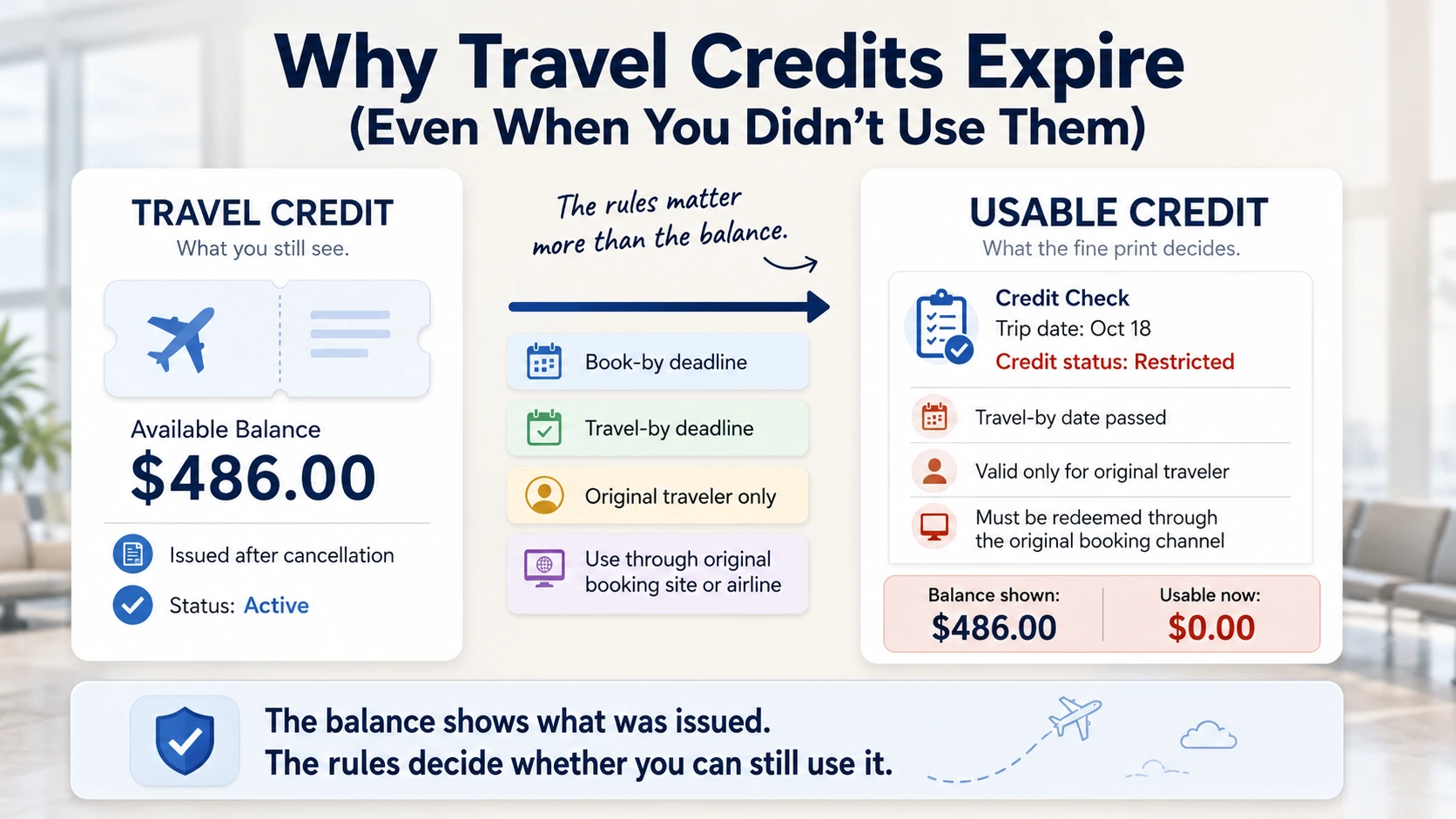
A travel credit balance is not the same as usable value.
A travel credit can still show a dollar amount even when the rules attached to it make the credit harder — or impossible — to use. The balance tells you what value was issued, but the expiration date, book-by deadline, travel-by deadline, traveler restrictions, and booking-channel rules decide whether that value still works for your trip.
Why Travel Credits Expire Even If You Never Used Them
Unused does not always mean unrestricted.
A travel credit usually starts with a specific event: a canceled flight, changed reservation, unused hotel deposit, cruise cancellation, or booking-site adjustment. When the company issues the credit, it may also attach conditions to that value. Those conditions can begin running from the original purchase date, the cancellation date, the credit issue date, or the deadline shown in the terms.
That is why a credit can expire even if you never booked a replacement trip.
From the traveler’s point of view, the value was never spent. But from the company’s point of view, the credit was not open-ended. It was issued under a policy, fare rule, promotion, or cancellation agreement that placed limits on when and how it could be used.
This is where many travelers get caught off guard. The credit may still feel like “money owed,” but the system may treat it more like a limited-use voucher. Once the deadline passes, the credit may become expired, restricted, or unavailable for the trip you are trying to book.
The most important thing to check is not only whether the credit has an expiration date. It is whether that deadline means the credit must be booked by, traveled by, or fully used by that date.
That distinction matters because a credit that looks active today may not work for a trip that takes place after the deadline.
Credit Deadline Check
Expiration Date vs Book-By Deadline vs Travel-By Deadline
The same expiration date can mean different things depending on the company and the type of credit. Before relying on the value, identify which deadline controls your credit.
Expiration Date
The credit may stop working after a stated date. Once that date passes, the unused value may be treated as expired even if you never applied it to a new booking.
Book-By Deadline
The credit must be applied to a new reservation before the deadline. The trip itself may be allowed to happen later, but the booking action must happen in time.
Travel-By Deadline
The trip itself must happen before the deadline. Booking before the date may not be enough if your flight, hotel stay, cruise, or activity occurs after the credit expires.
Travel Fine Print check: Do not assume “expires on” only means “book by.” Some credits must be booked by that date, while others require travel to be completed by that date.
Why the Expiration Rule Matters
The expiration date is only useful if you understand what it controls.
A travel credit may show a deadline in your account, email, or voucher notice, but that deadline may not always mean the same thing. In some cases, you only need to book a new trip before the date. In others, the trip itself must be completed before the date.
That difference can decide whether the credit is usable.
For example, a credit that must be booked by September 30 may still work for travel later in the year if the company allows future travel after the booking deadline. But a credit that must be traveled by September 30 may fail if you try to use it for an October trip, even if you booked before the deadline.
This is why travelers get surprised at checkout.
The credit balance may still appear. The account may still show value. But the trip you selected may not satisfy the rule attached to the credit.
Before choosing dates, ask one question:
“Does this deadline mean I must book by this date, travel by this date, or fully use the credit by this date?”
That answer matters more than the balance alone.
The Most Common Reasons Travel Credits Expire
Travel credits usually expire because they were never meant to work like open-ended cash.
The rules depend on who issued the credit, why it was issued, and what terms applied to the original booking. An airline credit from a canceled nonrefundable fare may work differently from a hotel credit, cruise credit, tour credit, or booking-site voucher.
The key is to look for the rule that limits the credit — not just the balance that appears in your account.
Common Credit Traps
Six Rules That Can Make an Unused Travel Credit Expire or Fail
A credit may look simple from the outside, but the rule that limits it is often buried in the original booking terms, cancellation email, voucher notice, account page, or checkout restrictions.
Original Booking Clock
The deadline may run from the original purchase date, ticket issue date, or booking date — not the day you canceled or received the credit.
Why it matters: the credit may have less usable time than you expected.
Book-By Rule
The credit may need to be applied to a new reservation before a specific deadline.
Check first: whether booking by the date is enough, or whether travel must also happen by then.
Travel-By Rule
The trip itself may need to happen before the credit expires. Booking before the deadline may not protect the value.
Why it matters: a credit may work for August travel but fail for a later trip.
Traveler Restriction
The credit may belong only to the original traveler, passenger, guest, loyalty account, or confirmation number.
Check first: whether someone else can use it, especially if a different person paid for the original trip.
Booking Channel Rule
The credit may only work through the airline, hotel, cruise line, tour company, or booking site that issued it.
Why it matters: the best new price may be somewhere your credit cannot be used.
Eligibility Limits
The new trip may not qualify because of fare type, room category, destination, travel dates, package rules, or promotional restrictions.
Check first: whether the credit is true payment value, goodwill value, or a limited-use promotion.
Travel Fine Print check: A travel credit does not always expire for one reason. Sometimes the date passes. Sometimes the traveler no longer qualifies. Sometimes the new trip does not fit the original rules.
What Kind of Travel Credit Did You Receive?
Not all travel credits follow the same rules.
Before you assume the company took back money, identify what kind of credit you were given. The expiration rules often depend on whether the credit came from your own unused payment, a voluntary cancellation, a service issue, or a limited-time promotion.
A credit connected to money you already paid may feel more like stored value. But even then, it may still be tied to the original traveler, original booking channel, original fare rules, or the date the original ticket or reservation was issued.
A voluntary cancellation credit is usually more restricted. If you canceled a nonrefundable or limited-change booking, the credit may be a narrow exception to the original rules rather than a flexible refund.
Goodwill or compensation credits are different again. These may be issued after a delay, service issue, overbooking, schedule change, or customer service complaint. Because they are often treated as courtesy value, they may come with shorter deadlines or tighter redemption rules.
Promotional credits are usually the least cash-like. Resort credits, onboard credits, dining credits, excursion credits, bonus booking credits, and booking-site coupons often work more like limited-use offers than refunded money.
The safest assumption is this: the more a credit behaves like a promotion, the more carefully you need to check the expiration date, eligible purchases, and redemption rules.
Traveler Risk
Planning around a travel credit before checking the rules can cost you twice.
A travel credit can make a future trip feel partly paid for, but that value may not apply to the dates, traveler, fare, room type, cruise, package, activity, or booking channel you want.
The risk is building the trip around value that only looks available. If the credit fails at checkout, expires before travel, or cannot be used through the booking path you need, you may lose the credit and still have to pay the new trip cost out of pocket.
Check the Fine Print
Not sure whether your travel credit can actually be used?
Use the Travel Fine Print Risk Checker to narrow whether the issue is an expiration date, book-by rule, travel-by deadline, traveler restriction, booking-channel limit, fare rule, or refund-vs-credit problem.
What to Check Before You Rely on a Travel Credit
Before you plan a new trip around a travel credit, treat the credit like a rule-based offer — not just a dollar amount.
Start with the original email, voucher notice, cancellation confirmation, or account page where the credit was issued. That is usually where the most important limits appear: the expiration date, eligible traveler, booking channel, fare or rate restrictions, and whether the credit must be booked by or traveled by a certain date.
Then compare those rules against the trip you actually want to book.
A credit may still work if you are booking the same type of trip, through the same company, for the same traveler, before the deadline. But it may fail if you try to use it for a different passenger, a different booking site, a different fare type, a different room category, or travel dates outside the eligible window.
This is where screenshots help.
If the credit appears active in your account, save the credit number, expiration date, terms, and any error message you receive during checkout. If you need to contact the airline, hotel, cruise line, or booking site, you want the conversation to be about the specific rule blocking the credit — not just the fact that the credit “should still be there.”
The goal is simple: confirm whether the credit can actually be applied before you make plans that depend on it.
Action Step
Check the credit rules before you start comparing new trips.
Before relying on a travel credit, confirm the specific rule that controls whether the value can still be used.
- Find the credit expiration date.
- Check whether the deadline means book by, travel by, or redeem by.
- Confirm whether the credit is tied to the original traveler.
- Check whether it must be used through the original airline, hotel, cruise line, or booking site.
- Compare the credit rules against the trip you actually want to book.
- Confirm whether the credit applies to the fare, rate, room, cruise, or package you selected.
- Save screenshots of the credit balance, terms, expiration date, and checkout errors.
- Ask the issuer to explain the exact rule if the credit does not apply.
Quick win: Before choosing dates, ask: “Can this credit actually be applied to the trip I want, or does it only look available in my account?”
Before You Use a Credit
Check the deadline, traveler, and booking path before you plan around the value.
Use the Travel Fine Print checklist to review confirmation details, refund rules, credit terms, payment records, expiration dates, booking channels, and other travel documents before a credit becomes harder to use.
What If Your Travel Credit Already Expired?
If your travel credit already expired, do not assume there is nothing left to do.
Start by confirming whether the credit is truly expired or whether it simply does not apply to the trip you selected. Sometimes the issue is not the expiration date. It may be the traveler name, booking channel, fare type, destination, room category, package rule, or travel-by deadline.
If the credit really has expired, contact the company that issued it and ask whether it can be reinstated, extended, or reviewed as a courtesy.
This is more likely to work when the credit only recently expired, the rules were unclear, the company changed your original trip, or you had a documented issue that prevented use.
Keep the request specific.
Instead of saying:
“I want my credit back.”
Ask:
“Can you confirm which rule caused this credit to expire, and whether it can be extended or reinstated as a courtesy?”
That gives the airline, hotel, cruise line, tour company, or booking site something concrete to review.
Also check how the credit was created. A credit issued after a company-initiated cancellation, major schedule change, service failure, or documented disruption may deserve closer review than a credit issued because you voluntarily canceled a restricted booking.
The practical goal is not to argue that every travel credit should last forever.
It is to find out whether the credit expired under the actual terms — or whether there is still a reasonable path to recover some value.
❓Frequently Asked Questions
These questions cover why travel credits expire, how book-by and travel-by deadlines work, whether expired credits can be extended, and why a credit may show a balance but fail at checkout.
Do travel credits expire?
Yes, many travel credits expire. The expiration rule depends on the airline, hotel, cruise line, tour company, booking site, fare rule, cancellation policy, or voucher terms that created the credit.
Some credits expire based on the original purchase date, ticket issue date, cancellation date, or credit issue date. Others may have separate book-by or travel-by deadlines.
Why do travel credits expire if I never used them?
Travel credits expire because they are usually conditional booking value, not cash. Even if you never applied the credit to a new trip, the deadline attached to that credit may still keep running.
The credit may be tied to the original booking, traveler name, cancellation date, ticket issue date, booking channel, fare type, or travel-by deadline.
Is a travel credit the same as a refund?
No. A refund usually sends money back to your original form of payment. A travel credit usually keeps value inside the airline, hotel, cruise line, tour company, or booking platform that issued it.
That means the company’s credit rules can control how, when, where, and by whom the value can be used.
What is the difference between book-by and travel-by?
A book-by deadline usually means you must apply the credit to a new reservation before that date. The actual trip may be allowed to happen later if the terms permit it.
A travel-by deadline means the trip itself must happen before the deadline. Booking before the date may not be enough if the flight, hotel stay, cruise, tour, or activity takes place after the deadline.
Can I get an expired travel credit extended?
Sometimes, but it is not guaranteed. You can ask the company that issued the credit whether it can be reinstated, extended, or reviewed as a courtesy.
Your chances may be better if the credit recently expired, the rules were unclear, the company changed your original trip, or you had a documented issue that prevented use.
Can someone else use my travel credit?
Often, no. Many travel credits are tied to the original traveler, passenger, guest, loyalty account, confirmation number, or booking profile.
Always check the transfer rules before assuming someone else can use the credit, even if that person paid for the original trip.
Why does my travel credit show a balance but not work at checkout?
A credit can show a balance because value was issued, but checkout may reject it if the trip does not satisfy the attached rules.
Common reasons include an expired deadline, wrong traveler, wrong booking channel, ineligible fare or room type, travel dates outside the allowed window, or a credit that must be redeemed directly with the company that issued it.
Can I turn a travel credit into cash?
Usually not, unless the terms, law, company policy, or specific disruption situation gives you a refund right. Many credits are designed to be used only toward future travel with the company that issued them.
If you believe you were entitled to a refund instead of a credit, compare the original cancellation reason, fare rules, refund policy, and whether the travel company or the traveler caused the cancellation.
Bottom Line
Travel credits often expire because they are usually not the same as cash.
They may represent unused value, but that value usually stays inside the rules of the airline, hotel, cruise line, tour company, or booking site that issued it.
That is why the balance alone can be misleading.
A credit may still show value in your account but fail because of an expiration date, book-by deadline, travel-by deadline, traveler restriction, booking-channel rule, fare limit, room category restriction, or promotional condition.
Before you rely on a travel credit, check three things:
Does the credit expire?
Does the deadline mean book by, travel by, or fully use by?
Can the credit actually be applied to the trip, traveler, and booking channel you want?
The safest move is to treat every travel credit as conditional value until you confirm the rules in writing.
A refund puts value back in your hands. A credit keeps value inside someone else’s rules.
Related Guides
If you are trying to understand whether a travel credit, voucher, refund, or future booking value can still be used, these related guides may also help:
Refunds, Credits, and Vouchers
- Flight Canceled: Refund or Credit? What Travelers Should Know
Use this if you were offered a travel credit after a canceled flight and need to understand when a refund may be different from a voucher or future flight credit. - Refund vs Travel Credit: What Travelers Should Check Before Accepting One
Helpful if you are deciding whether to accept a credit, voucher, or refund and want to understand what value you are keeping — and what rules may come with it.
Airline Changes and Rebooking Problems
- What Happens If an Airline Changes Your Flight Time?
Helpful if your travel credit came from a schedule change, canceled itinerary, or airline adjustment and you need to understand your rebooking options. - Airline Fees Explained: What Travelers Should Check Before Booking
Use this before applying a credit to a new flight, especially if the new fare adds baggage fees, seat fees, change rules, or other costs. - Advance Seat Selection Fees: Why Airlines Charge Extra to Choose a Seat
Helpful if the credit covers only the base fare and does not apply to seats, upgrades, extras, or add-ons.
Booking Channels, Insurance, and Proof
- Booking Hotels Through Third-Party Sites: What Travelers Should Know
Use this if your credit or voucher was issued by a booking site instead of the airline, hotel, cruise line, or travel provider directly. - Why Travel Insurance Claims Get Denied — And What to Check Next
Helpful before assuming travel insurance will reimburse an expired credit, unused voucher, or trip value you could not redeem. - Travel Insurance Claim Proof: What Your Documents Need to Prove
Use this if you need to document the original payment, cancellation reason, unused credit, expiration terms, or unrecovered loss.