
Your flight is delayed long enough that you need a hotel, meals, or transportation. The airline may not cover all of those costs, so you turn to travel insurance.
Travel insurance may reimburse certain delay-related expenses, but coverage is not triggered simply because the flight was late. The cause of the delay, how long it lasted, the policy’s covered reasons, the benefit limits, and the documentation you provide can all affect the claim.
Airline compensation and travel-insurance benefits are separate. A weather delay, for example, may result in limited airline assistance while still potentially qualifying for insurance benefits if weather is covered by the policy.
This guide explains when trip-delay coverage may apply, what expenses it may reimburse, which restrictions commonly affect claims, and what travelers should compare before buying coverage.
What Does Trip Delay Coverage Usually Pay For?
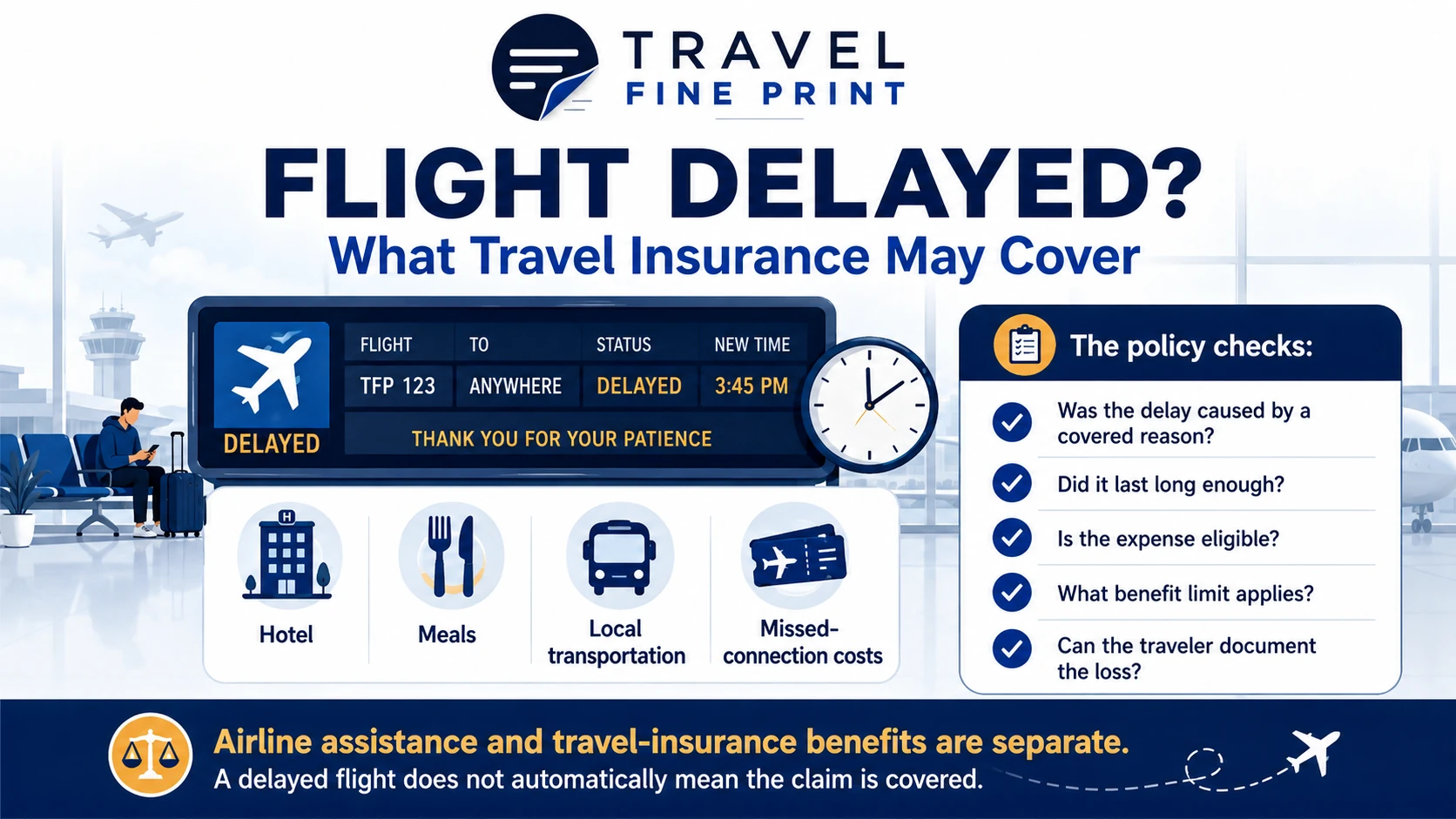
Trip-delay coverage generally reimburses the reasonable additional expenses you incur while waiting to continue your trip. It does not automatically refund the entire trip simply because a flight was delayed.
Depending on the policy, eligible expenses may include:
- Meals and refreshments
- A hotel or other necessary accommodation
- Transportation between the airport and hotel
- Communication expenses
- Certain prepaid, nonrefundable trip costs lost because of the delay
The policy may apply a per-day limit, a total benefit limit, or both. The traveler will also usually need to show that the delay resulted from a covered reason and lasted at least the minimum number of hours required by the plan.
Most trip-delay benefits are reimbursement-based, which means the traveler pays the expense and files a claim afterward. Keep the itemized receipts and proof showing when, how long, and why the flight was delayed.
Do not assume every cost caused by the disruption falls under trip delay. A replacement flight, the cost of catching up with a cruise or tour, or expenses caused by a missed connection may be evaluated under a separate missed-connection, trip-interruption, or transportation benefit. The names and boundaries of those benefits vary by policy.
Which Flight Delays May Qualify for Travel Insurance?
A flight delay may qualify only when the event responsible for the disruption fits the policy’s covered reasons or its definition of a qualifying common-carrier delay. The fact that the flight was late does not establish coverage by itself.
Depending on the plan, qualifying flight disruptions may include:
- Severe weather that prevents or delays the flight
- A mechanical breakdown or equipment failure
- An airline operational delay or cancellation, when included by the policy
- An unannounced strike or other covered labor disruption
- A natural disaster, airport closure, or other specifically listed event affecting the carrier
The exact wording matters. One policy may broadly cover a qualifying common-carrier delay after the required number of hours. Another may require the airline delay to result from one of several specifically named causes.
A mechanical or operational delay is therefore not automatically covered under every plan. The traveler may need documentation showing what caused the disruption, particularly when the policy connects trip-delay coverage to a defined list of events.
Weather also shows why airline responsibility and insurance coverage should be evaluated separately. An airline may provide limited assistance when weather is outside its control, while a travel-insurance policy may still consider eligible expenses if severe weather or the resulting carrier delay is covered. See Do Airlines Compensate You for Weather Delays? for the airline side of the issue.
Read the policy’s covered reasons, common-carrier definition, exclusions, and trip-delay benefit together. A brief summary of benefits may identify the coverage but leave out the conditions that decide whether a particular flight delay qualifies.
How It Works
Trip-Delay Coverage Must Pass More Than One Policy Check
What travelers often call flight-delay insurance is usually evaluated under a benefit called Trip Delay. The insurer does not look only at whether the flight was late or the traveler spent money.
Why this matters: A delay can be real and expensive while still failing to qualify because one part of the policy check was not satisfied.
How Long Must a Flight Be Delayed Before Coverage Begins?
Trip-delay benefits usually do not begin as soon as the airline announces a delay. The disruption must generally continue for the minimum period stated in the policy.
That waiting period can vary considerably. Current examples include:
- Allianz: The minimum covered delay varies by plan. Current Allianz materials describe plan thresholds ranging from three to six consecutive hours.
- Travel Guard Preferred: Trip-delay benefits currently begin when the trip is delayed for more than five hours due to a covered reason.
- Generali: Current thresholds are ten hours for the Standard plan, eight hours for Preferred, and six hours for Premium.
A shorter waiting period can be valuable because travelers may begin paying for meals, transportation, or a hotel before a longer threshold is reached. However, the shortest delay period does not automatically make one policy better. The covered reasons, daily reimbursement amount, total benefit limit, eligible expenses, exclusions, and surrounding benefits must also be compared.
Read the actual policy or schedule of benefits rather than relying only on a marketing summary. The documents should specify:
- When the waiting period begins
- Whether the hours must be consecutive
- Whether an overnight delay qualifies under a separate trigger
- Which covered reason must cause the delay
- When reimbursable expenses may begin
For example, a traveler may incur expenses during a four-hour delay, but a plan requiring a six-hour covered delay may provide no trip-delay reimbursement if the flight departs before that threshold is reached.
Benefit examples checked July 2026. Plan terms, benefit limits, availability, and state-specific policy forms may change. Review the current policy documents issued for the traveler before relying on coverage.
The thresholds above were verified against the current official Allianz, Travel Guard, and Generali materials.
Traveler Risk
A High Coverage Limit May Not Protect the First Expensive Hours
A plan may advertise $1,000 or more in total trip-delay coverage, but that number represents the maximum available under the benefit—not an automatic payment after any delay.
A traveler may begin paying for meals, transportation, or a hotel before the policy’s waiting period is reached. If the flight departs before that trigger, those otherwise reasonable expenses may receive no trip-delay reimbursement.
Even after coverage begins, daily limits, per-person limits, eligible-expense rules, and reimbursements from other sources may leave part of the cost unpaid.
The risk is assuming the advertised maximum tells you when coverage begins or how much one disruption will actually pay.
What Flight-Delay Expenses May Not Be Covered?
Trip-delay insurance is designed to reimburse reasonable, necessary expenses—not every cost connected to the disruption. Even when the delay itself qualifies, part of the claim may still be denied.
Expenses may not be covered when:
- The delay ends before the policy’s waiting period is reached
- The cause is not listed as a covered reason
- The purchase is unnecessary, excessive, or above the daily benefit limit
- The expense was already refunded or paid by the airline, credit card, hotel, or another source
- The traveler cannot show what was purchased or why it was necessary
- The cost falls under a different benefit, such as missed connection or trip interruption
For example, a policy may reimburse a reasonable airport hotel but not an upgraded luxury room when a suitable lower-cost option was available. Insurers may also subtract refunds received from the airline or another travel provider before calculating the eligible reimbursement.
A replacement flight is not automatically a trip-delay expense. Depending on the circumstances and policy wording, the added airfare needed to rejoin a cruise, tour, or itinerary may instead be evaluated under travel delay, missed connection, trip interruption, or another transportation benefit.
The benefit name matters less than the actual policy language. Before making a large purchase during a delay, contact the insurer’s assistance line when possible and ask how the expense may be evaluated.
Check the Fine Print
Not Sure Whether Your Flight-Delay Costs May Be Covered?
Use the Travel Fine Print Risk Checker to review the cause and duration of the delay, what the airline provided, which expenses you paid, and whether your insurance policy or credit card protection may be worth examining more closely before you file.
What Proof Does a Flight-Delay Insurance Claim Usually Need?
A claim generally needs evidence of both the disruption and the unreimbursed expense. An airline notification may help show that a delay occurred, while a receipt may show what you paid. Neither document necessarily proves the entire claim by itself.
Keep the original itinerary, written delay confirmation, itemized receipts, and records of any airline refund, voucher, hotel, meal, or other reimbursement.
For the full claim-documentation framework, see Proof of Loss for Travel Insurance Claims. If the insurer specifically asks for confirmation from the carrier, see Do You Need an Airline Delay Letter for Travel Insurance?
Travel Fine Print Takeaway
A delay claim can be delayed, reduced, or denied when the disruption, expense, or unreimbursed amount cannot be established. Save the itinerary, written delay confirmation, and itemized receipts as the disruption unfolds, and keep track of any voucher, refund, hotel, meal, transportation, or other reimbursement already provided by the airline or another source.
Action Step
What Should You Do While the Flight Is Delayed?
Do not wait until after the trip to determine which expenses may qualify. A few decisions made during the disruption can affect what the airline provides, what the insurer considers, and how much of the loss remains out of pocket.
Can You Receive Airline Assistance and Travel Insurance for the Same Delay?
Yes. The airline and the insurer may both respond to the same disruption, but they do not necessarily pay for the same loss.
The airline may rebook the traveler, provide a hotel, issue meal vouchers, arrange ground transportation, refund an unused ticket, or offer another form of assistance. Travel insurance may then evaluate the eligible expenses that remain unpaid, subject to the policy’s requirements.
A practical sequence is:
- Ask what the airline will provide before paying for the expense yourself.
- Keep written records of any hotel, meal voucher, refund, credit, or transportation provided.
- Submit only the eligible amount that remains unreimbursed.
For example, suppose the airline provides a $20 meal voucher and the traveler spends $38 on a reasonable meal. The insurer may consider the remaining $18 if the delay qualifies, the expense is allowed, and it remains within the applicable limit.
If the airline pays for a hotel directly, the traveler generally has no hotel expense to submit. If the airline issues a refund or travel credit, disclose it to the insurer so it can determine whether the payment reduces the covered loss.
The two protections can work together, but they do not create a right to collect twice for the same hotel room, meal, ticket, or transportation expense. For more on what the carrier itself may provide, see Do Airlines Compensate You for Delayed Flights?.
Can You Buy Travel Insurance After a Flight Delay Is Announced?
Travel insurance generally cannot be purchased retroactively to cover a disruption that is already happening or reasonably known. A traveler may still be able to buy a policy after booking the trip, but losses connected to an event that became known before coverage took effect may be excluded.
For example, buying insurance after the airline has announced the delay would not normally turn the existing delay into a covered event. The same concern may apply when a strike has already been announced, a storm has already been named, or another disruption is publicly known before the policy is purchased. Travel insurance is intended primarily for sudden and unforeseen events.
The effective date also matters. Some benefits begin shortly after the insurer receives the premium, while other time-sensitive benefits may require the policy to be purchased within a specified period after the first trip payment. The policy documents—not the purchase confirmation alone—determine when each benefit becomes active.
Example: A traveler sees that an evening flight has already been delayed because of a major storm and then purchases insurance that morning. The new policy would not ordinarily be expected to cover expenses arising from that already-known disruption. Had the policy been purchased before the storm became a known event, the claim could be evaluated under its covered reasons and other requirements.
Before the Delay Details Disappear
Save the timeline, receipts, and airline messages in one place.
Flight-delay claims may depend on the original itinerary, changing departure times, the reason given by the airline, itemized receipts, voucher details, and records of what another source already paid. Use the Travel Documents Checklist to organize those details before notifications disappear or the claim becomes harder to reconstruct.
❓Frequently Asked Questions
These questions explain when flight-delay coverage may begin, which expenses may qualify, and how airline assistance, credit-card protection, and other travel-insurance benefits can affect reimbursement.
Does travel insurance cover a short flight delay?
Only when the delay reaches the minimum period required by the policy. A three-hour delay may qualify under one plan but remain below another plan’s six-hour waiting period. The cause of the delay must also meet the policy’s coverage requirements.
Will travel insurance pay for a hotel after a delayed flight?
It may reimburse a reasonable hotel expense when the delay results from a covered reason, lasts long enough, and the policy allows lodging as a trip-delay expense. A hotel already arranged or paid for by the airline generally cannot also be claimed from the insurer.
Does travel insurance cover flight delays caused by weather?
It may. Severe weather or the resulting common-carrier delay must fit the policy’s covered reasons, and the disruption must still meet the waiting-period, expense, limit, and documentation requirements.
Can travel insurance cover a missed cruise caused by a flight delay?
Potentially. Meals and an airport hotel may fall under trip-delay coverage, while the cost of catching up with the cruise may be evaluated under missed-connection or trip-interruption coverage. The policy may also require a minimum delay or a qualifying connection.
Can a credit card and a travel-insurance policy cover the same delay?
Both protections may apply, but the traveler generally cannot collect twice for the same expense. One benefit may pay first, while the other considers the remaining eligible amount. Review the card’s Guide to Benefits and the insurance policy because their triggers, limits, and eligible travelers may differ.
Does travel insurance cover a delay that began before the policy was purchased?
Generally not. Buying a policy after the airline announces the delay—or after the event causing it becomes known—would not normally make that existing disruption eligible for coverage.
Will travel insurance pay for a replacement flight after a delay?
Sometimes, but not automatically. A replacement ticket may be evaluated under trip delay, missed connection, trip interruption, or another transportation benefit. Coverage depends on why the original flight was delayed, what happened to the remaining itinerary, and how the policy defines each benefit.
Bottom Line
Travel insurance may reimburse meals, lodging, local transportation, and other eligible costs when a flight delay results from a covered reason and lasts long enough. It does not pay simply because the flight was late, and the same expense generally cannot be reimbursed twice.
Before travel, compare the delay trigger, daily and total limits, credit-card protection, and the broader medical, missed-connection, and interruption benefits surrounding the delay. During a disruption, ask what the airline will provide, keep spending reasonable, and save proof as events unfold.
The best protection is the one that matches the trip’s largest financial risk—not necessarily the plan with the highest advertised limit.
Related Guides
These guides help you separate what the airline may provide from what insurance may reimburse and understand the connection and claim problems a flight delay can create.
Airline Assistance During a Delay
- Do Airlines Pay for Hotels During Overnight Delays?
Learn when an airline may provide a hotel, meals, or transportation—and when you may need to pay first and seek reimbursement elsewhere.
Missed Connections and Itinerary Risk
- What Happens If You Miss a Connecting Flight?
See how rebooking and responsibility can depend on whether the flights were issued as one protected itinerary. - Missed Connection on Separate Tickets
Understand why separate tickets can leave you responsible for replacement flights, hotel costs, and other losses after a delay.
Travel Insurance Decisions and Claims
- Does Travel Insurance Require Receipts? What They Do and Don’t Prove
Learn why receipts help establish what you spent but may not prove that the expense qualifies for reimbursement. - Travel Insurance Claim Denied? Why It Happens
Review the exclusions, deadlines, documentation gaps, and coverage conditions that can weaken or delay a claim. - Do You Need Travel Insurance for Refundable Trips?
See why a refundable flight or hotel may protect one reservation without covering delays, medical emergencies, baggage problems, or interruption costs.