
Hotel Billing & Checkout
Can a Hotel Charge You After Checkout? Fees, Holds & What to Do
A hotel charge appearing after you leave can be a legitimate final adjustment, a pending authorization hold, or a fee worth questioning. The key is identifying what actually posted and what documentation supports it.
The decision: Is the amount a temporary hold, a documented charge from your stay, or an unexplained payment you should challenge?
Practical hotel billing guidance, distinguishing authorization holds, final folios, post-checkout incidentals, and disputed charges. Rules and remedies depend on the facts, payment method, and applicable law.

Quick Answer
Can a hotel charge your card after checkout?
Yes. A hotel may post a final balance, authorized incidental, parking fee, minibar charge, or documented damage or cleaning fee after checkout if it has a valid basis to collect the amount. But a delayed charge is not automatically justified simply because the hotel submitted it.
First check whether it is pending or posted. A pending authorization may disappear without becoming a separate payment. For a posted charge, request an updated itemized hotel folio and the supporting explanation. There is no universal number of days after checkout that makes every charge valid or invalid.
Decision in 30 Seconds
Which kind of post-checkout hotel charge are you seeing?
| Situation | Most useful next action |
|---|---|
| Pending hold | Ask your card issuer or the hotel whether it is an authorization rather than a completed payment. Monitor for release. |
| Final room balance | Compare your confirmation, checkout folio, and the posted transaction; check pay-at-property terms. |
| Late incidental or fee | Request a dated, itemized line item and any applicable disclosure or receipt. |
| Damage, smoking, or cleaning | Ask for inspection notes, photos, the written policy, and a basis for the amount. |
| Possible duplicate or unfamiliar charge | Check if both transactions actually posted. Request a written reconciliation, and preserve card-dispute deadlines. |
If a debit-card hold reduces your available funds, contact your bank about release timing; a hotel cannot always force the bank to remove the authorization immediately.
Understand the Transaction
Pending hold vs. posted charge: why the difference matters
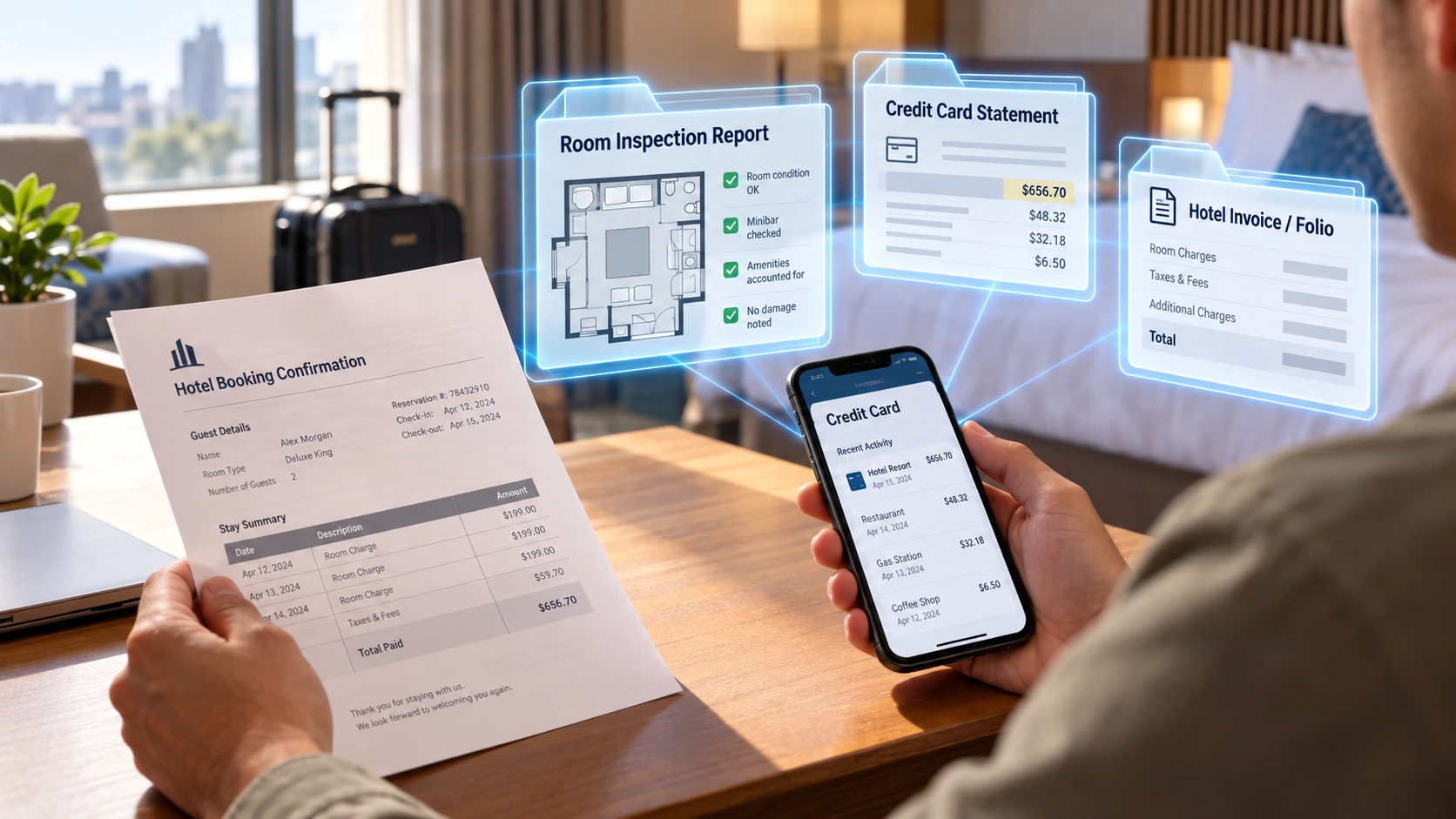
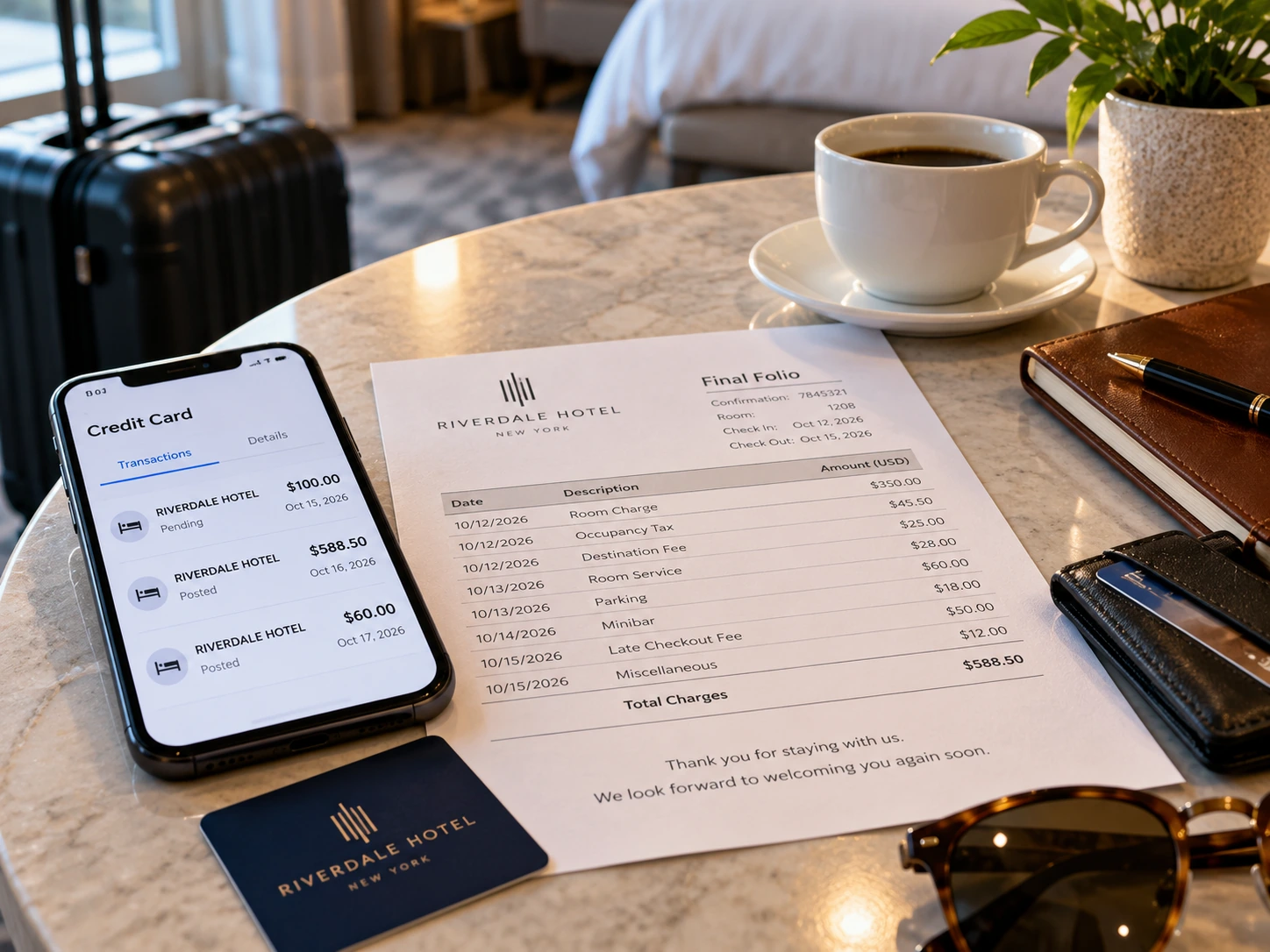
Hotels often authorize an amount at check-in for the room, taxes, and possible extras. When the final bill settles, the original authorization can temporarily remain visible next to a posted payment. That can look like two charges even when the hotel has only collected one.
Pending usually means the card issuer has reserved funds but the payment is not final. Posted indicates the transaction has settled. If two separate payments have posted, ask the hotel to reconcile them in writing; see our guide to a hotel charging you twice.
Why It Happens
Why hotels may add a charge after you leave
Final settlement
The property may submit the final room balance or taxes after checkout. A booking confirmation is not proof that payment already settled.
Late-posted incidentals
Parking, minibar, restaurant, room-service, spa, or other on-property purchases sometimes reach the billing system after the initial folio is prepared.
Mandatory property fees
Resort, destination, and other required charges may be collected at the property. Whether they were adequately disclosed is a separate question from when they posted.
Room-condition claims
Smoking, damage, missing items, or extraordinary cleaning may be billed after inspection. The hotel should identify the policy and evidence for the charge.
Billing error
Duplicate settlement, a wrong room folio, or an incorrect amount is possible. Ask for an updated statement instead of relying on the card descriptor alone.
A hotel charge appearing late is not the same as a late-checkout fee. The latter is a specific fee for occupying the room beyond the permitted departure time.
Higher-Risk Charges
Can a hotel charge for damage or smoking after checkout?
It may be able to, depending on the reservation terms, facts, and applicable law. These charges deserve closer scrutiny because they typically rely on a claim about what happened in the room.
Ask for dated photos or inspection records, the room number, the specific incident, the fee policy, and the calculation or invoice supporting the amount. A vague description such as “miscellaneous” or “room recovery” is not enough to help you evaluate the charge.
Do not assume that merely asking for proof obligates the hotel to reverse the payment. If the explanation remains unsupported or inaccurate, preserve the evidence for escalation.

Practical Resolution
What to do when a hotel charges you after checkout
1. Check the status
Confirm whether the amount is pending, posted, reversed, or refunded. Record the date, descriptor, amount, and last four card digits.
2. Compare three records
Put the booking confirmation, checkout folio, and card statement side by side. Watch for tax, incidental, deposit, and pay-at-property differences.
3. Request the updated folio
Ask the hotel’s billing team to explain what was added after checkout, on which date, and under which reservation term.
4. Ask for evidence
For disputed minibar, restaurant, damage, or cleaning charges, request receipts, inspection records, images, or policy language as appropriate.
5. Escalate without losing time
Use a manager or corporate guest-relations channel, then your card issuer if needed. Keep emails, screenshots, folios, and any response.
Simple wording for the hotel
“Please send an updated, itemized folio identifying the charge posted after my checkout, the date it was added, and the basis for the amount. If this is a damage or cleaning fee, please include the supporting records and policy.”
Your Payment Rights
Do not let a hotel investigation run out your card-dispute deadline
You can ask the hotel for documentation first, but do not wait indefinitely if the charge is unauthorized or cannot be resolved. Contact the card issuer promptly to learn the deadline and how to preserve your rights.
For many U.S. credit-card billing errors, the Fair Credit Billing Act process requires a written billing-error notice that reaches the card issuer at its designated dispute address within 60 days after it sent the first statement showing the error. Calling or opening an online dispute may help, but do not assume either replaces the required written notice unless the issuer expressly accepts that method for statutory billing-error notices. Not every hotel disagreement qualifies as the same type of billing error; debit-card protections and card-network procedures also differ. Check the rules for your particular card and claim.
The Consumer Financial Protection Bureau’s billing-error information is a useful starting point. Keep communicating with the property while protecting your cardholder rights.
The Fine Print
Five details that determine whether a post-checkout charge makes sense
Authorization is not settlement
A pending hold and an actual payment can appear together temporarily.
The final folio may differ from the booking summary
It can include property-collected amounts and authorized expenses not prepaid with the reservation.
Late posting does not automatically invalidate the fee
The proper question is whether the hotel had a documented and lawful basis to collect it.
Damage charges need specific supporting records
Ask for the claimed incident, inspection basis, applicable policy, and calculation.
Dispute rights have deadlines
Preserve relevant credit- or debit-card protections even while the hotel investigates.
My Take
I would focus on proof—not simply on when the charge appeared.
Hotels can settle legitimate charges after checkout, so I would not treat the posting date alone as evidence of wrongdoing. I’d start by checking whether money was actually collected, then compare the posted amount with the hotel’s itemized record.
For a vague damage fee or an unexplained duplicate payment, I would be persistent about documentation. And I would not let a slow hotel response jeopardize my card-dispute deadline. A written record gives you more leverage than repeated phone calls without a paper trail.
TFP Recommendation
Identify the charge, request the evidence, then choose the right response.
The Recommendation
Begin with the transaction status and final folio. If the charge is legitimate and documented, reconcile it to your stay. If it is unexplained, duplicated, or inconsistent with the agreed terms, ask for correction in writing and escalate promptly.
For a future hotel stay, compare not just the displayed room rate but also whether you’ll pay now or at the property, any incidental hold, and required charges shown at checkout. When comparing options, review the total price and payment terms on Hotels.com—then verify the property’s policies before booking.
Your Next Step
Smarter travel, straight to your inbox
Booking choices, hidden costs, travel rules and useful fine print — explained clearly.
Before You Go
Prevent the next billing surprise.
Before checkout, save your folio and note any open incidental authorization. These related guides help you understand billing timing, duplicate charges, and unexpected final costs.
Hotel Charged Me Twice
Separate a duplicate posted transaction from a temporary authorization.
Understand duplicate charges →Hotel Charged More Than Confirmed
Trace extra taxes, fees, deposits, and adjustments against the price promised.
Check unexpected costs →When Do Hotels Charge Your Card?
Understand booking, pre-arrival, check-in, and checkout payment timing.
Understand payment timing →Pay Now vs. Pay at Hotel
Choose a booking payment method with fewer surprises for your trip.
Compare payment options →Frequently Asked Questions
Hotel charges after checkout
Can a hotel charge you after checkout?
Yes. A hotel may post authorized balances, late incidentals, and certain documented fees after departure, subject to its terms and applicable law. Ask for an itemized folio if you do not recognize the amount.
How long after checkout can a hotel charge you?
There is no single universal deadline for every hotel charge. The answer depends on the charge, agreement, payment rules, and applicable law. A later charge still needs a valid basis and documentation.
Why did the hotel charge me again after I checked out?
It could be the final payment settling while an old hold remains pending, a late-posted extra, or a true duplicate. Check whether both amounts are posted before assuming two payments were collected.
Can a hotel charge a damage or smoking fee after I leave?
Potentially, if the fee is authorized and supported. Request the applicable policy, inspection records, dated photos, and calculation of the amount.
Can a hotel charge my card without notifying me first?
A separate advance notification is not necessarily required for every previously authorized charge. Whether a specific charge is permissible depends on the agreement, disclosure, and law. You can still ask for the billing basis and contest an incorrect charge.
What if the hotel refuses to explain a charge?
Keep the confirmation, folios, card statement, and written requests. Contact the card issuer promptly about dispute options rather than waiting indefinitely for the hotel.
Is a hotel deposit the same as a charge?
Not always. A deposit can be an actual payment or refundable amount; an authorization hold reserves funds without a completed charge. Check the transaction status and booking terms.
Should I dispute a charge while the hotel investigates?
Protect your cardholder deadlines. You can continue asking the hotel for evidence while contacting the card issuer. For a qualifying U.S. credit-card billing error, follow the issuer’s written-notice instructions within the applicable 60-day window; other card and dispute rules may differ.
Free Travel Guide
Avoid the travel mistakes that can cost you money, flexibility, or time.
Get 27 Travel Mistakes That Cost Travelers Thousands — a practical guide to booking mistakes, hidden costs, travel rules and decisions worth understanding before they become a problem.
- Spot booking details that are easy to overlook
- Understand where hidden costs can appear
- Recognize when a cheaper option comes with a tradeoff
- Make travel decisions with fewer surprises
You’ll also receive occasional practical guidance from Travel Fine Print on booking choices, hidden costs, travel rules and the fine print worth understanding. Unsubscribe anytime.