
You bought a flight ticket.
Then the airline wants more money just to choose a seat in advance.
That can feel confusing, especially when the ticket itself was not cheap.
But many airlines no longer treat advance seat selection as part of every base fare. Instead, the ticket usually covers transportation from one airport to another, while specific seat choices — aisle, window, exit row, extra legroom, front section, preferred seat, or even some standard seats — may be priced separately.
The cost can also differ widely by airline, fare type, route, seat location, demand, and when you choose the seat.
The real question is not just:
“Why do I have to pay for a seat?”
It is:
“What did my fare actually include, and how much control do I want before check-in?”
This guide explains why airlines charge advance seat selection fees, how those fees can differ between airlines, what happens if you do not pay, and how to decide whether choosing a seat is worth the extra cost.
Quick Answer
Why do airlines charge advance seat selection fees?
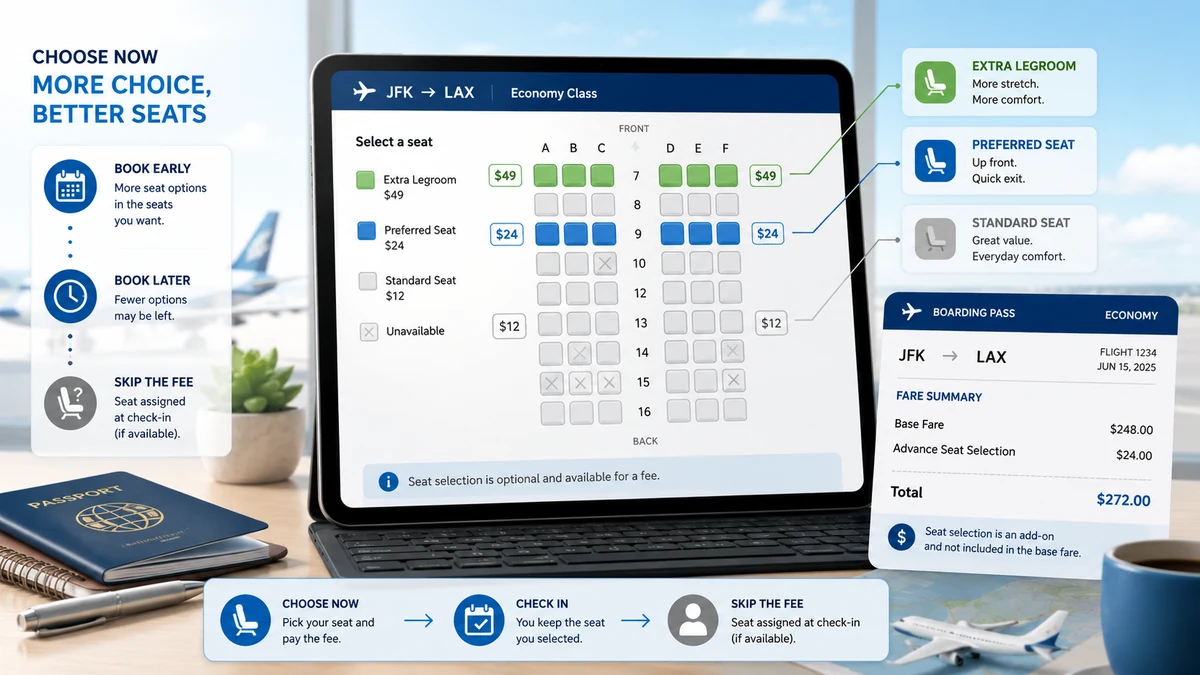
Airlines charge advance seat selection fees because many fares no longer include the right to choose a specific seat before check-in. Your ticket may include transportation on the flight, but seat choice — such as aisle, window, preferred location, exit row, extra legroom, or seats together — may be sold separately.
The cost can differ by airline, fare type, route, seat category, demand, loyalty status, and when you choose the seat. A basic economy fare may charge for seats that another fare includes, while preferred or extra-legroom seats may cost more even on regular economy fares.
You can usually still fly without paying for advance seat selection if you have a confirmed ticket, but you may lose control over where you sit. The airline may assign your seat at check-in or at the gate, and companions may not be seated together if the flight is full.
System Insight
Advance seat selection fees are not based only on the seat — they are based on the airline’s fare rules, route, seat category, timing, and how much control you want before check-in.
- Fare type matters because basic economy or light fares may restrict free seat choice more than standard economy fares.
- Seat category matters because standard seats, preferred seats, exit rows, front-of-cabin seats, and extra-legroom seats may all price differently.
- Airline policy matters because one airline may include standard seat selection while another charges for similar control.
- Timing matters because choosing early gives you more control, while waiting may reduce options even if it saves money.
Fee Differences
How Advance Seat Selection Fees Differ Between Airlines
Advance seat selection fees do not work the same way on every airline. One airline may include standard seat selection in the fare, while another may charge for choosing similar seats before check-in. The difference usually comes down to fare type, seat category, route, demand, and airline policy.
Fare Type
Basic economy vs standard economy
Basic economy, light, or saver fares often limit free advance seat selection. A standard economy fare may include more seat choice, but preferred or extra-legroom seats may still cost more.
Seat Category
Standard, preferred, and extra legroom
A standard seat may be free or lower cost, while aisle, window, front-of-cabin, exit row, preferred, or extra-legroom seats may carry higher fees.
Route and Demand
Longer or fuller flights can cost more
Seat fees may rise on popular routes, longer flights, peak travel dates, or flights where travelers are more likely to pay for comfort or to sit together.
Travel Fine Print check: Do not compare airfare by base price alone. Compare the fare plus the seat control you actually need, especially if you care about sitting together, avoiding a middle seat, getting extra legroom, or choosing a specific location before check-in.
Why the Base Fare Does Not Always Include Seat Choice
Many airlines use unbundled pricing.
That means the base fare may cover transportation from one airport to another, while other parts of the travel experience are sold separately. Seat selection is one of the easiest items to separate because not every traveler values seat location the same way.
One traveler may not care where they sit. Another traveler may need to sit with a child, avoid a middle seat, get extra legroom, stay near the front, or choose a specific side of the aircraft.
Instead of including the same seat-choice benefit for everyone, airlines may price that control separately.
That is why an expensive ticket does not always mean free advance seat selection. The question is not only how much the ticket costs. The question is what the fare includes.
What Happens If You Do Not Pay for Seat Selection?
If you have a confirmed ticket, you can usually still fly without paying for advance seat selection.
But you may not control where you sit.
Depending on the airline and fare type, your seat may be assigned at check-in, after check-in opens, or at the gate. If the flight is not full, you may still get a reasonable seat. If the flight is full, many of the better options may already be taken by passengers who paid earlier, selected seats through a higher fare, or received seats through loyalty status.
That can create several outcomes:
You may be assigned a middle seat.
You may not sit with your travel companions.
You may be placed farther back in the aircraft.
You may have limited ability to change seats once check-in opens.
You may not know your seat until close to boarding.
This does not mean paying is always necessary.
It means skipping advance seat selection is a trade-off. You save money, but you give up control over seat location, timing, and who you sit near.
Seat Control
What You Get Depends on When and How You Choose
Seat selection is mostly a control decision. Paying earlier may give you more control. Waiting may save money, but the airline may assign what is left.
Most Control
Paid advance selection
You choose a specific seat before check-in. This can help if you want an aisle, window, extra legroom, front section, or seats together with companions.
Some Control
Check-in assignment
You may be assigned a seat when check-in opens, sometimes with limited ability to change based on what remains available.
Least Control
Gate assignment
Your seat may be assigned close to boarding. This can happen with restrictive fares, full flights, or situations where the airline is still managing final seat inventory.
Travel Fine Print check: Waiting can save money, but it can also reduce your options. If sitting together, avoiding a middle seat, or getting extra legroom matters, decide before the best seats are gone.
When Advance Seat Selection Fees Catch Travelers Off Guard
Advance seat selection fees usually feel most frustrating when travelers assumed the ticket already included the choice.
That often happens in a few common situations.
Basic economy or light fares can be especially confusing. The ticket price may be high because of demand, but the fare rules may still be restrictive. A high price does not automatically mean seat choice is included.
Traveling with others can also make the fee feel less optional. If you are traveling with a partner, child, family member, or group, paying for seats may be the only reliable way to control whether you sit together.
Longer flights make seat location matter more. A middle seat may feel manageable on a short flight but much less comfortable on a long or overnight itinerary.
Late booking or late check-in can reduce the number of free or lower-cost options. By the time you look, many aisle, window, or together seats may already be gone.
Comparing airlines by base price alone can also create surprises. One airline may include standard advance seat selection, while another may charge for it. The cheaper fare may not stay cheaper once you add the seat control you need.
The fee is not only about the seat.
It is about how much certainty you want before the airline assigns one for you.
Traveler Risk
Comparing airfare without seat selection can make the cheaper ticket look better than it really is.
A lower base fare may not include the seat control you actually need. If you later pay for an aisle seat, window seat, extra legroom, preferred location, or seats together, the final cost may be closer to — or higher than — another airline or fare that included more upfront.
The risky assumption is thinking “ticket price” and “trip cost” are the same thing. If where you sit matters, compare the fare plus the seat selection cost before deciding which airline is really cheaper.
Check the Fine Print
Not sure if the cheaper fare is really cheaper?
Seat selection fees can change the real cost of a flight. Use the Travel Fine Print Risk Checker to narrow whether the issue is tied to the fare type, seat fee, baggage rule, booking path, or another travel add-on.
Action Step
Compare the seat fee before deciding which fare is cheaper.
Before paying for advance seat selection, decide whether the seat actually matters for this trip. Then compare the cost of paying for the seat against waiting, upgrading the fare, or choosing a different airline.
- Check whether your fare includes free advance seat selection.
- Compare standard, preferred, and extra-legroom seat prices.
- Check whether a higher fare includes seat selection plus other benefits.
- Decide whether sitting together matters for this trip.
- Consider flight length before paying for comfort or location.
- Check whether loyalty status or credit card benefits help.
- Compare the full fare plus seat fee across airlines.
- Save screenshots of seat fees before booking if the total matters.
Quick win: Ask yourself: “Would this still be the cheapest flight after I add the seats I actually want?”
Before You Book
Check the flight details before add-ons change the real price.
Advance seat selection is only one part of the final trip cost. Use the Travel Fine Print checklist to review seat fees, baggage rules, fare restrictions, documents, timing, and other booking details before you lock in a flight.
❓Frequently Asked Questions
These questions cover how advance seat selection fees work, why costs differ by airline, and when paying for a seat may or may not be worth it.
Why do airlines charge for advance seat selection?
Airlines charge for advance seat selection because many fares separate transportation from seat choice. Your ticket may get you on the flight, while choosing a specific aisle, window, preferred, extra-legroom, or front-section seat may cost extra.
This is part of unbundled pricing, where the base fare looks lower and travelers pay separately for the choices or comforts they want.
How do advance seat selection fees differ between airlines?
Advance seat selection fees differ by airline policy, fare type, route, aircraft, demand, and seat category. One airline may include standard seat selection on regular economy fares, while another may charge for similar seat control before check-in.
Preferred seats, extra-legroom seats, exit rows, aisle seats, window seats, and front-of-cabin seats may also price differently.
Do you have to pay for seat selection?
Usually, no. If you have a confirmed ticket, you can generally still fly without paying for advance seat selection. The trade-off is that the airline may assign your seat later, often at check-in or at the gate.
Skipping the fee may save money, but you may have less control over whether you get an aisle, window, middle seat, or seat near your companions.
What happens if you do not choose a seat?
If you do not choose a seat, the airline may assign one when check-in opens, after check-in, or at the gate. The timing depends on the airline, fare type, flight load, and remaining seat inventory.
You will usually still get a seat if you have a confirmed ticket, but it may not be the seat location you would have chosen.
Will airlines seat families together if they do not pay?
Some airlines try to seat families together, especially when children are involved, but you should not assume every airline, fare type, or full flight will make that easy.
If sitting together is essential, check the airline’s family seating policy and consider selecting seats early rather than waiting until check-in.
Is seat selection worth paying for?
Seat selection may be worth paying for if you care about sitting together, avoiding a middle seat, getting extra legroom, sitting near the front, choosing an aisle or window, or having certainty before check-in.
It may be less valuable if you are flying alone, taking a short flight, do not care where you sit, or are willing to accept whatever seat remains.
Are seat selection fees refundable?
Seat selection fee refunds depend on the airline, fare rules, reason for the change, and whether the airline moved you out of the seat or you changed the itinerary yourself.
Before paying, check whether the seat fee is refundable, transferable to a new flight, or forfeited if you cancel, change flights, or accept a different itinerary.
Is it cheaper to select seats later?
Not always. Waiting may help you avoid paying if a free assignment works for you, but it can also leave fewer seats available. Some preferred seats may sell out or become less useful if only scattered seats remain.
The better question is whether waiting is worth the loss of control. If you care about sitting together or choosing a specific location, selecting earlier may be more valuable than waiting for a possible savings.
Bottom Line
Advance seat selection fees are not just about paying extra for a seat.
They are about paying for control before the airline assigns one for you.
Your ticket usually gets you on the plane. But depending on the airline and fare type, it may not include the right to choose a specific seat in advance. Aisle seats, window seats, preferred rows, extra-legroom seats, exit rows, front-of-cabin seats, and seats together may all cost more.
That does not mean every traveler should pay.
If you are flying alone, taking a short trip, or do not care where you sit, skipping seat selection may be a reasonable way to save money. But if you are traveling with someone else, want to avoid a middle seat, need extra legroom, or care about where you sit, the seat fee may be part of the real trip cost.
The mistake is comparing airlines by base fare alone.
Before booking, compare the fare plus the seat control you actually need. A cheaper ticket may not stay cheaper once you add the seat selection, baggage, and other extras that matter for your trip.
Seat selection is optional only if the seat location is optional to you.
Related Guides
If you are trying to understand airline add-ons, seating choices, baggage rules, or why the final flight price changes after you start booking, these related guides may help:
Airline Fees and Add-Ons
- Airline Fees Explained: What Travelers Should Check Before Booking
Helpful if you want a broader explanation of airline add-ons, optional fees, and what may not be included in the base fare. - Why the Price You See at Checkout Isn’t the Price You Pay
Helpful if seat selection fees, baggage fees, taxes, or other add-ons change the final trip cost.
Flight Price Comparisons
- Why Travel Prices Are Different on Different Websites, Apps, and Devices
Use this if one booking path shows a lower fare but another includes different fees, seat rules, or add-ons. - Hidden Travel Fees Explained
Helpful if you want to understand how smaller travel charges can add up after the advertised price.
Flight Changes and Seat Issues
- Airline Schedule Changes: What Happens If Your Flight Time Changes?
Use this if a schedule change affects seats, paid extras, timing, or the flight you originally chose. - Can an Airline Change Your Flight Without Notifying You?
Helpful if the airline changed your itinerary and you are not sure what happens to your selected seat or paid add-ons.