
Hotel Cancellation Guide
Hotel Cancellation Policies Explained: Deadlines, Penalties, and Refund Rules
A hotel may let you cancel the reservation while still charging a penalty, keeping a deposit, issuing only a partial refund, or denying a refund after the deadline. The label alone does not tell you what happens to your money.
The decision: If you cancel this reservation, how much money do you actually get back—and what rule determines the answer?
About This Guidance
This guidance focuses on the terms that usually determine a hotel cancellation outcome: the exact deadline, hotel-local time zone, rate type, penalty, no-show rule, payment path, booking channel, and company responsible for any refund.
On This Page
- Quick Answer
- The Decision in 30 Seconds
- Four Rules That Determine the Outcome
- Main Types of Cancellation Policies
- What “Free Cancellation” Really Means
- Refundable vs. Nonrefundable
- Why the Booking Channel Matters
- What Happens After the Deadline
- What to Check Before You Cancel
- Why Refund Timing Can Vary
- The Fine Print That Matters
- TFP Recommendation
- Before You Go
- FAQ
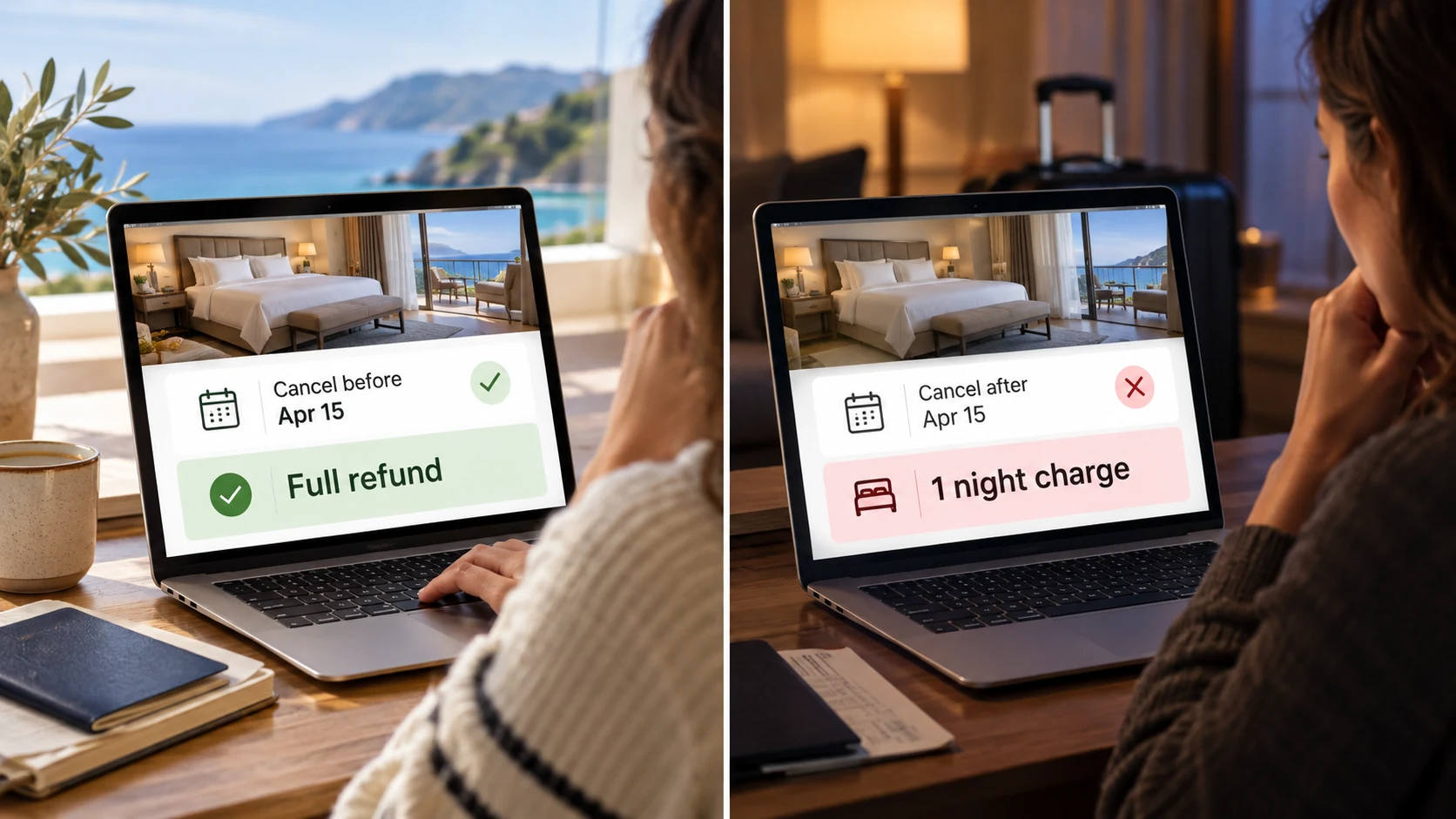
The same reservation can have very different financial outcomes depending on whether you cancel before or after the deadline.
Quick Answer
“Free cancellation” usually has an expiration date.
A typical hotel cancellation policy lets you cancel without a penalty before a stated deadline—often 24, 48, or 72 hours before arrival. After that cutoff, the hotel or booking platform may charge one night, keep a deposit, issue only a partial refund, or treat the rate as nonrefundable.
The outcome depends on the rate type, cancellation deadline, penalty, no-show rule, booking channel, and company that collected the payment.
Canceling the reservation and qualifying for a refund are two separate questions.
TFP rule: Before booking or canceling, check the exact cutoff date and time, the hotel’s local time zone, what penalty starts after the deadline, and who controls the refund.
The Decision in 30 Seconds
What should you check before relying on a cancellation policy?
| Check | Why it matters |
|---|---|
| Exact deadline | Date, cutoff time, and hotel-local time zone determine whether you are still inside the penalty-free window. |
| Rate type | Refundable, partially refundable, prepaid, promotional, and nonrefundable rates can produce different outcomes. |
| Penalty | The policy may allow a full refund, one-night charge, retained deposit, partial penalty, or full-stay loss. |
| Payment path | The hotel, booking site, agency, or portal that collected the money may control the refund. |
If you are still choosing where to stay, compare the cancellation deadline attached to each available hotel rate before assuming the lowest price gives you the same flexibility.
How It Works
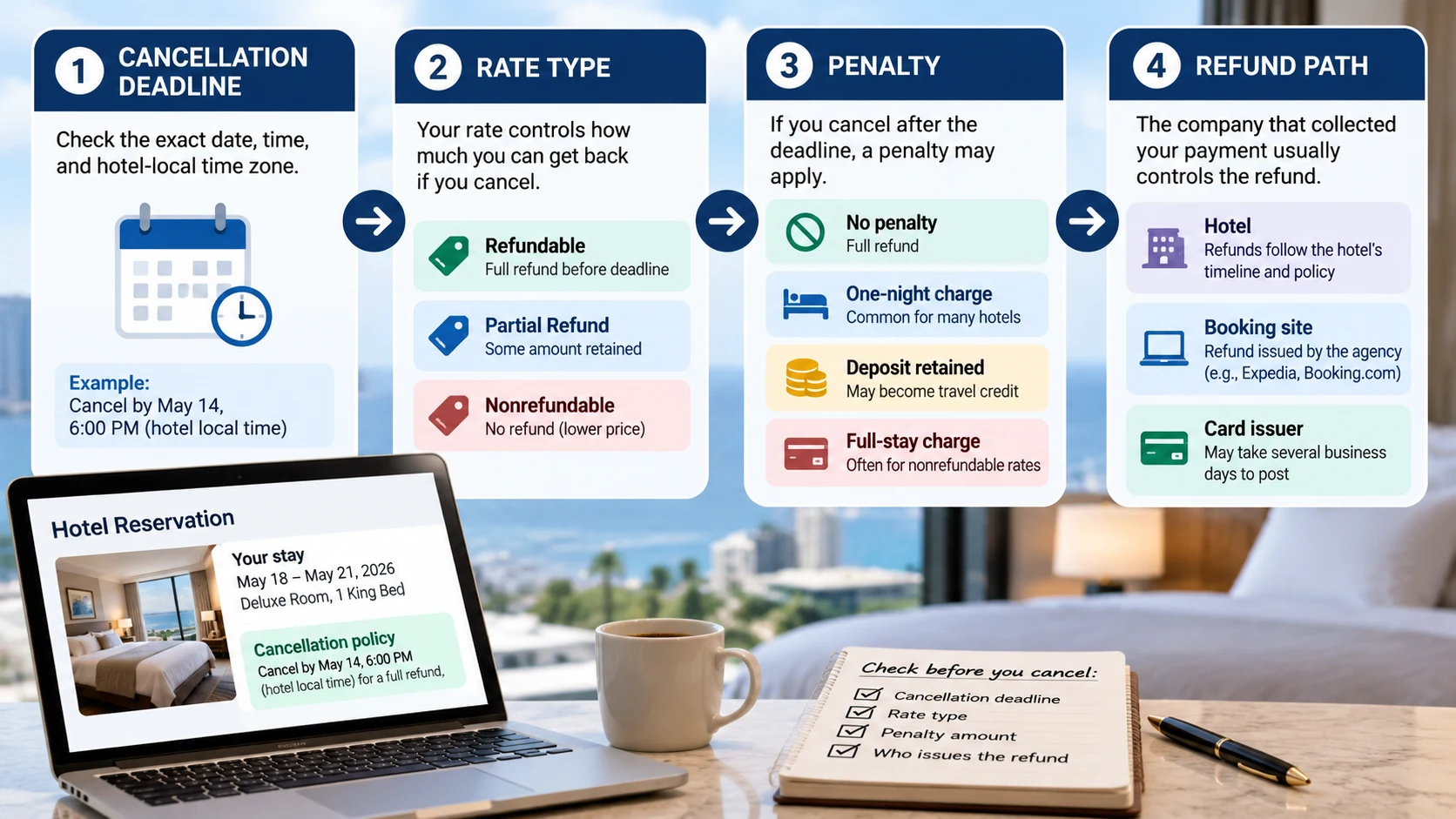
Four rules usually determine the cancellation outcome.
A cancellation result is rarely random. It follows a chain of terms that determines whether you receive a full refund, partial refund, credit, penalty, or no refund.
1. Cancellation deadline
The exact date, cutoff time, and hotel-local time zone determine whether you canceled inside the penalty-free window.
2. Rate type
Refundable, partially refundable, prepaid, promotional, and nonrefundable rates can all behave differently.
3. Penalty rule
The terms may allow a full refund, charge one night, keep a deposit, apply a partial penalty, or retain the full amount.
4. Payment and booking path
The hotel, booking site, travel agency, or portal that collected the payment may control the cancellation and refund process.
Policy Types
The main types of hotel cancellation policies
Cancellation labels can help you scan a booking, but they are not enough by themselves. The exact terms attached to the rate determine what the label really means.
Free cancellation
You can usually cancel without a hotel penalty before a stated deadline. Once the cutoff passes, the reservation may become subject to a one-night charge, deposit forfeiture, partial refund, or full penalty.
Partial refund
Part of the amount may be returned while the hotel or booking platform keeps a percentage, fixed fee, deposit, or portion of the stay.
One-night penalty or deposit
The first night may be forfeited, retained as a deposit, or—when the policy specifically allows it—preserved as a future travel credit.
Nonrefundable
The payment may be locked in from booking or once charged. A credit, date change, or exception may be offered, but the original policy may not require it.
No-show policy
Failing to arrive or cancel properly may trigger a separate penalty, cancel remaining nights, or apply the full-stay penalty described in the booking terms.
Cash refund, retained deposit, and future credit are different outcomes.
If a deposit becomes a future travel credit, check the expiration date, eligible travel dates, rebooking restrictions, rate-difference rules, and whether the original guest must use it.
When you are comparing rates for the same property, look at the cancellation terms attached to each room offer rather than comparing price alone.
Free Cancellation
“Free cancellation” still has a deadline.
Free cancellation usually means you can cancel without a penalty only until a specific date and time. It is a limited protection window—not permission to cancel at any time before arrival.
Hours or days before arrival
The policy may require cancellation 24, 48, 72, or more hours before check-in.
Specific date and time
The cutoff may be written as an exact local date and clock time.
Hotel-local time zone
The deadline may have already passed at the property even when it is still earlier where you live.
Special dates
Holidays, peak periods, events, and promotional rates may carry earlier or stricter deadlines.
Save the policy language before booking so you can later verify whether any penalty matches the terms you accepted.
Rate Choice
Refundable vs. nonrefundable hotel rates
A refundable rate gives you more flexibility, but that flexibility still depends on the cancellation deadline. A nonrefundable rate may cost less because you are accepting stricter cancellation terms.
Compare the actual price difference
A small discount may not justify losing meaningful flexibility.
Compare the deadline
Two rates at the same hotel may offer different cutoff dates and times.
Check payment timing
A refundable rate can still require prepayment, while a nonrefundable rate may occasionally permit a credit or date change.
Check the penalty
Understand whether the consequence is one night, a deposit, a percentage, or the entire stay.
For a deeper comparison of payment timing and flexibility, see Pay Now vs. Pay at Hotel.
If your plans are still uncertain, compare flexible and restricted hotel rates for the same dates before deciding how much cancellation protection is worth to you.
Booking Channel
Canceling the stay and getting the refund may involve different companies.
The cancellation policy may be attached to the hotel stay, but the company that sold the reservation can control how the cancellation and refund are processed.
Hotel confirms the room status
The property may be able to confirm that the reservation was canceled.
Booking platform applies the rate terms
A third-party site or travel agency may control the rules attached to the booking it sold.
Merchant of record returns the money
The company that charged the card often has to process any eligible refund.
Bank determines when the credit appears
Even after a refund is issued, the card issuer controls posting time.
A hotel may see your reservation without having authority to change the terms or refund money collected elsewhere. For more, see Booking Hotels Through Third-Party Sites.
After the Deadline
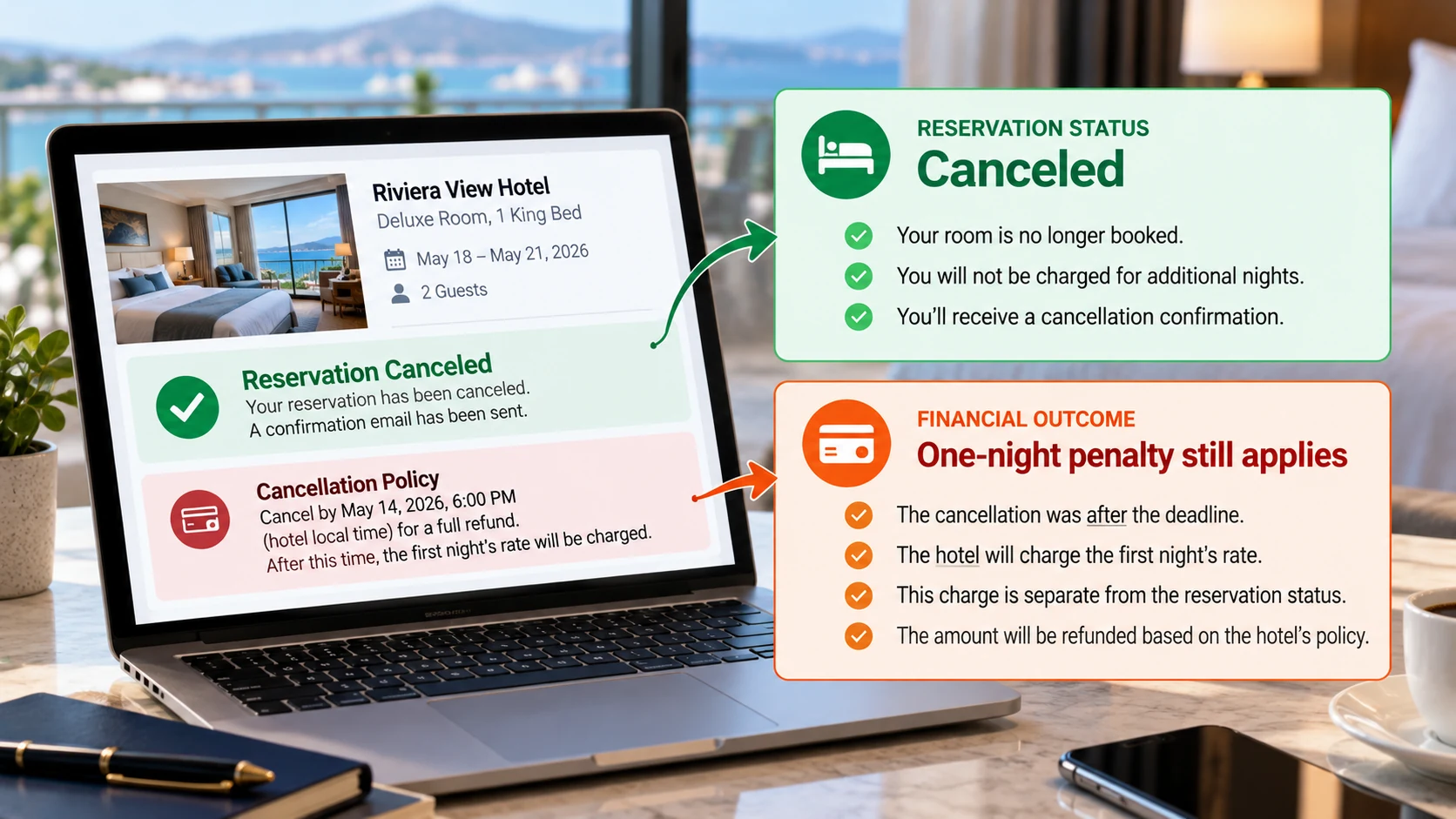
Canceling the room and avoiding the penalty are separate outcomes.
Once the cancellation deadline passes, the reservation may still be canceled—but the financial protection may already be gone.
One-night charge
The hotel or booking platform may charge the first night plus applicable tax.
Deposit retained
A previously collected deposit may be forfeited or, if the policy allows it, converted to future travel credit.
Partial penalty
The policy may retain a percentage or fixed amount while returning the rest.
Full amount retained
A prepaid or nonrefundable reservation may become subject to a 100% penalty.
No-show treatment
If no valid cancellation is recorded, the stay may be treated under a separate no-show rule.
Important distinction
The room can be canceled while the penalty remains valid. Canceling releases the inventory; it does not automatically erase a charge permitted by the terms.
Before You Cancel
Check the policy before you click Cancel.
Confirm the deadline and time zone
Use the hotel’s local time unless the policy explicitly says otherwise.
Confirm the rate and penalty
Know whether the rate is refundable, partially refundable, deposit-based, or nonrefundable.
Use the required cancellation channel
Some reservations must be canceled through the original booking site, agency, or portal.
Identify who collected payment
The merchant name can help tell you who must process any refund.
Save the evidence
Keep the policy, cancellation confirmation, timestamp, confirmation number, screenshots, emails, and any written outcome.
If you have not booked yet, review the cancellation deadline and penalty before choosing the room rate, not after your plans change.
Refund Path
Qualifying for a refund does not mean the money appears immediately.
Refund timing depends on who collected the payment, what kind of transaction occurred, and how quickly the bank or card issuer updates the account.
Direct hotel payment
The hotel or brand usually controls the refund request and processing date when it charged the card directly.
Third-party payment
A booking site, agency, portal, or package provider may need to approve and issue the refund.
Pending authorization
A pending hold may disappear after release instead of showing as a separate refund credit.
Follow the merchant name. The company that collected the money is usually the company that must return it.
If a deposit or authorization is involved, see Hotel Deposits for the difference between a refund, release, and bill credit.
The Fine Print That Matters
The cancellation label is only the beginning.
The deadline includes a time zone
A cutoff based on hotel-local time may expire earlier than you expect.
Free cancellation is temporary
The protection usually ends at a stated date and time.
Refundable does not mean identical outcomes
Refundability can depend on when you cancel, what penalty applies, and whether a deposit or prepayment was collected.
Canceling does not automatically erase the penalty
The reservation can be canceled while a valid charge still remains under the terms.
No-show rules can be different
Failing to cancel properly may trigger different charges and may cancel remaining nights.
The refund may come from someone other than the hotel
The merchant that collected the payment often controls the return of the money.
My Take
I would never rely on “free cancellation” without reading the line underneath it.
The cancellation label tells me almost nothing by itself. I want the exact cutoff, the hotel’s local time zone, the penalty after that cutoff, and who collected the money.
I also distinguish the reservation status from the financial outcome. A cancellation confirmation proves the room was canceled; it does not prove the booking qualified for a full refund.
If flexibility matters to the trip, I would compare the price premium for the flexible rate with the amount I could realistically lose if plans change.
TFP Recommendation
Choose the cancellation protection deliberately—not by the label alone.
The Recommendation
Use the exact deadline and penalty to value the flexible rate.
Compare the same hotel, room type, total price, cancellation cutoff, penalty, payment timing, and property-collected charges. Then decide whether the flexible option is worth the premium for your trip.
Your Next Step
Use your actual situation to decide what to do next.
Smarter travel, straight to your inbox
Booking choices, hidden costs, travel rules and useful fine print — explained clearly.
Before You Go
Cancellation is only one part of the hotel payment and refund trail.
Once you understand the cancellation outcome, these related guides can help with deposits, payment timing, third-party control, and no-show charges.

Hotel Deposits
Understand whether money should be refunded, released, applied to the stay, or retained under the terms.
Follow the deposit →Pay Now vs. Pay at Hotel
Compare payment timing and flexibility when choosing between prepaid and pay-later rates.
Compare payment timing →Booking Hotels Through Third-Party Sites
See how the booking channel can affect who controls cancellation, payment, and refunds.
Understand the booking relationship →Hotel No-Show Fees
Understand how failing to cancel properly can produce a different financial outcome from a late cancellation.
Understand no-show risk →FAQ
Hotel cancellation policies: common questions
What is a typical hotel cancellation policy?
A typical policy allows cancellation without a penalty before a stated deadline, often 24, 48, or 72 hours before arrival. After that deadline, the hotel or booking platform may charge one night, retain a deposit, issue a partial refund, or treat the booking as nonrefundable.
Does free cancellation mean I can cancel anytime?
No. Free cancellation usually applies only until a specific cutoff date and time. Once that window closes, a penalty may apply even though the booking originally displayed a free-cancellation label.
Can a hotel charge me if I cancel after the deadline?
Yes. A late cancellation may trigger a one-night charge, deposit forfeiture, partial penalty, or full nonrefundable charge, depending on the policy you accepted.
Can a nonrefundable deposit become future travel credit?
It can when the policy specifically allows it. Confirm the expiration date, eligible travel dates, rebooking restrictions, rate-difference rules, and whether the credit must be used by the original guest.
Who refunds me if I booked through a third-party site?
The company that collected the payment usually controls the refund. A hotel may confirm that the room was canceled without being able to return money collected by a booking platform, travel agency, portal, or package provider.
Why was I charged after canceling my hotel reservation?
The charge may reflect a late-cancellation penalty, retained deposit, prepaid or nonrefundable rate, no-show rule, or cancellation submitted through the wrong channel. Compare the charge with the policy and cancellation timestamp.
How long does a hotel refund take after cancellation?
Timing varies based on who collected the payment, when the refund was processed, and how quickly the bank or card issuer posts the credit. A pending authorization may simply disappear rather than appear as a separate refund.
What should I save when canceling a hotel booking?
Save the cancellation policy, deadline, time zone, rate type, penalty, payment terms, merchant name, cancellation confirmation number, timestamp, and any email, screenshot, or chat showing the request was accepted.

Free Travel Guide
Avoid the travel mistakes that can cost you money, flexibility, or time.
Get 27 Travel Mistakes That Cost Travelers Thousands — a practical guide to booking mistakes, hidden costs, travel rules and decisions worth understanding before they become a problem.
- Spot booking details that are easy to overlook
- Understand where hidden costs can appear
- Recognize when a cheaper option comes with a tradeoff
- Make travel decisions with fewer surprises
You’ll also receive occasional practical guidance from Travel Fine Print on booking choices, hidden costs, travel rules and the fine print worth understanding. Unsubscribe anytime.