
Hotel Overbooking and No-Room Problems
What Happens If a Hotel Is Overbooked and Has No Room for You?
A confirmed reservation does not always guarantee that the hotel will have a usable room available when you arrive. If it cannot honor the booking, the next step depends on what the hotel can still offer and who is responsible for fixing the problem.
You may be offered another room onsite, relocated to another hotel, referred back to the booking platform, or left trying to secure replacement lodging yourself. Before accepting any solution, confirm what you are getting, what it will cost, and what happens to the original reservation.
About This Guidance: Travel Fine Print examines hotel overbooking from the operational side of the reservation—how confirmed bookings interact with physical room inventory, how hotels handle room shortages and relocations, how third-party booking and payment responsibility can complicate the solution, and what travelers should document before accepting another room, another hotel, or paying for a replacement themselves. That practical focus helps identify when the hotel has actually resolved the problem and when the traveler may still face a downgrade, added cost, or reimbursement dispute.

How It Works
A Confirmed Reservation and an Available Room Are Not the Same Thing
The reservation confirms what the hotel or booking channel agreed to sell you. Physical room availability is determined later by the inventory the property can actually provide when you arrive.
Why this matters: A valid reservation establishes what you booked, but the real problem at arrival is how the hotel resolves an inventory failure. The replacement, payment responsibility, and written terms determine whether you are actually made whole.
First, Identify the Situation
What Kind of Overbooking Problem Are You Facing?
Not every “no room available” situation is handled the same way. Before leaving the property, figure out whether the hotel can still solve the issue onsite, wants to relocate you, is blaming the booking platform, or is refusing the stay without a clear replacement plan.
The Hotel Can Move You Onsite
There may still be a room available, but not the exact one you booked. This may be a room-type mismatch, downgrade, or alternate room offer inside the same hotel.
The Hotel Wants to Walk You
The hotel wants to relocate you to another property. Before accepting, confirm whether the replacement hotel and room category are truly comparable.
The Hotel Says the Platform Must Fix It
The hotel may say the booking came through differently. This is common with third-party bookings, prepaid stays, portals, wholesalers, or inventory mismatches.
The Hotel Refuses the Stay
The most serious version is no room, no comparable replacement, and no clear written remedy. This is when documentation becomes especially important.
When the Hotel Can Still Move You Onsite
Sometimes “overbooked” does not mean the hotel has no room anywhere in the building. It may mean the hotel does not have the room category, view, bed setup, or suite type you booked.
In that case, the hotel may offer another room onsite. That could be an upgrade, a comparable room, or a downgrade.
Start by asking whether the available room is equal to what you booked.
If the hotel offers a better room at no added cost, confirm that it is a complimentary upgrade before accepting it. If the hotel offers a lower category, ask what remedy can be documented now, such as a refund difference, hotel credit, points, fee adjustment, or amenity.
If the room is onsite and acceptable, that may be easier than relocating to another property. But do not let the hotel describe every alternate room as “comparable” without checking the actual room category, view, bedding, occupancy, and included features.
When the Hotel Wants to Walk You to Another Hotel
Being “walked” usually means the hotel sends you to another property because it cannot honor your reservation onsite.
That may sound like a simple fix, but the details matter.
A replacement hotel should be comparable or better whenever possible. If you booked a beachfront resort and the replacement is inland, lower-rated, farther from your plans, missing amenities, or in a lower room category, that is not the same stay. If you arrive late after a long or international flight, the disruption can be even more serious because you may have fewer practical options.
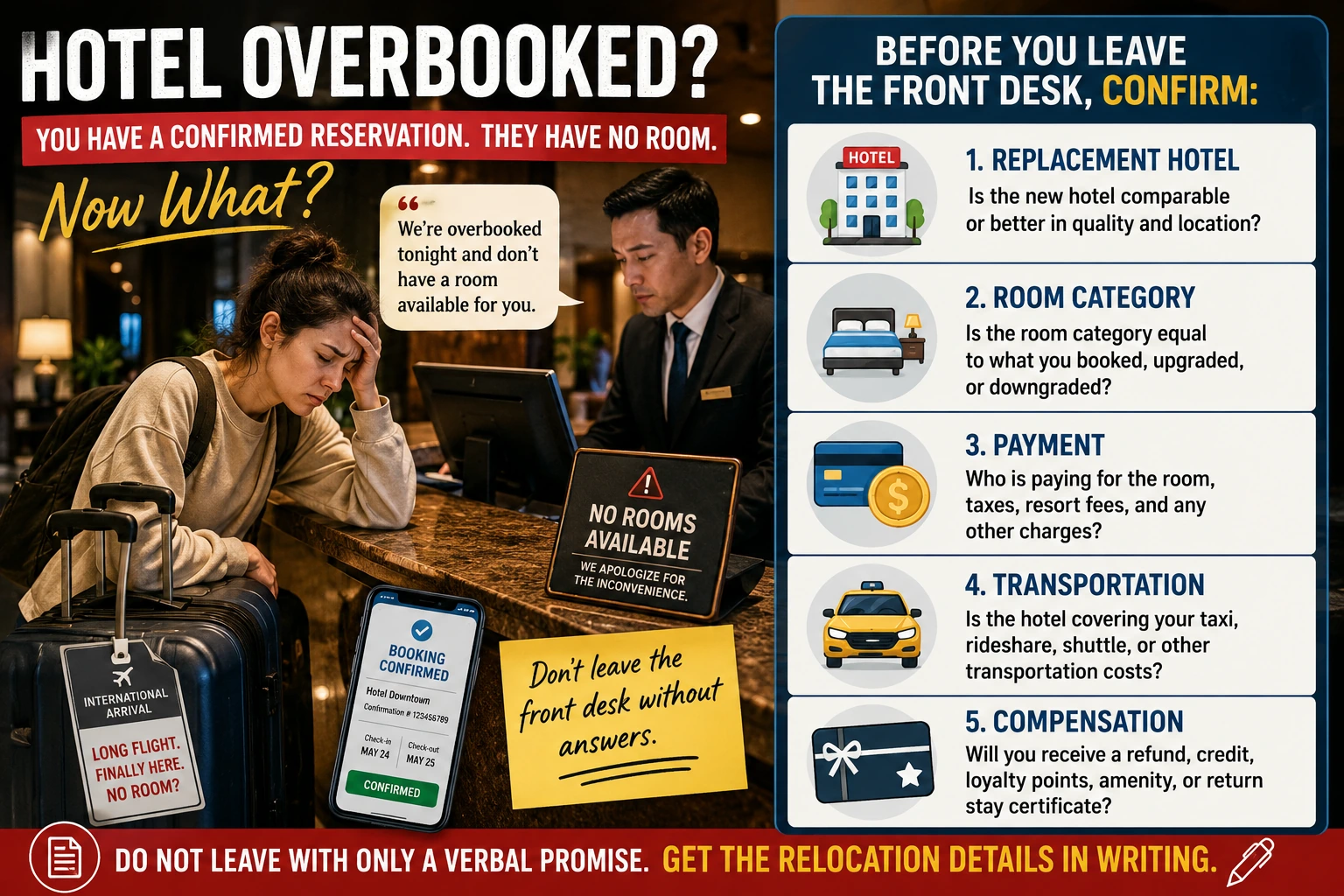
Before accepting the walk, ask five questions:
Is the replacement hotel comparable or better?
Is the room category equal to what I booked?
Who is paying for the replacement room, taxes, and fees?
Is transportation covered?
Will I receive anything for the inconvenience or downgrade?
Get the relocation details in writing before leaving the property. A verbal “they’ll take care of you over there” is not enough when you are tired, far from home, and about to start over at another front desk.
When the Hotel Says the Booking Platform Must Fix It
If you booked through an online travel agency, travel app, credit card portal, wholesaler, or package provider, the hotel may say the booking platform needs to fix the problem.
The hotel may physically control the rooms, but the booking platform may control the payment, refund path, customer service process, prepaid amount, or reservation wording. The hotel may also claim that it never received the exact room type, rate, or terms shown on your confirmation.
First, confirm that this is actually an overbooking problem. If the hotel cannot locate any reservation under your name, the booking may not have been transmitted yet or may exist under a different confirmation number. See Hotel Can’t Find Your Reservation? What to Do Before Check-In before assuming the property received and then oversold your booking.
That is why you need both sides involved quickly.
Ask the hotel to document what happened:
“The hotel is overbooked and cannot honor the reservation.”
“The room type is unavailable.”
“The hotel cannot accommodate the guest.”
“The booking must be handled by the third-party provider.”
Then contact the booking platform while you are still at the hotel. Do not wait until checkout or the next day if you are standing in the lobby with no room.
Use this script:
“The hotel says it cannot honor my confirmed reservation and has no room available. I need help securing comparable accommodations tonight and confirming who is responsible for payment or refund.”
When the Hotel Refuses the Stay Without a Clear Solution
The worst version is when the hotel has no room, offers no comparable replacement, and gives no clear written remedy.
This can leave the traveler trying to find last-minute lodging at a higher price, late at night, in an unfamiliar place, after already paying or securing a reservation.
If that happens, slow the situation down as much as possible. Ask for a manager, the reason in writing, and whether the hotel is arranging alternate accommodations or expecting you to find your own.
Also ask whether the reservation is being refused because of overbooking, maintenance, inventory error, late arrival, payment issue, booking-platform mismatch, or another reason.
If you must book another hotel yourself, save every receipt, screenshot, chat message, name, time, and written explanation. If the original hotel or booking platform later disputes reimbursement, the documentation will matter more than the frustration you felt in the lobby.
Quick Decision Guide
What to Confirm Before Accepting the Walk
Replacement hotel
Ask whether the new hotel is comparable or better in location, quality, amenities, and convenience.
Room category
Confirm whether the replacement room is equal, upgraded, or downgraded from the category you booked.
Payment responsibility
Confirm who is paying for the replacement room, taxes, resort fees, deposits, and any difference in rate.
Transportation
Ask whether the original hotel is arranging or reimbursing taxi, rideshare, shuttle, or other transfer costs.
Compensation
If the replacement stay is inferior, ask about a refund difference, credit, points, fee adjustment, or return stay certificate.
Written proof
Get the arrangement documented before leaving the front desk. A verbal promise is hard to prove later.
What If the Replacement Hotel Is Worse Than What You Booked?
This is where many overbooking situations become more frustrating.
A hotel may say it is “moving you to another property,” but that does not automatically mean the replacement is equal. The new hotel may be farther away, lower-rated, missing resort amenities, in a less convenient area, or offering a lower room category than the one you booked.
That matters because the disruption is not only the move. It is the loss of the stay you actually chose.
If the replacement hotel is inferior, ask the original hotel or booking platform to document the difference and explain what remedy applies. That remedy may be a refund difference, hotel credit, loyalty points, waived fees, transportation reimbursement, dining credit, or a return stay certificate.
A return stay certificate can be useful, but it is not the same as an immediate refund. Before accepting one as the main remedy, ask whether it has blackout dates, expiration rules, room-category limits, taxes or fees, or booking restrictions.
The more the replacement differs from what you booked, the more important it is to get the offer in writing before you leave the original hotel.
Traveler Risk
Leaving Without Written Details Can Make Reimbursement Harder
If the hotel sends you elsewhere with only a verbal promise, it may be harder to prove later who agreed to pay, what room category was promised, whether transportation was covered, or what compensation was offered. Before leaving the original hotel, ask for the replacement property, room type, payment responsibility, transportation arrangement, and any refund, credit, points, or return stay certificate in writing.
Check the Fine Print
Not Sure What the Hotel Owes You?
When a hotel is overbooked, the answer often depends on the booking channel, payment path, room category, replacement hotel, and what was documented at the front desk. Use the Travel Fine Print Risk Checker to spot which details may affect your next step.
Action Step
Document the Overbooking Before You Accept the Replacement Hotel
Before you leave the original property, gather the details that show what happened, what the hotel offered, and who agreed to pay for the replacement stay.
Quick win: Before leaving the front desk, ask: “Can you please write down the replacement hotel, who is paying, and any compensation being offered?”
What If You Booked Through a Third-Party Site?
If you booked through an online travel agency, travel app, credit card portal, wholesaler, or package provider, the overbooking problem can become more complicated.
The hotel may be the place telling you there is no room, but the booking platform may control the payment, refund path, customer service process, prepaid amount, or reservation terms. The hotel may offer a relocation, while the platform may still need to approve a refund, rate adjustment, or alternate accommodation.
This is why you should contact the booking platform while you are still at the hotel, especially if the hotel says:
“We cannot refund this because you booked through a third party.”
“The booking came through differently.”
“You need to call the platform for relocation.”
“We do not have payment from you directly.”
“The platform needs to approve the new hotel.”
Ask the hotel to document that it cannot honor the reservation. Then contact the platform and explain the situation clearly:
“The hotel says it is overbooked and has no room available for my confirmed reservation. I am still at the property. I need comparable accommodations tonight and written confirmation of who is paying for the replacement stay.”
Keep both records together: the hotel’s explanation and the third-party confirmation. If each side later points to the other, those details can help show what happened and when.
TFP Recommended Next Step
Still Need a Room Tonight?
If the hotel and booking platform are not securing replacement accommodations, compare nearby availability before booking another room yourself.
Travel Fine Print Move: Before paying, ask both the hotel and booking platform to confirm in writing whether they will cover or reimburse a replacement stay. Keep any response with your original confirmation and new hotel receipt.
Travel Fine Print may earn a commission if you book through this link, at no extra cost to you.
Travel Fine Print Takeaway
A Walk Is Not Fully Solved Until the Details Are Written Down
If a hotel is overbooked and sends you to another property, the relocation is not fully solved until the details are written down. Confirm where you are going, what room category you are getting, who is paying, how transportation is handled, and what compensation applies if the replacement stay is inferior.
❓Frequently Asked Questions
These questions can help you understand what to ask for when a hotel is overbooked, your confirmed room is unavailable, or the hotel wants to relocate you to another property.
Can a hotel have no room even if my reservation is confirmed?
Yes, it can happen. A confirmed reservation means the hotel or booking platform accepted the booking, but the hotel may still run out of available rooms because of overbooking, maintenance issues, delayed departures, group blocks, room inventory errors, or system mismatches.
If the hotel cannot honor your confirmed reservation, ask what comparable replacement hotel is being arranged, who is paying for the new room, whether transportation is covered, and what written compensation or refund applies before you leave the front desk.
What does it mean when a hotel walks you?
Being walked usually means the hotel cannot honor your reservation onsite and relocates you to another property.
Before accepting, confirm the replacement hotel, room category, payment responsibility, transportation, and any compensation in writing.
Is a hotel required to pay for another hotel if it is overbooked?
Many hotels or brands may arrange and pay for alternate accommodations when they cannot honor a confirmed reservation, but the details can depend on the hotel, brand policy, booking channel, loyalty status, local rules, and circumstances.
Do not rely on a verbal promise. Ask who is paying for the replacement room, taxes, fees, deposits, and transportation before you leave.
What should I ask for if the replacement hotel is worse?
Ask for the difference to be documented and request a remedy that reflects the downgrade. That may include a refund difference, hotel credit, loyalty points, waived fees, transportation reimbursement, dining credit, or a return stay certificate.
Also confirm whether the replacement hotel, location, amenities, and room category are comparable to what you originally booked.
Should I contact the booking site if the hotel is overbooked?
Yes, especially if you booked through an online travel agency, travel app, credit card portal, wholesaler, or package provider.
The hotel may control onsite inventory, but the platform may control payment, refund rules, customer service, or alternate accommodation approval. Contact the platform while you are still at the property.
What proof should I save if a hotel has no room for me?
Save your original confirmation, payment details, screenshots, receipts, transportation costs, names of employees, times of conversations, written relocation details, and any email, chat, or app messages.
If the hotel or booking platform later disputes the issue, your documentation may be the strongest record of what happened and what was promised.
Bottom Line
If a hotel is overbooked and has no room available, the issue is not fully resolved just because the hotel offers to send you somewhere else.
Before leaving the original property, confirm whether the replacement hotel is comparable, whether the room category is equal to what you booked, who is paying, whether transportation is covered, and what compensation applies if the replacement stay is inferior.
This is especially important if you arrive late, after a long flight, or in an unfamiliar destination with fewer backup options.
A confirmed reservation gives you a starting point. Written documentation gives you leverage.
Related Guides
If a hotel is overbooked, cannot provide your confirmed room, or wants to relocate you to another property, these related guides may also help:
Room Availability and Room-Type Problems
- What Happens If a Hotel Gives You a Different Room Than You Booked?
Use this if the hotel still has a room available, but it is not the room type, view, bed setup, suite, or category you paid for. - Hotel Room Type vs Room Request: What Travelers Should Know
Helpful if you need to tell the difference between a guaranteed room category and a preference the hotel may try to honor. - Hotel Special Requests Explained: What Travelers Should Know Before Booking
Use this if the issue involves connecting rooms, high floor, quiet room, special occasion notes, or other requests that may not be guaranteed.
Overbooking, Relocation, and Cancellations
- Hotel Reservation Confirmed — Why Wasn’t My Room Available?
Helpful if the hotel says your confirmed room, room category, or inventory is unavailable when you arrive. - Can a Hotel Cancel Your Reservation After You Book?
Use this if the hotel says it cannot honor the booking, cancels the reservation, or asks you to accept another option. - Can a Hotel Change the Rate After Booking? What to Check First
Helpful if the hotel offers a replacement stay, different room, or relocation but the price, taxes, fees, or payment responsibility changes.
Refunds and Booking Channel Issues
- Can You Get a Refund on a Hotel Booking?
Review how hotel refunds depend on rate type, cancellation deadline, payment path, booking channel, and whether the hotel or third-party platform controls the refund. - Booking Hotels Through Third-Party Sites: What Travelers Should Know
Use this if the hotel says the booking platform must handle payment, relocation, refund approval, or alternate accommodations.