
You pay extra for a hotel room because the description says ocean view.
Maybe it is a beach vacation, anniversary trip, honeymoon, birthday stay, or the one upgrade you decided was worth it.
Then you arrive and the view is technically there — but only from the side of the balcony, past another building, through landscaping, or from a distant angle across the property.
That is where the frustration starts.
The room may meet the hotel’s definition of “ocean view,” but still fall short of what most travelers pictured when they booked.
The real question is not just:
“Can I see the ocean?”
It is:
“Is this view category worth paying extra for based on what I actually expect from the room?”
This guide explains how to compare ocean view, oceanfront, beachfront, and partial-view rooms before paying more for a view that may not match your expectations.
Quick Answer
What is the difference between ocean view and oceanfront hotel rooms?
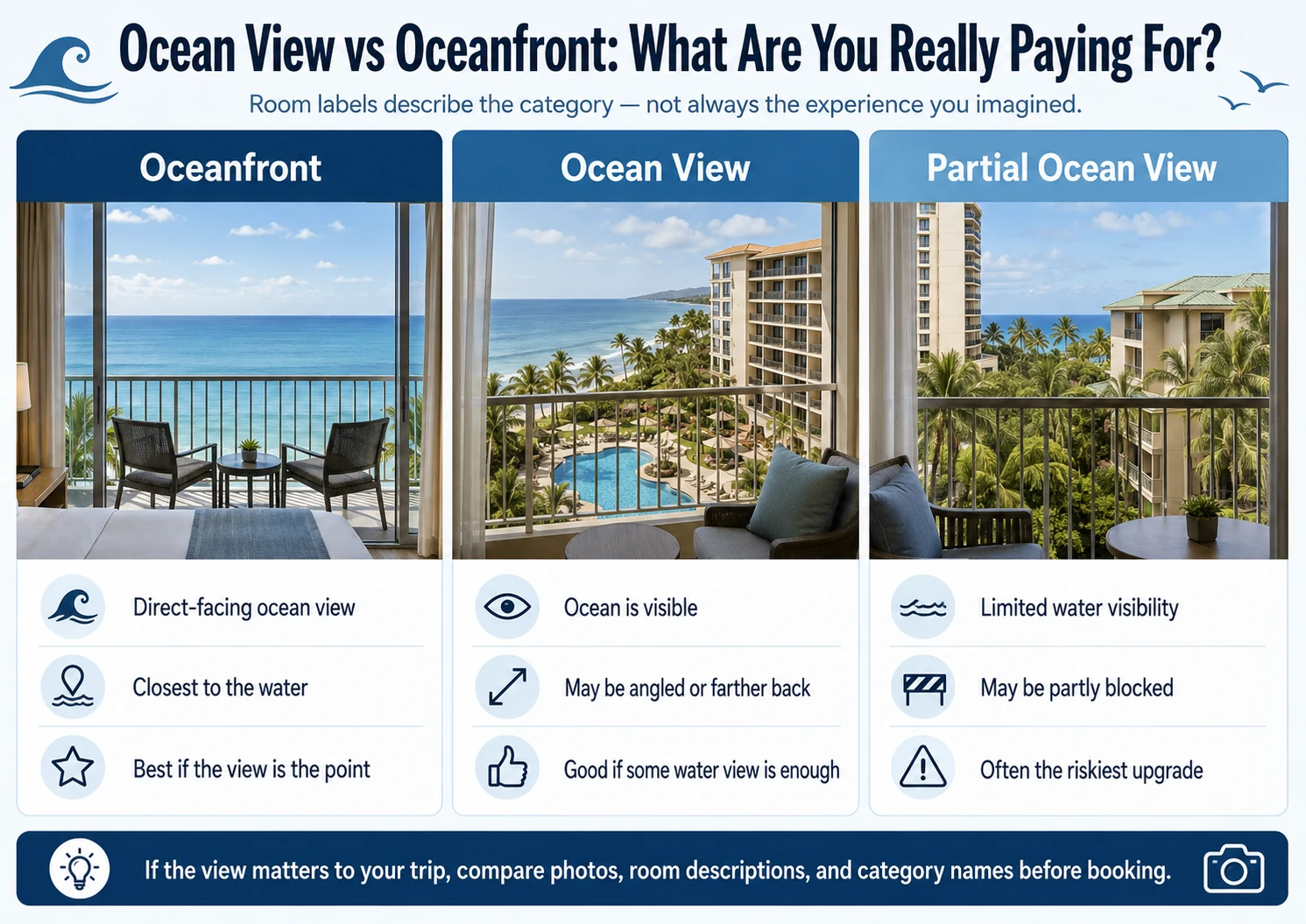
Oceanfront rooms usually face the ocean more directly, while ocean view rooms only need to provide some visibility of the water. An ocean view room may be angled, distant, partially blocked, or located farther back in the property.
The better choice depends on how much the view matters to your trip. If the balcony, sunrise, sound of the waves, or direct water view is part of what you are paying for, oceanfront is usually safer. If you only want some water visibility and plan to spend most of your time outside the room, ocean view may be enough.
System Insight
Hotel view categories are usually inventory labels, not view-quality guarantees.
- Visibility matters because “ocean view” may only mean the water can be seen from some part of the room or balcony.
- Angle matters because a side-facing room can technically show the ocean without facing it directly.
- Room assignment matters because two rooms in the same view category may offer different floors, angles, obstructions, or distances.
- Price matters because the upgrade may buy a category, not the exact view you imagined.
The Real Problem With “Ocean View” Rooms
The problem is not that “ocean view” is always wrong.
Sometimes an ocean view room is a good choice. You may get a pleasant angle of the water, a nice balcony, and a lower price than oceanfront.
The issue is that the phrase can sound more specific than it really is.
Hotels often use room categories to group similar inventory for pricing and availability. That category may describe what is generally visible from the room, but it may not guarantee the exact angle, floor, distance, balcony experience, or lack of obstruction.
That means a room can accurately qualify as ocean view and still disappoint a traveler who expected a direct, front-facing water view.
The better question is not whether the ocean is visible.
It is whether the view category matches how much the view matters to your stay.
An oceanfront room usually means the room is assigned to a category that faces the ocean more directly than a standard ocean view room.
The important word is usually. Oceanfront describes the room category, not a guaranteed postcard view from every angle of the room. The hotel may still assign oceanfront rooms across different floors, buildings, balcony positions, or sections of the property.
That means one oceanfront room may have a wide, direct view, while another may be lower, farther to the side, partly affected by landscaping, or shaped by the building layout.
The value of oceanfront is that it usually reduces the risk of a weak side-angle view. It does not remove every view-quality variable.
Before paying the oceanfront premium, check whether the description says direct oceanfront, beachfront, balcony, terrace, full ocean view, or similar wording. Those details can tell you more than the word oceanfront by itself.
Booking Decision
Which View Category Should You Actually Book?
The right choice depends less on the label and more on how much the view matters to your trip. Use the room category as a starting point, then decide whether the upgrade matches the experience you expect.
Book Oceanfront
The view is part of the trip.
Choose oceanfront if you plan to spend time on the balcony, want a direct water-facing room, or are booking for a special occasion where the view is a major part of the experience.
Book Ocean View
Some water visibility is enough.
Ocean view may be enough if you want a nicer outlook than a standard room but do not need the room to face the water directly or deliver a postcard-style view.
Be Careful With Partial View
The upgrade may be thin.
Partial ocean view can mean a narrow or angled glimpse of water. It may be fine at the right price, but it is the category most likely to disappoint if you expected a strong view.
When Oceanfront Is Usually Worth the Upgrade
Oceanfront is usually worth considering when the view is one of the main reasons you chose the hotel.
That may be true for honeymoons, anniversaries, milestone birthdays, beach vacations, or trips where you expect to spend real time in the room or on the balcony.
The upgrade may also make more sense when the destination itself is known for the view. A direct-facing ocean room can change the feel of the stay more than a small room-size upgrade or minor amenity difference.
Oceanfront may be the safer choice if you care about:
A direct-facing water view
Morning coffee or evening time on the balcony
Sunrise, sunset, or wave views
Avoiding side-angle disappointment
A special occasion where the room experience matters
The key is to decide whether you are paying for a place to sleep near the beach or paying for the view as part of the trip.
When Ocean View May Be Enough
Ocean view can be the better value when you want some water visibility but do not need the strongest possible view.
This may be true if you plan to spend most of the trip at the pool, beach, restaurants, excursions, or outside the hotel. In that case, a direct-facing room may not be worth the premium.
Ocean view may also make sense when the price difference is large, or when guest photos show that the property’s ocean view rooms are still pleasant.
Before choosing ocean view, look for signs that the category is strong enough:
Photos show actual water visibility
Reviews mention good views from ocean view rooms
The room is on a higher floor or favorable side of the property
The description does not rely on vague language
The price difference from oceanfront feels reasonable
If the hotel’s own photos are unclear or reviews mention “barely visible,” “side view,” or “not worth the upgrade,” treat the label cautiously.
When You Should Avoid Paying Extra for the View
Sometimes the smartest choice is not paying extra for a view at all.
It is skipping the view premium entirely.
That may be true when the description is vague, the photos do not show the actual room-category view, or reviews repeatedly mention disappointing angles, blocked views, or rooms far from the water.
Be cautious if the booking page uses language like:
“Possible ocean view”
“Select rooms may have ocean views”
“View varies by room”
“Partial water view”
“Resort and ocean view”
“Limited view”
“Room assigned at check-in”
Those phrases do not always mean the view will be bad. But they do mean you should not assume a direct, clear, ocean-facing room.
The goal is not to guarantee an exact room number. It is to reduce the chance that you pay extra for a view category that technically qualifies but still feels disappointing.
Traveler Risk
The room may match the category but still disappoint you.
If the hotel sold an ocean view category and the ocean is technically visible, it may be difficult to argue that the room was incorrectly assigned. The problem is usually not whether the label can be defended — it is whether the view matched what you thought you were paying extra to receive.
Check the Fine Print
Not sure where the booking risk is hiding?
Use the Travel Fine Print Risk Checker™ to spot whether your trip is more exposed to unclear room categories, hidden fees, third-party booking issues, cancellation rules, or refund problems before they cost you money.
What To Confirm Before You Book
Before paying extra for a view category, slow down and look for evidence of what the room actually delivers.
The name of the room is only one clue. The photos, room description, guest reviews, property layout, balcony language, and hotel confirmation can tell you much more.
This is especially important if the view is part of why you chose the hotel. A vague “ocean view” label may be fine for a casual trip, but it may not be enough for a honeymoon, anniversary, milestone birthday, or stay where the balcony view is part of the experience.
The goal is not to guarantee the exact room number. It is to reduce the chance that you pay extra for a view category that technically qualifies but still feels disappointing when you arrive.
Action Step
Check the actual view before you pay for the upgrade.
Before booking an ocean view or oceanfront room, look beyond the room name. Your goal is to confirm what the hotel is actually selling — a direct-facing view, a side-angle view, a partial view, or simply some water visibility.
Quick win: If the view is important, ask the hotel: “Does this room category face the ocean directly, or is the ocean visible only from an angle or part of the balcony?”
Before You Pay for the View
Save the room description before the view category becomes a dispute.
Ocean view, oceanfront, beachfront, and partial-view labels can sound similar but deliver very different rooms. Use the Travel Documents Checklist to save the room category, photos, balcony wording, rate name, booking terms, and confirmation before arrival.
What If the View Does Not Match What You Expected?
If you arrive and the view is disappointing, start by separating two questions.
First, did the hotel give you the room category you booked?
Second, does the actual view match what the hotel’s photos, description, or confirmation led you to expect?
Those are not always the same issue.
If you booked an ocean view room and the ocean is technically visible, the hotel may consider the room correctly assigned. But if the room description promised a balcony, direct ocean view, oceanfront location, or a specific view category that you did not receive, you may have a stronger reason to ask for a change.
At check-in or shortly after entering the room, ask politely and specifically:
“I booked this room because the view category was important. Is there another room available in the same category with a clearer or more direct view?”
If the hotel cannot move you, ask whether there is a paid or complimentary upgrade option, a room change the next day, or another practical solution. The earlier you ask, the more options the hotel may have.
Travel Fine Print Takeaway
Pay for the view you can verify, not the label you hope means more.
Oceanfront is usually the safer choice when the view is central to the trip. Ocean view can still be a good value, but only when the photos, reviews, room description, and hotel layout support the kind of view you expect.
❓Frequently Asked Questions
These are the most common questions travelers have when comparing ocean view, oceanfront, beachfront, and partial-view hotel rooms.
What is an oceanfront room?
An oceanfront room usually means the room is in a category that faces the ocean more directly than a standard ocean view room. It may be closer to the water or positioned on the beach-facing side of the property, but the exact view can still depend on the hotel layout, floor, balcony angle, landscaping, and nearby obstructions.
What is the difference between ocean view and oceanfront hotel rooms?
Oceanfront usually means the room faces the ocean more directly, while ocean view usually means the ocean is visible from the room or balcony. An ocean view room may be angled, farther back, partially blocked, or mixed with views of pools, rooftops, landscaping, or other buildings.
Does ocean view mean the room faces the ocean?
Not always. An ocean view room may be on the side of the building, farther back from the beach, or positioned so the water is visible only from a certain angle or part of the balcony.
What does partial ocean view mean?
Partial ocean view usually means the water is visible in a limited way. You may see only a small section of ocean, need to look from a certain angle, or have part of the view blocked by buildings, trees, rooftops, or other parts of the resort.
Is oceanfront usually worth the extra cost?
Oceanfront is more likely to be worth it when the view is a major part of the trip, such as a honeymoon, anniversary, special occasion, or stay where you plan to spend time on the balcony.
If you will mostly be outside the room and only want some water visibility, ocean view may be enough.
Can you ask for a different room if your ocean view is disappointing?
You can ask for a clearer view, room move, upgrade, or other solution, especially if the room does not match the description, photos, balcony wording, or confirmed room category.
But if the ocean is technically visible and the hotel assigned the category you booked, a refund or adjustment may not be guaranteed.
The Bottom Line
Ocean view and oceanfront rooms are not the same thing.
Oceanfront is usually the safer choice when the view is central to the trip. Ocean view can still be a good value, but it may mean angled, distant, partial, or partly obstructed water visibility.
Before paying extra, check the room photos, guest reviews, balcony details, property layout, and exact view wording. The goal is not just to book a room that technically shows the ocean. It is to book the room category that matches the experience you actually want.
Related Guides
If you are comparing ocean view, oceanfront, beachfront, or partial-view rooms, these related guides can help you understand what is actually guaranteed before you pay more.
Room Categories, Views, and Assignments
- Hotel Room Type vs Room Request: What Travelers Should Know
Learn the difference between the room category you paid for, the specific room you are assigned, and requests the hotel may try — but not promise — to honor. - What Happens If a Hotel Gives You a Different Room Than You Booked?
Use this if the hotel assigns a different room type, view, bed setup, suite, or category than the one shown on your confirmation. - Hotel Special Requests Explained: What Travelers Should Know Before Booking
Helpful if your stay depends on a high floor, quiet room, connecting room, balcony, view preference, or other request that may not be guaranteed.
Availability, Overbooking, and Room Changes
- Hotel Reservation Confirmed — Why Wasn’t My Room Available?
Use this if the hotel says your confirmed room, room category, or inventory is unavailable when you arrive. - What Happens If a Hotel Is Overbooked and Has No Room for You?
Helpful if the hotel cannot honor your confirmed stay and wants to move you to a different room or another property. - Can a Hotel Cancel Your Reservation After Booking?
Use this if the hotel cancels the reservation, says it cannot honor the booking, or asks you to accept another option.
Price, Fees, and Refund Questions
- Hotel Taxes and Fees Explained: Why the Final Price Is Higher
Helpful if you are comparing whether a view upgrade is worth it after taxes, resort fees, destination fees, and property charges are added. - Can You Get a Refund on a Hotel Booking?
Use this if the view, room category, or hotel stay does not match what you booked and you need to understand whether a refund, credit, or adjustment may be possible.