
You booked a hotel because the rate said free cancellation.
So when your plans changed, it felt safe to cancel.
But “free cancellation” does not always mean every dollar comes back. In many hotel bookings, it simply means you can cancel without a separate cancellation penalty if you meet the booking’s conditions.
That distinction matters.
A reservation may still involve prepaid deposits, taxes, service fees, resort fees, booking platform charges, currency differences, or refund processing rules that affect how much money you actually recover.
The real question is not just:
“Can I cancel for free?”
It is:
“What money, if any, is actually refundable?”
This guide explains what “free cancellation” usually protects, what it may not refund, and what to check before you cancel a hotel booking.
Quick Answer
Does hotel free cancellation mean you get a full refund?
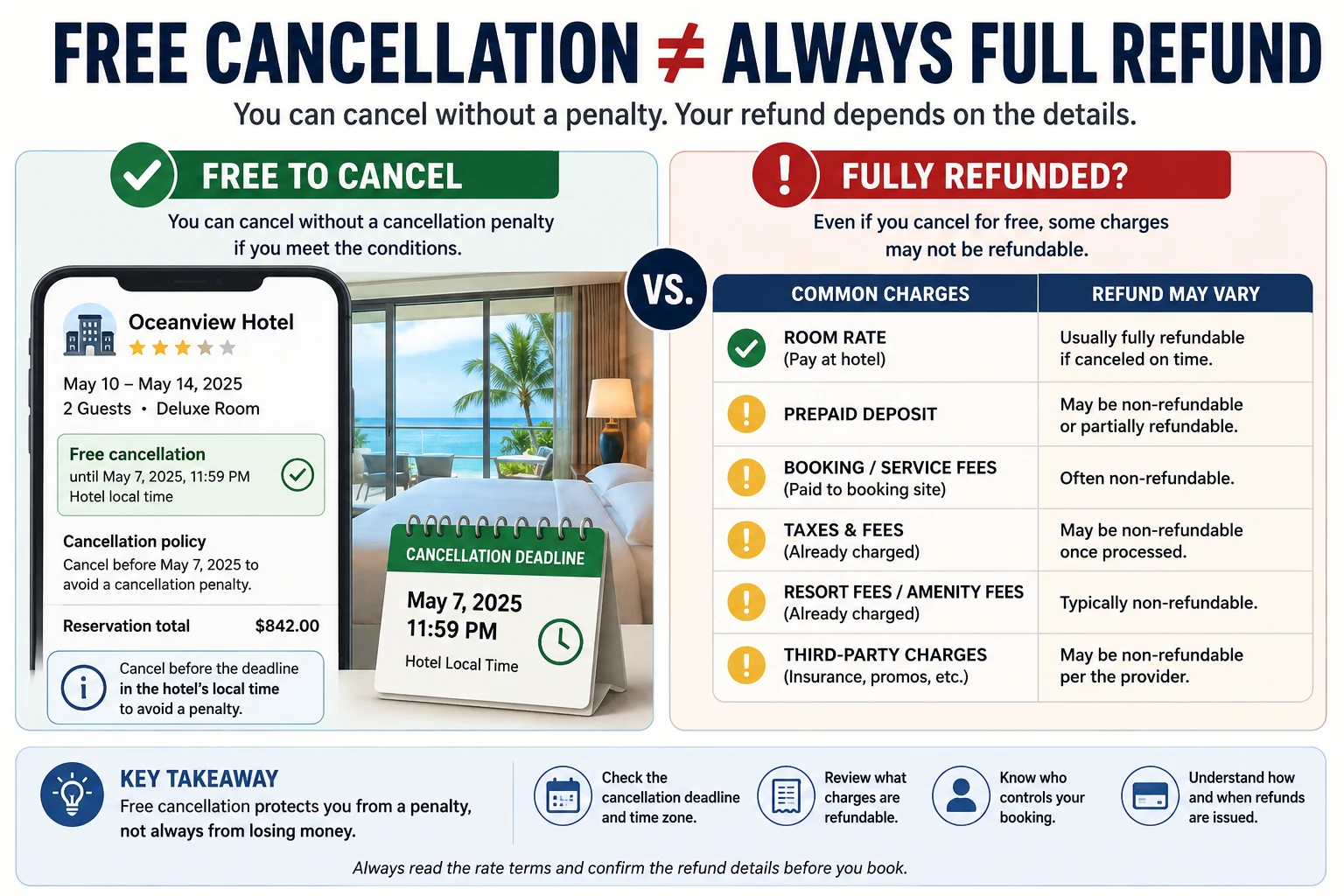
Not always. Hotel free cancellation usually means you can cancel without a cancellation penalty before the deadline, but it does not automatically guarantee that every charge is refundable.
Your refund can still depend on whether you prepaid, whether deposits or booking fees are refundable, whether taxes and resort fees were already charged, how you booked, and whether the refund is returned as cash, credit, or a delayed card refund.
System Insight
Free cancellation and full refund are not the same promise.
- Cancellation rights matter because the booking may let you cancel without a penalty only before a specific deadline.
- Refund rules matter because prepaid deposits, booking fees, taxes, service charges, or resort fees may follow separate refund terms.
- Who charged you matters because the hotel, online travel agency, deal site, or credit card portal may control the refund process.
- Timing matters because an approved cancellation does not always mean the refund has already posted back to your card.
What Free Cancellation Usually Means
In most hotel bookings, free cancellation means you can cancel the reservation before a stated deadline without paying a cancellation penalty.
That deadline may be 24 hours before arrival, 48 hours before arrival, several days before check-in, or a specific date and time shown in the booking terms.
The key point is that free cancellation usually controls the penalty for canceling. It does not automatically control every dollar connected to the booking.
Depending on the rate, a booking may still involve prepaid deposits, booking fees, taxes, resort fees, third-party platform charges, credits, currency differences, or refund processing timelines.
That is why two travelers can both cancel “free cancellation” hotel bookings and have different outcomes.
One traveler may receive every dollar back. Another may avoid a cancellation penalty but still lose a booking fee, wait longer for a prepaid refund, or receive credit instead of cash.
Common Situations
Which Free Cancellation Booking Are You Dealing With?
The refund outcome usually depends on whether you already paid and who controls the booking.
Pay at Hotel
You may not need a refund at all.
If the card was only used to guarantee the room and you cancel before the deadline, the hotel may simply cancel the reservation without charging you.
Prepaid Booking
You may be eligible for money back, but timing matters.
If you already paid, free cancellation may allow a refund, but the refund can still depend on rate terms, processing time, currency, and payment method.
Third-Party Site
The hotel may not control the refund.
When you book through an online travel agency or deal platform, the platform may control the payment, cancellation path, refund timing, or service fee rules.
Fees Already Charged
Some charges may follow separate rules.
Booking fees, service fees, resort fees, taxes, or add-ons may not always refund the same way as the room rate, even when cancellation itself is allowed.
Why You May Not Get Every Dollar Back
The biggest problem is that travelers often read “free cancellation” as if it applies to the entire transaction.
But a hotel booking may include more than the room rate. Taxes, resort fees, deposits, service fees, package add-ons, or booking-platform charges may each follow their own rules.
Some of those charges refund automatically when you cancel on time. Others may be non-refundable, delayed, or handled by a third party.
That is why the better question is not only whether the booking says “free cancellation.” It is whether the specific money you paid is refundable.
That is why the better question is not only whether the booking says “free cancellation.” It is whether the specific money you paid is refundable.
This is why the most important question is not only whether the booking says “free cancellation.”
It is whether the specific money you paid is refundable, who is responsible for returning it, and how long that refund may take.
When “Free Cancellation” Usually Does Mean a Full Refund
Sometimes the phrase really does work the way travelers expect.
You are more likely to receive a full refund when the booking terms clearly say the reservation is fully refundable, you cancel before the deadline, and the same company that charged you is responsible for processing the refund.
This is common with many flexible hotel rates, especially when:
You booked directly with the hotel
The rate says fully refundable
You cancel before the stated cutoff
No separate service fee was charged
The card was only used to guarantee the reservation
The confirmation shows no non-refundable deposit or package component
Even then, “full refund” does not always mean instant refund.
A hotel or booking site may approve the cancellation right away, but the money can take several business days to appear on your card. The timing may depend on the hotel, booking platform, payment processor, bank, or card issuer.
That delay can make it feel like something went wrong even when the refund is still being processed.
Why Prepaid Hotel Bookings Create More Confusion
Prepaid bookings are where “free cancellation” becomes especially confusing.
A prepaid hotel booking means some or all of the money was charged before arrival. That does not automatically make the booking non-refundable. Some prepaid rates are still refundable if canceled on time.
But prepaid bookings add more refund steps.
The refund has to be approved, processed, and returned to the original payment method. If the booking involved an online travel agency, package provider, foreign currency, points, travel credit, or split payment, the refund path can become less obvious.
Before relying on prepaid free cancellation, check:
Whether the room rate is refundable
Whether the deposit is refundable
Whether service fees are refundable
Whether taxes and fees are reversed automatically
Whether the refund goes back to your card or becomes credit
Whether the booking platform or hotel controls the refund
This is also why “free cancellation” and “pay at hotel” can feel very different. A pay-at-hotel booking may simply disappear when canceled on time. A prepaid booking may require an actual refund transaction.
Traveler Risk
The biggest mistake is canceling before saving the refund terms.
Once you cancel, the booking screen may change or disappear. If you did not save the cancellation deadline, rate rules, refund language, payment details, and fee breakdown before canceling, it can be harder to prove what the booking promised if the refund is smaller than expected.
Check the Fine Print
Not sure where your refund risk is hiding?
Use the Travel Fine Print Risk Checker™ to spot whether your trip is more exposed to hidden fees, unclear cancellation rules, third-party booking issues, travel credits, or refund problems before they cost you money.
Third-Party Booking Sites Can Change the Refund Path
When you book directly with a hotel, the hotel usually has more visibility into the reservation, payment status, cancellation terms, and refund process.
When you book through a third-party site, that may not be true.
The hotel may provide the room, but the booking site may control the payment, refund timing, service fee rules, cancellation process, customer service path, or credit/voucher terms.
That matters because travelers often call the hotel after canceling and expect the hotel to fix the refund. But if the third-party platform was the merchant of record, the hotel may not be able to issue the refund directly.
This does not mean third-party bookings are always bad. It means you need to know who charged your card and whose cancellation terms apply.
Before assuming the hotel controls the refund, check your confirmation for phrases like:
“Payment collected by…”
“Refund processed by…”
“Service fee is non-refundable”
“Cancel through your booking provider”
“Credit issued by the booking platform”
Those details usually matter more than the large “free cancellation” label.
Action Step
Save the refund terms before you cancel.
Before canceling a hotel booking labeled “free cancellation,” capture the details that show what you paid, what is refundable, who controls the refund, and when the cancellation deadline applies.
Quick win: Before clicking cancel, take one screenshot of the full cancellation page and one screenshot of the payment breakdown. Those two screenshots can be the difference between an easy refund follow-up and a vague customer service dispute.
Before You Cancel
Keep the proof you may need if the refund is smaller than expected.
Use the Travel Documents Checklist to save the booking confirmation, cancellation terms, payment breakdown, refund language, and screenshots that can help if you need to follow up with the hotel, booking site, or card issuer.
Third-Party Booking Sites Can Change the Refund Path
When you book directly with a hotel, the hotel usually has more visibility into the reservation, payment status, cancellation terms, and refund process.
When you book through a third-party site, that may not be true.
The hotel may provide the room, but the booking site may control the payment, refund timing, service fee rules, cancellation process, customer service path, or credit/voucher terms.
That matters because travelers often call the hotel after canceling and expect the hotel to fix the refund. But if the third-party platform was the merchant of record, the hotel may not be able to issue the refund directly.
This does not mean third-party bookings are always bad. It means you need to know who charged your card and whose cancellation terms apply.
Before assuming the hotel controls the refund, check your confirmation for phrases like:
“Payment collected by…”
“Refund processed by…”
“Service fee is non-refundable”
“Cancel through your booking provider”
“Refunds may take 7–14 business days”
“Credit issued by the booking platform”
Those details usually matter more than the large “free cancellation” label.
Refund, Credit, or No Charge: Know the Difference
A free-cancellation booking can end in three different ways.
Sometimes there is no refund because there was never a charge. This is common with pay-at-hotel reservations where the card was used to hold the room, but payment was not collected yet.
Sometimes there is a true refund. This usually happens when money was already collected and the booking terms allow that money to return to the original payment method.
Sometimes the outcome is a travel credit or voucher instead of cash. This can happen with certain booking platforms, package rates, promotional offers, or policy exceptions.
That matters because a refund and a credit are not interchangeable.
A refund returns money to your original payment method. A credit gives you future booking value, often with expiration dates, blackout dates, brand restrictions, or platform rules.
If you are close to the deadline, confirm the cutoff, save the terms, and cancel through the required channel before the window closes.
Travel Fine Print Takeaway
The refund path matters as much as the cancellation label.
Before relying on “free cancellation,” confirm whether you are avoiding a charge, receiving a cash refund, waiting for a prepaid refund, or accepting a travel credit. Those outcomes can feel similar during booking but very different after you cancel.
What Happens If You Cancel After the Deadline
Free cancellation almost always has a cutoff.
If you cancel after that deadline, the booking may become partially refundable, subject to a penalty, or fully non-refundable.
Even a short delay can matter. A deadline may be based on the hotel’s local time, not your home time zone. A traveler canceling late at night may think they are still within the window, while the hotel’s system may already treat the cancellation period as closed.
After the deadline passes, the hotel or booking site may still make an exception, but it usually becomes discretionary. That means the outcome may depend on the reason for cancellation, the property’s policy, the booking channel, loyalty status, documentation, or whether the hotel can resell the room.
If you are close to the deadline, do not wait. Confirm the cutoff, save the terms, and cancel through the required channel before the window closes.
❓Frequently Asked Questions
These are the most common points of confusion when a hotel booking says “free cancellation” but the refund is unclear.
Does hotel free cancellation mean a full refund?
Not always. It usually means you can cancel without a cancellation penalty before the deadline. A full refund still depends on whether the rate was refundable, whether you prepaid, which fees were charged, and who controls the refund.
Why didn’t I get all my money back after canceling on time?
Some charges may follow separate rules. Booking fees, service fees, deposits, resort fees, taxes, package components, or third-party platform charges may not always refund the same way as the room rate.
Is pay-at-hotel easier than prepaid free cancellation?
Pay-at-hotel bookings can be simpler because your card may only guarantee the room until the cancellation deadline. Prepaid bookings may still be refundable, but they require the money to be processed back to your payment method.
Who refunds the money if I booked through a third-party site?
It depends on who charged your card. If the booking site was the merchant of record, the hotel may not be able to issue the refund directly. Check the confirmation for payment and refund language.
Can I still get money back after the free-cancellation deadline?
Sometimes, but it is usually discretionary. After the deadline, the booking may become partially refundable, subject to a penalty, or fully non-refundable unless the hotel or booking platform makes an exception.
The Bottom Line
“Free cancellation” is useful, but it is not the same thing as a guaranteed full refund.
It usually means you can cancel before the deadline without a cancellation penalty. Your actual refund may still depend on whether the booking was prepaid, which fees were charged, who processed the payment, and whether the money comes back as cash, credit, or a delayed card refund.
Before you cancel, save the terms. Before you book, compare the refund rules — not just the cancellation label.
Related Guides
Hotel Cancellation Policies Explained
Learn how cancellation deadlines, rate types, booking channels, and refund paths decide what a hotel cancellation policy actually protects.
Hotel Deposits Explained: What Travelers Should Know Before Booking
Understand when hotel deposits are refundable, when they are not, and why deposit rules can affect what you get back after canceling.
Resort Fees Explained: And When You Can Actually Avoid Them
See why resort fees and destination fees may be treated differently from the room rate, even when a booking appears flexible.
What Happens If a Hotel Charges You Before Arrival?
Learn why some hotels or booking platforms charge before check-in and what that can mean for refunds, cancellations, and disputes.
Why Travel Refunds Can Take Longer Than Expected
Understand why a refund may be approved before the money actually appears on your card.