
Rental Car Pricing & Group Size
One Passenger Van vs Two Rental Cars: Which Costs Less?
A passenger van may have the higher daily rate. But once your group needs two rental cars, you are paying for that second vehicle every day of the trip.
Compare one larger vehicle against the full cost of two smaller vehicles—including the rental period and the expenses that may be duplicated with a second car.
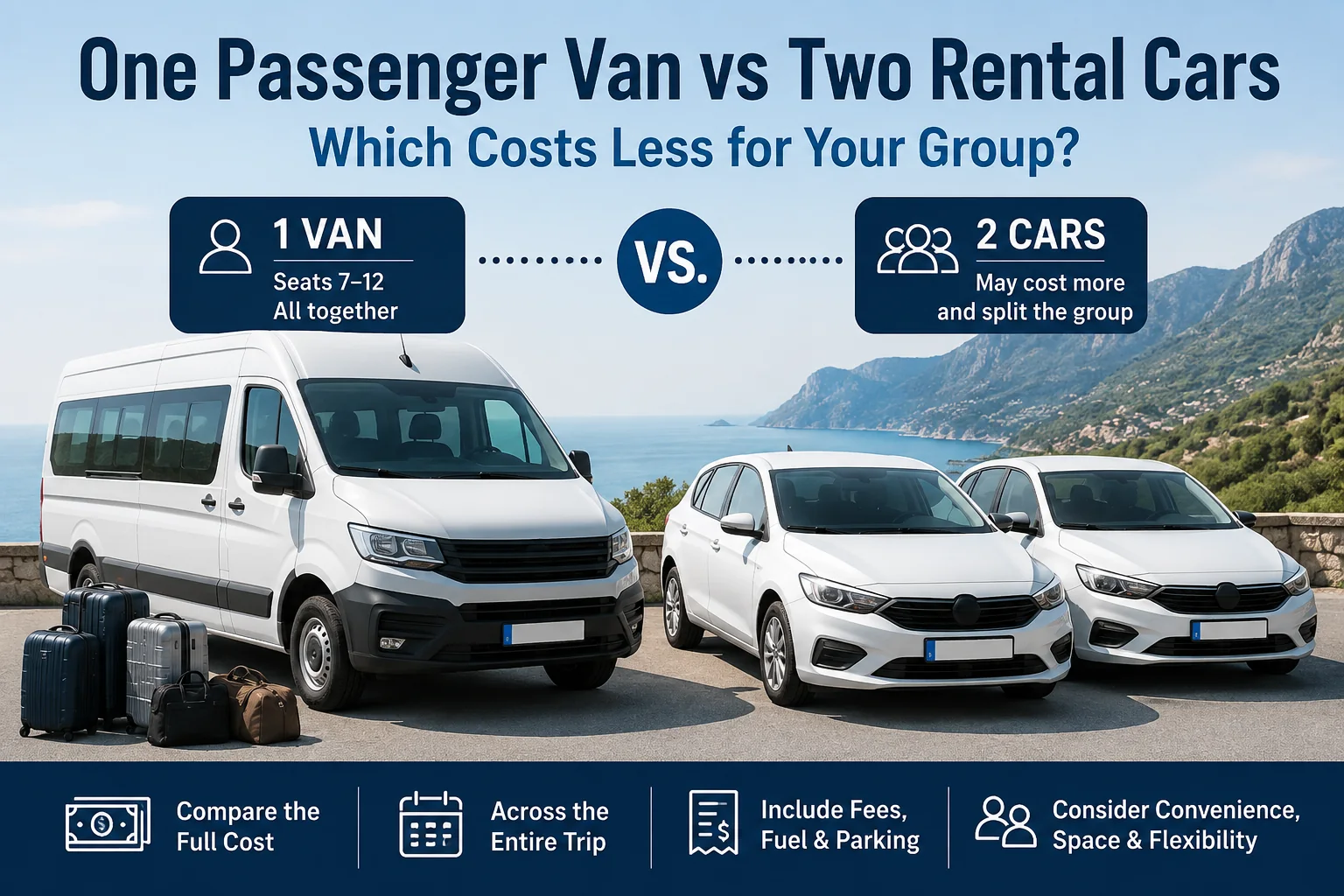
About This Guidance: Travel Fine Print evaluates this comparison by looking at the full rental structure rather than the advertised daily rate alone. That includes vehicle capacity, luggage space, rental length, taxes and facility charges, additional-driver rules, parking, tolls, fuel, coverage options, deposits, mileage limits, one-way fees, and other costs that may be duplicated when a group needs two vehicles. The goal is to identify the point where one larger rental becomes worth comparing with two smaller cars—and the practical tradeoffs that can matter even when the totals are not exactly equal.

How It Works
Four Checks Reveal Whether One Van Beats Two Rental Cars
Start with how many vehicles your group actually needs, then compare both options across the full rental period. The tipping point often appears when adding a second car begins duplicating costs for every day of the trip.
Confirm Vehicle Count
Check passenger and luggage capacity. If everyone and their bags will not realistically fit in one smaller car, compare the van against the number of cars you would actually rent.
Multiply the Full Rental
Compare each setup across the same number of days. A second car does not add one extra charge—it adds another daily rental for the entire rental period.
Add Duplicated Costs
Account for taxes, airport or facility fees, parking, toll equipment, fuel, coverage, additional drivers, and other costs that may apply to each vehicle separately.
Measure the Difference
If the van costs more, divide the difference by everyone traveling. A small per-person premium may be worth paying for luggage room, simpler logistics, and keeping the group together.
Why this matters: The break-even point is created by vehicle count multiplied across rental length. A van that looks expensive beside one compact car can become competitive once the real alternative is two cars for four, five, or seven days.
Passenger Capacity Is Not the Same as Usable Group Capacity
A rental car may technically seat five people, but that does not mean it can comfortably carry five travelers plus their luggage. Likewise, a passenger van advertised for seven, eight, or more passengers may provide very different cargo space depending on the vehicle class and seating configuration.
Use the number of vehicles your group can realistically travel in—not the maximum seat count printed on the listing. If luggage forces your group into two smaller cars, that second vehicle becomes part of the cost comparison for every day of the rental.
TFP Group Math
Before You Rent Two Cars, Check the Passenger-Van Price
Search both setups for the same dates and pickup location. Once your group needs a second vehicle, one larger rental may cost less, about the same, or only slightly more per traveler after you compare the full rental period.
Compare Before You Book
See current rental-car options for your trip
Compare passenger vans and smaller rental cars, then run the total cost for the number of vehicles your group actually needs.
Compare Rental Car Prices →Opens rental-car options on DiscoverCars
When One Van Can Be Worth More Even If It Costs More
A passenger van does not have to be the cheapest option to be the better value for the group. Once the totals are close, the useful question becomes how much extra the van costs per traveler for the entire trip.
If one van costs $160 more than two cars for eight travelers, that is a $20 upgrade per person. For some groups, that may be worth paying to keep everyone together, reduce navigation and coordination, use one parking space, simplify tolls, and avoid splitting luggage between vehicles.
The value can be even greater on trips where the group expects to travel together most of the time. On the other hand, if travelers want separate schedules or plan to split up frequently, two cars may provide flexibility that is worth more than any savings from a single vehicle.
The goal is not to make the van win. It is to identify the real cost difference, divide it across the group, and decide what that difference actually buys.
That same comparison logic applies to a bigger travel decision: whether to assemble the trip yourself or pay for more of the logistics to be organized for you. Our Guided Tour vs Independent Travel Cost guide shows how to compare the full trip math once transportation, hotels, sightseeing, transfers, meals, and other expenses are included.
A Cheap Van Is Not a Savings If It Cannot Carry Your Group
A passenger-van quote can look like the clear winner on paper and still create a problem at pickup if the vehicle class, luggage space, driver requirements, or rental terms do not match what your group actually needs.
Before treating the lower van total as a true savings, check the details that could force you into another vehicle—or add costs you did not include in the comparison.
- Passenger capacity: Confirm that the quoted vehicle accommodates everyone traveling, not just an estimated group size.
- Luggage capacity: A vehicle may have enough seats but not enough usable cargo room once every traveler brings suitcases, carry-ons, strollers, or other gear.
- Vehicle class: Check exactly what type of vehicle you are reserving and whether the listing guarantees that class or describes it as a comparable vehicle.
- Driver requirements: Review age restrictions, license requirements, additional-driver charges, and whether every person expected to drive must be added to the rental agreement.
- Pickup costs and holds: Airport fees, deposits, card holds, coverage choices, one-way charges, and other location-specific terms can materially change the amount required at pickup.
The risk is not simply paying too much for the van. It is arriving at the rental counter and discovering that the vehicle you priced cannot carry the group as planned—or that the terms add enough cost to erase the savings you expected.
Action Step
Compare the Exact Vehicle Setup Your Group Will Actually Use
Run both options for the same pickup location, dates, driver details, and trip length. Then compare one passenger van against the number of smaller cars your group would realistically need—not against a single car that cannot carry everyone and their luggage.
Group Math Example
Watch What Happens When the Group Needs a Second Rental Car
For this example, assume a smaller rental car costs $58 per day and that four travelers plus their luggage can fit in each car. A passenger van costs $104 per day and carries up to eight travelers. Both options are rented for five days, and paid parking costs $25 per vehicle on four of those days.
| Travelers | Smaller Cars Needed | Car Setup Total | Passenger Van Total | Difference | What the Math Says |
|---|---|---|---|---|---|
| 2 | 1 vehicle | $390 | $620 | Van +$230 | One car clearly cheaper |
| 4 | 1 vehicle | $390 | $620 | Van +$230 | One car still cheaper |
| 5 | 2 vehicles | $780 | $620 | Van saves $160 | Van becomes cheaper |
| 6 | 2 vehicles | $780 | $620 | Van saves $160 | One van still wins |
| 8 | 2 vehicles | $780 | $620 | Van saves $160 | Van still costs less |
The tipping point: In this example, the comparison changes at five travelers because the group now needs a second smaller rental car. The car setup jumps from $390 to $780 for the five-day trip, while the same $620 passenger-van setup still accommodates the group.
Illustrative pricing only. The totals above include the example rental rates and parking assumptions, but not every possible rental-car cost. Actual rates, taxes, airport and facility charges, coverage, deposits, tolls, fuel, mileage rules, vehicle capacity, luggage space, and availability vary by location and provider.
What Can Move the Break-Even Point?
The tipping point will not always occur at the same group size because rental-car pricing changes by location, travel dates, vehicle class, and pickup point. A passenger van may look expensive in one market and surprisingly competitive in another.
The biggest swing usually comes from costs that multiply with each vehicle. If two cars are required, you may be duplicating airport concession fees, facility charges, parking, toll-device fees, fuel, and some coverage or driver-related costs. Over a longer rental, those repeated expenses can widen the gap quickly.
Rental-car extras are a good example of why the first displayed rate may not represent the real trip cost. Our hidden travel fees guide explains how tolls, refueling, additional-driver charges, insurance choices, and other add-ons can appear later in the booking or travel process.
Vehicle availability can move the math in the opposite direction. Passenger vans are often more limited than standard cars, and high demand can push their daily rate substantially higher. A larger SUV may also become a third option worth comparing if it provides enough seats and luggage room without reaching full passenger-van pricing.
One-way rentals, mileage limits, deposits or card holds, young-driver charges, and additional-driver fees can also change the comparison. The right approach is to calculate the full trip cost for the exact vehicles you would actually rent, then rerun the math if the vehicle class, pickup location, or rental terms change.
For international rentals or trips where more than one person may drive, also check the Travel Documents Checklist before you book. Rental-car names, licenses, accepted identification, and payment-card requirements may need to match the traveler or driver listed on the reservation.
The Second Vehicle Creates the Comparison. Rental Length Can Magnify It.
Do not compare a passenger van with one smaller car if your group actually needs two. Once the second vehicle enters the equation, its rental rate and many trip costs can repeat across every day of the rental. That can make one larger vehicle cheaper—or bring the totals close enough that luggage space, parking, coordination, and keeping the group together become part of the value decision.
When Two Rental Cars Are Still the Better Choice
Two rental cars can still be the smarter option even when one passenger van looks competitive on price.
If the group expects to split up during the trip, two vehicles may be more useful than keeping everyone together. One part of the group can visit an attraction while others go shopping, return to the hotel, or follow a different schedule without forcing everyone to travel together.
If your group only needs transportation between the airport and hotel rather than a vehicle for the full trip, see Private Airport Transfer vs Uber before assuming a rental is the best way to keep everyone together.
Two cars may also be easier to drive and park, especially in older city centers, parking garages, narrow resort roads, or destinations where oversized vehicles are less convenient. A passenger van can reduce the number of vehicles while creating a different operational tradeoff.
Availability matters too. Standard rental cars are usually easier to replace if there is a mechanical issue, flight delay, or last-minute change. Passenger vans may have more limited inventory, so losing the reserved vehicle class can create a bigger problem for a group that depends on having those extra seats.
And if two cars are materially cheaper after you compare the full trip cost, the savings may simply outweigh the convenience of one vehicle.
The point is not to make the van win. It is to compare the actual two-car setup against the actual van setup, then decide whether price, flexibility, space, parking, and group logistics favor one option strongly enough to matter.
Rental Car Group Questions
Frequently Asked Questions
The cheapest-looking vehicle is not always the cheapest setup for the whole group. These answers cover the pricing, capacity, and rental terms that can change a passenger-van-versus-two-cars comparison.
Is a passenger van usually cheaper than renting two cars?
Not always. The result depends on the daily rates, rental length, vehicle availability, pickup location, and costs that apply to each vehicle.
The comparison becomes more important once your group genuinely needs a second car. At that point, the second rental rate repeats for every day of the trip and some other costs may also be duplicated.
How many people can fit in a passenger van with luggage?
That depends on the exact vehicle class and seating configuration. A van may advertise enough seats for the group while providing much less cargo room once all seats are occupied.
Check both the stated passenger capacity and the expected luggage space before booking. Suitcases, carry-ons, strollers, golf clubs, or other equipment can materially reduce usable capacity.
Should I include parking when comparing one van with two cars?
Yes, if your itinerary includes paid parking. Two vehicles may mean paying for two parking spaces at hotels, resorts, attractions, event venues, garages, or overnight locations.
Do not automatically add parking everywhere, though. Include only the costs that realistically apply to your trip.
Do rental-car taxes and airport fees apply to each vehicle?
Many rental charges are calculated separately for each rental contract or vehicle, but the exact structure varies by location and provider.
Compare the estimated or final rental total for both cars rather than assuming you can simply double the advertised base rate. Airport concession fees, facility charges, taxes, and other location-specific amounts can materially affect the comparison.
Is one van better if several people want to drive?
It can simplify the trip, but check the additional-driver rules. Rental companies may require every driver to be listed on the rental agreement, and additional-driver charges or age restrictions may apply.
Two cars can also be more practical when different travelers need separate schedules during the trip.
Can a large SUV be better than either a passenger van or two cars?
Yes. A large SUV may create a useful middle option if it provides enough passenger and luggage capacity at a lower rate than a passenger van.
The same rule applies: compare the exact vehicle class, realistic capacity, full rental price, and trip costs instead of relying only on the advertised number of seats.
What if the passenger van costs only a little more than two cars?
Divide the difference by the number of travelers. If the van costs $160 more for eight people, that is a $20 premium per traveler for the entire rental.
Then decide whether that premium is worth fewer vehicles, easier coordination, one parking space, more shared luggage space, and keeping the group together.
What should I verify before booking a passenger van?
Confirm the vehicle category, passenger and luggage capacity, pickup location, mileage rules, fuel policy, driver requirements, deposit or card hold, coverage options, taxes, fees, and cancellation terms.
Also check whether the booking guarantees the exact vehicle model or only a vehicle class described as “or similar.”
Bottom Line
A passenger van is not automatically cheaper than two rental cars, and two cars are not automatically the better value just because each one has a lower daily rate.
The comparison changes when your group can no longer realistically fit into one smaller vehicle. At that point, the second car adds another rental rate across the entire trip—and may also duplicate parking, tolls, fuel, driver-related costs, taxes, and other fees.
That is the real tipping point.
Compare one passenger van with the full cost of the two cars your group would actually need. If the van costs less, verify that it truly has enough passenger and luggage capacity before booking. If the totals are close, divide the difference across everyone traveling and decide whether keeping the group together and managing one vehicle is worth the small premium.
And if two cars remain meaningfully cheaper or give your group flexibility you will actually use, choose the two cars.
The goal is not to make the larger vehicle win. It is to make sure you are comparing the right number of vehicles for the full trip before deciding which option offers better value.
Before You Book
Price One Passenger Van Against Two Rental Cars Before You Decide
Enter the same pickup location, dates, and traveler details for both options. Then compare one passenger van with the full cost of the smaller rental cars your group would actually need.
Compare Rental Car Prices →Rental car comparison through DiscoverCars
TFP Move: If the passenger van costs more, divide the difference across everyone traveling. Then decide whether one vehicle, enough room for the group’s luggage, one parking space, simpler coordination, and keeping everyone together are worth the additional cost.
Travel Fine Print may earn a commission if you book through this link, at no extra cost to you.