
Hotel Room Decisions
Hotel Room Type vs. Room Request: What Is Actually Guaranteed?
You can book a hotel room and add a high-floor request, quiet-room request, connecting-room request, preferred building, view preference or even a specific room number. The important question is whether that detail was actually part of what you purchased—or simply something the hotel agreed to try to provide.
The decision: Treat the room type you booked as fundamentally different from a room request. If a feature is essential to the stay, try to book a category that explicitly includes it, obtain a confirmed selection, or get clear written confirmation. Do not rely on a subject-to-availability request for something you cannot comfortably travel without.
About This Guidance
Travel Fine Print separates hotel room categories, assignments, requests and confirmed selections so travelers can understand what was actually purchased, what may be assigned later, and which preferences can still depend on availability.
On This Page
- Quick Answer
- The Decision in 30 Seconds
- What Is a Hotel Room Type?
- What Is a Room Request?
- What Is a Room Assignment?
- Four Booking Terms Compared
- What Is Usually Part of the Booking?
- What Is Usually Just a Request?
- Details That Can Be Either
- What “Subject to Availability” Means
- Why Requests Are Not Always Honored
- If It Matters, Book It
- How to Tell What You Actually Booked
- If the Room Is Different
- The Fine Print That Matters
- TFP Recommendation
- Before You Go
- FAQ

At check-in, the important distinction is whether a room detail was part of the category you booked, specifically confirmed, or only added as a request.
Quick Answer
Are hotel room requests guaranteed?
Usually, no. A hotel room request marked “subject to availability,” “request,” or “preference” generally means the hotel may try to honor it but has not promised that exact detail.
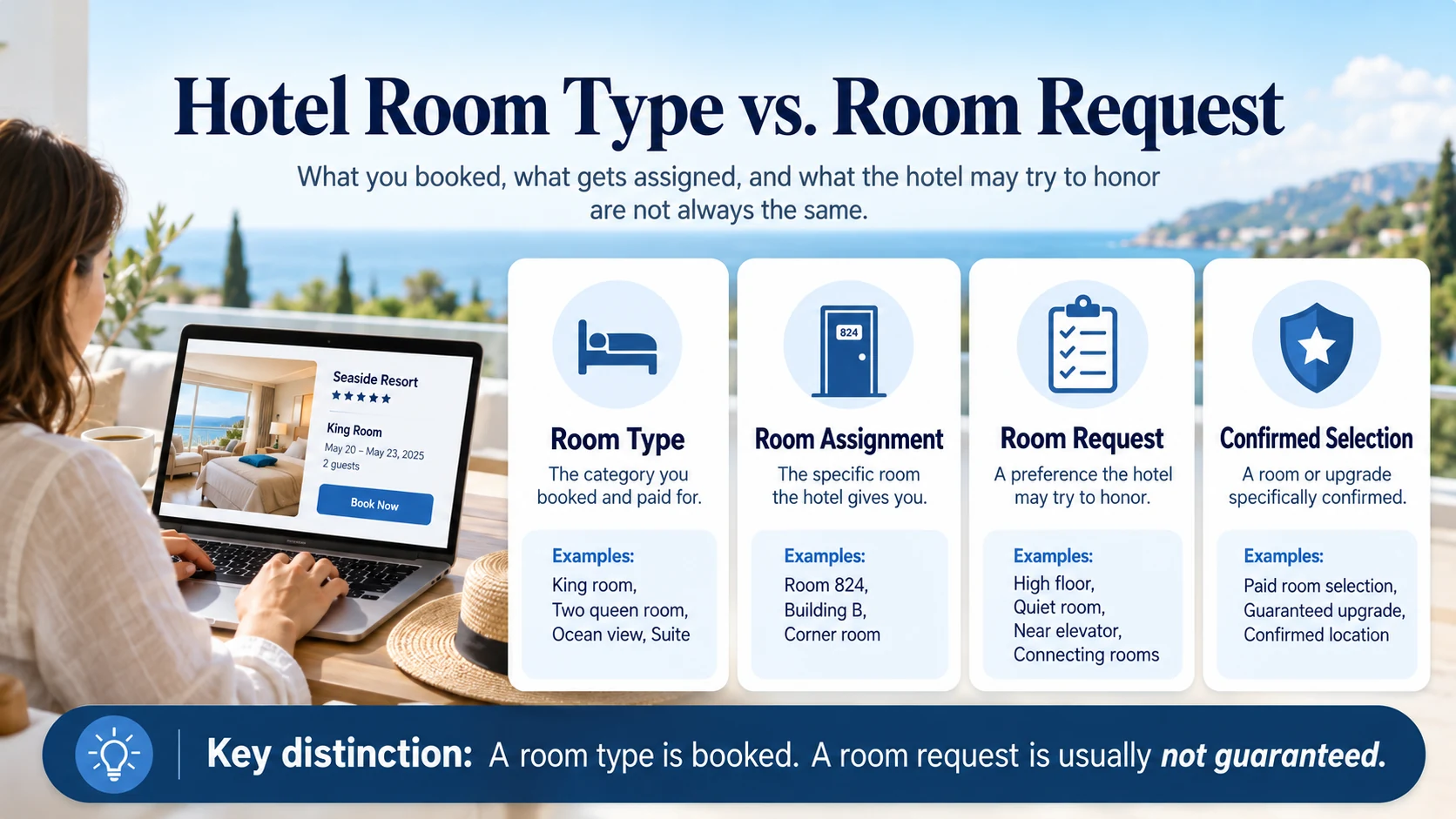
A booked room type is different. If your confirmation identifies a specific category—such as a king room, two queen room, suite or ocean-view room—that is the category you selected and paid for. A room assignment is the exact physical room the hotel later gives you within that category.
TFP rule: If a room detail is essential, try to book it as part of the room category or obtain clear confirmation. Do not rely only on the special-request field for a must-have feature.
The Decision in 30 Seconds
First decide whether the detail was purchased, confirmed, assigned or merely requested.
| Room detail | How I would treat it |
|---|---|
| King vs. two queens | Booked room type if the bed setup is explicitly sold as the category you purchased. |
| Suite vs. standard room | Booked room type when the suite is the actual category on the reservation. |
| Ocean-view category | Booked room type if you paid for Ocean View rather than merely requesting a water view. |
| High floor | Usually a request unless the hotel sells or confirms a particular floor or location. |
| Quiet room | Usually a request and dependent on the specific rooms available. |
| Near or away from elevator | Usually a request unless included in a specific paid room selection. |
| Specific room number | Usually a request unless the property specifically confirms or sells that room selection. |
| Connecting rooms | Verify carefully — this can be sold or confirmed at some properties and merely requested at others. |
| Balcony or view | Check the room description — it may be a category feature or only a preference. |
| Paid room selection or upgrade | Stronger than an ordinary request — check exactly what the confirmation says was selected or included. |
Room Type
What is a hotel room type?
A hotel room type is the category you selected and paid for. Depending on the property, the category may describe the bed setup, room class, suite type, view, accessibility features, occupancy or other characteristics.
Examples might include King Room, Two Queen Room, Junior Suite, Ocean View Room or an accessible room category.
Why this matters
The room type is the starting point for understanding what you bought. If a detail is explicitly part of the category on the confirmation, that is fundamentally different from adding the same detail later as a preference.
Room Request
What is a hotel room request?
A room request is usually a preference the hotel notes and may try to honor if the right room is available when assignments are made.
High floor
You prefer a higher room, but the property may not have one available within the category you booked.
Quiet location
The hotel may try to place you away from elevators, ice machines, event spaces or other sources of noise.
Near or away from elevator
This typically depends on which rooms in your booked category are assignable when you arrive.
Preferred building or wing
The request can be noted without guaranteeing that exact part of the property.
Specific room number
The room may be occupied, out of service, not ready or already needed for another assignment.
A request appearing in your reservation notes does not automatically turn it into a booked feature.
Room Assignment
What is a room assignment?
A room assignment is the specific physical room the hotel gives you within the category you booked—for example, Room 1427 in the tower, on the 14th floor, near the end of the hallway.
That assignment often happens closer to arrival because the hotel must consider which rooms are occupied, vacant, clean, out of service, arriving early, departing late or already committed to other guests.
This is why booking a King Room does not necessarily mean the hotel knows your exact room number months in advance.
Room Detail Check
Room type vs. room assignment vs. room request vs. confirmed selection
These terms can sound similar, but they do different jobs in a hotel reservation.
| Booking term | What it means |
|---|---|
| Room Type | The category you booked and paid for, such as King Room, Two Queen Room, Suite, Ocean View or an accessible room category. |
| Room Assignment | The exact room number or location the hotel assigns within the booked category, often closer to arrival. |
| Room Request | A preference the hotel may try to honor, such as high floor, quiet room, preferred building or specific room number. |
| Confirmed Selection | A specific room, location, upgrade or other detail that the hotel specifically confirms, sometimes for a fee or as a booking or loyalty benefit. |
What You Bought
Which room details are usually part of the booking?
The strongest clue is the room name and description on the reservation. Details expressly sold as part of that category carry much more weight than notes entered into a special-request box.
Common examples include the room class, suite type, bed setup, view category or accessibility features when those details are actually part of the category you selected.
Look at the confirmation—not just what you remember selecting.
Ask whether the feature appears in the actual room-type name or description. That is stronger evidence than seeing it only in a separate requests or comments section.
Usually a Preference
Which details are usually just room requests?
Preferences tied to the exact location of the room are commonly handled as requests because the hotel cannot always know in advance which specific rooms will be assignable.
That commonly includes high floor, low floor, near elevator, away from elevator, quiet location, certain building or wing, and a specific room number.
If the confirmation uses phrases such as request, preference, subject to availability, request only, not guaranteed or we’ll do our best, treat that as a signal that the detail may not be promised.
The Important Gray Area
Some room details can be either a booked feature or merely a request.
This is where many hotel misunderstandings begin. The same feature can have very different weight depending on how it was sold.
Ocean view
If you paid for an Ocean View room type, the view is part of the category. If you booked a standard room and added “ocean view please” in the request field, it is a preference. See our Ocean View vs. Oceanfront guide for the separate question of what that view category may actually deliver.
Balcony
Some hotels sell balcony rooms as distinct categories. At others, a balcony preference may be noted without being guaranteed.
Connecting rooms
The property may offer a confirmed connecting-room product, or it may simply accept a request and try to match two room assignments later.
Club level or location
This can be a paid room class at one property and only a location preference at another.
Before assuming the feature is included, check the available room categories and see whether the property sells it as a distinct room type.
Fine-Print Language
What does “subject to availability” actually mean?
For a hotel room request, subject to availability generally means the hotel can note the preference and may try to honor it, but fulfillment depends on the inventory that can actually be assigned.
The hotel may not know until closer to arrival which rooms are clean, vacant, out of service, occupied longer than expected or needed to satisfy other confirmed booking requirements.
The phrase does real work.
“Subject to availability” is telling you the requested detail remains uncertain. It should not be read the same way as “guaranteed,” “confirmed,” “selected” or a feature included in the booked room category.
Why Requests Change
Why might the hotel be unable to honor a room request?
The matching room is occupied
Your preferred floor or location may not have an available room within the category you actually booked.
The room is not ready
The hotel may have a room that matches the request later, but not one that is clean and assignable when you arrive.
A room is out of service
Maintenance issues can unexpectedly reduce the inventory available for specific floors, room numbers or locations.
Other commitments take priority
The hotel may also be balancing accessibility requirements, paid selections, confirmed upgrades, loyalty benefits, stay patterns and other room commitments.
That does not necessarily mean the request was ignored. It may mean the hotel could not satisfy both the booked category and the preferred assignment with the inventory available.
If It Matters
If the room detail matters, book it—don’t just request it.
A request is useful for a preference. It is a poor substitute for a feature that can make or break the stay.
If you need two beds, a suite, a specific view category, a balcony or another must-have feature, compare room types that explicitly include what you need rather than choosing a cheaper category and hoping the hotel can add the feature later.
A booked room type, paid room selection, confirmed upgrade or clear written confirmation gives you a much stronger basis for resolving a problem than a preference sitting in the reservation notes.
Read the Reservation
How can you tell what you actually booked?
Start with the exact room name and description on the confirmation. Then separate those purchased details from anything shown under requests, preferences, notes or comments.
Room type name
Look for the exact category: King Room, Two Queen Room, Suite, Ocean View, Accessible Room or another named product.
Included features
Check the description for the bed setup, view, balcony, occupancy, accessibility features and other details expressly tied to that category.
Request language
Separate wording such as “requested,” “preference,” “subject to availability” or “not guaranteed” from what the category itself includes.
Paid or confirmed selections
Save proof of any room-selection fee, paid upgrade or separately confirmed feature.
If you want to see how the property currently separates the options, it can help to compare the room descriptions being sold and see whether your must-have feature appears as a distinct category.
The strongest question to ask
“Is this detail part of my booked room type, or was it only listed as a request?”

If the Room Is Different
What should you do if the room does not match what you expected?
Separate the problem into two questions:
Did the hotel give you the room type you booked?
If you booked a Two Queen Room and receive a King Room, or booked an Ocean View category and receive a category without that booked feature, the issue may involve the room type itself.
Did you receive the booked type but miss a request?
If you booked a standard King Room and requested a high floor, quiet location or specific room number, the hotel may have provided the booked category while being unable to satisfy the preference.
Show the hotel your confirmation and ask it to explain which details were part of the booked category versus the request. If the booked room type is unavailable, ask what comparable room, adjustment, upgrade, credit or other practical remedy may be available.
If the issue is only a request, ask whether another room in the same category may become available later or whether a room move is possible.
The Fine Print That Matters
A reservation can contain both promises and preferences.
The room type is the foundation
Start with the category named on your reservation. That is more important than a preference listed separately in the notes.
“Requested” is not the same as “confirmed”
A hotel can acknowledge that it received a request without promising that the request will be fulfilled.
Exact room assignment may come later
The hotel often needs current occupancy, housekeeping and maintenance information before it can decide which physical room to assign.
Some features can be either
A view, balcony, connecting arrangement or location may be a booked feature at one property and only a request at another. Read how the specific hotel sells it.
Booking channel can add another layer
If a request was entered through another booking company, you may also need to confirm that the hotel actually received it. See Booking Hotels Through Third-Party Sites.
Compare the actual room, not just the lowest rate
If the feature matters enough to affect the trip, compare rooms by the features they actually include before deciding which rate is cheapest for what you need.
My Take
I would never leave a must-have room detail sitting only in the request box.
If a high floor would be nice, I am comfortable requesting it and accepting that the hotel may not be able to honor it.
If I genuinely need two beds, a particular room class or another feature that would materially affect the stay, I want to see that detail in the room type or obtain clear confirmation before I rely on it.
The distinction is not whether the hotel heard the request. It is whether the hotel actually sold or confirmed the detail.
TFP Recommendation
Use requests for preferences. Use booked categories or confirmation for requirements.
The Recommendation
If you can enjoy the trip without the detail, a request is usually fine. If the detail affects sleeping arrangements, accessibility, the room class you are paying for or another essential part of the stay, treat it as something to book or confirm—not merely request.
Before paying, separate the category being sold from the preferences being collected. That one step prevents many check-in surprises.
Your Next Step
Decide which room details are essential enough that they need to be part of the booked category—not merely a request added after the reservation is made.
Smarter travel, straight to your inbox
Booking choices, hidden costs, travel rules and useful fine print — explained clearly.
Before You Go
Make sure the rest of the hotel booking matches what you expect.
Once you know which room details are truly part of the reservation, check the view category, booking channel, payment structure and final price with the same level of care.

Ocean View vs. Oceanfront
Understand what the room label may—and may not—tell you before paying a premium for the view.
Compare view categories →Why Travel Prices Differ Across Websites
Learn why the same-looking hotel room can appear at different prices and how to compare the real booking.
Compare the real price →Pay Now vs. Pay at Hotel
Decide whether a prepaid rate is worth giving up some payment or cancellation flexibility.
Compare payment timing →Booking Hotels Through Third-Party Sites
Know who controls changes, cancellations and reservation details when another company sits between you and the hotel.
Understand the booking channel →FAQ
Hotel room types and requests: common questions
What does subject to availability mean for a hotel room request?
It generally means the hotel may try to honor the request but has not guaranteed that exact room detail. Fulfillment depends on the rooms, features and locations that can actually be assigned.
Are hotel room requests guaranteed?
Usually not. A request is generally a preference unless the hotel sells the detail as part of the booked category, confirms it specifically, charges for a selection, or otherwise states that it is guaranteed.
What is the difference between a room type and a room request?
A room type is the category you booked and paid for. A room request is generally a preference the hotel may try to honor if the right room is available.
What is the difference between a room type and a room assignment?
The room type is the category you purchased. The room assignment is the exact physical room number and location the hotel eventually places you in within that category.
Can I request a specific hotel room number?
Yes, but a specific room number is commonly treated as a request unless the property offers and confirms a specific room-selection option. The room may be occupied, unavailable, out of service or needed for another assignment.
When do hotels assign specific rooms?
Many properties make or refine room assignments closer to arrival, when they have better information about occupancy, housekeeping, maintenance, departures and the rooms actually available to assign.
Are connecting rooms guaranteed?
Not automatically. Some hotels sell or specifically confirm connecting arrangements, while others only accept them as requests. Check the exact booking language rather than assuming “connecting rooms requested” means they are guaranteed.
Is an ocean view a room type or a request?
It can be either. If Ocean View is the category you booked and paid for, it is part of the room type. If you booked another category and merely asked for an ocean view, it is generally a request.
What should I do if I do not get the room I expected?
First determine whether the missing detail was part of the booked room type or only a request. If the hotel did not provide the category you purchased, show the confirmation and ask what correction or comparable alternative is available. If the issue is only a request, ask whether another room or later room move is possible.
How can I improve the chances that a hotel honors my request?
Book any must-have feature as part of the room category when possible. Then add the preference clearly, contact the property closer to arrival, and ask whether it is merely noted, specifically confirmed or still subject to availability.
Free Travel Guide
Avoid the travel mistakes that can cost you money, flexibility, or time.
Get 27 Travel Mistakes That Cost Travelers Thousands — a practical guide to booking mistakes, hidden costs, travel rules and decisions worth understanding before they become a problem.
- Spot booking details that are easy to overlook
- Understand where hidden costs can appear
- Recognize when a cheaper option comes with a tradeoff
- Make travel decisions with fewer surprises
You’ll also receive occasional practical guidance from Travel Fine Print on booking choices, hidden costs, travel rules and the fine print worth understanding. Unsubscribe anytime.