
You find a hotel with a nightly rate that looks reasonable.
Then you move toward checkout.
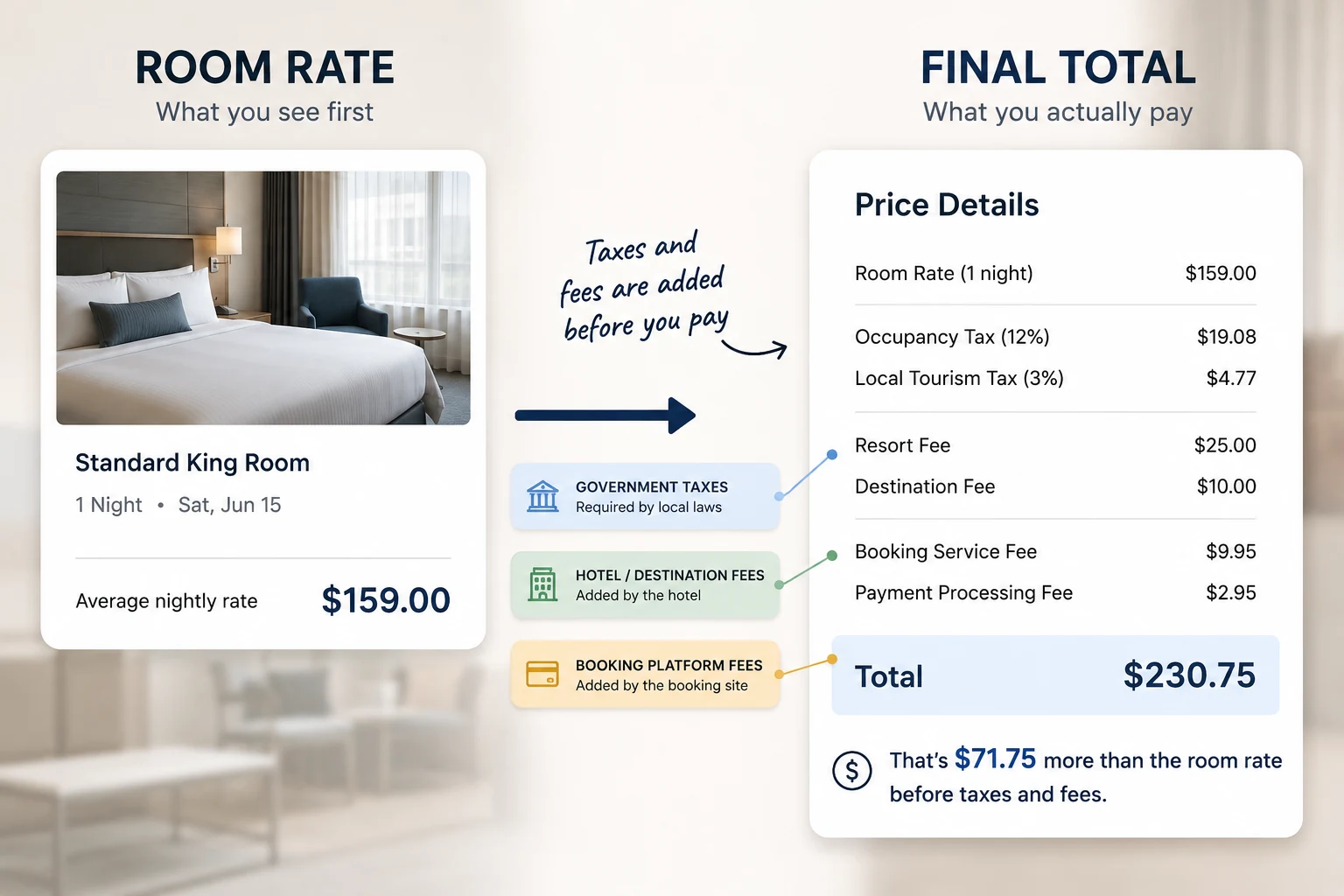
Suddenly, the room rate is only part of the price. Taxes, destination fees, resort fees, service charges, occupancy taxes, local surcharges, and property fees start appearing underneath the rate.
That can make the final hotel total look much higher than the price that first caught your attention.
The confusing part is that not all of those charges mean the same thing.
Some are government-required taxes. Some are hotel-imposed fees. Some are booking-platform charges. Some are estimated online but collected later at the property. And some may be mandatory even if they appear below the advertised room rate.
The real question is not just:
“Why did the hotel price go up?”
It is:
“Which charges are required, which ones are hotel-added, and which ones should I count before booking?”
This guide explains hotel taxes and fees in plain English, including occupancy taxes, resort fees, destination fees, property fees, surcharges, and charges that may still appear at check-in.
Quick Answer
What are hotel taxes and fees?
Hotel taxes and fees are extra charges added to the base room rate. Taxes are usually government-required charges, such as occupancy tax, lodging tax, sales tax, tourism tax, or local hotel tax. Fees are often added by the hotel, resort, or booking platform for amenities, destination access, service charges, parking, reservation processing, or other property-level costs.
The important distinction is that taxes usually come from local rules, while fees often come from the hotel or booking site. Both can raise the final price, but they are not the same thing.
Before booking, compare the final stay total — not just the nightly rate — and check whether any charges are mandatory, estimated, or due at the property.
System Insight
A hotel’s nightly rate is only the starting point. The final price depends on taxes, mandatory fees, and charges that may appear later in the booking path.
- Taxes usually come from a city, county, state, tourism district, or other government authority.
- Hotel fees may be added by the property for resort access, destination benefits, services, facilities, or amenities.
- Booking-platform fees may appear when a third-party site adds service, recovery, or processing charges.
- Property charges may still be collected at check-in or checkout, especially for parking, pets, deposits, or local fees.
- The final stay total is the number to compare — not the first nightly rate shown in search results.
Hotel Charge Guide
Choose the Hotel Tax or Fee You Want to Understand
Hotel charges can look similar at checkout, but they may come from different sources. Start by identifying the type of charge before deciding whether it is required, hotel-added, optional, estimated, or due at the property.
Government Tax
Occupancy Tax
Why cities, counties, states, or tourism districts may add hotel taxes to the room rate.
Hotel-Imposed Fee
Resort or Destination Fee
Why these charges are usually not taxes, even when they appear near the taxes section.
Property Charge
Property Fee
What a property fee may mean and why it can be mandatory even if it is listed separately.
Extra Charge
Hotel Surcharge
How surcharge language may be used for local charges, service costs, energy fees, or other add-ons.
Required Charge
Mandatory Hotel Fees
Which fees are usually unavoidable once you book and why they belong in the real room price.
At Check-In
Due-at-Property Charges
What hotels may still collect later, including deposits, parking, pet fees, local taxes, or estimated charges.
Why the Room Rate Looks Lower Than the Final Hotel Price
The room rate is usually only the starting price.
When you search for a hotel, the first price you see may show the nightly room rate before all taxes, fees, and property-level charges are included. That can make one hotel look cheaper than it really is, especially when the final checkout total includes several extra line items.
Hotel taxes and fees may include occupancy tax, lodging tax, sales tax, tourism tax, resort fees, destination fees, property fees, service fees, booking-platform fees, parking fees, or local surcharges.
The key is that these charges do not all come from the same place.
Some are required by local law. Some are added by the hotel. Some are charged by the booking platform. Some are estimated online and finalized at the property. And some may be mandatory even if they appear below the advertised room rate.
That is why two hotels with the same nightly rate can have very different final totals.
That same total-cost logic matters when comparing different types of stays. If you’re choosing between an all-inclusive resort and a regular hotel, compare the full vacation value of both options rather than just the nightly rate.
That difference can become even more important for a larger group because taxes and required hotel charges may apply across several rooms. For a practical example, see Orlando Villa vs Hotel Rooms to compare one property with the full cost of every hotel room a group would actually need.
What Is Occupancy Tax?
Occupancy tax is one of the most common hotel charges travelers see at checkout.
Occupancy tax — sometimes called lodging tax, hotel tax, room tax, tourist tax, or bed tax — is usually a government-required charge applied to short-term hotel stays.
Cities, counties, states, tourism districts, and other local authorities may collect these taxes to help fund tourism programs, convention centers, transportation projects, destination marketing, local services, or other public costs tied to visitors.
Unlike resort fees, destination fees, or property fees, occupancy taxes are generally not created by the hotel itself. The hotel collects the money, but the tax is usually set by local law.
Occupancy tax may be charged as a percentage of the room rate, a flat nightly amount, or a combination of both. That is why hotel tax totals can vary dramatically between destinations.
A hotel in a major tourist city, beach destination, resort area, or international market may have a much higher tax total than a hotel with the same room rate in a smaller market.
The important point is this: occupancy tax is usually a required government charge, not an optional hotel fee.
↑ Back to hotel taxes and fees
Are Resort Fees and Destination Fees Taxes?
No. Resort fees and destination fees are usually hotel-imposed charges, not government taxes.
That distinction matters because many travelers assume every charge listed under “taxes and fees” is required by law. In reality, some charges are created by the hotel or resort itself.
Resort fees are commonly used to bundle amenities such as Wi-Fi, gym access, pool access, beach chairs, local transportation, bottled water, fitness classes, business center access, or other property features.
Destination fees work similarly but are often framed as broader “property access,” “urban amenity,” or “destination experience” charges.
Unlike occupancy taxes, resort fees and destination fees are usually controlled by the hotel or brand. They may vary between properties and may not appear clearly in the first advertised nightly rate.
The confusing part is that booking pages may group taxes and hotel fees together even though they come from different sources.
That can make it harder to tell which charges are legally required, which are hotel-imposed, and which may still be collected at the property.
If a resort fee or destination fee is mandatory, treat it as part of the real room price before comparing hotels.
↑ Back to hotel taxes and fees
Which Charges Can Still Appear at Check-In?
No. Resort fees and destination fees are usually hotel-imposed charges, not government taxes.
That distinction matters because many travelers assume every charge listed under “taxes and fees” is required by law. In reality, some of those charges are created by the hotel or resort itself.
Resort fees are commonly used to bundle amenities such as Wi-Fi, gym access, pool access, beach chairs, local transportation, bottled water, or other property features.
Destination fees work similarly but are often framed as broader “property access” or “experience” charges.
Unlike occupancy taxes, these fees are usually controlled by the hotel, may vary between properties, and are not always displayed clearly in the first advertised room rate.
Booking pages may group taxes and hotel fees together even though they come from different sources.
↑ Back to hotel taxes and fees
What Does Surcharge Mean at a Hotel?
A hotel surcharge is an extra charge added on top of the base room rate.
The word “surcharge” is broad, so it does not always tell you exactly who created the charge or why it was added. A surcharge may be tied to local costs, service fees, energy costs, administrative expenses, booking-platform charges, or property-level fees.
That is why you should not assume a surcharge is automatically a tax.
Some surcharges may be required by local rules or tied to government programs. Others may be created by the hotel, resort, or booking platform. In some cases, the surcharge may simply be another name for a mandatory fee that is not included in the first nightly rate.
Before booking, check whether the surcharge is:
required or optional,
charged per night or per stay,
included in the online total or collected at the property,
created by the government, hotel, or booking platform,
and refundable if you cancel the reservation.
If the surcharge is mandatory, treat it as part of the real hotel price. A lower nightly rate may not be a better deal if required surcharges make the final total higher.
↑ Back to hotel taxes and fees
Which Hotel Fees Are Mandatory?
Mandatory hotel fees are charges you usually cannot opt out of once you book the room.
These may include resort fees, destination fees, facility fees, service charges, or required local fees added by the property. The names vary, but the important point is whether the charge is optional or required.
A mandatory fee is different from an optional charge such as spa services, minibar purchases, room service, or late checkout.
The tricky part is that some mandatory hotel fees are not included in the first room rate travelers see. They may appear later in the checkout flow, in the policies section, or as a note that says the fee will be collected at the property.
Before booking, look for phrases like:
- “mandatory fee”
- “property fee”
- “resort fee due at hotel”
- “destination fee collected at check-in”
- “local charges may apply”
If the fee is mandatory, treat it as part of the real room price.
Travel Fine Print Takeaway
A mandatory fee should be treated like part of the room price.
If a hotel fee is required, it is not really optional from the traveler’s point of view. Even if the fee appears below the room rate or is collected at the property, it still belongs in your total trip cost before you decide whether the hotel is actually a good deal.
↑ Back to hotel taxes and fees
Which Charges Can Still Appear at Check-In?
Even after you pay online, some hotel charges may still appear at check-in or checkout.
That does not always mean the hotel is charging you twice. Some charges are estimated online, collected locally, authorized temporarily, or triggered only when you arrive at the property.
Common charges that may still appear at the hotel include incidental holds, security deposits, parking fees, pet fees, resort fees, destination fees, property fees, local tourism taxes, city taxes, minibar charges, room-service charges, early check-in fees, late checkout fees, or currency conversion adjustments.
The key question is whether the charge was disclosed before booking.
Look for sections labeled “due at property,” “pay at hotel,” “fees collected at check-in,” “local charges,” “additional charges may apply,” or “not included in total.”
If a charge was disclosed in the booking terms, the hotel may still collect it even if you already paid the room rate online.
Before handing over your card, ask whether the amount is a temporary hold, a mandatory fee, a local tax, or an actual charge. That distinction matters when you review your final folio after checkout.
↑ Back to hotel taxes and fees
Hotel Pricing Formula
Why the Final Hotel Price Ends Up Higher
The nightly room rate is often only the starting point. The final hotel total may combine government taxes, hotel-imposed fees, booking platform charges, and property-level costs that appear later in the booking process.
Important: Some of these charges may appear during checkout, while others may only be collected at the property during check-in or checkout.
Why Booking Sites Combine Taxes and Fees
Booking sites often combine different charges under one label, such as “taxes and fees.”
That label may be convenient for checkout, but it is not always helpful for travelers.
A single “taxes and fees” line may include government taxes, hotel-imposed resort fees, destination fees, property fees, booking-platform service fees, tax recovery charges, estimated local charges, or fees collected later at the property.
This matters because travelers may assume the entire amount is government-required when only part of it may be an actual tax.
The rest may be a hotel fee, a platform fee, or a property-level charge bundled into the same section.
That is why it is worth expanding the price details whenever the booking site allows it. The more specific the line items are, the easier it is to understand the real cost before you book.
Before assuming a charge is unavoidable, check whether it is a tax, a mandatory hotel fee, a booking-platform charge, an estimated amount, or something due at the property.never the booking site allows it. The more specific the line items are, the easier it is to understand the real cost.
Traveler Risk
A single “taxes and fees” line can hide very different charges.
The risky assumption is that everything labeled as a fee is optional, or that everything labeled as a tax is government-required. In reality, hotel booking pages may bundle taxes, resort fees, destination fees, platform fees, and property charges together. If you do not expand the price details before booking, you may not know which charges are unavoidable, which are hotel-imposed, and which may still be collected at the property.
How to Tell Whether a Hotel Charge Is a Tax or a Fee
One of the easiest ways to understand a hotel charge is to ask:
“Who created this charge?”
If the charge comes from a city, county, state, tourism district, or government agency, it is usually a tax.
If the charge comes from the hotel, resort, booking platform, property management company, or travel site, it is usually a fee.
That distinction matters because taxes are generally government-required charges, while fees are often business-imposed charges tied to amenities, operations, pricing strategy, booking services, or property-level costs.
In many hotel bookings:
- occupancy tax is usually a government charge,
- lodging tax is usually a government charge,
- sales tax is usually a government charge,
- tourism tax is usually a government charge,
- resort fee is usually a hotel-imposed fee,
- destination fee is usually a hotel-imposed fee,
- property fee is usually a hotel-imposed fee,
- booking fee is usually a platform-imposed fee,
- and surcharge depends on who created it and how it is described.
The confusing part is that booking sites may combine all of these under one “taxes and fees” label during checkout.
So the label matters, but the source matters more. Before assuming a charge is unavoidable, optional, refundable, or government-required, check who created it, whether it is mandatory, and whether it is included in the final price or due at the property.
Travel Fine Print Takeaway
The label matters less than the source of the charge.
A charge listed under “taxes and fees” may come from the government, the hotel, or the booking platform. Before assuming it is unavoidable, check who created the charge and whether it is mandatory, optional, estimated, or collected separately at the property.
Action Step
Expand the full price breakdown before booking the room.
The first nightly rate rarely tells the full story. Reviewing the complete taxes and fees section can help you understand the real cost before checkout or check-in surprises appear later.
Quick win: Before booking, compare hotels using the final stay total — not the advertised nightly rate.
Before You Book
Save the full hotel price breakdown before taxes and fees change the real cost.
Hotel taxes, resort fees, destination fees, property charges, deposits, and due-at-property costs can be easy to miss if you only compare the nightly rate. Use the Travel Documents Checklist to keep the booking total, fee details, cancellation terms, payment records, and hotel folio organized before you need them later.
Can You Avoid Hotel Taxes and Fees?
You usually cannot avoid government-required hotel taxes. If a city, state, county, or tourism district requires a tax on short-term lodging, the hotel generally has to collect it.
Hotel fees are different.
Some fees are mandatory once you book, while others depend on what you use during the stay.
You may be able to avoid or reduce certain hotel fees by:
- comparing the final total before booking,
- choosing a hotel without resort or destination fees,
- booking directly when direct rates show clearer fee details,
- avoiding paid parking if you do not need a car,
- declining optional add-ons,
- checking whether loyalty status or award stays waive certain fees,
- and reading the “fees due at property” section before payment.
Do not assume every extra charge can be removed.
Instead, separate the charges into three groups:
- Required taxes: usually unavoidable.
- Mandatory hotel fees: usually unavoidable once booked.
- Optional charges: avoidable if you do not use the service.
❓Frequently Asked Questions
Hotel taxes and fees can rise quickly because multiple charges may stack together. A stay may include occupancy tax, sales tax, tourism tax, resort fees, destination fees, parking charges, and booking platform fees all at once.
Usually no. Resort fees are typically hotel-imposed charges rather than government taxes. They are often used to bundle amenities such as Wi-Fi, pool access, or gym access into a mandatory daily fee.
Many hotel search results initially display only the room rate. Taxes, mandatory fees, estimated local charges, and property-level fees may be added later during checkout or check-in.
Usually only if the reservation itself is refunded. If you cancel within the refundable period, taxes are often refunded with the room rate. If the booking is non-refundable, the taxes may also be non-refundable.
Some fees may still appear at the property if they were disclosed in the policies or “fees due at property” section. This can include parking fees, incidental holds, local taxes, pet fees, or destination fees.
Bottom Line
Hotel taxes and fees can make a room look cheaper at first than it actually is.
Taxes are usually government-required charges, such as occupancy tax, lodging tax, sales tax, or tourism tax. Fees are often added by the hotel, resort, or booking platform, such as resort fees, destination fees, service fees, parking fees, or property charges.
The safest move is to compare the final total, not the first nightly rate.
Before booking, expand the full price breakdown and check whether any charges are mandatory, estimated, or due at the property.
Related Guides
If hotel taxes, resort fees, destination fees, or property charges are making the final price harder to understand, these related guides can help you compare the real cost before and after booking.
Hotel Prices, Fees, and Checkout Surprises
- Why the Price You See at Checkout Isn’t the Price You Pay
Use this if the final booking total changes because of taxes, fees, service charges, currency conversion, or add-ons that appear later in the checkout flow. - Hotel Destination Fees Explained
Helpful if the hotel adds a destination fee, amenity fee, urban fee, or similar daily charge that is separate from the room rate. - Can a Hotel Change the Rate After Booking? What to Check First
Use this if the hotel rate, taxes, fees, or total price changes after you already booked.
Payment Timing, Holds, and Deposits
- Pay Now vs Pay at Hotel: Which Option Is Safer?
Helpful if you are deciding whether to prepay online or pay at the property, especially when taxes, deposits, and local fees may be handled differently. - Why Hotels Put Pending Charges on Your Card
Use this if you see a temporary authorization, incidental hold, deposit, or pending charge after check-in. - Do You Get Hotel Deposits Back?
Helpful if the hotel collected a security deposit, incidental hold, or refundable deposit and you want to know when it may be released.
After-Stay Charges and Refund Questions
- Can Hotels Charge You After Checkout?
Use this if a hotel adds charges after your stay for parking, minibar, damage, resort fees, destination fees, taxes, or other property-level costs. - Can You Get a Refund on a Hotel Booking?
Helpful if taxes, fees, prepaid charges, or booking-channel rules affect how much money you can actually recover.