
Hotel Billing · Travel Decisions
Hotel Charged Me Twice? How to Identify and Fix a Double Charge
Two charges for one hotel stay can look like duplicate billing. The next step depends on whether one amount is still pending, whether the booking site and hotel collected different payments, or whether you were genuinely charged twice.
The decision: First identify which transactions have posted and who collected each payment. If one is pending, confirm whether it is a temporary hold. If two posted payments cover the same obligation, request a correction and protect your card-dispute deadline.
Travel Fine Print is independently written. Some links on this page are affiliate links, including Hotels.com; we may earn a commission if you book through them, at no additional cost to you. Our recommendations prioritize the booking terms and practical next steps.
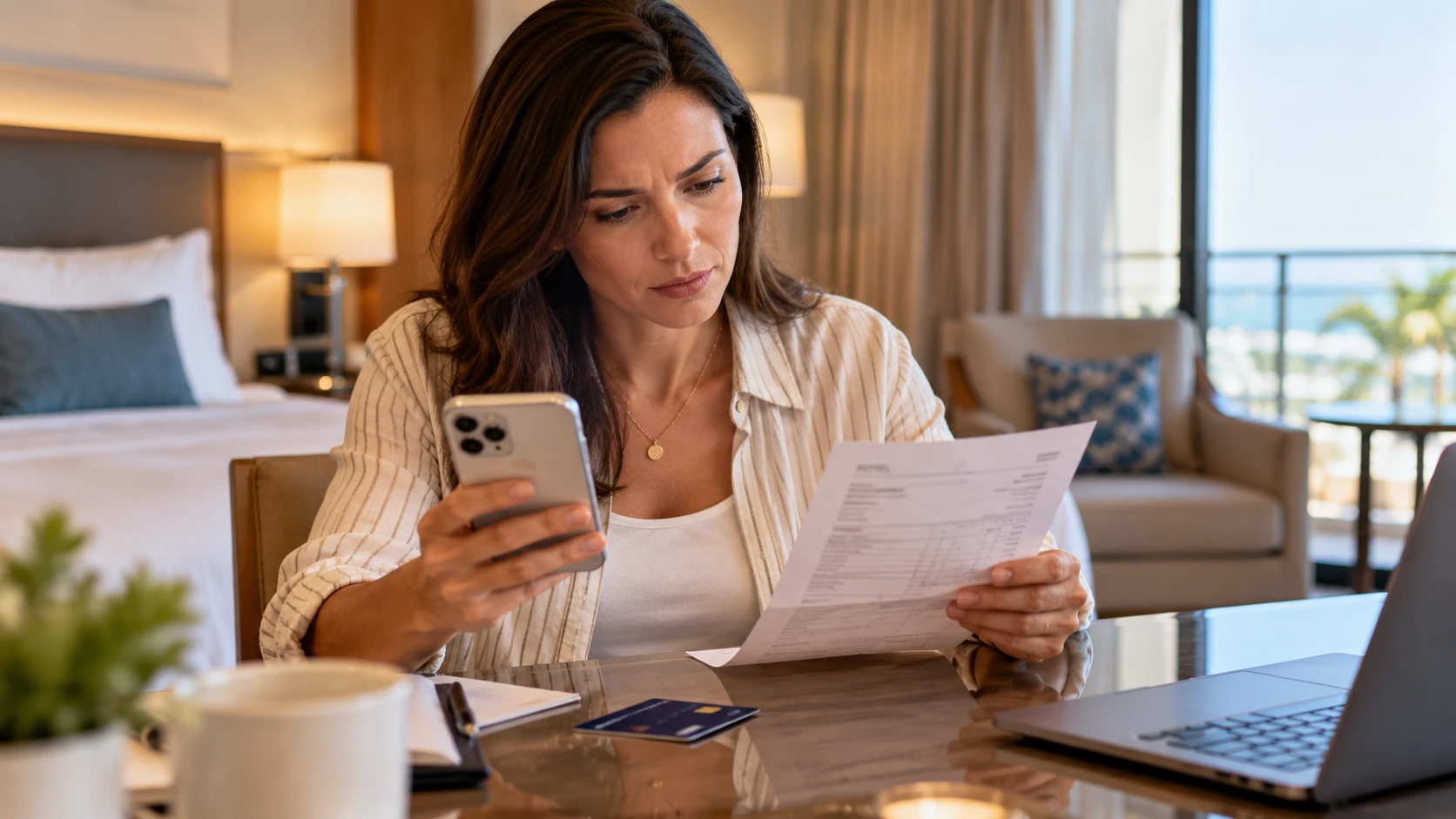
Quick Answer
What should you do if a hotel charged you twice?
Check whether both amounts are posted. A pending transaction may be a temporary authorization rather than a second payment. If both posted, compare merchant names, amounts, the booking confirmation and the final hotel folio. Ask the hotel or booking platform to explain and reverse any unsupported charge. If it remains unresolved, contact your card issuer without missing applicable dispute deadlines.
Decision in 30 Seconds
Which kind of second hotel charge are you seeing?
Three situations can look nearly identical in a banking app—but call for different responses.
| What you see | Likely explanation | Your next step |
|---|---|---|
| One pending, one posted | Temporary authorization or hold alongside the final payment | Ask the hotel whether the hold was released and your issuer when it should clear. |
| Booking platform and hotel charged | Separate amounts due to different merchants—or potentially duplicate room collection | Match each merchant and amount to prepaid terms, deposits and property fees. |
| Both charges posted for one stay | Potential duplicate payment, if one lacks a valid billing purpose | Request an itemized correction; promptly safeguard your dispute rights. |
Important: Equal amounts alone do not prove a duplicate; different amounts do not rule one out. The issue is whether the hotel or another merchant charged for something you did not owe.
Why a pending hotel charge is not always a double charge
Hotels commonly request an authorization when you check in or when a card is used to secure incidental expenses. An authorization can reduce your available credit or account balance without becoming a completed posted charge. The final room charge may then post while the authorization is still visible.
Do not assume that a hold will clear on an exact timetable. The release and display of funds can depend on the hotel, merchant processor, card network, issuer and whether you used a debit or credit card.
Ask two specific questions: “Has the hotel released or reversed the authorization?” and “Does my bank show the second entry as pending or posted?” The answers separate a delayed release from an actual second payment.
For more on the distinction, see hotel pending charges and hotel incidental holds.
What if both the booking site and hotel charged you?
First check whether the booking was prepaid, pay at property, or only partially prepaid. A booking platform may take the room payment while the hotel collects local taxes, parking, resort fees, incidentals or another disclosed balance. Merchant names can differ even when both charges relate to one stay.
Look for a line on the confirmation such as “paid today,” “due at property,” or “taxes and fees collected by the property.” Compare those amounts to the final folio. If both merchants collected the same prepaid room obligation, ask the booking platform and hotel to identify the merchant of record and correct the duplicate.
Related guidance: booking hotels through third-party sites and hotel deposits.
For a future reservation, you can compare hotel options on Hotels.com—but check the final payment breakdown, not just the headline nightly rate.

What to Check
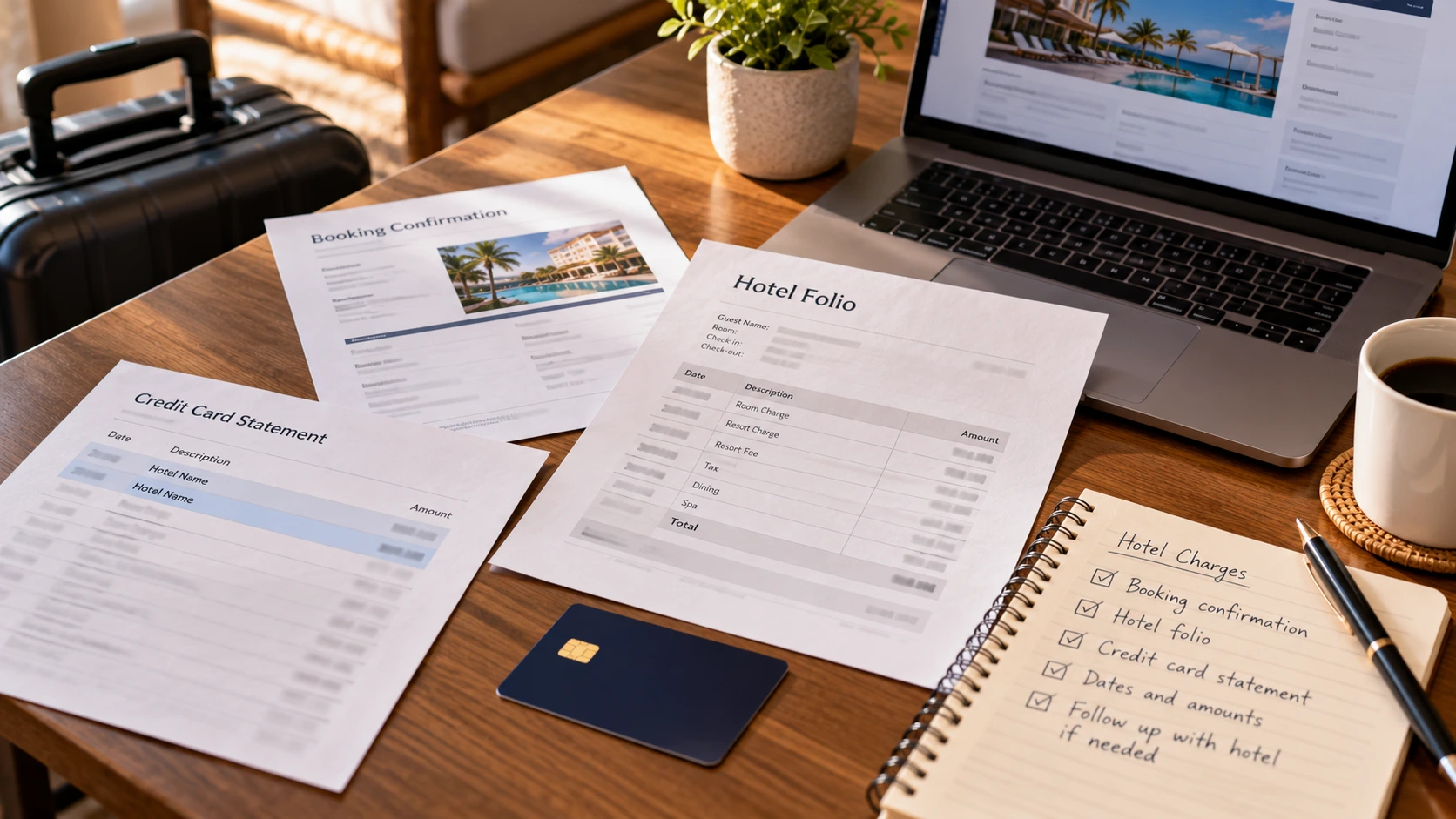
Build a simple paper trail before you escalate
You do not need a complicated claim file. You need records that make the duplicate—or the legitimate reason for each charge—easy to identify.
1. Card transactions
Take screenshots showing the date, amount, merchant name and pending/posted status for both entries. Avoid sending full card numbers.
2. Booking confirmation
Check the total and what was paid upfront versus due at check-in, checkout or directly to the property.
3. Hotel folio
Request the itemized final bill showing room nights, taxes, fees, deposits applied, payments and adjustments.
4. Written explanation
Save emails or messages from the hotel and booking platform identifying which merchant collected each charge and whether a reversal was issued.
What to say when you contact the hotel
Start with a precise request rather than simply saying that you were charged twice. An individual front-desk employee may see the final payment without seeing the bank’s pending authorization or the booking site’s collection.
Suggested message: “I see two hotel-related transactions for my stay on [dates]: [amount and merchant] and [amount and merchant]. Both currently show as [pending/posted]. Can you provide the itemized folio and identify which payment covered the stay, which amount was an authorization or deposit, and whether a reversal or refund has been issued?”
Ask for a response from the billing or accounting team if the front desk cannot reconcile it. If the booking site processed the charge, contact its payment-support team too. Request a transaction reference or written confirmation of any refund.
Escalation and Deadlines
When should you dispute the second hotel charge?
If both transactions posted and a charge cannot be justified by the stay, your confirmation or the hotel folio, contact your card issuer promptly. You can ask the hotel to correct the error while also protecting your card-dispute rights; these actions do not have to happen one after the other.
For U.S. credit cards: federal billing-error protections generally require a written notice to the issuer within 60 calendar days after the statement showing the error was sent. Calling or using an app alone may not preserve all Fair Credit Billing Act protections. Follow the dispute instructions on your statement and use the billing-inquiries address or issuer-approved process. Read the CFPB’s explanation of credit-card dispute rights and the FTC’s sample dispute letter.
Debit-card disputes, non-U.S. cards and other claims may follow different rules. Report potentially fraudulent or unauthorized transactions immediately; do not wait for a hotel callback. Continue paying undisputed amounts as your issuer instructs.
Do not wait indefinitely for hotel accounting. If a dispute deadline is near, submit the necessary card-issuer notice on time even if the property says it is still investigating.
The Fine Print That Matters
Four distinctions that determine your next step
Pending authorization ≠ completed payment
Pending holds can make available funds look lower without indicating that the hotel collected twice.
Same trip ≠ same charge
Room payment, security deposit and separate disclosed hotel fees can be processed at different times or by different merchants.
Posted twice ≠ automatically justified
Two posted charges require a clear explanation; the final folio and booking terms should reconcile to the total paid.
Merchant correction ≠ dispute deadline extension
An open support ticket does not necessarily extend cardholder deadlines. Protect your rights while working toward a resolution.
My Take
I would investigate the transaction, not just the amount.
If one charge is pending, I would first ask whether it has been released. If both are posted, I would line up the folio with the booking confirmation and find exactly which amount has no billing basis.
I would give the hotel a clear chance to explain a legitimate charge—but never let that conversation run past a card-dispute deadline.
TFP Recommendation
Identify the second payment, then choose the right correction path.
The Recommendation
Do not assume two transactions mean double collection—but do not dismiss two unexplained posted charges as “just a hold.”
Check status, compare merchants and documents, ask for a written explanation, and contact your card issuer promptly when an actual billing error is possible.
Your Next Step
Choose the action that matches what you see.
For your next booking, it may help to review hotel listings on Hotels.com alongside the booking terms and any amounts due at the property.
Smarter travel, straight to your inbox
Booking choices, hidden costs, travel rules and useful fine print — explained clearly.
Before You Go
Know what the hotel may collect before your next stay.
Read the payment terms and keep your confirmation. These related guides explain the charges that most often resemble duplicate payments.
When comparing your next stay, browse hotels on Hotels.com and confirm whether payment is collected upfront or at check-in.

Hotel Pending Charges
When a hotel transaction is still awaiting settlement or release.
Understand pending charges →Hotel Incidental Holds
Why the hotel may temporarily reserve additional funds.
Review incidental holds →Hotel Deposits
Understand upfront deposits and how they relate to your final bill.
Understand deposits →Third-Party Hotel Bookings
Find out who processes payments and who can correct a billing error.
Check payment responsibility →Frequently Asked Questions
Hotel double charges: answers to common questions
Why did my hotel charge me twice?
It might be a pending authorization alongside a posted payment, a deposit followed by a final charge, separate hotel and booking-platform payments, or a true duplicate. Check the status and purpose of each transaction before assuming two payments were collected.
What should I do if a hotel charged me twice?
Compare pending and posted transactions with the booking confirmation and final itemized folio. Ask the merchant responsible for the unexplained posted charge to correct it in writing. If unresolved, contact your card issuer promptly and protect applicable dispute deadlines.
Can a hotel charge my card twice for the same stay?
A hotel may authorize funds and later post the completed payment, which can appear as two entries temporarily. Two separate posted charges for the same obligation, without a legitimate explanation, may be a billing error.
How long does a hotel pending charge take to disappear?
Release timing varies by hotel, card issuer, transaction type and payment network. Ask the hotel whether it reversed or released the authorization and ask your issuer when your available balance should update; avoid assuming a universal timeframe.
Can a booking site and hotel both charge me?
Yes, when the booking platform collects prepaid accommodation and the hotel separately collects authorized fees, deposits or incidentals. Compare each merchant name and transaction with the confirmation. Two charges for the same prepaid room amount require investigation.
Who should I contact first, the hotel or my bank?
For an explainable hotel charge, ask the hotel or booking platform for the folio and payment breakdown. Contact the card issuer immediately if the charge is unauthorized, a serious billing error is suspected, or a dispute deadline is approaching; the two steps can happen in parallel.
Can I dispute a hotel double charge on my credit card?
A duplicate posted charge may qualify as a credit-card billing error. Under U.S. federal billing-error procedures, sending an appropriate written notice generally within 60 days after the statement with the error was sent protects important rights. Follow your issuer’s instructions and check rules that apply to your card and country.
What documents help prove a duplicate hotel charge?
Save the original confirmation, final hotel folio, statement showing both posted entries, merchant names and transaction dates, receipts, deposit terms, and written responses from the hotel or booking platform. Redact full card numbers before sharing records.
Free Travel Guide
Avoid the travel mistakes that can cost you money, flexibility, or time.
Get 27 Travel Mistakes That Cost Travelers Thousands — a practical guide to booking mistakes, hidden costs, travel rules and decisions worth understanding before they become a problem.
- Spot booking details that are easy to overlook
- Understand where hidden costs can appear
- Recognize when a cheaper option comes with a tradeoff
- Make travel decisions with fewer surprises
You’ll also receive occasional practical guidance from Travel Fine Print on booking choices, hidden costs, travel rules and the fine print worth understanding. Unsubscribe anytime.