
Hotel Payment Guide
Hotel Incidental Holds Explained: Charges, Debit Cards & Release Times
You can arrive with a prepaid room and still be asked for a card at check-in. That does not automatically mean the hotel is charging you twice. It may be placing a temporary authorization for incidentals, fees, or other costs that could arise during the stay.
The decision: Is this hotel transaction only a temporary authorization—or has it become a real charge that is affecting money you need during the trip?
About This Guidance
This guide focuses on how hotel incidental authorizations work at check-in, how they differ from deposits and posted charges, why debit cards can create more cash-flow risk, and what to ask before presenting your card.
On This Page
- Quick Answer
- The Decision in 30 Seconds
- Hold vs. Charge vs. Deposit
- How Incidental Holds Work
- What You May See on Your Card
- Credit Card vs. Debit Card vs. Prepaid Stay
- When Hotel Holds Stack Up
- How Much Will the Hotel Hold?
- When Does the Hold Go Away?
- What If the Hold Becomes a Charge?
- The Fine Print That Matters
- TFP Recommendation
- Before You Go
- FAQ

A hotel incidental hold is usually a temporary authorization, but it can still reduce available credit or cash while you travel.
Quick Answer
A hotel incidental hold is usually temporary—but the impact can be real.
A hotel incidental hold is typically a temporary card authorization used to reserve money for possible extra charges during the stay, such as parking, room service, minibar purchases, mandatory property fees, damage, smoking charges, or unpaid balances.
It is usually not a final charge. If you do not use the full amount, the unused portion should normally be released after checkout. But your bank or card issuer controls when the money or available credit actually looks usable again.
The practical issue: a credit-card hold reduces available credit; a debit-card hold can tie up actual money in your checking account. A routine hold can therefore be harmless for one traveler and disruptive for another, depending on the card used and how much spending room remains for the trip.
The Decision in 30 Seconds
What does the hotel transaction probably mean?
| What you see | What it probably means |
|---|---|
| Pending amount at check-in | Usually a temporary authorization for incidentals or unpaid hotel costs. |
| Pending hold + final posted charge | The two may overlap temporarily while the original authorization is being released or replaced. Do not automatically add both together as the true hotel cost. |
| Amount has posted | Treat it as a real charge and compare it with the final hotel folio. |
| Prepaid room + new hold | The room may be paid, but the hotel still wants authorization for incidentals, fees, or damage risk. |
If you are still choosing a hotel, see what the property says may still be due or authorized at check-in before assuming the booking total is the only amount your card will need to support.
Start Here
Hold vs. charge vs. deposit
These three hotel transactions can all involve your card, but they do not work the same way.
Incidental hold
A temporary authorization that reserves part of your available credit or bank balance. It is usually pending rather than posted.
Posted charge
A completed transaction that the hotel has actually billed to your account. Once the amount posts, compare it with the final folio.
Deposit
An amount that may be collected before or during the stay and later applied, refunded, released, or retained according to the booking terms.
The first diagnostic step
Check whether the transaction is pending, posted, duplicated, or replacing an earlier authorization.
For a deeper explanation of hotel deposits, see Hotel Deposits.
How It Works
How hotel incidental holds actually work
At check-in, the hotel asks your bank or card issuer to reserve a certain amount. The hold may be a flat amount, an amount per night, or another figure tied to the hotel’s policy and expected extras.
If you add room charges or leave an unpaid balance, part of the authorization may be used toward the final bill. If you do not, the unused amount should be released after the stay.
Before booking, it can help to look at the payment details attached to the rate you are considering, especially if you plan to use a debit card or will be moving between several hotels.
The timing distinction that matters
The hotel controls when it releases the unused authorization. Your bank or card issuer controls when that amount stops affecting your available balance.
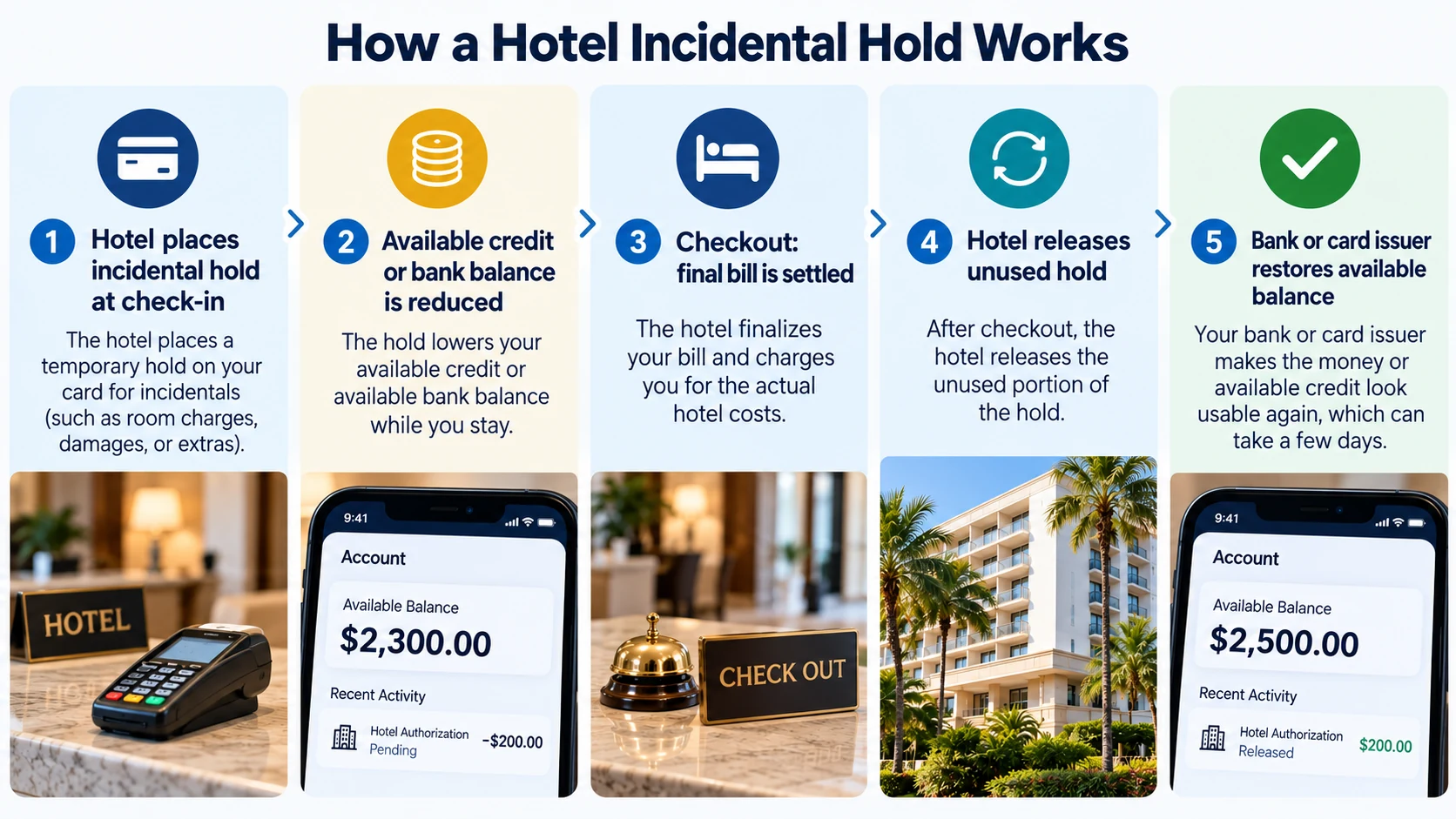
Card Activity
What you may see on your card during and after the stay
Your account may never use the word “hold.” An incidental authorization can simply look like another pending hotel transaction.
A pending amount appears at check-in
This is commonly the hotel reserving funds or credit for possible extras.
The hold is higher than expected
Some hotels hold a flat amount while others calculate the authorization by night, length of stay, room balance, or property policy.
The room is prepaid, but a hold still appears
Prepaying the room does not necessarily remove the need for an incidental authorization.
The hold and final bill overlap
Your account can temporarily show both the pending authorization and the final posted hotel charge.
This is different from a hotel charging your card before arrival for a deposit, advance payment, or booking guarantee. See When Does a Hotel Charge Your Card?.
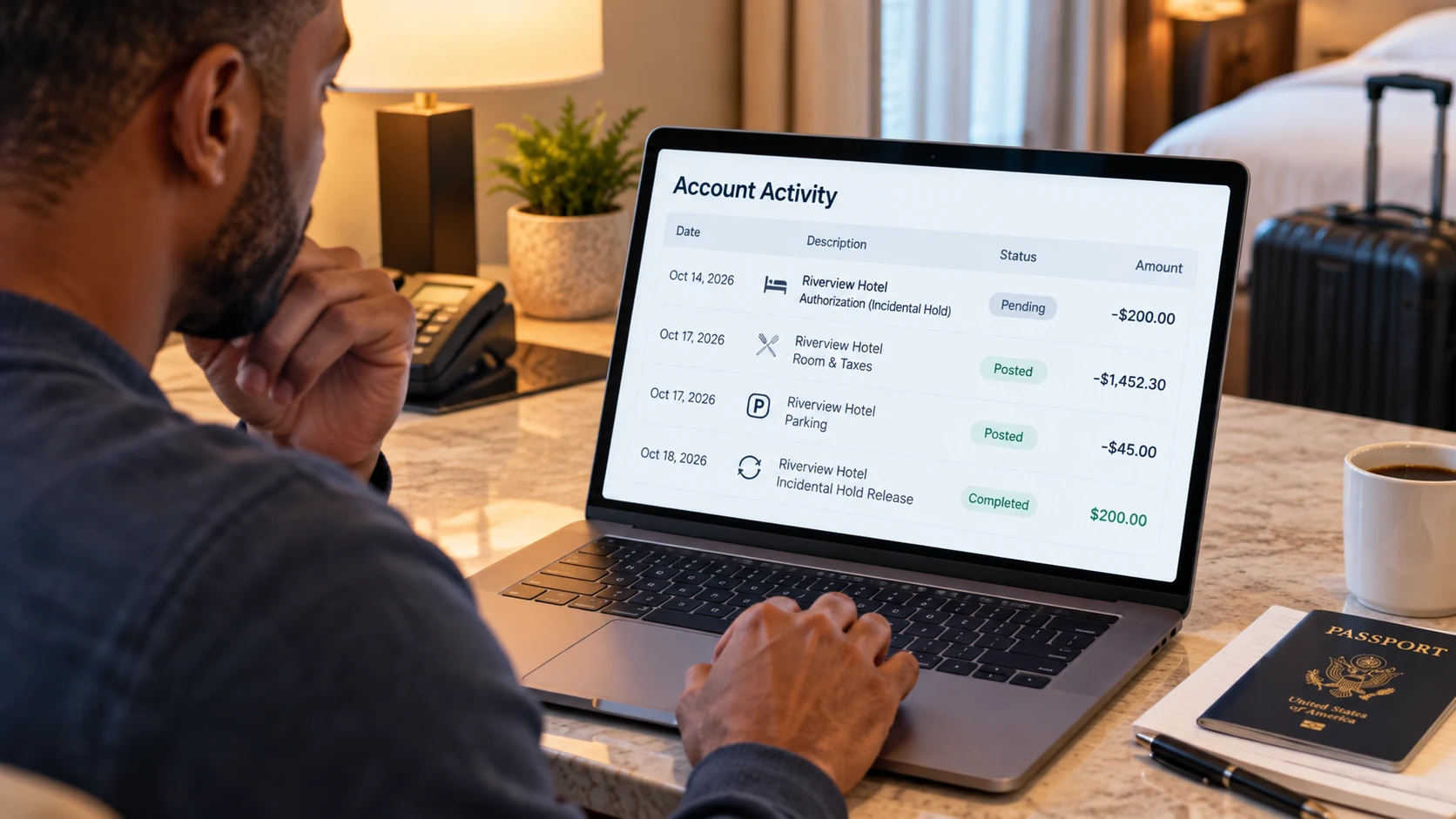
Card Impact Comparison
Credit card vs. debit card vs. prepaid stay
The same hotel hold can be harmless, inconvenient, or trip-disrupting depending on the card you use and how much money you need available during the stay.
| Situation | What happens | What to watch |
|---|---|---|
| Credit card | The hold usually reduces available credit rather than removing money from your bank account. | Make sure you have enough available credit for the hold plus the rest of the trip. |
| Debit card | The authorization can reduce the actual cash available in your checking account. | Ask the hold amount before using the card for check-in. |
| Prepaid stay | The room rate may already be paid, but the property can still require authorization for incidentals, fees, or damage. | Separate the prepaid room cost from the incidental authorization. |
If cash flow matters to your trip, review whether the rate is prepaid or leaves charges to be handled at the property.
Multiple Hotels
Hotel holds can stack during the same trip.
This is one of the easiest incidental-hold problems to underestimate. If you check out of one hotel and into another before the first authorization fully clears, both holds can affect your available balance at the same time.
Temporary does not mean painless.
A $200 authorization at one hotel may be manageable. Several overlapping holds can become a real cash-flow problem if you still need the same account for meals, transportation, gas, tips, or the next hotel.
If you are changing hotels: assume the authorizations may overlap for at least part of the trip. Keep enough spending room outside the amount being held so the next authorization does not interfere with meals, transportation, gas, tips, or the next stay.
Before Check-In
How much will the hotel hold?
There is no universal incidental-hold amount. The property may use a flat authorization, a nightly amount, a percentage, or another formula based on its policy.
Flat amount
The hotel authorizes one fixed amount for the stay.
Nightly amount
A hold that sounds small per night can become much larger over a longer stay.
Room balance plus incidentals
A property may authorize the unpaid room balance plus an additional cushion for incidentals.
Property-specific formula
Hotel category, destination, length of stay, and expected extras can all affect the authorization amount.
If you have not booked yet, check the property’s check-in and payment policies for your dates, then contact the hotel directly if the incidental-hold amount is not stated.
The question to ask before handing over your card
“How much will be held for incidentals, is that amount flat or per night, and when should I expect the unused amount to be released?”
Release Timing
When does a hotel incidental hold go away?
The unused portion should normally be released after checkout, but that does not mean your available balance recovers the same moment.
Hotel releases the authorization
The property completes the final billing process and releases the amount it no longer needs.
Bank or issuer processes the release
Your financial institution determines when the hold disappears or the available credit or cash becomes usable again.
It may not look like a refund
A released authorization often simply disappears rather than producing a separate refund transaction.
If the hold remains: first confirm with the hotel that it has actually released or completed the authorization. If the hotel has finished its part, the next timing question belongs with the bank or card issuer.
When the Transaction Changes
What if the hotel hold turns into a posted charge?
Once the amount has posted, it is no longer only a temporary authorization. At that point, compare the transaction with the final hotel folio.
Match the amount to the folio
Look for room charges, taxes, parking, dining, property fees, minibar, damage, smoking charges, or other incidentals.
Check for an overlapping authorization
A pending hold can remain visible briefly even after the final bill posts.
Ask what the charge represents
If the posted amount is not explained by the folio, ask the hotel to identify the charge and provide the supporting billing record.
The important change is status: pending authorization and posted charge require different questions.
If a final charge has posted while the original authorization is still pending, first ask whether that pending amount is being released before treating the two transactions as a duplicate charge.
Before leaving the hotel, review the final folio. It is much easier to reconcile parking, dining, property fees, room charges, or other incidentals while the stay is still fresh and the front desk can explain the bill.
The Fine Print That Matters
A temporary hotel hold can still create a real travel-budget problem.
Prepaid does not mean the hotel is finished with your card
The room may already be paid while incidentals, parking, fees, damage risk, or unpaid balances still require authorization at check-in.
A debit-card hold can tie up actual cash
The money may be temporarily unavailable for meals, transportation, gas, tips, or another hotel.
The hold and final bill can overlap
Your account may briefly show both without the hotel having charged the same amount twice.
Several hotel holds can stack
Moving among multiple properties can leave several authorizations outstanding at the same time, so the available credit or cash needed for the next part of the trip matters.
The hotel and the bank control different parts of the process
The hotel releases the authorization; your financial institution determines when the balance looks available again.
A posted transaction is no longer just a hold
Once it posts, reconcile it against the folio and ask what the charge represents if it does not match.
My Take
I would be much more careful using a debit card for hotel incidentals.
The issue is not whether the hold eventually disappears—it normally should. The issue is whether I need that money before it clears.
If the same checking account is paying for meals, transportation, gas, tips, or another hotel, a routine temporary authorization can become a practical problem very quickly.
For me, the important question is not “Will I get the money back?” It is “Can I afford to have this amount unavailable while I am still traveling?”
TFP Recommendation
Ask about the hold before you hand over your card.
The Recommendation
Know the amount, structure, card impact, and likely release timing before check-in.
Ask whether the hotel uses a flat hold, nightly authorization, or another formula; whether the amount differs for debit cards; and when the property normally releases unused funds after checkout. When practical, a credit card is usually easier to manage because the authorization reduces available credit instead of tying up checking-account cash.
If you do use a debit card, budget the hold as money you may not be able to use during the stay. If you are moving between hotels—or traveling close to your available credit or checking balance—leave enough room for authorizations to overlap without disrupting the rest of the trip.
Your Next Step
Use your situation to decide what to do now.
Smarter travel, straight to your inbox
Booking choices, hidden costs, travel rules and useful fine print — explained clearly.
Before You Go
Understand the other hotel transactions that can look like an incidental hold.
These related guides help separate deposits, pre-arrival charges, third-party payment paths, and prepaid booking terms from the authorization placed at check-in.

Hotel Deposits
Understand when an amount is a deposit, temporary authorization, prepayment, or charge that may later be refunded.
Separate the transactions →When Does a Hotel Charge Your Card?
See when hotels may authorize or charge a card at booking, before arrival, check-in, or after checkout.
Understand the timing →Booking Hotels Through Third-Party Sites
Understand how the booking channel and merchant of record can affect hotel payment and billing questions.
Follow the payment path →Pay Now vs. Pay at Hotel
Compare prepaid and pay-later rates without assuming either one eliminates check-in authorizations.
Compare payment timing →FAQ
Hotel incidental holds: common questions
What is a hotel incidental hold?
A hotel incidental hold is a temporary card authorization used to reserve money for possible extra charges during your stay. It may cover parking, room service, minibar purchases, mandatory property fees, damage, smoking charges, or unpaid balances.
Is a hotel incidental hold a charge?
Usually, no. It is normally a pending authorization rather than a final posted transaction. But it can still reduce your available credit or available bank balance while the authorization is active.
Do hotel incidental holds get refunded?
Usually, the unused portion is released rather than refunded in the traditional sense. The pending authorization may simply disappear, be reduced, or be replaced by the final posted hotel bill after checkout.
How long does a hotel incidental hold last?
The timing varies by property, card type, and financial institution. The hotel may release the unused amount after checkout, but the bank or card issuer controls when your available credit or cash reflects that release.
What does a $200 incidental hold mean?
It means the hotel is temporarily reserving up to $200 for possible extras or unpaid costs. It does not automatically mean you spent $200. If the hotel does not need the full amount, the unused authorization should normally be released.
Why did my prepaid hotel still put a hold on my card?
Prepayment usually covers the booked room rate, but the hotel may still need authorization for incidentals, parking, property fees, restaurant charges, minibar items, damage, smoking charges, or other costs not included in the prepaid amount.
Is a hotel incidental hold the same as a deposit?
Not necessarily. An incidental hold is usually a temporary authorization. A deposit may be an actual payment collected before or during the stay and may be applied, refunded, released, or retained according to the booking terms.
Are hotel holds worse on debit cards?
They can be. A credit-card hold usually reduces available credit, while a debit-card hold may reduce the actual cash available in your bank account. That can matter if you still need the same money during the trip.
Can several hotel incidental holds overlap?
Yes. If you stay at multiple hotels before earlier authorizations clear, several holds may affect your available credit or bank balance at the same time.
What should I do if the hotel hold posts as a charge?
Compare the posted amount with the final hotel folio. If the amount is not explained by the room bill, parking, fees, dining, damage, or other documented charges, ask the hotel what the transaction represents and request the supporting billing record.

Free Travel Guide
Avoid the travel mistakes that can cost you money, flexibility, or time.
Get 27 Travel Mistakes That Cost Travelers Thousands — a practical guide to booking mistakes, hidden costs, travel rules and decisions worth understanding before they become a problem.
- Spot booking details that are easy to overlook
- Understand where hidden costs can appear
- Recognize when a cheaper option comes with a tradeoff
- Make travel decisions with fewer surprises
You’ll also receive occasional practical guidance from Travel Fine Print on booking choices, hidden costs, travel rules and the fine print worth understanding. Unsubscribe anytime.