

Travel Decision Guide
Paris Museum Pass: Is It Worth It?
The Paris Museum Pass can save money, but only when the museums and monuments you already want to visit add up to more than the pass. The wrong way to use it is to buy the pass first, then add attractions just to make the math work.
The decision: Buy the Paris Museum Pass when your natural itinerary reaches the break-even point and the included sights fit comfortably into the same 48-, 96- or 144-hour window. Skip it when individual tickets cost less, you qualify for free admission at many sites, or the pass would turn Paris into a race.
About This Guidance
Travel Fine Print evaluates the Paris Museum Pass by comparing current pass pricing, individual admission costs, reservation requirements, validity rules, age-based free admission and the effect the pass can have on the pace of a Paris itinerary.

Planning the sights you genuinely want to visit comes first; the Museum Pass decision comes second.
Quick Answer
Is the Paris Museum Pass worth it?
It is worth it when the individual admission prices for the museums and monuments you already want to visit exceed the pass price without forcing an unrealistic itinerary. The current official prices are €85 for 48 hours (about $95), €105 for 96 hours (about $118) and €125 for 144 hours (about $140).
For example, the Louvre (€32), Musée d’Orsay (€16) and Arc de Triomphe (€22) currently total €70—less than the 48-hour pass. Add Sainte-Chapelle (€22) and the total reaches €92, so the pass begins to save money.
TFP rule: do the itinerary first and the pass math second. If the pass only works because you add attractions you would not otherwise visit, it is not really saving you money.
If the pass does fit your itinerary, you can buy through the official Paris Museum Pass site or compare the 2-, 4- and 6-day Paris Museum Pass option sold through Viator. Compare the final price and terms before choosing where to buy.
The Decision in 30 Seconds
Buy the pass for the itinerary you want—not the itinerary the pass creates.
| Your situation | What TFP would prioritize |
|---|---|
| Louvre + Musée d’Orsay + one other paid sight | Individual tickets — the 48-hour pass may still cost more. |
| Louvre + Orsay + Arc de Triomphe + Sainte-Chapelle | Price the 48-hour pass — the current individual total is about €92 versus €85 for the pass. |
| Several included museums and monuments spread across four days | 96-hour pass — it can preserve more breathing room than compressing everything into 48 hours. |
| Versailles plus several included Paris sights | Pass becomes more compelling — Versailles is one of the higher-priced included admissions. |
| Mostly neighborhoods, cafés, parks and one or two museums | Skip the pass — individual tickets preserve flexibility. |
| Children under 18 or travelers who qualify for free admission | Calculate each traveler separately — not everyone in the group needs the same product. |
How It Works
The pass runs by consecutive hours, not calendar days.
The official Paris Museum Pass currently comes in three durations: 48 hours for €85 (about $95), 96 hours for €105 (about $118), and 144 hours for €125 (about $140). The clock starts when you first use the pass at an included museum or monument. If you prefer to purchase through a travel marketplace, You can also compare 2-, 4- and 6-day Paris Museum Pass options.
48 hours
€85 / about $95. Best when several higher-priced attractions already fit naturally into two consecutive days.
96 hours
€105 / about $118. Often the better balance when you want savings without treating Paris like an admission checklist.
144 hours
€125 / about $140. Strongest when museums and monuments are a major part of a longer Paris stay.
USD amounts are approximate and will vary with the exchange rate and any card conversion fees. These approximations use roughly €1 = $1.12 as of October 5, 2026.
TFP Tip
Because validity is measured in hours, a 48-hour pass activated in the afternoon can remain usable into the afternoon two days later. You do not necessarily need to start first thing in the morning.
The Break-Even Math
Four attractions do not automatically make the pass worthwhile.
The official pass site says visitors save on average from around the fourth visit with the 48-hour pass, the fifth with the 96-hour pass and the sixth with the 144-hour pass. But the actual result depends on which attractions you choose.
Louvre
€32 — about $36.
Versailles + Trianon
€25 — about $28.
Sainte-Chapelle
€22 — about $25. If this is one of only a few priorities, compare a focused Notre-Dame + Sainte-Chapelle experience instead of assuming you need a multi-attraction pass.
Arc de Triomphe
€22 — about $25.
Musée d’Orsay
€16 — about $18. If Orsay is one of your main paid stops, compare an individual Musée d’Orsay entry ticket.
Musée Rodin
€15 — about $17.
Example: the pass loses
Louvre (€32) + Orsay (€16) + Arc de Triomphe (€22) = €70 (about $78). The 48-hour pass costs €15 more.
Example: the pass starts to win
Add Sainte-Chapelle (€22) and the total becomes €92 (about $103). The €85 pass saves about €7 (roughly $8).
Example: good math can still produce a bad itinerary
Louvre (€32) + Versailles (€25) + Sainte-Chapelle (€22) + Arc de Triomphe (€22) totals €101 (about $113). That beats the 48-hour pass by €16, but squeezing all four into 48 hours may not be how you want to experience Paris.
When It Works
The pass is strongest when your existing itinerary is attraction-heavy.
I would seriously consider it when several higher-priced included attractions are already priorities and they fit into the same validity window without forcing an unnatural schedule. A mix such as the Louvre, Sainte-Chapelle, Arc de Triomphe and Musée d’Orsay also spreads the experience across art, architecture and viewpoints rather than making every stop another long museum visit.
The 96-hour version can be particularly useful when you want to protect meals, neighborhoods and unscheduled time. Paying more for a longer pass can still be the better travel decision if it prevents you from compressing Paris into two overloaded days.
When to Skip It
A slower Paris trip can make individual tickets the better choice.
The Museum Pass is a poor fit when your real itinerary is built around neighborhoods, cafés, parks, shopping, food, free churches and viewpoints with only one or two paid museums. It is also less compelling if you prefer long, unhurried museum visits rather than several admissions in the same window. And if one of your sightseeing days would be better spent outside the city, compare the train, tour and private-transfer options for Giverny before compressing more museums into Paris.
If the only way to reach break-even is to add attractions you did not already want to see, the pass is designing the trip instead of discounting it.
In that situation, individual products can be the better fit. You can buy Musée d’Orsay entry on its own, choose a guided Louvre visit, or focus on a Notre-Dame + Sainte-Chapelle experience rather than paying for access across a much larger museum network.

Reservation Fine Print
The pass does not eliminate planning—or every line.
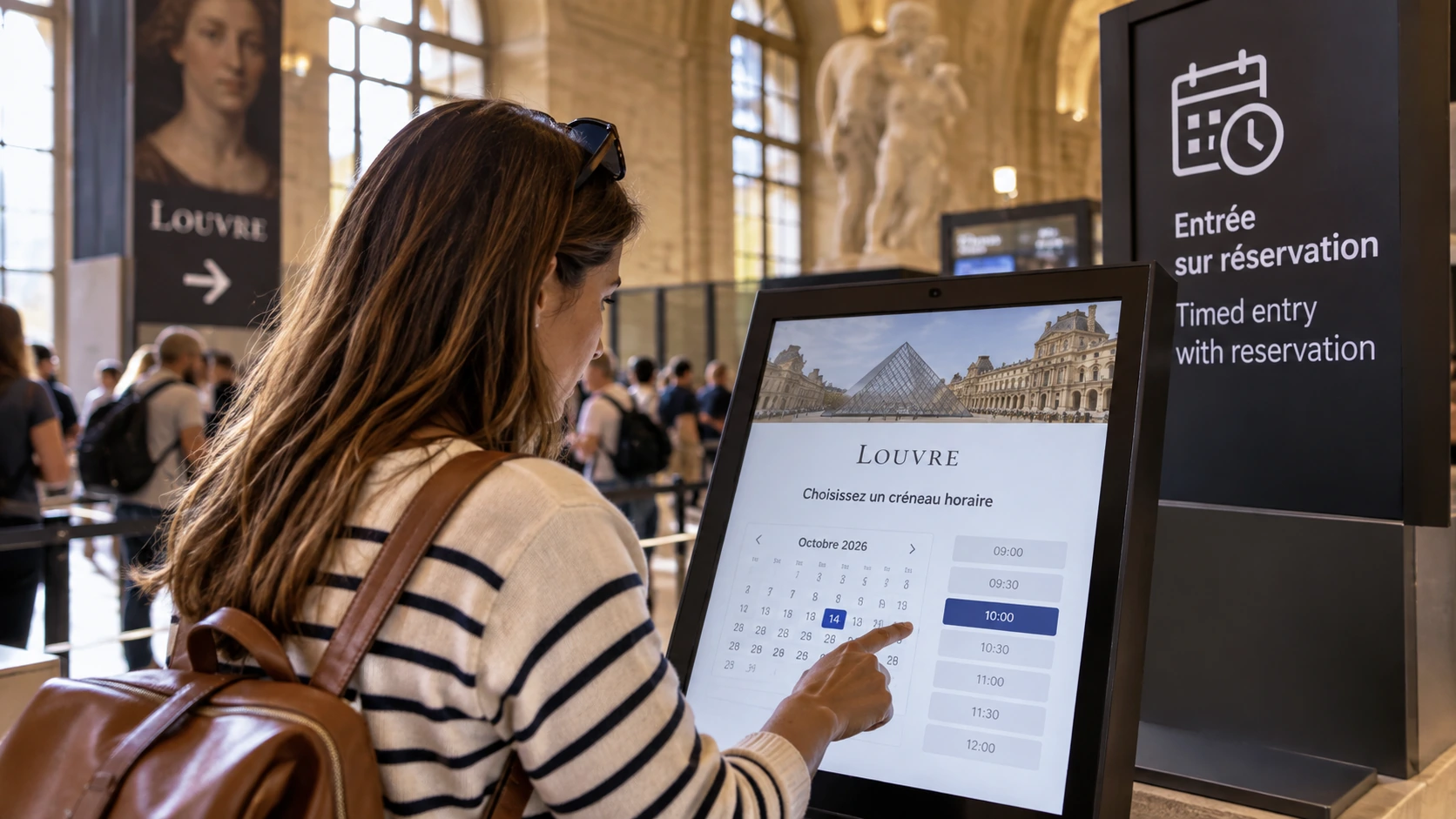
Some included sites require a separate free reservation even after you buy the Museum Pass. The official pass reservation system currently identifies major sites including the Louvre, Musée d’Orsay, Versailles, Sainte-Chapelle/Conciergerie, Musée de l’Orangerie, Hôtel de la Marine and the Notre-Dame towers as locations with reservation procedures for passholders.
The Louvre is the clearest example: the official pass site says that only a reserved time slot guarantees entry. Musée d’Orsay also requires timed reservations during its reception-area renovation period, which began March 10, 2026 and is currently expected to continue into summer 2028.
If the Louvre is the centerpiece of your trip rather than one stop among many, a guided Louvre visit with entry may solve a different need than a citywide museum pass: paying for help navigating one very large museum instead of paying for breadth. If you are still deciding whether paying for a guide is worth it at all, see Private Tour vs Group Tour for the broader tradeoffs around cost, flexibility and depth.
And “skip the ticket line” should not be read as “skip every line.” Security screening, capacity controls and site-specific access rules can still apply.
Families & Younger Travelers
Do not automatically buy the same pass for everyone in your group.
Many included museums and monuments are already free for visitors under 18. Many are also free for qualifying European Union nationals or residents under 26, subject to the individual site’s eligibility and proof requirements.
That means a family might buy passes for the adults while the children use free-admission eligibility. A mixed group can have completely different break-even points even when everyone follows the same itinerary.
Museum Pass vs Paris Sightseeing Passes
The right pass depends on whether you want museums, a few highlights, or a packed sightseeing schedule.
The official Paris Museum Pass is the cleanest benchmark when your priority is participating museums and monuments. Broader sightseeing passes solve a different problem: they bundle attractions and experiences beyond the official museum network.
Official Paris Museum Pass
Best for museums and monuments. Compare the pass price with the admission total for the sights already on your itinerary. It does not become a better value simply because a broader bundle includes more things.
Explorer-style pass
Best for a defined number of paid attractions. Some Explorer-style passes let travelers choose a fixed number of attractions rather than paying for consecutive sightseeing days.
All-Inclusive-style pass
Best for travelers planning several paid experiences per day. Some All-Inclusive-style passes include the Paris Museum Pass and add a wider selection of attractions and experiences.
What the sample math looks like in U.S. dollars
Current U.S.-dollar sample itineraries help illustrate the difference between the two models:
| Sample | Pass price | Walk-up total shown | Shown savings |
|---|---|---|---|
| Explorer Pass — 3 attractions | $96 | $130.95 | $34.95 |
| All-Inclusive Pass — 2 days | $228 | $322.91 | $94.91 |
The important question is not whether the sample itinerary shows a saving. It is whether those are attractions and experiences you would actually pay to visit independently. A pass can look valuable on paper while including things that would never have made your own Paris itinerary.
Compare current Paris sightseeing passes →
TFP Tip
Some sightseeing-pass sites let travelers switch currency, including to U.S. dollars, before comparing current pass prices. Product availability and pricing can vary by selected dates and trip length.
The Fine Print That Matters
The biggest risk is buying access before checking availability.
Reservations can still be required
Buying the pass does not create Louvre, Versailles or other timed reservations for you. Check the specific reservation process for your must-do attractions.
Availability is not guaranteed
High-demand time slots can sell out. The official pass site warns that being unable to obtain the reservation you want is not a reason for a pass refund.
One visit per included site
The pass generally provides one entry to each included museum or monument rather than unlimited repeat admission.
Temporary exhibitions are generally excluded
The pass is designed around permanent museum and monument admission; special or temporary exhibitions can require separate payment.
The pass is not refundable or exchangeable
That makes itinerary confidence and reservation availability worth checking before you buy.
Security lines can remain
Priority admission does not remove required security screening, capacity controls or every queue.
Versailles has its own exclusions
The pass does not necessarily include every garden or seasonal program component, so check Versailles-specific access for your date.
My Take
I would rather leave a few euros on the table than turn Paris into a race.
I like having an itinerary outline, but I do not want every hour predetermined. That makes the Museum Pass something I would calculate rather than automatically buy.
If four attractions I genuinely wanted to see already pushed the individual admission total above the 48-hour price, I would buy it. If I had to add a fourth attraction just to make the pass “pay for itself,” I would not.
I would also consider the 96-hour pass over the 48-hour version if the extra time produced a better trip, even if the theoretical savings were smaller. The goal is not to maximize admissions per euro; it is to pay less for the Paris trip you actually want.
TFP Recommendation
Price your must-do attractions first, then choose the shortest pass that fits them comfortably.
The Recommendation
Start with the museums and monuments you would pay to visit even if the Museum Pass did not exist. Add those admission prices, check the reservation availability for the highest-demand sights, then compare that real itinerary with the appropriate pass duration.
If individual tickets are cheaper, skip the pass. If the totals are close, choose based on convenience and pace rather than a tiny theoretical saving. If the pass clearly wins, buy it—but do not assume the reservations are solved until you have actually secured the required time slots.
Your Next Step
Check the current official pass details and reservation requirements for the attractions you consider non-negotiable. Then compare the purchase path or alternative that actually matches your itinerary.
Smarter travel, straight to your inbox
Booking choices, hidden costs, travel rules, and useful fine print — explained clearly.
Before You Go
Connect the Museum Pass decision with the rest of your Paris plan.
Where you stay, how you arrive, whether your phone is ready and what you do with your bags can all affect how easily you move between timed museum reservations and the rest of the city.

Where to Stay in Paris
Hotel geography can make early museum reservations and cross-city sightseeing much easier.
Compare Paris neighborhoods →Luggage Storage Paris
Timed-entry days are easier when bags are already handled, especially on arrival, departure or hotel-change days.
Plan your luggage strategy →Paris Airport Transfer
Compare taxi, transfer and public-transport options before tying museum reservations too closely to arrival day.
Compare Paris transfer options →Best eSIM for France
Mobile data helps keep timed reservations, maps, tickets and last-minute schedule changes available while sightseeing.
Compare France eSIM options →FAQ
Paris Museum Pass: common questions
How much is the Paris Museum Pass?
The current official prices are €85 for 48 hours (about $95), €105 for 96 hours (about $118), and €125 for 144 hours (about $140). Dollar amounts are approximate and vary with exchange rates and card conversion fees. You can also compare 2-, 4- and 6-day Museum Pass options before deciding where to buy.
When does the Paris Museum Pass start?
It activates when you first use it at an included museum or monument and then runs for 48, 96 or 144 consecutive hours rather than by calendar day.
Does the Paris Museum Pass include the Louvre?
Yes, but the pass alone does not guarantee Louvre entry. Passholders should reserve a timed entry slot in advance. If the Louvre is your main priority rather than one stop among many, compare a guided Louvre visit with entry instead.
Does the Paris Museum Pass include Versailles?
It includes participating Versailles admission, but a reservation is required and security screening still applies. Some garden or seasonal-program access can have separate rules.
Does the Paris Museum Pass let you skip the line?
It can remove the ticket-purchase step at participating sites, but it does not eliminate required reservations, security checks, capacity limits or every queue.
Is the Paris Museum Pass worth it for two days?
It can be, but the attractions matter more than the count. Louvre + Orsay + Arc de Triomphe currently total about €70, below the €85 48-hour pass. Add Sainte-Chapelle and the total becomes about €92, so the pass starts to save money. If you only plan one or two paid sights, compare individual Musée d’Orsay entry, a guided Louvre visit, or a Notre-Dame + Sainte-Chapelle experience before buying a broader pass.
Should children get a Paris Museum Pass?
Often no. Many included museums and monuments are already free for visitors under 18, so check the eligibility rules before buying a pass for a child. For families mixing free museum admission with other paid attractions, compare broader Paris sightseeing-pass options to see whether a different bundle makes more sense for the adults.
Can I visit the same museum twice with the pass?
The pass generally provides one entry to each included site rather than repeat admission to the same attraction.
Free Travel Guide
Avoid the travel mistakes that can cost you money, flexibility, or time.
Get 27 Travel Mistakes That Cost Travelers Thousands — a practical guide to booking mistakes, hidden costs, travel rules, and decisions worth understanding before they become a problem.
- Spot booking details that are easy to overlook
- Understand where hidden costs can appear
- Recognize when a cheaper option comes with a tradeoff
- Make travel decisions with fewer surprises
You’ll also receive occasional practical guidance from Travel Fine Print on booking choices, hidden costs, travel rules, and the fine print worth understanding. Unsubscribe anytime.