
A delayed flight can create a lot of confusion fast.
One traveler is asking for compensation. Another wants a hotel voucher. Someone else just wants to know whether the airline has to rebook them or give them a refund.
But those are not all the same thing.
A delayed flight does not automatically mean the airline owes you cash compensation. In many U.S. flight delay situations, the more realistic options are rebooking, a refund if the delay is significant and you choose not to travel, or airline-provided assistance such as meals or hotels depending on the airline, cause, and length of the delay.
That is why the real question is not just:
“My flight is delayed — what do I get?”
It is:
“Am I owed compensation, a refund, rebooking, or just airline assistance?”
This guide explains when airlines compensate passengers for delayed flights, when a refund may be available, when meal or hotel support may apply, and why the cause of the delay matters.
⚡ Quick Answer
Do airlines compensate you for delayed flights?
In the United States, airlines generally are not required to pay cash compensation just because a flight is delayed. That does not mean you have no options. Depending on the delay, you may be entitled to rebooking, a refund if the delay is significant and you choose not to travel, or airline-provided assistance such as meals or hotel accommodations.
The key is separating cash compensation from refunds, rebooking, and delay assistance. What you receive can depend on the cause of the delay, how long it lasts, whether you continue traveling, the airline’s commitments, and whether your trip falls under U.S., EU, UK, or other passenger-rights rules.
System Insight
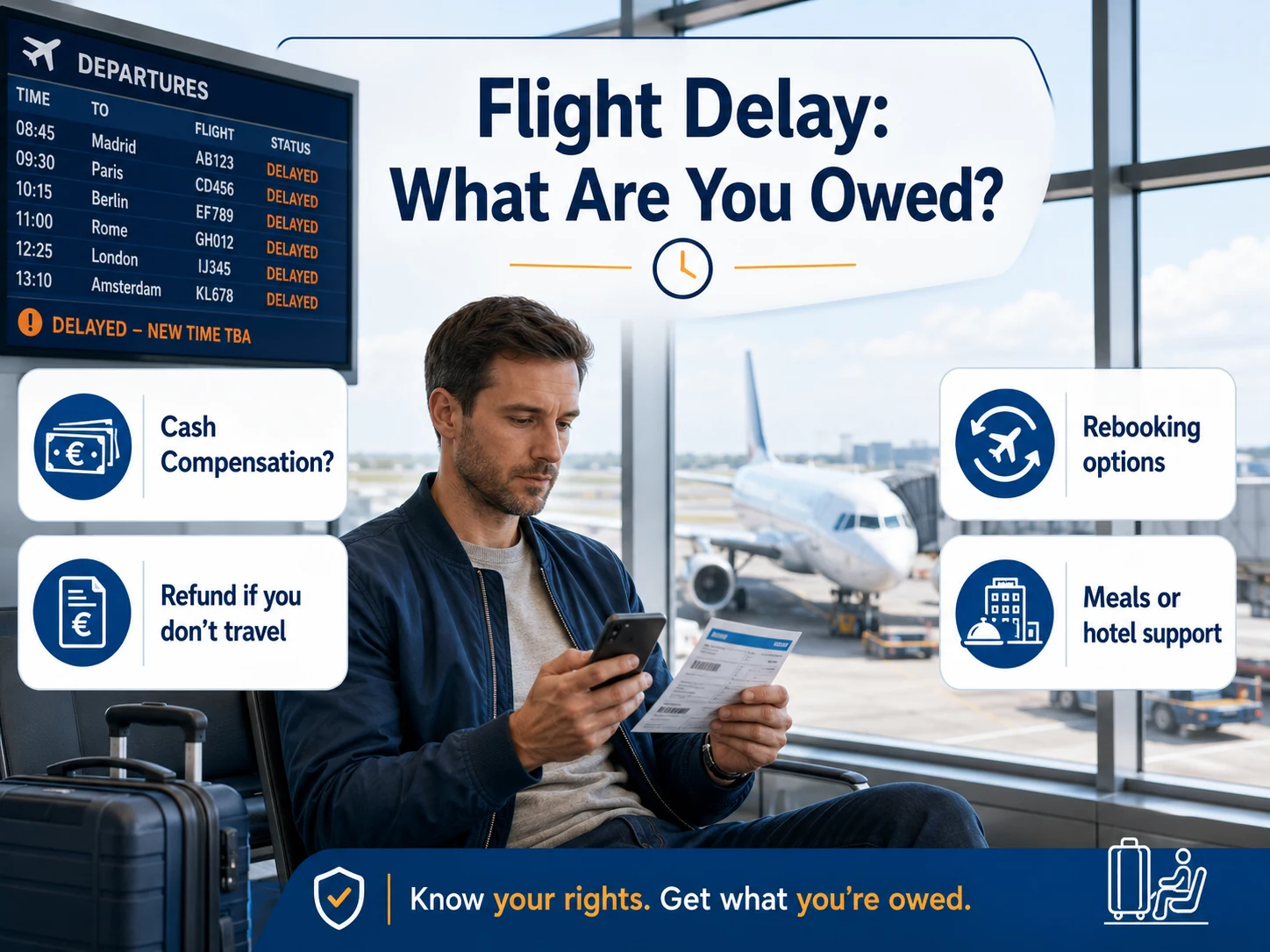
Flight delay compensation is not the same as a refund, rebooking, or hotel voucher.
- Cash compensation is limited because U.S. airlines usually do not owe money just because a flight is delayed.
- Refund rights are different because a significant delay may allow you to stop traveling and request money back instead.
- Rebooking is the most common solution because airlines usually try to move delayed passengers to a later option.
- Meals and hotels depend on the situation because assistance often depends on the airline, delay cause, and available options.
Why a Delayed Flight Does Not Always Mean Compensation
A delayed flight can create several possible outcomes, but they are not interchangeable.
Cash compensation means the airline pays you money because of the delay. A refund means you stop traveling and get money back for the unused ticket. Rebooking means the airline moves you to another flight. Assistance means the airline may provide meals, hotels, transportation, or vouchers while you wait.
Most confusion happens when travelers use the word compensation to mean all of those things.
But airlines, regulators, and policies treat them differently.
Delay Outcome Guide
Compensation vs Refund vs Rebooking vs Assistance
A delayed flight can lead to different outcomes. The key is knowing which one applies before you ask the airline for the wrong thing.
Money Paid Because of the Delay
Cash compensation is not automatic in many U.S. delay situations. It depends on the route, passenger-rights rules, airline policy, and cause of the delay.
Ask when: you want to know whether the airline owes you money beyond your ticket value.
Money Back If You Do Not Travel
A refund is different from compensation. It usually applies when the delay becomes significant and you choose not to take the rebooked or delayed flight.
Ask when: the trip no longer works and you want to stop traveling instead of being rebooked.
A Later Flight or New Routing
Rebooking is often the main way airlines handle delays. The airline may move you to a later flight based on available seats and routing options.
Ask when: you still want to travel and need the fastest workable replacement option.
Meals, Hotels, or Vouchers
Delay assistance may include meal vouchers, hotel rooms, ground transportation, or other support, but it often depends on the airline and delay cause.
Ask when: the delay is long, overnight, or caused by something within the airline’s control.
Quick rule: do not ask only, “Do I get compensated?” Ask whether your situation qualifies for cash compensation, refund, rebooking, or delay assistance.
U.S. Flight Delays vs EU and UK Compensation Rules
Not all delayed flights are handled under the same passenger-rights rules.
For many U.S. domestic itineraries, airlines generally are not required to pay cash compensation just because a flight is delayed. The more common outcomes are rebooking, refund eligibility if the delay becomes significant and you choose not to travel, or airline-provided assistance depending on the airline’s commitments and the situation.
International rules can be different. Under EU passenger-rights rules, some delayed travelers may qualify for compensation if they arrive at their final destination at least three hours late and the delay was not caused by extraordinary circumstances. UK passenger-rights guidance uses a similar concept: compensation may apply when the flight arrives more than three hours late and the airline was at fault.
This is why two travelers on delayed flights can have very different outcomes. One may only be offered rebooking or a voucher, while another may have a formal compensation claim depending on the route, airline, arrival delay, and cause of the disruption.
The safest question is not just:
“How long was my flight delayed?”
It is:
“Which passenger-rights rules apply to this flight?”
Why the Cause of the Delay Matters
The reason for the delay can affect what the airline is likely to offer.
A delay caused by the airline — such as a mechanical issue, crew problem, maintenance delay, aircraft swap, or operational issue — may lead to more support. That could include meal vouchers, hotel accommodations for overnight delays, or more flexible rebooking options, depending on the airline’s commitments and the situation.
A delay outside the airline’s control is different.
Weather, air traffic control restrictions, airport congestion, security disruptions, and other external issues usually make compensation or extra assistance less likely. The airline may still rebook you, but it may not cover the added costs that come with the delay.
That is why one of the first things to ask is:
“What is the official reason for the delay?”
The answer can shape whether you should ask for compensation, a refund, rebooking, a meal voucher, a hotel, or documentation for a travel insurance or credit card claim.
Delay Cause Guide
Controllable vs Uncontrollable Flight Delays
The airline’s responsibility can change depending on whether the delay was within the airline’s control or caused by outside conditions.
More likely to trigger assistance
When the delay is caused by the airline’s operation, support may be more likely, though not every outcome is guaranteed.
- Mechanical or maintenance problems
- Crew scheduling issues
- Aircraft swaps
- Operational delays
- Airline-controlled operational delay/li>
Less likely to include extra support
When the delay is caused by external conditions, the airline may still rebook you, but meals, hotels, or compensation may be less likely.
- Weather disruptions
- Air traffic control restrictions
- Airport congestion
- Security disruptions
- Widespread regional delays
Quick rule: ask for the official delay reason and save proof. The cause can affect airline assistance, refund decisions, and any claim you file later.
Are Meals, Hotels, and Vouchers the Same as Compensation?
Not exactly.
Meals, hotels, transportation, travel credits, or airline miles may feel like compensation, but they are usually better understood as delay assistance. The airline may offer them to help during a disruption, but that does not always mean the airline owes cash compensation for the delay itself.
This distinction matters because a traveler may receive a meal voucher or hotel room without being owed cash. Another traveler may receive a refund if the delay becomes significant and they choose not to travel, but not receive additional money for inconvenience.
The most useful question is:
“What kind of help is the airline offering — refund, rebooking, voucher, hotel, credit, miles, or compensation?”
That helps you avoid treating every offer as the same thing.
When Airlines May Provide Meals, Hotels, or Other Assistance
Airline assistance is more likely when the delay is long, within the airline’s control, and leaves passengers waiting for several hours or overnight.
Ask the airline what it will provide based on its customer service commitments.
Depending on the situation, that may include:
- meal vouchers
- hotel accommodations
- transportation to and from a hotel
- same-day rebooking
- standby options
- travel credits or miles
- reimbursement instructions
- written documentation of the delay reason
If the delay is caused by weather, air traffic control, airport conditions, or another issue outside the airline’s control, assistance may be more limited.
The safest move is to ask early and document the answer.
Traveler Risk
Assuming every delay creates compensation can make you ask for the wrong thing.
The risky assumption is thinking a delayed flight automatically means the airline owes you cash compensation.
In many delay situations, especially in the United States, the more realistic outcome may be rebooking, refund eligibility if the delay is significant and you choose not to travel, or airline assistance such as meals, hotels, transportation, credits, or vouchers.
Before asking for compensation, first identify what outcome actually applies: cash compensation, refund, rebooking, meal or hotel assistance, travel credit, or documentation for a claim.
Not Sure What To Ask the Airline For?
A delayed flight can create several possible paths.
You may need rebooking if you still want to travel, a refund if the delay is significant and the trip no longer works, a meal or hotel voucher if the delay is long and within the airline’s control, or documentation if you plan to file a travel insurance or credit card claim.
The key is to ask for the right outcome before your options narrow.
Check the Fine Print
Not sure whether your delay means compensation, refund, or rebooking?
Use the Travel Fine Print Risk Checker to narrow whether your issue is flight delay compensation, refund eligibility, rebooking, airline assistance, missed connection risk, hotel support, or documentation for a claim.
What To Ask the Airline During a Delay
When your flight is delayed, do not ask only whether you are “entitled to compensation.”
That question may be too broad.
Instead, ask specific questions that match the outcome you need: whether the airline will rebook you, whether the delay is significant enough to allow a refund if you do not travel, whether meals or hotels are available, and what the official delay reason is.
Action Step
Ask for the specific delay outcome you need.
During a delay, your options can change quickly. Ask clear questions so you know whether you are dealing with compensation, refund eligibility, rebooking, assistance, or documentation.
- Ask for the official reason for the delay.
- Ask whether the delay is within the airline’s control.
- Ask whether rebooking is automatic or whether you need agent help.
- Ask whether meal vouchers are available if the delay is long.
- Ask whether hotel support applies if the delay becomes overnight.
- Ask whether you can request a refund if you choose not to travel.
- Ask whether accepting a rebooking affects refund options.
- Save screenshots, receipts, delay notices, and airline responses.
Quick win: ask for the official delay reason in writing or in the airline app if possible. That detail can matter for refunds, vouchers, insurance claims, or credit card trip delay benefits.
Before You Rely on a Claim or Reimbursement
If the airline does not provide cash compensation, meals, hotels, or reimbursement, you may still have other possible paths through travel insurance, credit card trip delay benefits, or a later airline request.
But those options usually depend on documentation.
Do not rely only on memory or verbal promises at the gate. Save the delay reason, airline messages, receipts, rebooking details, boarding passes, and screenshots while the disruption is happening.
Before You Leave the Airport
Save proof of the delay, the cause, and what the airline offered.
Use the Travel Documents Checklist to save delay notices, airline messages, boarding passes, rebooking details, receipts, hotel or meal voucher details, and screenshots before you file a claim or request reimbursement.
When Travel Insurance or Credit Card Benefits May Matter
If the airline does not cover your extra costs, travel insurance or credit card trip delay benefits may be worth checking.
Those benefits are separate from airline compensation. They usually depend on the covered reason for the delay, how long the delay lasted, what expenses you paid, and whether you can provide documentation.
That is why receipts and written delay details matter. A meal, hotel, transportation, or overnight expense may be harder to recover later if you cannot show what happened, why it happened, and what you paid.
Travel Fine Print Takeaway
A delayed flight does not automatically mean cash compensation. Separate compensation from refunds, rebooking, meals, hotels, vouchers, and claim documentation. The right next step depends on the delay cause, how long it lasts, whether you still travel, and which passenger-rights rules apply.
❓Frequently Asked Questions
These questions explain when a delayed flight may lead to compensation, refund options, rebooking, meal vouchers, hotel support, or other airline assistance.
Do airlines compensate you for delayed flights?
Sometimes, but not always. In many U.S. delay situations, airlines are generally not required to pay cash compensation just because a flight is delayed.
You may still have options such as rebooking, a refund if the delay is significant and you choose not to travel, or airline assistance such as meals or hotels depending on the airline, delay cause, and length of the disruption.
How long does a flight have to be delayed for compensation?
It depends on where you are flying, which passenger-rights rules apply, and why the delay happened. In the U.S., a longer delay may affect refund or assistance options, but it does not automatically create a right to cash compensation.
For some EU or UK flights, compensation may depend on arrival delay, route, airline, and whether the delay was caused by circumstances outside the airline’s control.
Can I get a refund if my flight is delayed?
You may be able to get a refund if the delay is significant and you choose not to travel. A refund is different from compensation because it usually means getting money back for the unused ticket rather than receiving extra money for inconvenience.
Before accepting a rebooked flight, ask whether doing so affects your refund options.
Do airlines have to pay for hotels or meals during delays?
Not always, especially for U.S. delays. Some airlines may provide meal vouchers, hotel rooms, or transportation during long or overnight controllable delays based on their customer service commitments.
If the delay is caused by weather, air traffic control, airport issues, or other outside factors, assistance may be more limited. Ask the airline what its customer service commitments provide for your specific delay.
Does a weather delay qualify for compensation?
Usually, weather delays are treated differently from airline-controlled delays. Because weather is outside the airline’s control, cash compensation and extra assistance may be less likely.
The airline may still rebook you, but meals, hotels, or reimbursement may depend on the airline’s policy and the specific circumstances.
What should I ask the airline for during a delay?
Ask for the official delay reason, whether the delay is within the airline’s control, whether rebooking is available, whether meal or hotel assistance applies, and whether you can request a refund if you choose not to travel.
Also save screenshots, receipts, boarding passes, airline messages, and delay notices in case you later need to request reimbursement, file a travel insurance claim, or use credit card trip delay benefits.
Bottom Line
A delayed flight does not automatically mean the airline owes you cash compensation.
The more realistic question is what type of outcome applies: compensation, refund, rebooking, assistance, or documentation for a claim.
In many U.S. delay situations, airlines are generally focused on getting you to your destination or giving you a refund option if the delay becomes significant and you choose not to travel. Meals, hotels, vouchers, credits, or miles may be offered in some situations, but they are not the same as guaranteed cash compensation.
The cause of the delay matters too.
Airline-controlled delays may lead to more assistance. Weather, air traffic control, airport congestion, security disruptions, and other outside issues can limit what the airline is likely to provide.
Before you assume you are owed compensation, ask what category your situation falls into. Then save proof of the delay, the cause, what the airline offered, and any expenses you paid.
That documentation may matter later if you request a refund, ask for reimbursement, file a travel insurance claim, or use credit card trip delay benefits.
Related Guides
If you are trying to understand what an airline owes you after a delay, these related guides can help you separate refunds, credits, rebooking, hotel support, insurance claims, and documentation.
Flight Delays, Cancellations, and Airline Support
- Flight Canceled: Refund or Credit?
Helpful if the disruption becomes a cancellation and you need to understand refund vs credit options. - Overnight Flight Delay Hotel Voucher
Use this if a long delay leaves you stranded overnight and you want to know when hotel support may apply. - What Happens If You Miss Your Flight?
Helpful if a delay causes you to miss a flight and you need to understand rebooking, no-show, and ticket-value risks. - Does Travel Insurance Cover Flight Delays?
See when trip-delay benefits may reimburse meals, lodging, transportation, and other costs—and which waiting periods, limits, and claim requirements apply.
Refunds, Credits, and Ticket Value
- Airline Refund vs Travel Credit: What’s the Difference?
Helpful if the airline offers credit instead of money back after a delay, cancellation, or itinerary change. - Non-Refundable Flights: What Travelers Should Know Before Booking
Use this if your delay affects a restrictive fare and you need to understand credit, change, and refund limits. - Why the Checkout Price Isn’t Always the Final Travel Cost
Helpful if rebooking creates new costs, fare differences, baggage fees, seat charges, or extra expenses.
Travel Insurance and Documentation
- Travel Insurance Claim Proof: What Documents You May Need
Helpful if you need records showing the delay reason, airline response, receipts, or extra expenses. - Travel Insurance Claim Denied for Lack of Documentation
Use this if you are relying on a claim and need to avoid missing proof, receipts, or airline confirmation. - Why Travel Insurance Claims Get Denied
Helpful if you are expecting insurance to cover delay-related costs but need to understand common claim problems.