
You canceled a booking, changed part of a trip, checked out early, or received a refund notice — but the amount was smaller than you expected.
That can feel confusing because travelers often think of a booking as one total price.
You paid one amount. So it feels like the refund should be based on that same amount.
But travel refunds are rarely that simple.
A flight, hotel stay, package, or add-on can include a base price, taxes, fees, penalties, used portions, non-refundable charges, service fees, credits, and extras that may all follow different rules.
That is where many travelers get stuck.
A partial refund does not always mean the company made a mistake. It may mean only certain parts of the booking qualified for money back.
The real question is not just:
“Why didn’t I get a full refund?”
It is:
“Which parts of my booking were refundable, which parts were deducted, and which parts were never eligible to come back?”
This guide explains why partial travel refunds happen, what may be deducted, what may still be refundable, and what to ask before canceling, accepting a credit, or assuming the refund amount is correct.
Quick Answer
Why did I only get a partial travel refund?
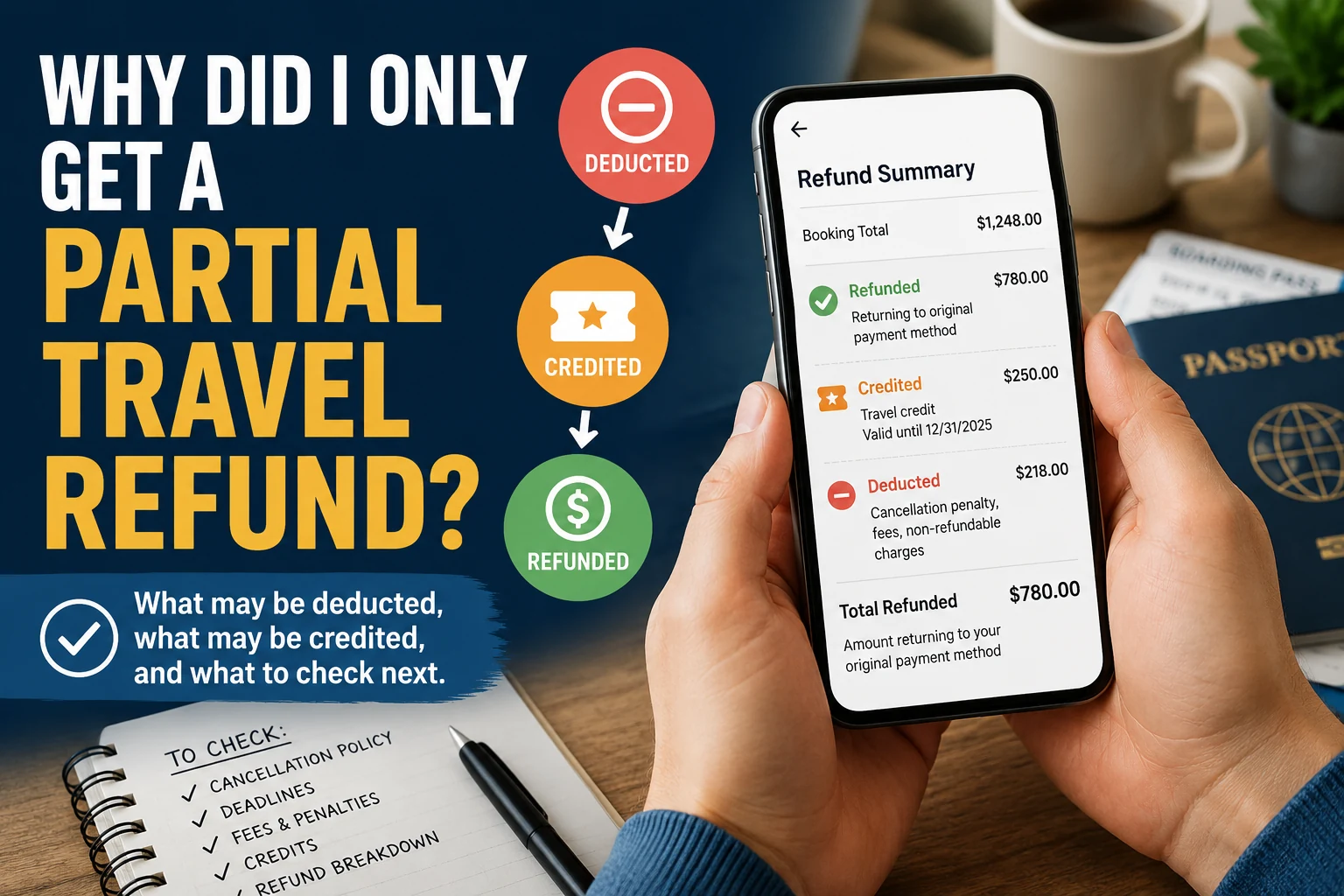
You usually receive a partial travel refund when only some parts of your booking qualify for money back. The final refund may be reduced by cancellation penalties, non-refundable rates, used nights or flight segments, service fees, booking fees, excluded add-ons, or provider-specific rules.
A partial refund does not always mean the refund was wrong. It often means the provider separated the booking into refundable and non-refundable parts. Before accepting the amount as final, ask for a breakdown showing what was refunded, what was deducted, and why.
System Insight
Partial refunds happen because travel bookings are calculated in pieces, not as one simple total.
- The base price matters because discounted, prepaid, or non-refundable rates may limit what comes back.
- The timing matters because canceling after a deadline can trigger penalties or reduce the refund.
- The used portion matters because nights, segments, services, or add-ons already used are usually deducted.
- The fees matter because booking fees, service fees, and cancellation charges may not be refundable.
- The refund method matters because part of the value may return as cash, while another part may become travel credit.
What a Partial Travel Refund Actually Means
A partial travel refund means you are getting back only the portion of the booking that still qualifies for a refund.
That amount may be much lower than the total you paid.
This happens because travel companies often do not treat a booking as one single refundable amount. They separate the reservation into parts, then apply the rules to each part.
For example, a hotel may refund unused nights but keep a one-night cancellation penalty. An airline may keep the base fare but return certain taxes or issue part of the value as credit. A tour company may refund the activity cost but keep a booking or service fee.
That is why the refund amount can feel random, even when it follows the policy.
The better question is not only:
“How much did I pay?”
It is:
“Which parts of what I paid are still eligible to come back?”
The current page already makes this point well: partial refunds often happen because penalties, non-refundable portions, unused services, taxes, and fees are treated differently.
Why Your Refund Was Less Than Expected
A partial refund usually happens because one or more deductions were applied before the refund was issued.
The most common reasons include:
- You canceled after the free cancellation deadline.
- A one-night, percentage, or flat cancellation penalty applied.
- The rate was prepaid, discounted, or non-refundable.
- Part of the trip was already used.
- Service fees or booking fees were excluded.
- Taxes or fees were handled separately from the base price.
- Add-ons, seats, bags, upgrades, or extras had different refund rules.
- The provider issued part of the value as travel credit instead of cash.
- You booked through a third party with its own fee or policy.
This is why two travelers can cancel similar bookings and receive very different refund amounts.
The final refund is based on the refund rules attached to each part of the booking — not just the total charge on your receipt.
Refund Outcomes Compared
Full Refund vs Partial Refund vs No Refund vs Travel Credit
The refund outcome depends on timing, rate type, provider rules, used portions, penalties, and whether the value comes back as cash or credit.
Most or all of the payment returns.
Most common when you cancel within the free cancellation window, booked a refundable rate, or the provider caused the change.
Some money comes back, but deductions apply.
Common when penalties, used portions, non-refundable charges, service fees, or excluded add-ons reduce the refund.
No cash is returned.
Often tied to strict non-refundable rates, missed deadlines, no-shows, fully used services, or rules that exclude refund eligibility.
Value stays with the provider.
Instead of cash, part of the booking may stay with the provider as credit, voucher value, or future-use balance. This can preserve some value, but it also keeps your money tied to that airline, hotel, tour company, or booking platform.
Quick rule: a partial refund is not just a smaller refund. It is a refund after the provider subtracts anything that the policy says is used, penalized, excluded, credited, or non-refundable.
Why Part of Your Refund May Become Travel Credit Instead of Cash
Sometimes a partial refund does not mean all eligible value comes back to your original payment method.
Part of it may be kept on file as a travel credit, voucher, future stay credit, airline credit, or reusable balance.
That can happen when the provider wants to preserve the value of the booking without issuing a full cash refund. For hotels, this may look like keeping a non-refundable deposit on file for a future stay. For airlines, it may look like converting unused ticket value into credit. For tours, packages, or activities, it may look like offering a voucher instead of returning the full amount to your card.
From the traveler’s perspective, this can be confusing because the money is not gone — but it is also not fully back in your control.
A credit may still have value, but it usually comes with conditions, such as:
- Expiration dates
- Rebooking deadlines
- Same-provider restrictions
- Same-traveler restrictions
- Limited property, route, or destination options
- Fare or rate differences
- Non-transferable value
- Rules about whether the credit can be combined with promotions
That is why a credit is not the same as a refund.
A refund gives you money back. A credit keeps value tied to the travel provider.
Before accepting a partial refund with credit, ask:
“How much is coming back to my card, how much is staying on file as credit, when does the credit expire, and what restrictions apply?”
What Parts of a Booking May Still Be Refundable
A partial refund usually makes more sense once you separate the booking into parts.
The total charge on your receipt may look like one amount, but the provider may treat each piece differently when calculating the refund.
Some parts are more likely to be refundable. Others may be deducted, retained, converted to credit, or excluded entirely.
Common pieces to check include:
- Base fare or base rate — often the most restricted part, especially with non-refundable flights, prepaid hotels, discounted rates, or special promotions.
- Taxes and government fees — sometimes refundable if the service was not used, though they may need to be requested separately.
- Unused nights or trip segments — may be refundable if only part of the trip was used, depending on the policy.
- Cancellation penalties — may reduce the refund before anything is returned.
- Service or booking fees — often retained even when part of the booking is refunded.
- Add-ons and extras — seats, bags, upgrades, resort fees, transfers, activities, or prepaid services may follow separate rules.
- Travel credits or vouchers — part of the value may stay with the provider instead of returning to your original payment method.
This is why the amount returned can feel smaller than expected.
A partial refund is usually not based on what feels fair. It is based on which parts of the booking the policy still treats as refundable.
The current page already explains this core issue well: travel providers may return certain portions, such as taxes or unused services, while keeping penalties, fees, used portions, or non-refundable charges.
Traveler Risk
Accepting a partial refund without a breakdown can hide what was deducted.
The risk is assuming the refund amount is correct just because the provider issued it. A partial refund may be accurate, but it may also hide penalties, retained fees, excluded add-ons, missing taxes, or value converted to credit instead of cash.
Before accepting the amount as final, ask for a line-by-line explanation showing what was refunded to your original payment method, what was deducted, what stayed on file as credit, and what policy was used to calculate the final amount. A credit may preserve some value, but it also keeps that value tied to the provider instead of returning cash to you.
Check the Fine Print
Not sure why your travel refund was smaller than expected?
The Travel Fine Print Risk Checker can help you sort the issue: cancellation penalty, non-refundable rate, unused service, travel credit, service fee, taxes, add-ons, third-party booking, or documentation problem.
❓Frequently Asked Questions
These questions explain why partial travel refunds happen, what may be deducted, when value may stay with the provider as credit, and how to check whether the refund amount makes sense.
Why did I only get a partial travel refund?
You usually receive a partial travel refund because only some parts of your booking were eligible to come back as cash. The provider may have deducted a cancellation penalty, non-refundable rate portion, used nights, used flight segments, service fees, booking fees, or excluded add-ons.
A partial refund can also happen when part of the value is kept on file as travel credit instead of being returned to your original payment method. Ask for a breakdown showing what was refunded, what was deducted, what became credit, and which policy was used to calculate the final amount.
Does a partial refund mean the company made a mistake?
Not always. A partial refund may be correct if the booking policy allows only certain portions to be returned.
But you should still verify the calculation. Check whether taxes, unused services, refundable add-ons, eligible credits, or unused portions were included correctly before accepting the amount as final.
What parts of a travel booking are often refundable?
Refundable portions may include unused nights, unused flight segments, certain taxes or government fees, eligible add-ons, unused services, or amounts covered by a flexible cancellation policy.
The exact answer depends on the provider, booking channel, rate type, cancellation timing, and whether part of the trip was already used.
Why were fees or penalties deducted from my refund?
Fees or penalties may be deducted if you canceled after the free cancellation deadline, booked a non-refundable or discounted rate, used part of the trip, booked through a third party, or agreed to terms that excluded certain charges from refunds.
Ask which specific fee or penalty was applied and where it appears in the cancellation policy.
Why did part of my refund become travel credit instead of cash?
Some travel providers issue part of the value as credit instead of returning everything to your original payment method. This may happen when a booking has non-refundable terms, when a deposit is kept on file, or when the provider allows future use instead of a cash refund.
A credit can still be useful, but it is not the same as cash. Check the expiration date, booking restrictions, transfer rules, eligible hotels, routes, or services, and whether rate or fare differences will apply when you use it.
Can I ask for cash instead of travel credit?
You can ask, but whether the provider has to issue cash depends on the booking terms, cancellation reason, provider policy, and whether any refund rights apply.
If the provider is offering credit instead of cash, ask whether the credit is optional, whether any portion can be refunded to your original payment method, and whether accepting the credit closes any other refund option.
Before You Accept the Refund
Save the Policy, Refund Screen, and Breakdown
Partial refunds can be hard to challenge without proof. Save the cancellation policy, original receipt, itemized charges, refund notice, provider messages, credit terms, screenshots, and any explanation showing why part of the booking was deducted or retained.
❓Frequently Asked Questions
These questions explain why partial travel refunds happen, what may be deducted, and how to check whether the amount you received makes sense.
Why did I only get a partial travel refund?
You usually receive a partial travel refund because only some parts of your booking were refundable. The provider may have deducted a cancellation penalty, non-refundable rate portion, used nights, used flight segments, service fees, booking fees, or excluded add-ons.
Ask for a breakdown showing what was refunded, what was deducted, and which policy was used to calculate the final amount.
Does a partial refund mean the company made a mistake?
Not always. A partial refund may be correct if the booking policy allows only certain portions to be returned.
But you should still verify the calculation. Check whether taxes, unused services, refundable add-ons, or eligible credits were included correctly before accepting the amount as final.
What parts of a travel booking are often refundable?
Refundable portions may include unused nights, unused flight segments, certain taxes or government fees, eligible add-ons, unused services, or amounts covered by a flexible cancellation policy.
The exact answer depends on the provider, booking channel, rate type, cancellation timing, and whether part of the trip was already used.
Why were fees or penalties deducted from my refund?
Fees or penalties may be deducted if you canceled after the free cancellation deadline, booked a non-refundable or discounted rate, used part of the trip, booked through a third party, or agreed to terms that excluded certain charges from refunds.
Ask which specific fee or penalty was applied and where it appears in the cancellation policy.
Can part of my refund become travel credit instead of cash?
Yes. Some providers return part of the value as a travel credit, voucher, e-credit, or future-use balance instead of refunding everything to your original payment method.
Before accepting the credit, check the expiration date, traveler restrictions, booking rules, transfer limits, and whether accepting the credit affects any cash refund option.
Bottom Line
A partial travel refund means some of your money is coming back, but not everything you paid qualifies.
That usually happens because the booking is split into parts. The provider may treat the base rate, taxes, fees, penalties, used portions, add-ons, credits, and non-refundable charges differently.
The refund may be lower than expected because one or more parts were deducted, retained, excluded, used, or converted into travel credit.
Before accepting the amount as final, ask for the refund breakdown.
You want to know:
- What returned to your original payment method
- What became travel credit or voucher value
- What was deducted as a penalty
- What was considered non-refundable
- What taxes, fees, services, or add-ons were reviewed separately
- What policy or deadline was used to calculate the refund
The mistake is judging the refund only against the total amount you paid.
The smarter move is to compare the refund against the parts of the booking that were actually eligible to come back.
Related Guides
Partial refunds often connect to cancellation penalties, travel credits, non-refundable bookings, refund timelines, and documentation. These guides help travelers understand why the amount returned may be less than expected.
Refunds and Credits
- Airline Refund vs Travel Credit: What’s the Difference? — Helps travelers understand when money may come back as cash versus credit or voucher value.
- Why Do Travel Credits Expire? — Useful when part of the refund becomes future travel value instead of returning to the original payment method.
Non-Refundable Bookings
- Can You Get Money Back From a Non-Refundable Flight? — Explains when a non-refundable flight may still have value through credit, taxes, fees, add-ons, insurance, or card benefits.
- What Happens If You Cancel a Non-Refundable Hotel Booking? — Useful when hotel penalties, prepaid rates, or unused nights affect how much money comes back.
Documentation and Timing
- Travel Insurance Claim Proof: What Documents You May Need — Helps travelers understand what proof to save when a partial refund may need to support an insurance or card-benefit claim.