
Organized Tours and Booking Platforms
TourRadar Review: Should You Book Through TourRadar or Direct?
TourRadar brings organized tours from many operators into one place, making it easier to compare itineraries, departure dates, prices, reviews, and trip options before deciding where to book.
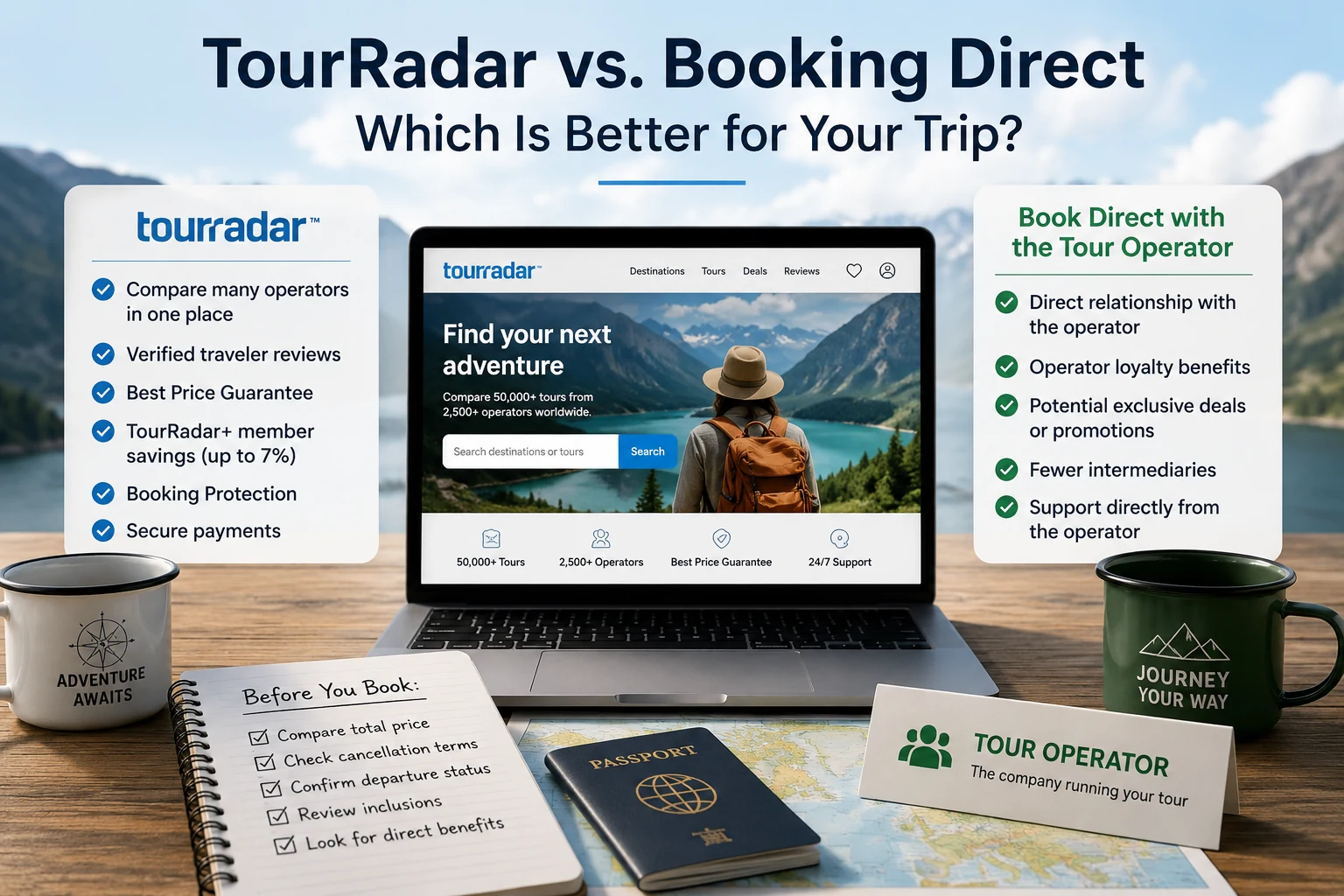
For some trips, booking through TourRadar may offer added convenience, support, or marketplace pricing. For others, booking directly with the tour operator may make more sense. The key is to compare the same trip on both sides and look beyond the headline price.
Before You Book
Compare the details that can change the decision
- Match the exact trip. Compare the same itinerary, departure date, room or accommodation type, and tour operator.
- Compare the final price. Look at the total cost on both sides, including any promotions, discounts, fees, or included extras.
- Check the booking terms. Compare cancellation rules, payment requirements, support, protections, and any benefits offered by each booking channel.
- Confirm the departure details. Check whether your booking is confirmed and whether the tour itself is guaranteed to operate.
There is no automatic winner. The better option depends on the specific tour, price, terms, and support available when you book.
About This Guidance: Travel Fine Print reviewed TourRadar’s marketplace terms, booking protections, cancellation rules, operator responsibilities, and departure-status guidance to evaluate the practical differences between booking through TourRadar and booking through the company operating the tour. The focus is not on rating every tour operator or itinerary, but on the fine print that can change your cost, flexibility, protection, and options if something changes after you book.

How It Works
TourRadar Lets You Compare and Book Tours From Many Operators in One Place
TourRadar brings organized trips from many different tour operators into one marketplace. Instead of researching each company separately, travelers can compare itineraries, departure dates, prices, reviews, and available options before choosing the trip that best fits their plans.
Search & Compare
Compare trips from multiple operators by destination, travel style, dates, price, ratings, itinerary, and included experiences.
Choose Your Tour
Review the operator, itinerary, available departure dates, booking details, and important terms attached to the specific trip you are considering.
Book Through TourRadar
Complete the reservation through TourRadar. Some departures confirm immediately, while others require the operator to confirm availability.
Travel With the Operator
The selected tour operator delivers the actual trip, while TourRadar remains the marketplace through which you booked and provides an additional booking and support layer.
Why this matters: TourRadar can simplify the shopping process by letting you compare multiple operators without visiting each company separately. Before booking, review the terms attached to the specific operator and departure you choose so you can compare the full value—not just the headline tour price.
What Does TourRadar Add to the Booking?
TourRadar’s value is that it lets you compare and book trips from many operators through one marketplace. Once you find a tour you want, the real decision is whether TourRadar or the operator’s own booking channel gives you the better combination of price, benefits, terms, and support.
TourRadar Handles the Marketplace Experience; the Tour Operator Delivers the Trip
This structure is part of what gives TourRadar its value. You can search and compare trips from many different operators through one marketplace, complete the booking through TourRadar, and have an additional booking and support layer around the reservation.
The selected tour operator still delivers the itinerary and controls many of the trip-specific terms. That means the smartest comparison is not simply “TourRadar versus the operator.” It is booking the same trip through TourRadar versus booking it through the operator’s own channel and deciding which gives you the better overall combination of price, benefits, terms, and support.
Is It Cheaper to Book Through TourRadar or Direct?
TourRadar says the price of a specific tour should generally be the same as booking that tour directly with the operator. But that does not necessarily mean the final amount you see at checkout will always be identical on both channels.
TourRadar has its own savings program, TourRadar+, which is free for account holders. Depending on your booking history and the tour you choose, eligible bookings may receive an additional TourRadar+ discount. Some operators may also have their own discounts already reflected on TourRadar, and those savings can sometimes be combined.
The operator’s own website may have a different promotion, loyalty benefit, or direct-booking offer. That is why the most useful comparison is not the published starting price. Compare the final price for the same tour, departure date, accommodation selection, number of travelers, and included services.
TourRadar also offers a Best Price Guarantee, but the competing offer needs to match the same operator, tour, dates, passengers, inclusions, booking terms, cancellation terms, and currency. That makes it important to compare truly equivalent offers rather than two prices that only appear similar.
Compare Before You Book
Found a Tour You Like? Check the TourRadar Offer Before You Pay
Once you know the exact tour, operator, and departure you want, check how that trip is being offered through TourRadar. Compare the total price, included benefits, payment terms, cancellation rules, and booking support with the operator’s direct offer.
Check the Marketplace
See the TourRadar side of the comparison
Find your tour on TourRadar, note the current price and terms, then compare them with booking directly through the operator.
Check Tours on TourRadar →Opens TourRadar in a new tab
5 Things to Check Before Booking Through TourRadar
TourRadar can simplify the process of finding and comparing organized tours, but the details can vary significantly from one trip to another. Before booking, review the terms attached to the specific operator and departure you choose rather than assuming every TourRadar reservation works the same way.
1. Check Which Company Is Operating the Tour
TourRadar is the marketplace you use to search and book, while the company identified as the tour operator is responsible for delivering the actual trip.
That matters because two tours listed side by side on TourRadar may have very different hotel standards, group sizes, included meals, optional activities, cancellation rules, and operating practices.
Before booking, look beyond the overall TourRadar listing and review the operator name, itinerary, inclusions, recent traveler feedback, and any operator-specific terms.
2. Read the Cancellation Terms for the Specific Operator
There is not one universal cancellation policy covering every TourRadar trip.
Cancellation and payment conditions can depend on the tour operator, the itinerary, the departure date, and how close you are to travel when you cancel. A trip that allows relatively flexible cancellation several months in advance may become partially or fully nonrefundable as departure approaches.
Do not rely only on a general statement that a booking is “flexible.” Check the actual cancellation schedule attached to the trip before paying a deposit or final balance.
3. Check Whether the Departure Is Guaranteed
A confirmed reservation and a guaranteed departure answer two different questions.
A confirmed booking generally tells you that your reservation has been accepted. A guaranteed departure tells you that the operator has committed to running that departure under the stated conditions.
Some organized tours require a minimum number of travelers before the departure is guaranteed.
This becomes especially important if you are also purchasing expensive airfare, arranging additional hotel nights, or making other nonrefundable travel plans around the tour.
4. Understand What TourRadar Booking Protection Adds
TourRadar provides an additional support and booking-protection layer when you reserve through its marketplace. That can be a meaningful advantage when compared with simply discovering an operator and completing the transaction elsewhere.
But Booking Protection should not be confused with travel insurance.
Its role is tied to the TourRadar booking and issues involving the marketplace or operator, while travel insurance may address an entirely different set of personal and trip-related risks depending on the policy.
The useful question is not simply whether protection exists, but what situation you expect it to protect you from.
5. Check Whether Your Booking Is Instant or Requires Confirmation
Not every TourRadar listing necessarily confirms in exactly the same way.
Some trips can be confirmed immediately. Others may require the tour operator to verify availability before the reservation becomes fully confirmed.
If your booking is still awaiting operator confirmation, avoid treating the trip as final simply because you submitted the reservation request.
Wait for the confirmation details and review the departure status before committing to other expensive arrangements that depend on the tour operating as planned.
What These Checks Are Really Doing
None of these points means booking through TourRadar is unusually risky. They reflect how a marketplace containing thousands of trips from many different operators naturally works.
The advantage is choice and comparison in one place.
The tradeoff is that you still need to evaluate the terms of the particular trip you choose.
System Insight
Confirmed Booking and Guaranteed Departure Are Not the Same Thing
- Confirmed booking: Your reservation has been accepted and your place on the tour is secured.
- Guaranteed departure: The departure has been confirmed to operate regardless of how many travelers have booked.
- Some operators use minimum traveler requirements: A confirmed reservation may therefore exist before the departure reaches guaranteed status.
- Check before making nonrefundable plans: If expensive flights, hotels, or other arrangements depend on the tour operating, verify the departure status first.
When Does Booking Through TourRadar Make the Most Sense?
TourRadar tends to add the most value when you are still comparing operators or when its price is close to booking direct. In those cases, the convenience of comparing trips in one place—along with Booking Protection, support, and available savings—can make the marketplace the stronger overall offer.
Booking direct deserves a closer look when the operator offers a materially better price, a valuable direct-only benefit, or benefits tied to an existing relationship with that operator.
Booking Channel Guide
When TourRadar May Offer the Better Value
No single booking channel wins every time. These are the situations where TourRadar’s marketplace model is most likely to add something meaningful.
You’re Comparing Several Operators
TourRadar lets you compare different tour companies, itineraries, dates, prices, and traveler feedback without researching every operator separately.
The Prices Are Similar
When the same tour costs roughly the same through both channels, TourRadar’s marketplace benefits can become an important part of the comparison.
You Value an Extra Support Layer
Booking through the marketplace gives you TourRadar’s support and Booking Protection in addition to the company actually operating your trip.
You Want a Simpler Search Process
A marketplace can be especially useful when you know the destination or travel style you want but have not yet decided which company should operate the trip.
The Overall Value Beats Booking Direct
Price matters, but so do savings, support, protection, convenience, cancellation terms, and any benefits offered by either booking channel.
If you are still deciding what kind of organized trip you want, start with our Small Group Tour vs Large Group Tour guide. And if you are not yet sure whether an organized tour is the right format at all, compare Guided Tour vs Independent Travel before choosing a booking platform.
When Booking Direct May Make More Sense
TourRadar can add real value, but there are situations where booking through the tour operator’s own website may be the better choice.
The clearest example is price. TourRadar says the specific tour price should be the same as booking directly with the operator, but an operator may still offer its own promotion, loyalty benefit, credit, or booking incentive that changes the overall value.
Booking direct may also appeal to travelers who already know exactly which operator they want to use. If you are no longer comparing companies or itineraries, some of TourRadar’s biggest marketplace advantages—discovery and side-by-side comparison—become less important.
A direct booking can also make sense when the operator offers a benefit you cannot receive through TourRadar, such as a loyalty perk, repeat-guest incentive, exclusive promotion, or a more favorable payment or cancellation term.
Finally, some travelers simply prefer having the entire commercial relationship with the company operating the trip. TourRadar remains an additional support layer when you book through its marketplace, but the underlying operator is still responsible for delivering the tour itself.
Do not assume booking direct is automatically cheaper or better. Compare the same tour, departure, inclusions, terms, and final price on both channels. If the offers are close, TourRadar’s Booking Protection, support, convenience, and available savings may give it the stronger overall value—unless the operator offers a meaningful direct-only benefit.
Is TourRadar Legit and Safe to Book With?
Yes. TourRadar is a legitimate, established booking platform for organized multi-day tours. The company was founded in 2010 and currently says its marketplace connects travelers with more than 2,500 tour operators offering more than 50,000 trips in over 160 countries. TourRadar also provides 24/7 customer support around the booking experience.
TourRadar also handles payments through its platform, provides direct messaging with operators, and includes Booking Protection with TourRadar reservations. The company says it screens operators before allowing them onto the marketplace, although the individual operator—not TourRadar—still delivers the actual trip.
Independent customer feedback is also substantial. As of August 2026, TourRadar has more than 10,000 reviews on Trustpilot and a 4.5 out of 5 TrustScore. Recent feedback is generally positive about the ease of booking, customer support, and the ability to communicate with operators, although reviews also show that individual experiences and trip details can vary.
Legitimate Platform Does Not Mean Every Tour Is Identical
This is the distinction that matters most when evaluating TourRadar.
TourRadar itself can be legitimate and trustworthy while the quality, accommodations, itinerary, guide experience, cancellation terms, and operating standards differ substantially from one tour operator to another. TourRadar currently lists more than 2,500 operators, so you should evaluate the company actually running the trip in addition to evaluating the marketplace.
That is also why traveler reviews on TourRadar can be particularly useful. Look for reviews of the specific operator and tour you are considering, not simply opinions about TourRadar as a booking website.
What Extra Protection Does TourRadar Add?
Booking through TourRadar gives you several layers that you would not necessarily have if you found an unfamiliar operator online and dealt with it entirely on your own.
TourRadar handles the payment process, provides a platform for communicating with the operator, offers 24/7 support, and includes Booking Protection. If an operator goes out of business, TourRadar currently says it will provide either a full refund or an alternative trip.
Those protections do not eliminate the need to read the operator’s terms. Cancellation policies still vary by operator, and TourRadar specifically directs travelers to review the applicable policy for the individual trip before booking.
TourRadar is a legitimate booking marketplace, and its third-party role is not automatically a disadvantage. The platform can add useful comparison, payment, support, and Booking Protection benefits around the trip you choose. The more important decision is whether the specific tour operator, itinerary, departure, price, and terms work for you. Review the operator’s recent feedback, cancellation rules, departure status, and final price before booking. If those details check out, TourRadar can be a practical—and sometimes better-value—way to book the trip.
TourRadar Booking Questions
Frequently Asked Questions
These are some of the most important details to understand when deciding whether to book an organized tour through TourRadar or directly with the tour operator.
Does TourRadar charge a booking fee?
TourRadar states that it does not charge travelers a separate booking fee. Its current tour listings also state that TourRadar does not add an extra fee for supported payment methods.
You should still compare the final price for the exact tour and departure you want, including any operator promotions or TourRadar+ savings available at the time of booking.
Can you cancel a TourRadar booking?
Yes, but the cancellation policy depends largely on the tour operator and the specific booking terms. Cancellation fees may increase as the departure date approaches, and some bookings can become partially or fully nonrefundable.
TourRadar lets travelers request a cancellation through the Booking Conversation Page. Review the operator’s cancellation schedule before booking rather than assuming every TourRadar trip has the same flexibility.
Is TourRadar more expensive than booking directly?
TourRadar says the price of the specific tour should be the same as booking directly with the operator. However, the final value can still differ because TourRadar and the operator may offer different promotions, loyalty benefits, or savings.
Compare the same operator, itinerary, departure, accommodations, inclusions, and terms on both channels before deciding which offer is better.
Who do you contact if there is a problem after booking through TourRadar?
For issues involving the actual tour, the tour operator is generally the best first contact because it is responsible for delivering the trip. Travelers can communicate with the operator through TourRadar’s Booking Conversation Page.
TourRadar also provides customer support and Booking Protection, giving travelers an additional support layer if an important booking or operator issue cannot be resolved directly.
Bottom Line: Is TourRadar Worth Using?
Yes. TourRadar is worth considering when you are shopping for an organized tour, especially if you want to compare multiple operators, itineraries, dates, prices, and traveler feedback in one place.
Its value goes beyond search convenience. Booking through TourRadar can add Booking Protection, centralized support, and available marketplace savings while still giving you access to trips operated by established tour companies.
That does not mean TourRadar will always be the best place to book. Once you find the trip you want, compare the same departure with the operator’s direct offer and check the final price, cancellation terms, included benefits, and departure status.
If the price and terms are comparable, TourRadar can be the better overall value because you are getting an additional marketplace and support layer without sacrificing much—or anything—on price. If the operator offers a meaningfully better direct-only deal or benefit, booking direct may make more sense.
The goal is not to automatically choose TourRadar or automatically book direct. It is to use TourRadar’s comparison advantages, then choose the booking channel that gives you the strongest overall deal for the specific trip.
TFP Recommended Starting Point
Start With the Tour, Not the Booking Channel
If you’re still deciding where to go or which operator fits your trip, TourRadar is a useful place to narrow the field. Compare organized tours from multiple companies in one place, find the itinerary that works for you, and then use the checks in this guide before you book.
Start Your Search
Find a Trip That Fits
- Destination
- Travel dates
- Travel style
- Tour operator
- Itinerary
- Traveler reviews
Compare operators, itineraries, dates, and current prices.
Related Travel Fine Print Guides
If you’re comparing TourRadar with another booking channel, these guides can help you check whether the price and terms you’re seeing are truly comparable:
- Why Travel Prices Are Different on Different Websites — explains why the same travel product can appear at different prices across booking channels and what to compare before assuming one is cheaper.
- Hidden Travel Fees: How to Spot Extra Charges Before You Book — helps you look beyond the advertised price and compare the actual cost after required fees and add-ons.
- Why the Checkout Price Isn’t Always the Final Travel Cost — covers costs that may be separated, estimated, or collected later rather than included in the first total you see.
TFP Recommended Starting Point
Still Comparing Tours?
TourRadar lets you compare operators, itineraries, dates, reviews, and current prices in one place.
Check Tours on TourRadar →Then compare your favorite with the operator’s direct offer.
Travel Fine Print may earn a commission if you book through this link, at no extra cost to you.