
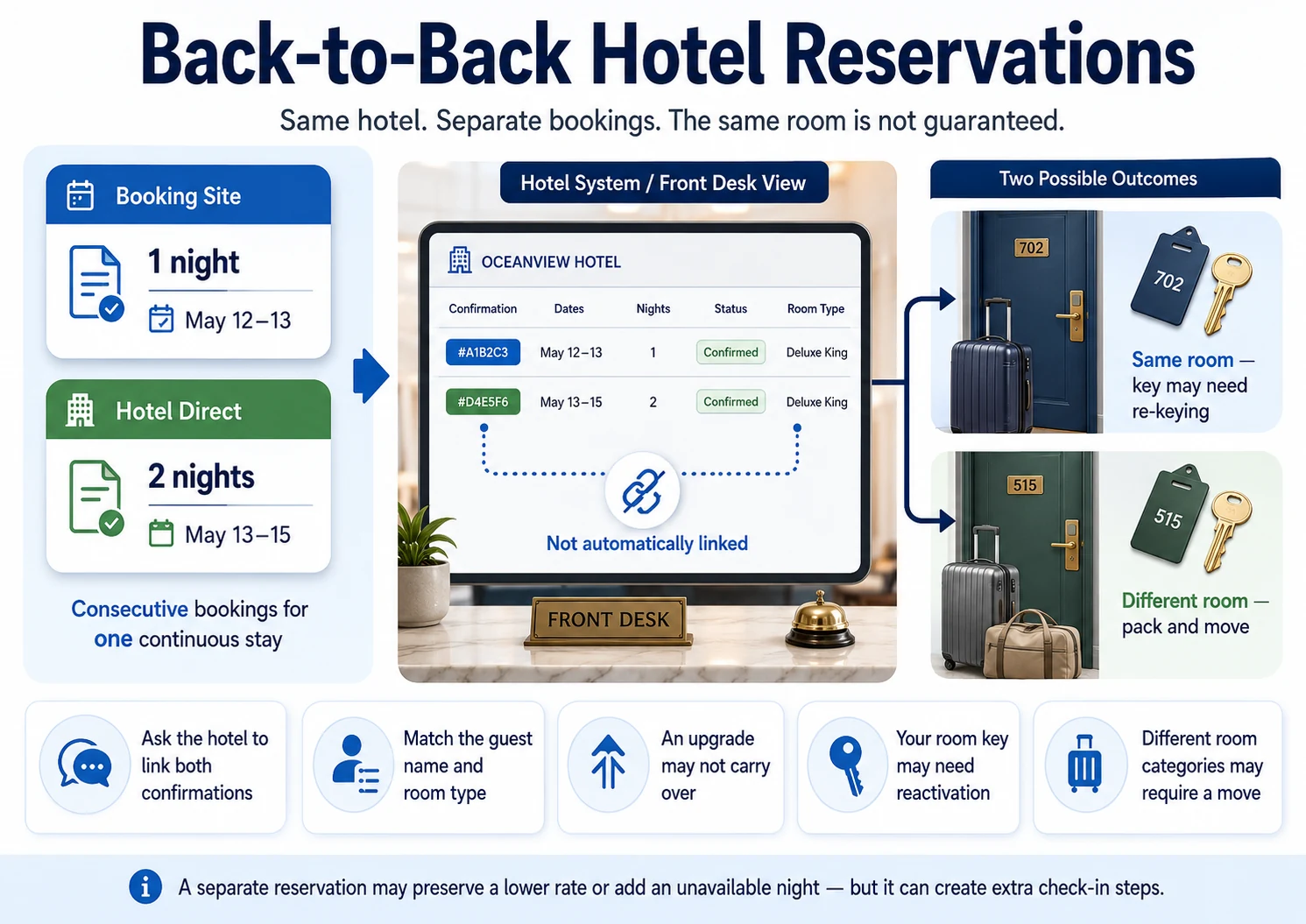
You book the first night of a hotel stay through an online travel agency, then reserve the next two nights directly with the hotel. The dates connect perfectly, the guest name is the same, and you plan to remain at the property for one continuous stay.
But the hotel may still treat them as two separate reservations.
That can create problems at check-in. The bookings may not be linked in the hotel’s system, one reservation may have a different room category, or one segment may receive an upgrade that does not apply to the other. Even when the hotel wants to keep you in the same room, staff may need to review availability and adjust room assignments before confirming that you will not have to move.
The same issue can happen when you add a night to an existing stay, preserve an older lower rate by creating a separate reservation, or book different room types because the preferred category was unavailable for the entire trip.
Back-to-back hotel reservations can work smoothly, but consecutive dates alone do not guarantee one room. The deciding factor is whether the property can align the actual room assignment and manage the transition between the separate bookings.
About this guidance: Travel Fine Print’s guidance draws on experience with hotel reservations, consecutive bookings, room assignments, front-desk operations, inventory controls, and the practical issues that arise when separate reservations are intended to function as one continuous stay. Whether guests can remain in the same room depends on room-category matching, availability, payment and booking sources, and the hotel’s ability to connect the reservations before arrival.
How Back-to-Back Hotel Reservations Work
Consecutive dates may look like one stay to the traveler, but the reservations usually remain separate unless someone takes additional steps to connect them.
You create two separate bookings
The dates connect, but each reservation receives its own confirmation number, rate, payment terms, cancellation rules, and booking conditions.
The hotel receives separate reservation records
The bookings may have different channels, room codes, loyalty details, upgrades, payment arrangements, or room assignments. Consecutive dates alone may not alert the hotel that you intend one continuous stay.
You request that the reservations be cross-referenced
Contact the hotel or its central reservations office and provide every confirmation number. This may be necessary even when both bookings were made through the hotel’s own website.
The request must reach the property
A central reservations agent may link the bookings or add a note in a separate booking system, but that information may not transfer to the hotel’s reservations or rooms division team. The agent may need to contact the property directly as a special request.
The hotel manages the transition
If the property can align the room assignments, you may remain in place and have your key card reactivated. Otherwise, you may need to complete another check-in or pack and move to a different room.
What Are Back-to-Back Hotel Reservations?
Back-to-back hotel reservations are two or more separate bookings for consecutive nights at the same property that the traveler intends to use as one continuous stay.
For example, you might book:
- The first night through an online travel agency and the next two nights directly with the hotel
- Six nights in one room category and a seventh night in another because the preferred room was unavailable
- An original stay at a lower rate and a separate additional night after deciding to extend the trip
- Consecutive reservations using different promotions, points, certificates, or payment methods
Even when the departure date of one reservation matches the arrival date of the next, the hotel system may still treat them as separate stays. Each booking can have its own confirmation number, rate, room assignment, payment terms, cancellation rules, loyalty details, and folio.
Back-to-back reservations are not the same as duplicate reservations. A duplicate booking usually means two reservations cover the same night, which can create double-charge or cancellation risks. Back-to-back bookings cover different nights but are intended to connect.
The practical issue is that the hotel may not realize you plan to remain continuously unless the reservations are cross-referenced. Even after they are linked, the property may still need to process the bookings separately when one reservation ends and the next begins.
Same Room Name, Different Hotel Treatment
Two reservations can show the same room description to the traveler while carrying different internal details that affect upgrades, floor assignments, benefits, and whether the hotel can keep the guest in one room.
Booking-Site Reservation
- Created through a third-party booking channel
- Loyalty status may not be fully attached or recognized
- Assigned from the standard inventory originally purchased
- Third-party rate and payment conditions may apply
- Upgrade or preferred-floor benefits may not be included
Direct Loyalty Reservation
- Created directly while logged into the loyalty account
- Member status and stay preferences may be attached
- May receive a preferred-floor or upgraded assignment
- Direct-booking benefits or member rates may apply
- Room placement may differ from the third-party segment
What Happens When the Reservations Have Different Room Types?
Keeping the same room becomes less likely when the consecutive reservations are for different room categories.
A traveler might reserve a swim-up suite for six nights and then book a standard room for the seventh because the swim-up category was unavailable. Even if the hotel later has a swim-up suite open, the final night does not automatically become an upgrade.
The property may be able to keep the guest in the preferred room, but that depends on availability, housekeeping plans, room assignments, upgrade priorities, and whether the hotel is willing to adjust the second reservation. The traveler should not assume that availability showing online means the room can be reassigned without additional cost.
When the hotel cannot align the room categories, the guest may need to:
- Pack and vacate the first room by checkout time
- Store luggage until the second room is ready
- Complete another check-in
- Provide a payment method again
- Receive new room keys
Whether that inconvenience is acceptable depends on why the separate booking was necessary. A traveler may tolerate a mid-stay move to secure an extra night, preserve a favorable rate, or access a room category that was only available for part of the trip.
The tradeoff is not always whether the booking arrangement is ideal, but whether the added night or lower price is worth the possibility of changing rooms.
What Happens When One Reservation Ends and the Next Begins?
The transition may involve nothing more than refreshing your room key, or it may require a second check-in and a mid-stay room change.
Stay in the room and reactivate the key
The hotel keeps you in the same room, but you may need to stop at the front desk when the first reservation ends so your key card can be re-keyed or extended.
Complete another check-in
The hotel may need to close one folio, verify your payment method, issue new keys, or complete another registration process before the next reservation begins.
Pack and move to another room
You may need to vacate the first room by checkout time, store your luggage, and wait until the room assigned to the second reservation is ready.
What Changes When One Reservation Is Booked Through a Third Party?
Back-to-back reservations can be harder to manage when one segment is booked through an online travel agency and the other is booked directly with the hotel.
The two reservations may have different payment arrangements, rate rules, loyalty recognition, upgrade eligibility, and room assignments. Even when both confirmations show the same room type, the direct booking may be treated differently because it is connected to a loyalty profile or member benefits.
A third-party booking may also be controlled partly by the booking site. The hotel may be able to adjust the room assignment, but changes to the rate, payment terms, or cancellation conditions may still need to go through the online travel agency.
Contacting the hotel’s central reservations office can help, but it does not always mean the property team will see the relationship between the bookings. A central agent may add a note or link the reservations in a separate booking platform, while that information does not transfer through the connection to the hotel’s property-management system.
When staying in the same room matters, ask whether the hotel’s own reservations or rooms division team has received the request. A central reservation agent may need to contact the property directly on your behalf.
Insider insight: A reservation can transmit successfully to the hotel without the special request or relationship between two bookings transmitting with it. The confirmation numbers may be visible while the operational context is not.
Can Selecting the Same Room in Advance Help?
A limited number of hotels allow guests to select a specific room before arrival. Choosing the same room for both reservations may improve the likelihood of remaining in place, but it does not guarantee the assignment.
How It May Help
- You can request the same room number for both reservation segments.
- The property’s room-assignment team may see your preference before arrival.
- It may reduce the chance of the two bookings being assigned to different floors or room locations.
- The option may be included at no charge for direct-booking guests or loyalty members.
What to Confirm
- Specific-room selection is often a request rather than a guarantee.
- Not every hotel offers the feature or makes it available for every room category.
- Some properties charge direct-booking guests an additional selection fee.
- Third-party reservations may be excluded or may require a separate paid option.
Can You Add a Night Without Repricing the Original Stay?
Creating a second reservation can sometimes be the safest way to add a night without disturbing the rate already secured for the original stay.
Suppose you booked three nights months ago at $220 per night, but the hotel is now charging $310. Modifying the original reservation to include a fourth night could cause the entire stay to be repriced under current availability and rate rules—not just the added night.
A separate one-night reservation may allow you to preserve the original rate for the first three nights while paying the current rate only for the additional night. The tradeoff is that the hotel now has two bookings to manage, and remaining in the same room becomes a request rather than a certainty.
Before creating the second reservation, ask the hotel or central reservations office whether it can:
- Extend the existing reservation without repricing the original nights
- Add the extra night at the current rate while preserving the earlier rate
- Match or honor the original nightly rate for the additional night
- Confirm whether the same room category is available across the full stay
The hotel may agree to one of these options, but it is generally discretionary. Assistance can also be more limited when the original reservation was booked through a third party because the hotel may not control that reservation’s rate or modification rules.
Travel fine print: Protecting a favorable rate with a separate booking may save money, but the savings should be weighed against the possibility of another check-in, a key-card reset, or a room move.
Do Not Assume the Hotel Has Connected Your Reservations
The biggest risk is arriving with the expectation that both bookings have already been linked and that the same room has been protected for the entire stay.
Even when you contacted a booking site, loyalty program, or central reservations office, the request may not have reached the property team responsible for assigning rooms.
- Different room assignment: The second reservation may already be assigned to another room.
- Upgrade does not continue: An upgrade attached to one booking may not apply to the other.
- Little flexibility at arrival: The hotel may be sold out when staff discover the mismatch.
- Mid-stay room move: You may need to pack, store luggage, and wait for another room.
- Separate processing requirements: Additional payment authorizations, registration steps, or key-card updates may still apply.
The risk is not simply that the reservations remain separate. It is discovering the mismatch at arrival—or when the first reservation ends—after the hotel has assigned its rooms and may no longer have enough flexibility to keep you in place.
How Do You Link Two Hotel Reservations Before Arrival?
Do not wait until check-in to tell the hotel that the reservations are intended to form one continuous stay. Contact the property several days before arrival and provide every confirmation number.
Ask the hotel to confirm:
- Both reservations appear under the same lead guest name
- The dates connect without a gap or overlap
- The room categories and occupancy details match
- The property’s reservations or rooms division team can see the request to remain in the same room
- Any upgrade, loyalty benefit, or preferred-floor assignment attached to one booking will affect the other
- A specific-room selection has been applied to both reservations, when that option is available
- You will need to stop at the front desk, present payment again, or have the room key reactivated when the second reservation begins
When contacting a central reservations office, ask whether the agent can communicate directly with the property rather than only adding a note in the booking system. A reservation note may not transfer through every system connection or reach the team assigning rooms.
Whenever possible, request written confirmation by email or chat. It will not guarantee the outcome, but it gives the hotel a clearer record of what was requested before arrival.
What Should You Confirm With the Front Desk?
Even when you contacted the hotel in advance, review the arrangement again at arrival while staff may still have flexibility to adjust the room assignments.
Both confirmation numbers are visible
Ask the agent to open both reservations and verify that the second booking is noted as part of the same continuous stay.
The same room is assigned across both bookings
Do not rely only on matching room-type names. Ask whether the actual room assignment can remain unchanged.
The upgrade or room location applies to both segments
Confirm whether a higher-floor room, loyalty upgrade, or preferred location continues after the first reservation ends.
You understand the transition process
Ask whether you must return to the desk, reactivate the key card, present payment again, or complete another check-in.
Separate holds or folios will be created
Clarify whether each reservation will generate its own incidental authorization, payment charge, receipt, or folio.
The hotel has a backup plan if you must move
Ask when the first room must be vacated, whether luggage storage is available, and when the replacement room is expected to be ready.
Send the Hotel One Clear Request With Every Confirmation Number
Contact the property before arrival rather than relying only on notes added by a booking site or central reservations office. Include the guest name, dates, room types, booking channels, and every confirmation number.

Use separate reservations deliberately, not casually. The real question is whether the savings, added night, loyalty benefit, or limited availability is worth accepting some uncertainty. A quick key-card reset may be a reasonable tradeoff; packing and changing rooms may not be. When avoiding disruption matters more than the price difference, one continuous reservation is usually the safer choice.
❓Frequently Asked Questions
These common questions explain what travelers should expect when consecutive hotel nights are held under separate reservations.
Can a hotel combine two back-to-back reservations?
The hotel may be able to cross-reference the bookings and manage them as one continuous stay, but it usually cannot erase the separate rates, confirmation numbers, payment terms, or cancellation conditions. Linking the reservations is not the same as formally merging them.
Do I need to check out between two hotel reservations?
Not always. You may be allowed to remain in the room, but the hotel could still require you to visit the front desk, close the first folio, confirm payment, sign new registration paperwork, or complete another check-in for the second reservation.
Will my hotel key stop working when the first reservation ends?
It can. The key may have been programmed only through the checkout time of the first booking. Even when you remain in the same room, you may need to have the key card reactivated or extended when the second reservation begins.
Does booking the same room type guarantee that I can stay in the same room?
No. Two confirmations may both say “Standard King,” but the bookings can carry different internal room codes, loyalty benefits, floor assignments, upgrades, or inventory restrictions. Ask the hotel about the actual room assignment rather than relying only on the public room description.
Will a loyalty upgrade continue across both reservations?
Not necessarily. An upgrade may be attached only to the direct or loyalty-linked portion of the stay. The hotel may extend it to the other reservation when space allows, but that should be treated as a request rather than an entitlement.
What should I do when one reservation was booked through a third party?
Contact the property directly and provide both confirmation numbers. The booking site may control the rate, payment, or cancellation terms, but the hotel generally controls room assignments. Ask whether the property’s reservations or rooms division team can see the request to keep the stay in one room.
Does selecting the same room number guarantee that I will not have to move?
No. When a hotel offers advance room selection, choosing the same room for both bookings may improve the odds, but room selections are often subject to operational changes. Confirm whether the feature is guaranteed, complimentary, or subject to an additional fee.
Bottom Line
Back-to-back reservations can preserve a lower rate or add a night that was otherwise unavailable, but the hotel may still treat each segment separately. When the savings are worth the risk, contact the property with every confirmation number and confirm the room assignment at check-in; when avoiding a move matters more, one continuous reservation is the safer choice.
Related Guides
These guides can help you understand who controls each reservation, what the hotel has actually promised, and what to do if the second booking does not carry over as expected.
Booking Channels and Reservation Control
- Third-Party Hotel Booking: What Changes With Payments, Cancellations, and Refunds?
See how booking through another platform can affect changes, support, and loyalty benefits. - Pay Now vs Pay at Hotel: Which Option Is Safer?
Compare prepaid and pay-at-property bookings before choosing separate payment paths.
Room Types, Requests, and Assignment
- Hotel Room Requests Are Subject to Availability: What Is Actually Guaranteed?
Understand the difference between a booked category, room assignment, and request. - Hotel Special Requests: Are They Guaranteed?
Learn when reservation notes may still require direct hotel confirmation. - What Happens If a Hotel Gives You a Different Room Than You Booked?
Use this if the room provided does not match the confirmed category.
Availability and Rate Problems
- What Happens If a Hotel Is Overbooked and Has No Room for You?
Know what to confirm if the hotel cannot accommodate part of your stay. - Can a Hotel Change the Rate After Booking? What to Check
Review what to compare before modifying or extending an existing reservation.