
You add a hotel special request during booking.
Maybe you ask for a high floor, quiet room, connecting rooms, early check-in, late checkout, a king bed, a crib, a rollaway bed, or a romantic room setup.
The request appears on the booking screen, so it can feel like part of the reservation.
But that is where travelers often get caught.
A hotel special request is usually not the same as a guaranteed booking term. It may be a note, a preference, a request sent through a booking platform, or something the hotel can only confirm later based on availability, staffing, room inventory, guest priority, or whether the request requires an extra fee.
The real question is not just:
“Can I add a special request to my hotel booking?”
It is:
“Did the hotel receive it, confirm it, price it, and agree to guarantee it?”
This guide explains how hotel special requests work, why they are often subject to availability, how requests flow through hotels and booking sites, and what to confirm before arrival if the request matters to your trip.
Quick Answer
Are Hotel Special Requests Guaranteed?
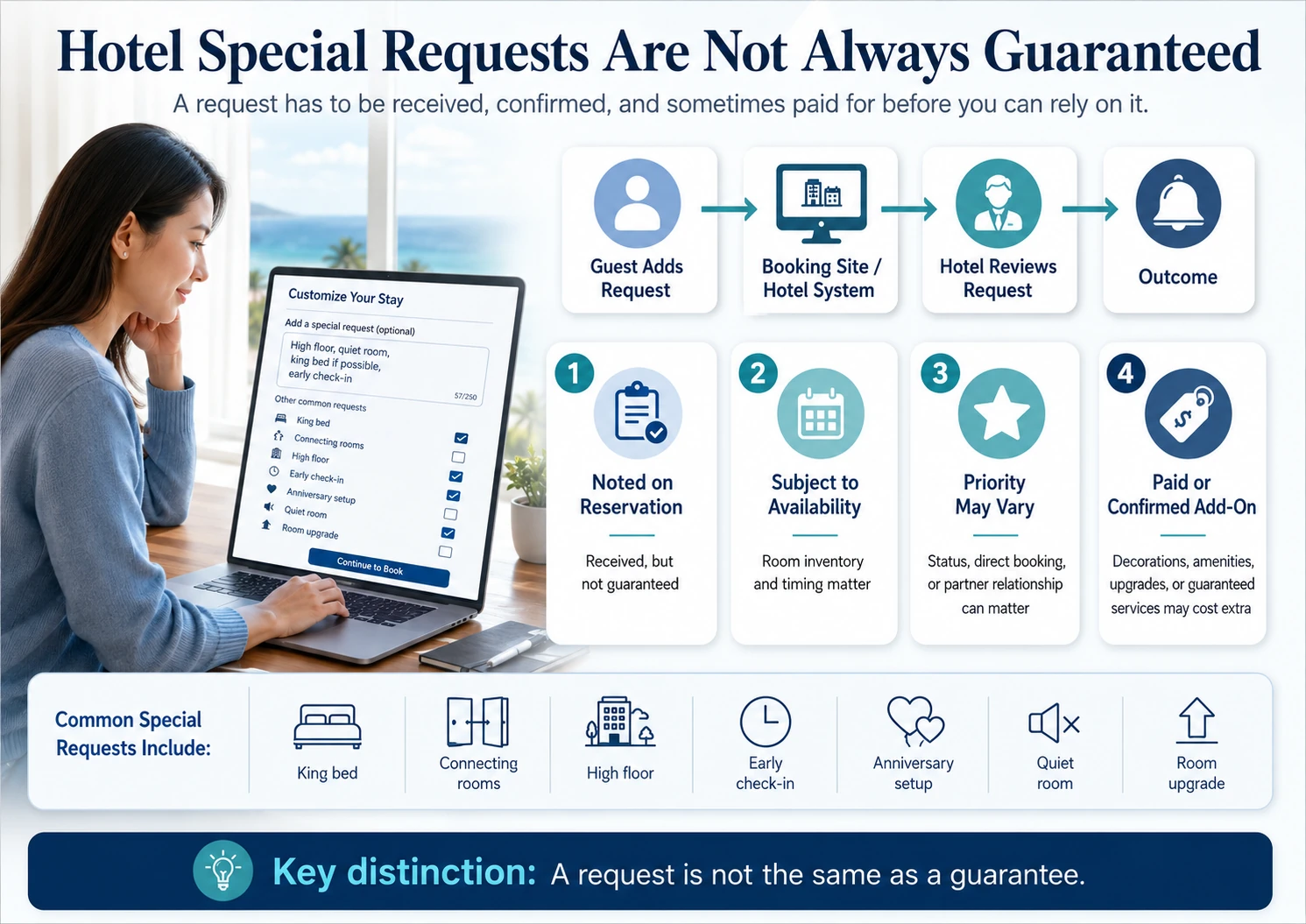
Hotel special requests are usually not guaranteed unless they are paid for, included in the booking terms, or specifically confirmed by the hotel in writing. A request may be noted on the reservation, but the hotel may still handle it based on availability, timing, guest priority, staffing, room inventory, or extra fees.
This matters because a request on a booking screen is not always the same as a confirmed hotel commitment. A high floor, quiet room, connecting room, king bed, early check-in, late checkout, or romantic room setup may still depend on what the hotel can provide when you arrive.
Before relying on a special request, confirm whether it is noted, confirmed, guaranteed, subject to availability, or available for an added fee.
What Does “Subject to Availability” Mean for Hotel Requests?
When a hotel request is subject to availability, it means the hotel may try to honor it, but has not promised it in advance.
The request may depend on which rooms are clean, which room types are open, when you arrive, how many other guests made similar requests, whether the request requires staff preparation, and whether the hotel charges extra for that option.
If the request affects your stay in a meaningful way, ask the hotel whether it is noted, confirmed, guaranteed, or available for an added fee.
System Insight
A hotel special request has to travel through the booking path before it can be honored.
- The booking source matters because a request may start with a hotel website, third-party booking site, travel agent, tour operator, call center, or guest message.
- The request may only be a note unless the hotel has actually received, reviewed, and agreed to honor it.
- Availability still matters because room inventory, housekeeping timing, staffing, guest priority, and arrival time can affect whether the request can be fulfilled.
- Guarantee language matters because “we have noted your request” is not the same as “your request is guaranteed.”
Requested vs Confirmed vs Guaranteed: Why the Difference Matters
The biggest mistake travelers make is treating every special request the same way. A note on the reservation, a hotel acknowledgment, and a paid guaranteed service can mean very different things.
Requested
The request may appear on the reservation, but the hotel has not promised it will be available or assigned.
Confirmed
The hotel has acknowledged the request, but it may still depend on availability unless the confirmation clearly says it is guaranteed.
Guaranteed
The request is included in the booking terms, paid for as an add-on, or specifically guaranteed by the hotel in writing.
How Hotel Special Requests Usually Flow to the Property
A special request can reach the hotel in different ways depending on how you booked.
If you book directly with the hotel, the request may be added through the hotel website, call center, reservation team, mobile app, or guest messaging system. That does not automatically guarantee it, but the request may be easier for the hotel to see, clarify, or confirm before arrival.
If you book through a third-party site, travel agent, tour operator, package provider, or credit card portal, the request may move through that partner’s system first. The hotel may receive it as a note, message, code, or special instruction attached to the booking.
That path matters because the person who takes the request is not always the person who assigns the room, approves the upgrade, or prepares the amenity.
The same limitation applies when a traveler asks the hotel to connect two consecutive bookings. Linking separate hotel reservations and requesting the same room may be noted, but the actual room assignment still needs to be reviewed by the property.
A request for a high floor, connecting rooms, early check-in, or room decoration may be visible to the hotel, but it may still need to be reviewed against room availability, staffing, fees, guest status, arrival time, and operational priorities.
That is why the safest approach is to treat the original request as step one. If the request matters, follow up with the hotel directly and ask whether it is noted, subject to availability, confirmed, paid, or guaranteed.
Common Request Types
Common Hotel Special Requests and What They Usually Depend On
Some hotel requests are simple notes. Others depend on availability, room inventory, staffing, guest priority, or an added fee. These are the request types travelers should not assume are guaranteed unless the hotel confirms them clearly.
Room Assignment
High floor, quiet room, view, or specific room number
These requests usually depend on available inventory, arrival timing, room readiness, and how the hotel prioritizes assignments.
Bedding and Room Setup
King bed, two beds, connecting rooms, or rollaway bed
Bedding and connecting-room requests may be limited by room type, occupancy rules, hotel layout, or whether the request was guaranteed at booking.
Timing Requests
Early check-in or late checkout
These requests often depend on occupancy, housekeeping schedules, arrival volume, loyalty status, and whether the hotel charges a fee.
Celebration Add-Ons
Birthday, anniversary, honeymoon, or room decoration
Special occasion setups may require advance notice, hotel confirmation, and an added fee for decorations, amenities, cakes, flowers, wine, or setup service.
Travel Fine Print check: If the request affects comfort, cost, accessibility, or the purpose of the trip, do not rely only on a note in the booking form. Ask the hotel what is actually confirmed.
Why Some Special Requests Get Priority
Hotels do not usually handle every special request in the same order.
Some requests are handled first come, first served. Others depend on room availability, staffing, arrival time, housekeeping status, or the type of request. A simple note for a quiet room may be reviewed differently from a paid anniversary setup, an accessibility-related need, or a room upgrade request tied to loyalty status.
Guest priority can also matter. A hotel may give priority to loyalty members, direct-booking guests, VIP guests, repeat guests, paid upgrades, or guests booked through travel agents, tour operators, or partners that have a special relationship with the property.
That does not mean other guests are ignored. It means the hotel may be balancing many requests against limited inventory.
For example, several guests may request a high floor, but only a limited number of rooms may be available on higher floors when those guests arrive. Multiple guests may request connecting rooms, but the hotel may only have a few sets that match the booked room types. A birthday or anniversary setup may require advance notice, staff coordination, and an added charge.
The practical point is simple: the more important the request is to your trip, the more important it is to confirm it directly and early. A request that matters should not be left as a quiet note in a booking field.
Traveler Risk
Seeing a request on your confirmation does not always mean it is guaranteed.
The risky assumption is thinking a request becomes part of the booking just because it appears in a notes field, confirmation email, or booking-site message. Unless the hotel clearly confirms it, charges for it, or includes it in the booking terms, the request may still be subject to availability, arrival timing, room inventory, guest priority, or operational limits.
Check the Fine Print
Not Sure Whether a Hotel Request Is Actually Protected?
Use the Travel Fine Print Risk Checker to narrow whether the issue is a special request, booking-channel problem, added fee, room assignment issue, cancellation rule, or another hotel fine-print concern.
What To Confirm Before You Rely on a Hotel Special Request
Before you rely on a hotel special request, make sure you know what level of commitment you actually have.
A note in the reservation is the weakest form. It means the request may be visible, but it does not necessarily mean the hotel has approved it, assigned it, priced it, or guaranteed it.
A stronger confirmation comes from the hotel directly, especially if the response clearly says the request is confirmed, prepaid, included, or guaranteed. Even then, read the wording carefully. “We have noted your request” is not the same as “your request is guaranteed.”
This matters most when the request affects the purpose of the trip. Connecting rooms, accessibility needs, early arrival, room decorations, a specific room number, or a paid amenity should be confirmed directly with the hotel before arrival.
The safest question to ask is:
“Is this request noted, confirmed, or guaranteed?“
Action Step
Confirm important requests directly with the hotel.
If a request affects your comfort, cost, arrival, room setup, accessibility, or celebration plans, do not rely only on the booking notes. Contact the hotel and ask what is actually confirmed.
Quick win: Use clear wording: “Can you confirm whether this request is guaranteed, subject to availability, or available for an additional fee?”
Before You Arrive
Check the Details Before You Rely on the Request
Use the Travel Fine Print checklist to review booking confirmations, request details, payment terms, hotel policies, arrival timing, and other trip details before a small assumption becomes a bigger problem.
When Special Requests May Cost Extra
Some hotel special requests are simple preferences. Others are services.
A quiet room, high floor, or bedding preference may be handled as a request based on availability. But requests that require staff time, added products, special setup, or guaranteed inventory may come with an additional fee.
This is common with special occasion requests. Birthday decorations, anniversary setups, honeymoon amenities, cakes, flowers, wine, balloons, towel art, or other in-room surprises often require advance notice and may need to be purchased through the hotel, concierge, guest services team, or an approved vendor.
The same can apply to rollaway beds, cribs, premium views, early check-in, late checkout, room upgrades, or guaranteed connecting rooms. Some hotels may provide these as a courtesy when available. Others may charge, especially when the request requires reserved inventory, products, or staff time.
Before assuming a request is complimentary, ask two direct questions:
“Is there a fee for this request?”
“If I pay for it, is it guaranteed?”
That distinction matters. Paying for an amenity or upgrade may give you a stronger confirmation than simply adding a note, but you should still save the written terms, price, and confirmation details.
Travel Fine Print Takeaway
A request is not the same as a promise.
Hotel special requests are usually preferences unless the hotel clearly confirms, guarantees, or charges for them. If the request affects your room setup, arrival timing, celebration plans, accessibility needs, or trip comfort, get the answer in writing before you rely on it.
What To Do If the Hotel Cannot Honor Your Request
If the hotel cannot honor your special request, start by asking what alternatives are available.
For room-related requests, the hotel may be able to offer a different room, a later room move, a different bedding setup, or a note for housekeeping or front desk follow-up. For timing requests, the hotel may offer bag storage, access to facilities, or a paid early check-in or late-checkout option if available.
If the request was only noted, the hotel may not owe compensation simply because it could not fulfill it. But if the request was paid for, clearly guaranteed, or confirmed in writing, ask the hotel to explain what happened and what remedy is available.
For third-party bookings, also check whether the request was submitted through the booking site, travel agent, or tour operator. The hotel may have received the reservation but not the request details, or the request may have arrived as a note rather than a confirmed service.
The most useful question is:
“Was this request visible to the hotel, and was it guaranteed or only subject to availability?”
The hotel still has to receive the request, review it, and decide whether it can be fulfilled based on availability, timing, room inventory, guest priority, staffing, and any required fee.
❓Frequently Asked Questions
These questions cover how hotel special requests work, what “subject to availability” means, when requests may cost extra, and what travelers should confirm before relying on a request.
Are hotel special requests guaranteed?
Usually, no. Hotel special requests are often subject to availability unless they are paid for, included in the booking terms, or clearly confirmed by the hotel in writing. A request may appear on your reservation without becoming a guaranteed part of the booking.
What does “subject to availability” mean for hotel requests?
Subject to availability means the hotel may try to honor the request, but has not promised it in advance. The request may depend on available rooms, housekeeping timing, arrival time, guest priority, staffing, or whether the hotel charges extra for that option.
What does “special request” mean on a hotel booking?
A special request is usually a note or preference added to the reservation. It may tell the hotel what you prefer, but it does not always mean the hotel has approved, assigned, priced, or guaranteed the request.
Should I contact the hotel directly about a special request?
Yes, especially if the request matters to your stay. Contact the hotel directly to ask whether the request is noted, confirmed, guaranteed, subject to availability, or available for an additional fee. Save the hotel’s written response if the request is important.
Can hotels charge extra for special requests?
Yes. Requests that require staff time, added products, room setup, premium inventory, or guaranteed service may come with an additional fee. This can include room decorations, cakes, flowers, wine, early check-in, late checkout, upgrades, rollaway beds, or other amenities.
Are romantic hotel special requests guaranteed?
Romantic hotel special requests are usually not guaranteed unless the hotel confirms them directly, charges for them, or includes them in a paid package. Room decorations, champagne, flowers, cakes, towel art, or anniversary setups may require advance notice, staff availability, and an added fee.
Why did the hotel not honor my special request?
The request may have been subject to availability, entered through a booking site but not guaranteed, unavailable due to room inventory, or lower priority than paid, guaranteed, loyalty, direct-booking, or partner-related requests. If the request was confirmed or paid for, ask the hotel what remedy is available.
What is the difference between a room type and a room request?
A room type is the category you booked, such as a king room, two-bed room, ocean-view room, or suite. A room request is usually a preference, such as high floor, quiet room, connecting rooms, or a specific location. The hotel is generally more obligated to provide the booked room type than an unguaranteed request.
Bottom Line
Hotel special requests are useful, but they are not automatically guaranteed.
A request may appear on your booking confirmation, but that usually means it was noted — not necessarily approved, assigned, paid for, or promised. The hotel still has to receive the request, review it, and decide whether it can be fulfilled based on availability, timing, room inventory, guest priority, staffing, and whether the request carries a fee.
If the request matters to your trip, do not rely only on a booking form note. Contact the hotel directly and ask whether the request is noted, confirmed, guaranteed, subject to availability, or available for an additional fee.
The fine print difference is simple: a request tells the hotel what you want. A confirmation tells you what the hotel has actually agreed to provide.
Related Guides
If you are trying to understand hotel requests, booking terms, or what the hotel is actually required to provide, these guides may also help:
Booking Channel and Request Handling
- Booking Hotels Through Third-Party Sites
See how OTA bookings, travel apps, and booking portals can affect whether special requests reach the hotel and who can modify them. - Pay Now vs Pay at Hotel: Which Option Is Safer?
Compare how payment timing can affect flexibility, fees, upgrade handling, and what happens if hotel needs change. - Hotel Cancellation Policies Explained
Learn how hotel policies decide what is flexible, what is guaranteed, and what may still depend on timing, terms, or booking channel.
Room Requests and Check-In Issues
- Hotel Room Type vs Room Request
Learn why a room request is usually a preference, while a booked room type is the category the hotel is expected to provide. - What Happens If a Hotel Gives You a Different Room Than You Booked?
Learn what to do at check-in if the hotel cannot honor your requested room details — and how to tell whether the issue is a missed preference or a room category problem. - What Happens If You Arrive Early for Hotel Check-In?
Learn why early check-in is usually a request, not guaranteed room access, and what to confirm before arriving before standard check-in time.
Fees, Add-Ons, and Final Charges
- Why the Price You See at Checkout Isn’t the Price You Pay
Review how hotel fees, upgrades, add-ons, and paid request options can change the final cost of a stay. - Hotel Charged More Than the Booking Confirmation
Use this if a room upgrade, amenity, setup request, or hotel add-on appears as an unexpected charge after booking.