
Hotel Booking Channels
Booking Hotels Through Third-Party Sites: When Is It Worth It?
A third-party hotel rate can be cheaper, more convenient, or bundled with useful benefits. The tradeoff is that the hotel may provide the room without controlling every part of the reservation. Before choosing the lowest visible price, compare the savings with who controls payment, changes, cancellations, refunds, and support.
The decision: Book through a third-party site when the savings or benefits are meaningful and the terms are clear. Lean direct when the price difference is small and you place more value on simpler changes, hotel loyalty benefits, or having the property control more of the reservation.
About This Guidance
This guidance focuses on how hotel reservations move between booking platforms, hotel systems, payment processors, and property staff—and which company can actually help when something changes after booking.
On This Page
- Quick Answer
- The Decision in 30 Seconds
- How Third-Party Hotel Booking Works
- When Third-Party Booking Is Worth It
- When Booking Direct May Be Better
- How to Compare the Real Offer
- Who Controls Changes?
- Who Charges the Card?
- What About Room Types and Requests?
- What to Check Before Booking
- Save the Terms
- The Fine Print That Matters
- TFP Recommendation
- Before You Go
- FAQ

The room may be the same, but the booking relationship is not. Price, payment timing, loyalty benefits, special requests, and who controls changes can differ by booking channel.
Quick Answer
Is it safe to book a hotel through a third-party site?
Yes—booking through a reputable third-party hotel site can be a perfectly reasonable choice. The important question is not whether the booking is “safe” in the abstract, but whether the price advantage and convenience are worth the terms attached to the reservation.
The hotel may provide the room while the booking platform controls the rate, payment, cancellation, refund, or change process. A valid hotel confirmation does not necessarily mean the hotel has authority over every part of the booking.
TFP rule: Compare the total price and benefits, then identify who controls the reservation if something changes.
The Decision in 30 Seconds
The best booking channel depends on the value you gain and the control you may give up.
| Your situation | What I would lean toward |
|---|---|
| Third-party price is meaningfully lower | Third party can make sense if the total price and terms are clear. |
| Price difference is very small | Direct may be worth the extra control, especially if flexibility matters. |
| Plans may change | Prioritize flexibility and verify who controls modifications and refunds. |
| Hotel loyalty benefits matter | Check eligibility before booking third party; some rates may not qualify for points, status credit, upgrades, or property benefits. |
| You need a specific room type or request | Verify exactly what is sold and what transfers to the hotel. |
| Rate is prepaid or nonrefundable | Confirm the merchant of record and refund path before paying. |
| Third-party package adds real value | Third party may win when the package savings or benefits are meaningful. |
| Terms are vague or incomplete | Pause until you know the total cost, cancellation rules, and who controls the reservation. |
How It Works
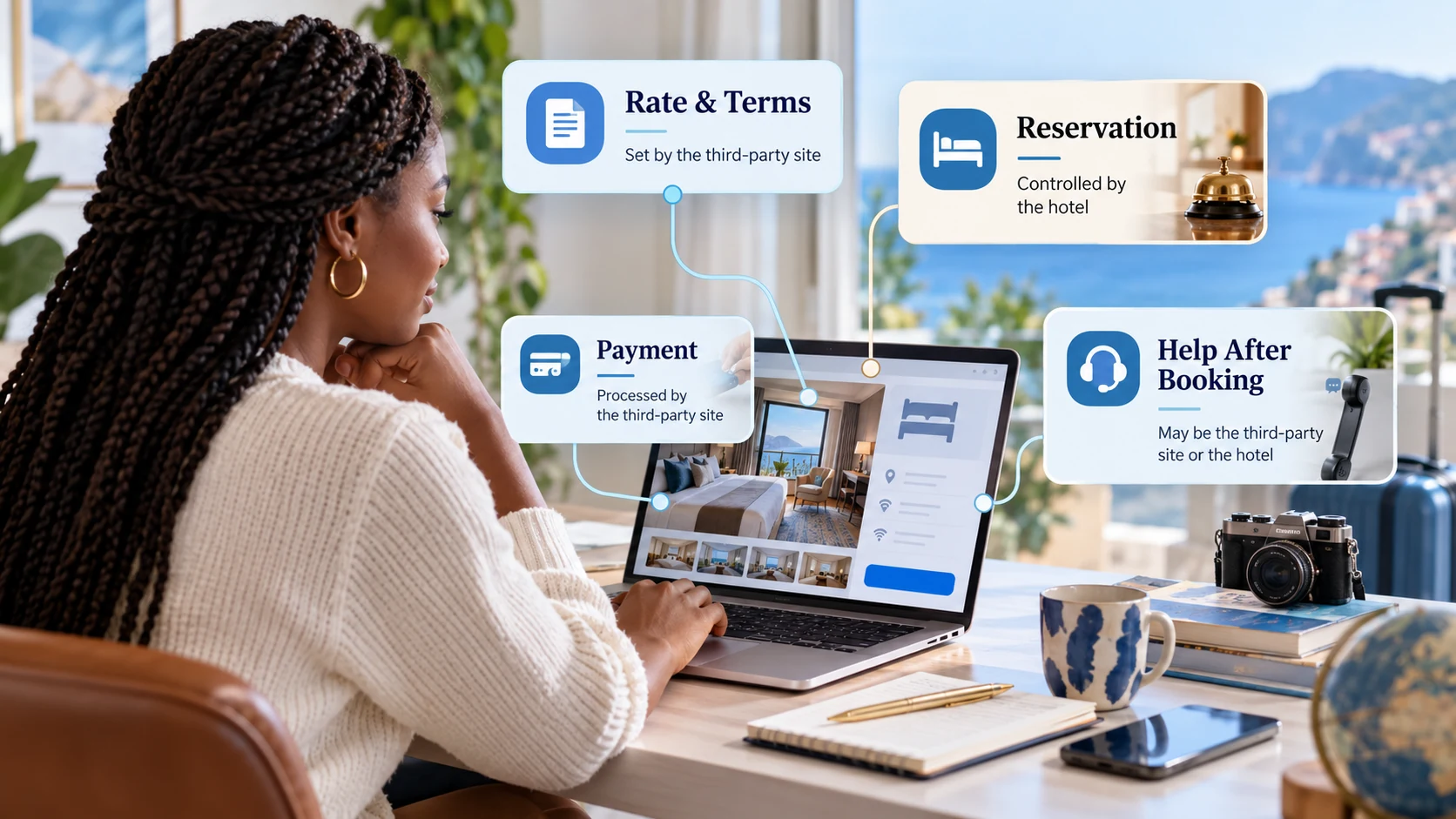
Four parts of a third-party hotel booking may be controlled separately.
The booking platform may sell the reservation, the hotel may provide the stay, and either company may collect payment. That split determines who can actually help when a change, cancellation, refund, or billing question arises.
1. Rate and terms
The booking platform displays the room, price, payment timing, cancellation policy, and conditions attached to the rate.
2. Reservation record
The booking must be transmitted to the hotel, but the platform may still retain control over changes, cancellations, or customer service.
3. Payment collector
The booking site may charge the card in advance, or the hotel may collect payment later. The company that charged you usually matters most for billing corrections and refunds.
4. Help after booking
The hotel may handle the stay itself while the booking platform handles rate changes, cancellations, refund approval, or other reservation issues.
The distinction that matters
The hotel can provide the room without controlling every part of the reservation.
When Third Party Wins
When is booking through a third-party site worth it?
A third-party booking can offer strong value when the savings, package benefits, or convenience are meaningful enough to outweigh the additional layer between you and the hotel.
The total savings are meaningful
Compare the full amount after taxes, booking fees, deposits, resort or destination fees, and property-collected charges—not just the advertised nightly rate.
The package adds real value
Member prices, app rates, travel credits, packages, or bundled benefits can make the third-party offer materially better.
The terms are clear
You understand the room type, payment timing, cancellation deadline, refund rules, and who controls changes.
Your plans are stable
A more restrictive booking can be easier to accept when the likelihood of needing a change is low.
If a third-party offer looks cheaper, compare why travel prices differ across websites before assuming you are looking at identical terms.
When Direct May Win
When might booking directly with the hotel be worth paying more?
Direct booking can be more attractive when the savings elsewhere are small and the booking relationship itself has value.
You expect to change the reservation
Fewer parties can make modifications easier when dates, occupancy, room type, or stay length may change.
Loyalty benefits matter
Hotel points, elite-night credit, upgrades, breakfast, late checkout, or other benefits may depend on booking eligibility.
The hotel is offering a similar price
If the direct rate is nearly the same, the simpler support path may be worth the difference.
Your room requirements are complicated
Connecting rooms, accessibility needs, special room types, or other must-have details may be easier to clarify directly with the property.
Compare the Real Offer
Do not compare hotel rates by nightly price alone.
The useful comparison is the full booking: exact room, total price, payment timing, cancellation terms, included benefits, and support path.
Total price
Include taxes, booking fees, deposits, resort or destination fees, and other charges due at the property.
Exact room type
Confirm that the room category, bedding, occupancy, view, and included amenities actually match.
Payment timing
Determine whether the booking is prepaid, partially prepaid, or payable at the hotel.
Cancellation terms
Compare the exact deadline, penalty, refund path, and time zone rather than relying on a general hotel policy.
Included benefits
Breakfast, credits, transfers, package inclusions, loyalty eligibility, or member benefits can change the real value.
If you are comparing offers side by side, compare room descriptions, total prices, and payment options together.
After You Book
The hotel may see your reservation without having authority to change it.
A property can often locate a third-party reservation in its system while still having limited authority over the rate, cancellation status, payment record, or permitted modifications.
Depending on the booking arrangement, the hotel may be unable to change dates, length of stay, occupancy, room category, lead guest, price, or refund status without action from the booking platform.
Ask one direct question
“Does the hotel have authority to make this change, or must it be completed by the booking platform?”

Payment Control
Check who the merchant of record is.
Before completing a third-party booking, identify which company will actually charge your card. That company is usually the merchant of record and often becomes central to billing questions, payment corrections, and refunds.
Prepaid by booking platform
The booking site may collect the room cost before the stay. The hotel may approve a cancellation or refund request without being able to return the money itself.
Pay at property
The hotel may collect payment closer to arrival or checkout even though the booking platform still controls the reservation record or cancellation terms.
Split responsibility
The booking platform may control the rate while the hotel separately collects taxes, resort fees, deposits, or incidental holds.
For the payment tradeoff itself, see Pay Now vs. Pay at Hotel.
Room Details
Third-party booking can add another layer to room types and special requests.
Make sure the exact room category is clear before paying. A bedding preference, high-floor request, connecting-room request, or other special note may not carry the same weight as the room type itself.
Our guide to Hotel Room Type vs. Room Request explains the difference between what you actually booked and what the hotel may only try to honor.
If the room itself matters, compare the exact room categories being sold rather than relying on a request field to create the room you want.
Before You Pay
What should you check before booking through a third-party site?
Exact hotel and room category
Check the property address, room name, bedding, occupancy, view, and included amenities.
Total price
Include taxes, booking fees, deposits, resort or destination fees, and other property-collected charges.
Payment timing
Know whether the rate is prepaid, partially prepaid, or payable at the hotel.
Merchant of record
Identify who will actually charge your card and therefore who may need to correct a billing problem later.
Cancellation deadline
Record the exact date, cutoff time, time zone, and penalty after the deadline.
Refund terms
Confirm whether the rate is refundable, partially refundable, or nonrefundable—and who must process any refund.
Who handles changes
Know whether date changes, occupancy corrections, room modifications, or cancellations must go through the booking platform.
Included benefits
Review breakfast, resort credits, transportation, package inclusions, loyalty eligibility, and other benefits tied to the rate.
One Practical Step
Save the booking terms before you close the checkout page.
The confirmation email may not preserve every detail shown before payment. Save the information that proves exactly what you selected, what it cost, and which rules applied.
Capture the room offer
Save the room category, bedding, occupancy, included benefits, and property address.
Save the full price
Include taxes, booking fees, deposits, and charges payable at the property.
Preserve the rules
Save the payment timing, cancellation deadline, refund terms, and merchant-of-record language.
Keep both contact paths
Store the booking-platform confirmation, support details, and any separate hotel confirmation number together.
The Fine Print That Matters
The room may be the same. The booking relationship is not.
The lowest rate may not be the lowest total
Compare taxes, fees, deposits, property charges, and included benefits before deciding which offer is actually cheaper.
The hotel may not control the reservation
A property can see and service the stay while lacking authority over changes, cancellation terms, or refunds.
Payment path matters
The company that charged the card is often central to billing corrections and refunds, even when the hotel approves the underlying change.
Hotel policy may not be your rate policy
A third-party rate can have its own cancellation deadline, deposit rule, prepayment requirement, or nonrefundable condition.
Room requests may travel differently
Confirm the booked room category separately from any special request, preference, or note added through the booking platform.
Preserve the checkout terms
The clearest evidence of what you bought is often the final price, room description, and rules displayed before payment.
My Take
I would not pay more to book direct simply because “direct is safer.”
If a reputable third-party site offers a meaningful savings, useful package, or better combination of price and payment terms, I would seriously consider it.
If the savings are small, my plans may change, or I care about hotel loyalty benefits, room flexibility, or having the property control more of the reservation, I would be more inclined to book direct.
The deciding factor is not the logo on the booking page. It is who controls the reservation if I need help later.
TFP Recommendation
Choose the best full booking—not automatically the cheapest channel.
The Recommendation
A third-party hotel booking can be a strong value when the price advantage or benefits are meaningful and the terms are clear.
Before paying, confirm the exact room, total price, cancellation deadline, payment timing, included benefits, property-collected charges, and which company controls changes and refunds. If that information is unclear, the lower rate is not yet a fully comparable offer.
Your Next Step
Decide whether the third-party offer is actually better once you account for price, flexibility, room certainty, and who will control the reservation if something changes.
Smarter travel, straight to your inbox
Booking choices, hidden costs, travel rules and useful fine print — explained clearly.
Before You Go
Once you choose the booking channel, check the rest of the reservation.
Payment timing, room type, cancellation terms, and the final price can matter just as much as whether you booked direct or through another site.

Why Travel Prices Differ Across Websites
Understand why the same-looking room may have different prices, inventory, margins, and rate rules.
Compare the real price →Hotel Room Type vs. Room Request
Know which room details you actually purchased and which preferences may still depend on availability.
See what is guaranteed →Pay Now vs. Pay at Hotel
Compare prepaid and pay-at-property rates before choosing the payment path that fits your plans.
Compare payment timing →Hotel Cancellation Policies Explained
Understand how rate type, deadline, booking channel, and refund path determine what happens if plans change.
Review cancellation rules →FAQ
Third-party hotel booking: common questions
What does third-party hotel booking mean?
It means reserving through an online travel agency, travel app, credit card portal, package provider, discount site, or booking marketplace rather than completing the reservation directly with the hotel.
Is it safe to book a hotel through a third-party site?
Booking through a reputable third-party platform can be safe and worthwhile. The key is verifying the exact hotel, room category, total price, payment timing, cancellation terms, merchant of record, and property-collected charges before paying.
Can a third-party hotel rate be cheaper than booking direct?
Yes. A booking platform may offer a different margin, member price, app rate, package, credit, inventory source, or promotional rate. Compare the total price and terms rather than the nightly rate alone.
Who charges my card for a third-party hotel reservation?
It depends on the selected rate. The booking platform may collect payment in advance, or the hotel may charge the card closer to arrival or checkout. Look for “pay at property,” “prepaid,” “due now,” or similar payment language.
Can the hotel change or cancel a third-party booking?
Sometimes, but not always. The hotel may see the reservation while having limited authority to change dates, occupancy, room type, price, cancellation status, or payment terms.
Are third-party cancellation policies different from the hotel’s policies?
They can be. The rate sold through the booking platform may have its own cancellation deadline, deposit rule, prepayment requirement, refund path, or nonrefundable condition.
Who handles the refund for a third-party hotel booking?
Refunds usually follow the payment path. If the booking platform charged the card, it will generally need to process the refund even if the hotel approves the cancellation.
Do hotel loyalty benefits apply to third-party bookings?
Not always. Points, elite-night credit, upgrades, breakfast, late checkout, or other program benefits may depend on the hotel program and the rate or booking channel used. Check the applicable terms before booking if those benefits matter.
What should I save after booking through a third-party site?
Keep the final price, room description, payment terms, cancellation deadline, refund rules, confirmation number, support information, and any separate hotel confirmation number.
Free Travel Guide
Avoid the travel mistakes that can cost you money, flexibility, or time.
Get 27 Travel Mistakes That Cost Travelers Thousands — a practical guide to booking mistakes, hidden costs, travel rules and decisions worth understanding before they become a problem.
- Spot booking details that are easy to overlook
- Understand where hidden costs can appear
- Recognize when a cheaper option comes with a tradeoff
- Make travel decisions with fewer surprises
You’ll also receive occasional practical guidance from Travel Fine Print on booking choices, hidden costs, travel rules and the fine print worth understanding. Unsubscribe anytime.