
A hotel destination fee can make the final price feel higher than the rate you thought you booked.
You may see one room price in search results, then notice a daily destination fee at checkout, in the confirmation, or at the front desk. The charge may be listed separately from the room rate, even though the hotel treats it as a required part of the stay.
That is why destination fees are so frustrating.
They can look like optional amenity charges, but many hotels treat them as mandatory. The real question is not only whether you have to pay the fee. It is whether the fee was clearly disclosed before you booked.
This guide explains what a hotel destination fee is, when it is usually mandatory, when it may be worth questioning, and what to check before booking so the final hotel price does not surprise you later.
Quick Answer
Do you have to pay hotel destination fees?
Usually, yes. If a hotel destination fee was clearly disclosed before you booked, the hotel will usually treat it as a mandatory part of the stay. The fee may apply even if you do not use every amenity included with it.
But if the fee was hidden, added later, poorly disclosed, charged differently than shown, or tied to amenities that were unavailable, you may have a stronger reason to ask for a waiver, refund, or explanation.
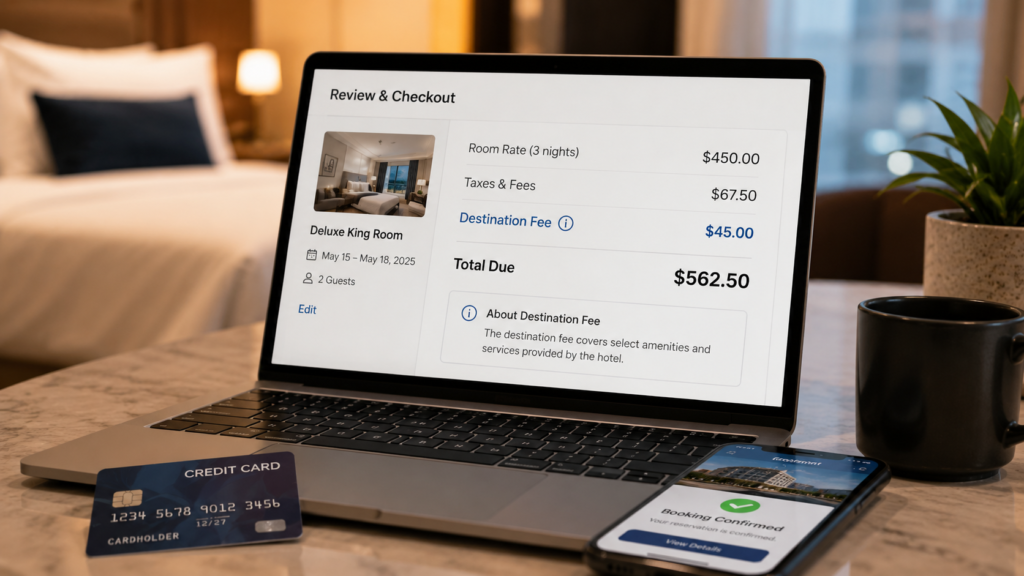
Before booking, open the full price details and look for terms like destination fee, amenity fee, urban fee, facility fee, resort fee, property fee, or mandatory charge.
System Insight
The name of the fee matters less than how clearly it was disclosed.
- Destination fees are hotel-imposed charges, not the same as government taxes.
- Mandatory fees may apply even if you do not use the amenities listed.
- Disclosure timing matters because a fee shown before booking is different from one revealed at check-in.
- Booking channel matters because hotel websites, OTAs, and travel portals may display fees differently.
- Proof matters because screenshots of the checkout page can help if the final charge does not match what you were shown.
Fee Disclosure Check
What Should You Check Before Paying a Destination Fee?
A destination fee is usually treated as mandatory when it was clearly disclosed before booking. The important questions are what the fee is, when it appeared, whether the charge matches the booking terms, and what proof you saved.
Fee Type
What the Fee Is
Destination fees are hotel-imposed charges, not the same as government taxes.
Usually Required
When It Is Mandatory
If the fee was clearly shown before booking, the hotel will usually treat it as required.
Challenge Point
When to Question It
Hidden, late, mismatched, duplicate, or unavailable-amenity fees are worth asking about.
Documentation
What to Save
Keep screenshots, confirmations, folios, and checkout-price details before disputing a fee.
What Is a Hotel Destination Fee?
A hotel destination fee is a hotel-imposed daily charge added to the room rate. It is often used by city hotels or destination-area properties and may be described as covering bundled perks such as Wi-Fi, bottled water, local calls, fitness access, streaming, or food-and-beverage credits. In practice, a destination fee often works like a resort fee under a different name. The hotel may describe the fee as covering amenities, but the charge is usually not optional if it was part of the booking terms. The key distinction is that a destination fee is created by the hotel. It is not the same as an occupancy tax, sales tax, tourism tax, or other government-imposed charge.↑ Back to destination fee checks
When Is a Destination Fee Usually Mandatory?
A destination fee is usually mandatory when it was clearly disclosed before you booked. If the checkout page, rate details, confirmation, or mandatory-fee section showed the charge before you confirmed the reservation, the hotel will usually treat it as part of the stay. That means you may still have to pay it even if you do not use the included amenities. Before assuming the fee is optional, check: – whether it appeared before checkout, – whether it was listed as mandatory, – whether it was charged per night, per room, or per stay, – whether taxes were added on top of the fee, – and whether your confirmation matches the final hotel folio.↑ Back to destination fee checks
When Should You Question a Destination Fee?
A destination fee is more worth questioning when the problem is disclosure, accuracy, or availability — not simply that you dislike the charge. You may have a stronger reason to ask about the fee if: – it was not clearly shown before booking, – it appeared only at check-in or after the cancellation deadline, – it was hidden inside a vague “taxes and fees” line, – the amount does not match your confirmation, – the fee was charged twice, – the listed amenities were closed or unavailable, – or your loyalty status, rate type, or booking program says the fee should be waived. None of these guarantees a refund, but they give you a clearer basis for asking.↑ Back to destination fee checks
What Proof Should You Save Before Disputing a Destination Fee?
Before disputing a destination fee, save the documents that show what you were told before booking and what you were charged later. Useful proof includes: – the final checkout screen, – the hotel confirmation email, – the “taxes and fees” breakdown, – the rate details or mandatory-fee language, – the hotel folio, – the credit card charge, – and screenshots from the hotel or booking site. The strongest question to ask is: “Can you show me where this destination fee was disclosed before I confirmed the reservation?”↑ Back to destination fee checks
Important Distinction
Mandatory Does Not Always Mean Clearly Disclosed
A hotel destination fee can be mandatory and still raise a legitimate concern if the fee was not clearly shown before you booked.
The key question is not only whether the hotel requires the fee. It is whether you had a fair chance to see the full price before committing to the reservation.
That is why the timing matters. A fee you saw clearly before booking is different from a fee that appears for the first time at check-in, after a prepaid reservation, or deep inside a confirmation email.
Traveler Risk
The hardest destination fees to challenge are the ones you discover after you feel locked in.
Destination fees create the most frustration when they appear after you have already prepaid, used points, passed the cancellation deadline, or arrived at the front desk. At that point, changing hotels may no longer be practical.
That does not automatically mean the fee will be removed. But if the charge was not clearly disclosed before booking, does not match your confirmation, or was tied to amenities that were unavailable, you have a stronger reason to ask questions before simply accepting it.
Check the Fine Print
Not Sure If a Destination Fee Is Worth Questioning?
Use the Travel Fine Print Risk Checker to review the type of hotel fee, when it appeared, and whether the charge may be worth asking about before you pay, dispute it, or assume it is required.
After you decide the fee is worth questioning, slow the issue down before paying, disputing, or escalating. The strongest position usually comes from comparing what you were shown before booking with what the hotel charged later.
You can ask questions about a destination fee, request a waiver, or challenge unclear disclosure. But if the hotel treats the fee as mandatory, refusing to pay at check-in may create practical problems. A stronger approach is to ask where the fee was disclosed before you booked and then compare that answer with your confirmation, checkout page, and hotel folio.
Action Step
Check the destination fee before you commit to the hotel.
Before booking, confirm whether the destination fee is part of the required price. The goal is to avoid choosing a hotel based on a lower room rate before seeing the full mandatory cost.
- ✓Open the full price breakdown, not just the nightly rate.
- ✓Look for destination fee, amenity fee, facility fee, urban fee, property fee, or resort fee.
- ✓Check whether the fee is charged per night, per room, or per stay.
- ✓Confirm whether the fee is collected online or at the property.
- ✓Check whether taxes are added on top of the fee.
- ✓Save screenshots of the checkout page, confirmation, and fee details.
Quick win: Before booking, ask: “Is the destination fee included in the total price shown here, or will it be charged separately at the hotel?”
Before You Book
Save the hotel fee details before the final price changes.
Use the travel documents checklist to keep your hotel confirmation, fee breakdown, checkout screenshots, payment records, and folio organized in case a destination fee appears later or does not match what you were shown.
Screenshots are especially useful because fee disclosures can change, booking pages can be hard to recreate, and third-party sites may show hotel-imposed charges differently than the hotel’s own website.
Do Destination Fees Apply on Points, Free Nights, or Third-Party Bookings?
Sometimes, yes.
A destination fee may still apply when the room is booked with points, a free night certificate, a package, a credit card travel portal, or a third-party site. Hotels often treat the fee separately from the base room rate.
Before booking, check whether the fee is included, waived, or collected separately at the property. This matters most for award nights, prepaid bookings, loyalty stays, and third-party reservations.
A useful question to ask before confirming is:
“Will the destination fee be charged separately at the hotel, or is it included in the total price shown here?”
What To Do If You Were Already Charged a Destination Fee
If you were already charged, gather the proof before disputing the fee.
Compare the original checkout price, confirmation email, fee breakdown, hotel folio, and credit card charge. Then ask the hotel:
“Can you show me where this destination fee was disclosed before I confirmed the reservation?”
If you booked through a third-party site, contact the booking platform too. The hotel may control the fee, while the booking site may control how it was disclosed.
If the charge was hidden, added later, duplicated, or different from your confirmation, you can ask for a refund, escalate to the hotel brand or booking site, or consider a credit card dispute if the final charge does not match what was disclosed.
❓Frequently Asked Questions
Destination fees create confusion because they often sit somewhere between the room rate, hotel amenities, and mandatory charges. These are the questions travelers usually need answered before deciding whether to pay, challenge, or avoid the fee.
What is a hotel destination fee?
A hotel destination fee is a hotel-imposed charge added to the room rate. It may be described as covering bundled perks such as Wi-Fi, bottled water, fitness access, local calls, or food-and-beverage credits.
Is a hotel destination fee mandatory?
Usually, yes. If the destination fee was clearly disclosed before booking, the hotel will generally treat it as a required part of the stay, even if you do not use every amenity included with the fee.
Can you refuse to pay a destination fee?
You can question the fee and ask where it was disclosed, but refusing to pay at check-in can create problems if the hotel treats the fee as mandatory. It is usually better to ask for proof of disclosure or request a waiver based on a specific issue.
Is a destination fee the same as a resort fee?
Not always, but they often work in a similar way. Resort fees are common at resort properties, while destination fees are often used by city hotels or destination-area hotels. Both may be mandatory hotel-imposed charges.
Can a destination fee be waived?
Sometimes. A hotel may consider a waiver if the fee was not clearly disclosed, the amenities were unavailable, the amount does not match your confirmation, or your loyalty status or rate type includes a fee waiver.
What should I do if the destination fee was not disclosed?
Ask the hotel to show where the fee appeared before you booked. Compare that explanation with your checkout screenshot, confirmation, fee breakdown, and hotel folio. If the fee was hidden or added later, you may have a stronger reason to request a refund or escalate the issue.
Bottom Line
Hotel destination fees are usually mandatory when they were clearly disclosed before booking. That means you generally should not expect to refuse the fee simply because you did not use the amenities.
But disclosure matters.
If the fee appeared late, was buried in vague language, was added after you prepaid, or was not included in the total price you saw before confirming, you may have a stronger reason to question it.
The safest approach is to compare the full price before booking, open the fee details, and save proof of what you were shown. A destination fee may be hard to avoid at check-in, but it should not be a surprise after you have already committed to the stay.
Related Guides
Hotel Fees and Final Price Surprises
- Hotel Resort Fees Explained: What Travelers Should Know Before Booking
How resort fees work and why they may still apply even when the room rate looks lower. - Hotel Taxes and Fees Explained: Why the Final Price Is Higher
How taxes, destination fees, resort fees, property fees, and surcharges affect the real booking total. - Hidden Fees in Travel: Why Your Final Price Changes
A broader guide to the charges that can appear after the advertised price.
Hotel Charges and Payment Problems
- Why the Price You See at Checkout Isn’t the Price You Pay
Why the final hotel or travel price can change once taxes, fees, and payment terms appear. - Why Did My Hotel Charge More Than the Booking Confirmation?
What to check when the hotel charge does not match the price you expected. - Can a Hotel Charge You After Checkout?
Why charges can appear after your stay and what to review before disputing them.
Deposits, Holds, and Booking Terms
- Hotel Deposit Meaning: What Travelers Should Know Before Booking
How hotel deposits, holds, and upfront charges can affect the total cost of a stay.