
You landed late, your next flight is already boarding, or the gate has closed.
Now you need to know whether the airline has to rebook you, whether you will have to pay for a new flight, and what happens to the rest of your trip.
The answer depends on one major detail:
Were your flights booked together on one ticket, or were they booked separately?
If both flights are on the same itinerary, the airline will usually treat the connection as protected and rebook you to your final destination when a delay causes you to miss the next flight.
If the flights were booked separately, the second airline may treat you as a no-show, even if the first delay was not your fault.
That is why the real question is not just:
“What happens if I miss a connecting flight?”
It is:
“Was this connection protected, and who is responsible for getting me to my destination?”
This guide explains when airlines usually rebook you, when a missed connection may become your responsibility, how same-ticket and separate-ticket bookings are treated differently, and what to do as soon as you know you may miss your next flight.
⚡ Quick Answer
What happens if you miss a connecting flight?
If both flights were booked together on one ticket, the airline will usually rebook you to your final destination at no extra charge when a delay causes you to miss your connection. The replacement flight may be later, longer, or routed through another city, but the itinerary is usually treated as protected.
If your flights were booked separately, the second airline may treat you as a no-show and you may have to buy a new ticket yourself. Meals, hotels, vouchers, and reimbursement are separate from rebooking and usually depend on the cause of the delay, airline policy, and whether the itinerary was protected.
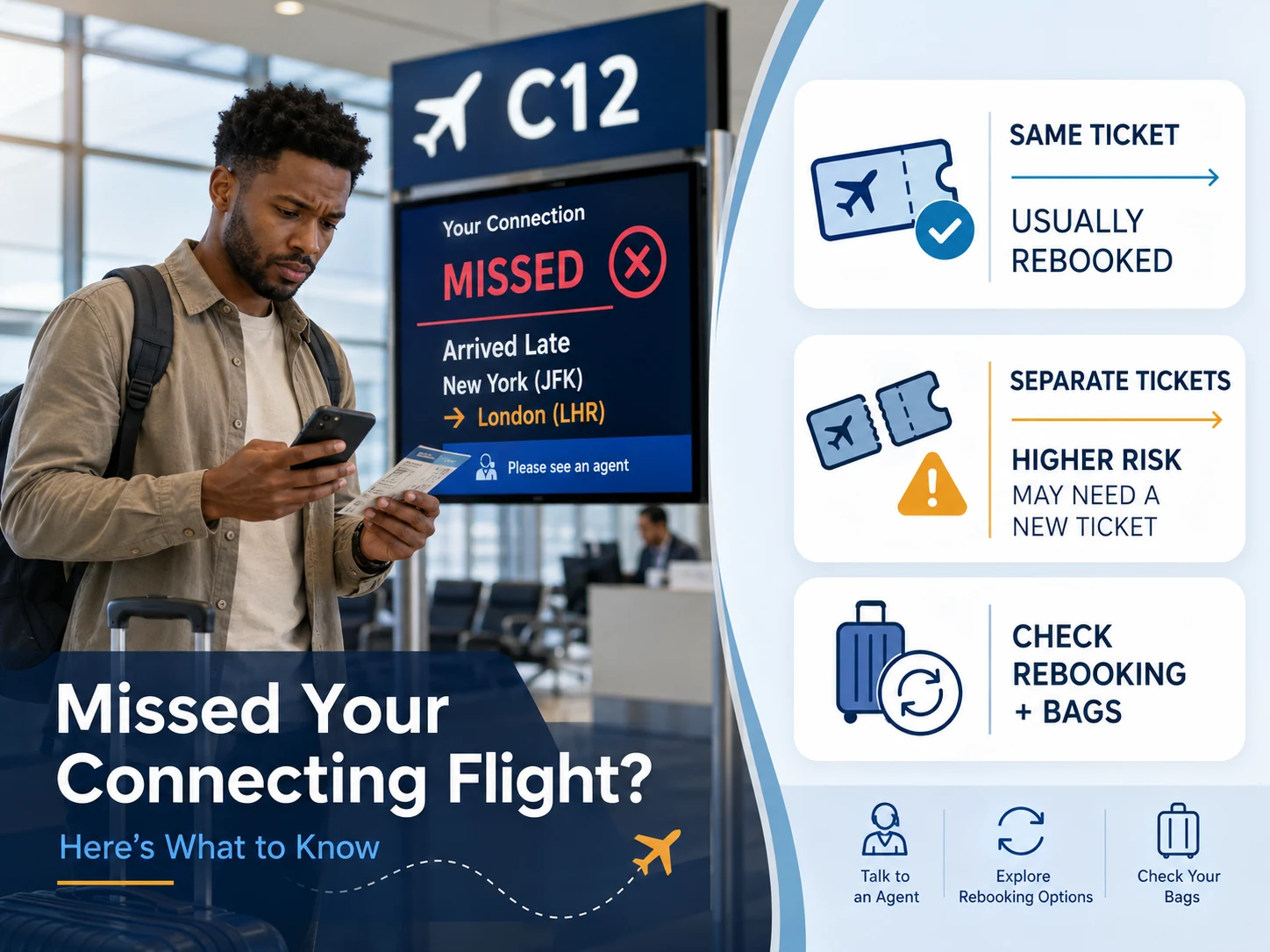
System Insight
A missed connection is handled first by ticket structure, then by cause.
- Same-ticket connections are usually protected because the airline sold the flights as one itinerary and will typically rebook you if a delay causes the missed connection.
- Separate tickets create more risk because the second airline may not treat the first delay as its responsibility.
- The cause of the delay matters because airline-controlled delays may lead to more support than weather, air traffic control, immigration, security, or other outside issues.
- Rebooking is not the same as compensation because the airline may get you to your destination without covering every meal, hotel, new ticket, or missed prepaid plan.
Start Here: Which Missed Connection Situation Applies?
Before you decide what the airline owes you, identify which situation applies.
A missed connection is usually handled differently depending on whether your flights were booked on one ticket, whether they were booked separately, and what caused the delay.
Find Your Situation
Which Missed Connection Situation Applies to You?
Start with the detail that best matches your trip. The outcome can change quickly depending on how the flights were booked and what caused the missed connection.
Your Flights Were Booked Together
The airline will usually rebook you to your final destination if a delay caused the missed connection.
Separate TicketsYour Flights Were Booked Separately
The second airline may treat you as a no-show, and you may need to buy a new ticket yourself.
Airline DelayThe Airline Caused the Delay
You may have stronger options for rebooking, meals, hotels, or other support depending on the situation.
Outside CauseWeather, ATC, Security, or Immigration
The airline may still rebook a same-ticket itinerary, but extra support may be more limited.
Quick rule: first confirm whether the flights were on one ticket or separate tickets. Then ask what caused the delay and what rebooking options are available.
What Usually Happens When You Miss a Connecting Flight
When you miss a connecting flight, the airline usually starts with one question:
Were both flights booked on the same ticket?
If the answer is yes, the connection is usually treated as protected. That means the airline will typically rebook you to your final destination if the first flight was delayed and caused you to miss the next flight.
If the answer is no, the missed connection may become your responsibility. The second airline may treat you as a no-show because that flight was on a separate reservation.
That is why two travelers can miss connections for the same reason and get very different outcomes. One may be rebooked automatically. The other may be told to buy a new ticket.
If Your Flights Were on the Same Ticket
If your flights were booked together on one itinerary, your missed connection is usually treated as protected.
That means the airline will usually rebook you to your final destination at no extra charge if a delay on the first flight caused you to miss the next one.
But protected does not always mean convenient.
You may be placed on the next available flight, routed through a different city, moved to a later departure, or delayed overnight if seats are limited.
Ask the airline:
- What flight have I been rebooked on?
- Are there earlier options through another route?
- Is there space on a partner airline?
- What happens to my checked bag?
- If the delay is overnight, are meals or hotel assistance available?
A same-ticket connection gives you more protection, but it does not guarantee the fastest route, the best seat, or coverage for every extra cost.
Travel Fine Print Takeaway
Protected does not always mean convenient. A same-ticket connection usually means the airline will rebook you, but it does not guarantee the fastest route, best seat, nonstop option, meal voucher, hotel room, or reimbursement for every extra cost.
↑ Back to missed connection situations
If Your Flights Were Booked Separately
Separate tickets create a much higher risk.
If your connecting flight was booked on a separate reservation, the second airline may not treat the first delay as its responsibility. Even if the first flight was late because of weather, crew, maintenance, or air traffic control, the next airline may see only one thing:
You did not show up for the flight you booked.
That can lead to a no-show problem.
If you miss a separately booked flight, you may need to:
- buy a new ticket
- pay a fare difference
- lose the unused value of the missed flight
- lose later flights on that same separate reservation
- work with the second airline before departure to protect the booking
Contact the second airline as soon as you know you may miss the flight. Do not wait until the flight departs if you can avoid it.
Ask whether they can move you to a later flight, preserve the ticket value, apply a same-day change, or prevent the reservation from being processed as a no-show.
Separate tickets can save money upfront, but they can leave a gap in protection when something goes wrong.
↑ Back to missed connection situations
If the Airline Caused the Missed Connection
If your missed connection was caused by something within the airline’s control, you may have stronger options than if the delay was caused by weather or another outside event.
Airline-controlled delays can include mechanical issues, crew scheduling problems, maintenance delays, aircraft swaps, boarding delays, or other operational issues.
If your flights were on the same ticket, the airline will usually rebook you to your final destination. Depending on the length of the delay and the airline’s policy, you may also be able to ask about meal vouchers, hotel assistance, transportation, or other support if you are stranded for several hours or overnight.
Ask the airline:
- What caused the delay?
- Have I already been rebooked?
- Is there an earlier routing available?
- Are meals or hotel assistance available?
- What happens to my checked bag?
- Can you confirm the delay reason in the app, by message, or in writing?
The key is to get the airline to confirm how the delay is being classified. That classification can affect what support is available beyond rebooking.
Rebooking and extra support are not the same thing. The airline may rebook you on a same-ticket itinerary, but meals, hotels, or other assistance usually depend on why the missed connection happened.
↑ Back to missed connection situations
If Weather or Another Outside Cause Delayed You
Not every missed connection is caused by the airline.
Weather, air traffic control, airport congestion, security delays, immigration lines, and other outside disruptions can all cause travelers to miss connections.
If your flights are on the same ticket, the airline will usually still try to rebook you to your final destination.
But support beyond rebooking may be limited.
That means you may be moved to a later flight without being offered meals, hotel coverage, transportation, or reimbursement for extra expenses. During major disruptions, available seats can also disappear quickly because many travelers are being rebooked at the same time.
This is where travelers often confuse being rebooked with being compensated. A same-ticket itinerary may protect your route to the final destination, but it does not always protect you from every cost caused by the delay.
Outside-cause delays may still get you rebooked, but not fully covered. Weather, air traffic control, immigration, security, and airport issues can limit what the airline provides beyond getting you to your destination.
What If Your Layover Was Too Short?
A short layover can make a missed connection feel like the airline set you up to fail.
But after you miss the connection, the outcome still depends mostly on how the ticket was booked.
If the airline sold both flights together on one ticket, the connection usually met the airline’s minimum connection time for that airport and route. That does not mean the connection was comfortable, but it usually means the airline treats the itinerary as protected if a delay caused you to miss the next flight.
If you created the short layover yourself with separate tickets, the risk is higher. The second airline may not care that the first flight was late because it was not part of the same protected itinerary.
A short layover matters, but it is not the first question to answer after the missed connection.
The first question is:
Were both flights on one ticket, or were they booked separately?
What Happens to Your Checked Bags If You Miss a Connecting Flight?
If you checked a bag, do not assume it will automatically follow the same path you do.
On a same-ticket itinerary, your bag is usually tagged to your final destination. If the airline rebooks you after a missed connection, the bag may be rerouted to the new flight automatically.
But during disruptions, bags can still be delayed, held at the connecting airport, or arrive before or after you do.
If your flights were booked separately, baggage can be more complicated. You may have needed to collect and recheck the bag between flights. If you missed the second flight before rechecking the bag, the second airline may not have control of it.
Before leaving the counter, ask:
- Is my bag still checked to my final destination?
- Was my bag transferred to the new flight?
- Do I need to collect and recheck it?
- What baggage claim number should I use if it is delayed?
- Will the bag arrive before me, after me, or on the same replacement flight?
The bag question is separate from the passenger question. Confirm both before you leave the airport.
What To Do Right Now If You Miss a Connecting Flight
Once you know you are going to miss your connection — or once the flight has already left — act quickly.
Available seats can disappear fast, especially when multiple travelers are being rebooked after the same delay.
Start with the airline app, but do not rely on it alone. Get in line at the customer service desk and call or message the airline at the same time if those options are available.
If your flights are on the same ticket, ask the airline to confirm your new itinerary and whether there are earlier or better routing options.
If your flights are on separate tickets, contact the second airline immediately. The goal is to reach them before the missed flight is fully processed as a no-show.
Ask:
- Have I already been rebooked?
- Are there earlier routing options?
- Can I be placed on standby?
- Can you protect the rest of my itinerary?
- What happens to my checked bag?
- If this is a separate ticket, can the missed flight value still be preserved?
The faster you act, the more options you may have before seats, ticket value, or later flights are affected.
Traveler Risk
Assuming every missed connection is protected can get expensive.
The biggest risk is assuming the airline will automatically fix the problem. That is often true when both flights are on one ticket, but it may not be true when the flights were booked separately.
If the second airline treats you as a no-show, you may lose the missed flight, later flights on that reservation, or the value of the unused ticket. That is why you should confirm your ticket structure before leaving the airport or buying a replacement flight.
Not Sure What Applies?
Find out whether your missed connection is protected or risky.
Use the Travel Fine Print Risk Checker to narrow whether your issue is a same-ticket missed connection, separate-ticket no-show risk, delay compensation question, rebooking issue, baggage problem, or documentation concern.
Use the Risk CheckerWhen a Missed Connection Gets Expensive
A missed connection does not always create a major financial problem.
If your flights are on one ticket and the airline can rebook you quickly, the disruption may only cost you time.
Costs start adding up when the delay stretches overnight, seats are limited, your bags are delayed, or your flights were booked separately.
The most common added costs include:
- a new ticket if your second flight was on a separate reservation
- hotel costs if the delay extends overnight
- meals during a long wait
- ground transportation if you need to leave the airport
- baggage delivery or replacement essentials if your bag is delayed
- lost prepaid hotel nights, tours, cruises, or transfers
- fare differences if the airline does not protect the missed flight
The important distinction is this:
Rebooking gets you to your destination. Support may include meals, hotels, or transportation. Compensation or reimbursement means money back, credits, or repayment for costs you paid yourself.
Those are different outcomes, and they are not always available in the same missed-connection situation.
Action Step
Before you leave the airport, confirm your ticket status, rebooking, and checked bag.
Do not leave with only a verbal “you should be fine.” Ask the airline to confirm the key details while you still have access to airport staff.
- Confirm whether your flights were on one ticket or separate tickets.
- Ask whether you have already been rebooked.
- Ask whether earlier or better routing options are available.
- Confirm whether the rest of your itinerary is still active.
- Ask what happens to your checked bag.
- Ask whether meals, hotel, transportation, or vouchers are available if the delay is long or overnight.
- Save delay notices, screenshots, receipts, boarding passes, and airline messages.
When Travel Insurance or Credit Card Benefits May Matter
Airline rebooking is only one part of the problem.
If a missed connection causes extra costs, you may also need to check your travel insurance policy or credit card trip delay benefits.
That can matter if you paid for:
- meals during a long delay
- an overnight hotel
- transportation between the airport and hotel
- replacement essentials if your bag was delayed
- missed prepaid tours, hotels, cruises, or transfers
- a new flight after a separate-ticket connection failed
But these benefits usually depend on the reason for the delay, how long the delay lasted, what expenses were covered, and whether you have the right documentation.
Before filing a claim, gather:
- boarding passes
- delay notices
- airline app screenshots
- written reason for the delay
- rebooking confirmation
- receipts for meals, hotels, transportation, or replacement items
- baggage delay reports if checked luggage was involved
Travel insurance and credit card benefits are not the same as airline compensation. They are separate claim paths with their own rules.
Before You File a Claim
Save proof of the missed connection before details disappear.
If you need reimbursement, travel insurance support, credit card benefits, or airline follow-up, documentation matters. Save the delay reason, boarding passes, app screenshots, rebooking details, receipts, baggage reports, and written airline responses while the disruption is still fresh.
Use the Travel Documents ChecklistTakeaway
The ticket structure matters more than the missed connection itself.
If both flights were booked together, the airline will usually rebook you after a missed connection caused by a delay. If the flights were booked separately, the second airline may treat you as a no-show. Once that happens, your options may depend on timing, fare rules, available seats, and whether the airline is willing to preserve the ticket value.
Frequently Asked Questions
Missed Connecting Flight FAQ
Missed connections can be confusing because the answer changes depending on whether your flights were booked together, what caused the delay, and whether the airline treats the itinerary as protected.
Will the airline rebook me if I miss my connecting flight?
Usually, yes — if both flights were booked together on the same ticket. The airline will typically rebook you to your final destination, but the replacement flight may be later, longer, or routed through a different city.
Do I have to pay if I miss a connecting flight?
If the missed connection was part of one ticket, you usually should not have to pay for the replacement flight. If your flights were booked separately, the second airline may treat you as a no-show and require you to buy a new ticket.
What if my first flight is delayed and I miss my connection?
If both flights are on one ticket, the airline will usually rebook you after a delay causes the missed connection. If the flights are on separate tickets, the second airline may not treat the first delay as its responsibility.
What happens if I miss a connecting flight on separate tickets?
The second airline may treat you as a no-show. You may need to buy a new ticket, pay a fare difference, or lose later flights on that separate reservation. Contact the second airline before departure if you know you may miss the flight.
What happens to my luggage if I miss a connecting flight?
On a same-ticket itinerary, your checked bag is usually tagged to your final destination and may be rerouted after you are rebooked. Still, ask the airline to confirm where your bag is going, whether it was transferred, and what claim number to use if it is delayed.
Can I get a hotel or compensation if I miss my connection?
Possibly, but it depends on what caused the missed connection, how long the delay lasts, the airline’s policy, and which passenger rights rules apply. Airline-controlled delays may lead to more support than weather, air traffic control, immigration, security, or other outside issues.
Bottom Line
Missing a connecting flight does not always lead to the same outcome.
If your flights were booked together on one ticket, the airline will usually rebook you when a delay causes you to miss the connection. The new flight may not be fast, direct, or convenient, but the itinerary is usually treated as protected.
If your flights were booked separately, the risk is different. The second airline may treat the missed flight as a no-show, even if the first delay was not your fault.
The key is to identify three things quickly:
- Were both flights on the same ticket?
- What caused the missed connection?
- Has the airline already rebooked you?
A missed connection is stressful, but the fastest way to protect yourself is to confirm your ticket structure, ask about rebooking, same-day change, or standby options immediately, and document what caused the delay.
Travel Insights
Know what to check before a travel problem gets expensive.
Missed connections, flight delays, no-show rules, refund limits, baggage issues, and travel insurance claims can all depend on details travelers often miss until the trip is already disrupted.
Join Travel Fine Print for practical guidance on:
- same-ticket vs separate-ticket connection risks
- airline rebooking, refund, and voucher fine print
- documentation to save before filing a claim
- travel rules that can affect your money, time, and trip plans
Related Guides
Missed connections often overlap with airline delays, no-show rules, separate-ticket risks, refunds, baggage problems, and claim documentation. These guides can help travelers understand what may happen next and what to check before accepting the airline’s first answer.
Missed Flights and Connection Risks
- Separate Ticket Connections: The Hidden Risk Most Travelers Miss — Explains why separate reservations can leave travelers responsible for a missed onward flight.
- Missed Flight or Canceled Ticket? What Travelers Should Know — Helpful when a missed flight may trigger no-show rules or affect the rest of the itinerary.
- Missed Boarding Cutoff: Can You Still Board If the Plane Is at the Gate? — Covers the gate-closed situation when boarding has ended but the aircraft has not departed.
Delays, Rebooking, and Airline Support
- Do Airlines Compensate You for Delayed Flights? — Explains the difference between compensation, refunds, rebooking, meals, hotels, and delay assistance.
- Overnight Flight Delay Hotel Voucher — Useful if a missed connection leaves a traveler stranded overnight and they need to know when hotel support may apply.
- Flight Canceled: Refund or Credit? How to Know What You’re Owed — Helps travelers understand refund vs credit options when the disruption turns into a cancellation.
Refunds, Bags, and Claim Documentation
- Airline Refund vs Travel Credit: What’s the Difference? — Explains why getting rebooked, credited, or refunded are different outcomes.
- Does Travel Insurance Cover Flight Delays?
See when trip-delay benefits may reimburse meals, lodging, transportation, and other costs—and which waiting periods, limits, and claim requirements apply. - Travel Insurance Claim Denied for Lack of Documentation — Helpful if a missed connection leads to out-of-pocket costs and the traveler later needs to support a claim.
- Travel Insurance Claim Proof: What Documents You May Need — Helps travelers know what to save for insurance, credit card benefits, or reimbursement claims.