
Your flight is delayed late into the night.
The airline rebooks you for the next morning, the airport is winding down, and now you need somewhere to sleep, something to eat, and possibly transportation to a hotel.
That is when the confusion starts.
Some travelers receive hotel vouchers. Others are told to book their own room. Some get meal vouchers, while others get nothing beyond a new flight. It can feel random, but airlines usually separate overnight delays into different categories.
A delay caused by the airline may be treated differently from a delay caused by weather, air traffic control, airport restrictions, or another outside event. A hotel voucher is also different from reimbursement after you pay for a room yourself.
The real question is not just:
“Will the airline pay for my hotel?”
It is:
“Was this a controllable overnight delay, and what hotel, meal, transportation, or reimbursement support does the airline’s policy actually provide?”
This guide explains when airlines may pay for hotels and meals during overnight delays, when they usually do not, and what to ask before you leave the airport or book a room on your own.
For the broader question of delay compensation, refunds, and rebooking rights, see Do Airlines Compensate You for Delays? (And When They Don’t).
Quick Answer
Do airlines pay for hotels during overnight delays?
Airlines may pay for a hotel, meals, and transportation during an overnight delay when the delay is controllable, meaning it was caused by something within the airline’s control. That can include mechanical problems, crew scheduling, maintenance, or certain operational disruptions.
If the delay is caused by weather, air traffic control, airport restrictions, security issues, or another outside event, the airline is usually less likely to provide hotel or meal support. Before booking your own room, ask whether the delay is considered controllable, whether hotel, meal, or transportation vouchers are available, and whether the airline will approve reimbursement if no voucher can be issued.
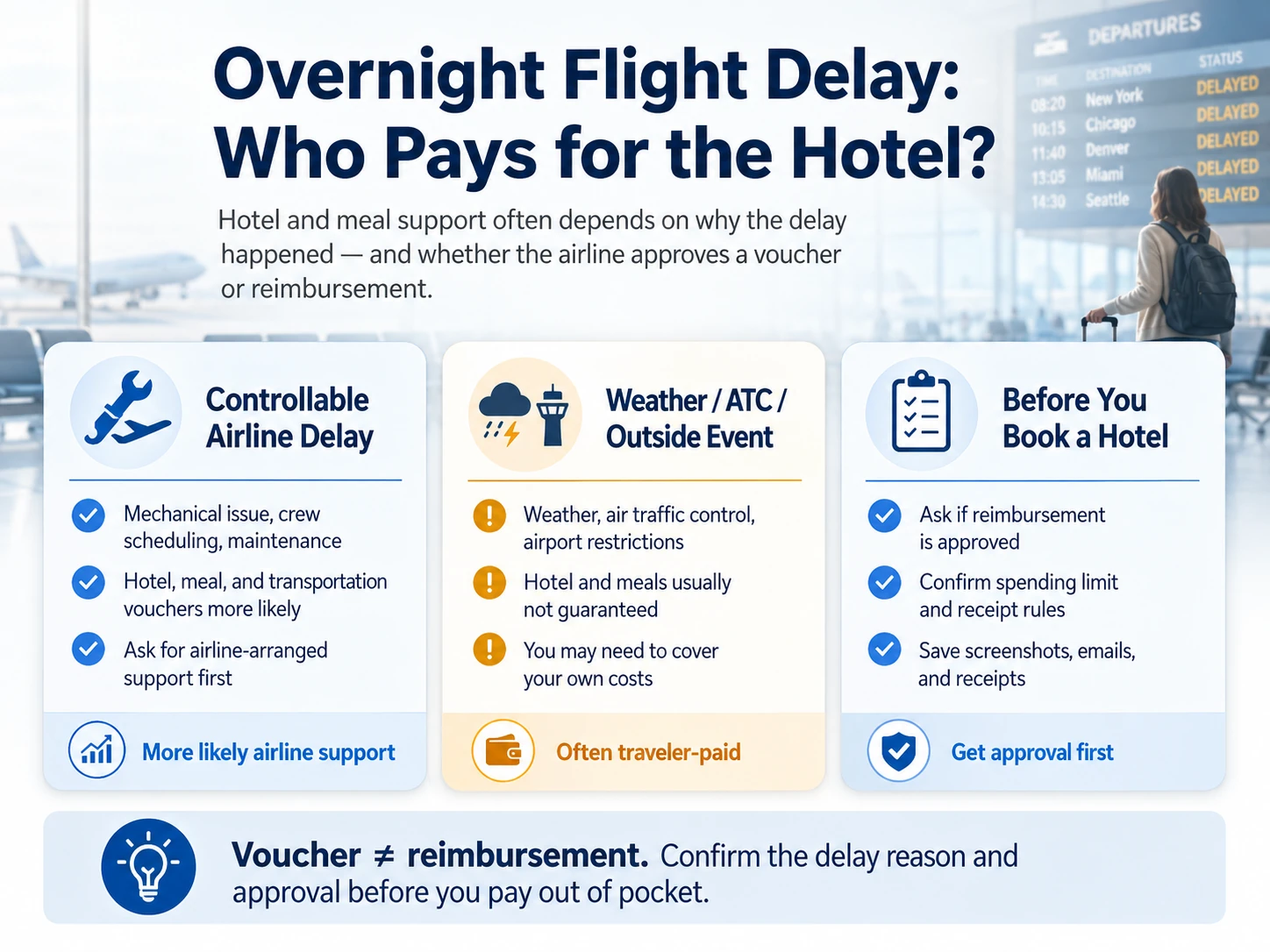
System Insight
Overnight hotel support usually depends on the cause of the delay, not just how long you are stuck.
- The controllable-delay distinction matters because hotel, meal, and transportation support is more likely when the airline caused the disruption.
- The outside-event distinction matters because weather, air traffic control, airport restrictions, and security issues usually reduce what the airline will provide.
- The voucher distinction matters because an airline-arranged hotel is different from booking your own room and hoping for reimbursement later.
- The availability distinction matters because even when support is offered, nearby hotel rooms and shuttle options can disappear quickly during widespread disruptions.
When Airlines May Pay — and When They Usually Don’t
Not every overnight delay is treated the same way.
Before assuming the airline owes you a hotel, separate the delay into one of three common situations: a controllable airline delay, an outside disruption, or a mixed situation where support may depend on timing, availability, and approval.
Overnight Delay Scenarios
Which overnight delay situation are you in?
Airline support usually depends on why the delay happened, whether the airline considers it controllable, and whether hotel rooms or meal vouchers are still available.
More Likely
Controllable Airline Delay
Mechanical issues, crew scheduling, maintenance, or airline operational problems may make hotel, meal, and transportation support more likely.
What this means: Ask for hotel and meal vouchers before booking anything yourself.
Less Likely
Weather or Outside Event
Weather, air traffic control, airport restrictions, security issues, or other external disruptions usually reduce what the airline will cover.
What this means: You may need to arrange and pay for your own hotel, meals, and transportation.
Check First
Limited Voucher or Reimbursement Situation
Sometimes vouchers run out, partner hotels are full, or the airline tells you to book your own room and request reimbursement later.
What this means: Get approval, limits, receipt instructions, and the reason for the delay in writing before paying out of pocket.
Why the Cause of the Delay Matters
Airlines usually do not decide hotel and meal support based only on the number of hours you are delayed.
They first look at why the delay happened.
If the airline caused the overnight disruption, such as through a mechanical issue, maintenance problem, crew scheduling issue, or operational decision, the delay may be treated as controllable. That is when hotel, meal, and transportation support is more likely.
If the delay was caused by weather, air traffic control, airport restrictions, security issues, or another outside event, the airline may still rebook you, but it is usually less likely to cover your hotel or meals.
That is why the same overnight delay can feel unfair. From the traveler’s perspective, the problem is the same: you are stuck overnight. From the airline’s policy perspective, the cause of the delay changes what support may be available.
The key question to ask is:
“Is this delay considered controllable by the airline?”
That answer usually matters more than whether the delay was inconvenient, expensive, or overnight.
Hotel Voucher vs. Reimbursement
A hotel voucher and hotel reimbursement are not the same thing.
A hotel voucher usually means the airline is arranging or authorizing the hotel directly. The airline may send you to a partner hotel, issue a voucher code, provide instructions through the app, or have an airport agent assign accommodations.
Reimbursement usually means you pay first and ask the airline to pay you back later.
That is riskier.
If the airline tells you to book your own hotel, ask for the reimbursement rules before you leave the airport. Some airlines may require advance approval, a maximum nightly amount, specific receipt details, or proof that the delay was within the airline’s control.
Do not assume that any hotel you book will be reimbursed.
The safer question is:
“If I book my own hotel because no voucher is available, what amount will the airline reimburse, and where is that policy written?”
If the agent cannot confirm the reimbursement process, treat the expense as something you may need to cover yourself.
How to Check the Airline’s Hotel and Meal Policy
Most travelers ask the gate agent whether the airline will pay for a hotel.
You can also check the U.S. Department of Transportation airline customer service dashboard to see what major U.S. airlines have committed to provide for controllable delays and cancellations.
That is the right place to start, but it should not be the only place you check.
Airlines may publish customer commitments, customer service plans, or delay and cancellation policies that describe when they provide hotel accommodations, meal vouchers, ground transportation, or reimbursement during controllable overnight delays.
The important part is that these policies often come with conditions.
Look for language that answers:
- whether the delay must be controllable
- whether the support applies only to an overnight delay
- whether the airline provides a hotel voucher or only possible reimbursement
- whether transportation to and from the hotel is included
- whether meal vouchers are included separately
- whether weather, air traffic control, airport restrictions, or security events are excluded
The policy language matters because a verbal answer at the airport may be incomplete, especially during a large disruption.
Before leaving the airport, ask the airline to confirm the delay reason, the hotel or meal support available, and whether reimbursement is allowed if no voucher can be issued. Then save screenshots, emails, app notices, text messages, receipts, and the name or location of the agent who gave the instruction.
Traveler Risk
Do not book your own hotel assuming the airline will reimburse you.
A gate agent may tell you to find a hotel, but that does not always mean the airline will reimburse any room you choose. Reimbursement may depend on whether the delay was controllable, whether the airline authorized the expense, whether there was a spending limit, and whether you submit the right receipts.
Before paying out of pocket, ask the airline to confirm the reimbursement amount, submission process, delay reason, and whether meals or transportation are included. If you cannot get that confirmed, treat the hotel cost as something you may need to cover yourself.
Check the Fine Print
Not sure what the airline may owe after an overnight delay?
Use the Travel Fine Print Risk Checker to narrow whether your issue is a controllable delay, weather disruption, missed connection, hotel voucher problem, reimbursement question, meal voucher issue, or broader delay-compensation concern.
Before we move into the action checklist, the important thing is to slow the situation down.
An overnight delay can make everything feel urgent, especially when hotels are filling up and other passengers are already making plans. But this is exactly when the details matter most.
Before you leave the gate area, book a room, or accept a quick verbal answer, try to confirm three things: why the delay happened, what support the airline is offering, and whether you have approval to pay out of pocket.
Action Step
Ask these questions before you leave the gate area or book a hotel.
If your delay turns into an overnight stay, focus on getting clear answers before hotel rooms disappear, the gate closes, or you pay for something the airline may not reimburse.
- ✓Ask whether the delay is considered controllable.
- ✓Ask whether hotel vouchers are available.
- ✓Ask whether meal vouchers are included.
- ✓Confirm whether transportation to and from the hotel is covered.
- ✓Ask what to do if no airline-arranged hotel is available.
- ✓Get reimbursement approval, limits, and receipt instructions in writing.
Quick win: Ask, “Is this a controllable delay, and if I book my own hotel because no voucher is available, what amount will the airline approve for reimbursement?”
Before You Leave the Airport
Save the proof before the delay details disappear.
Hotel, meal, transportation, and reimbursement questions often depend on the delay reason, airline instructions, receipts, app notices, voucher details, and written approval you received at the airport. Use the Travel Documents Checklist to keep the details organized before you need them for an airline claim, insurance claim, or credit card benefit.
What If the Airline Says No Hotel Rooms Are Available?
Even when an airline offers hotel support, that does not always mean a room will be available.
During widespread disruptions, nearby airport hotels can fill quickly. Partner hotels may run out of rooms, shuttle service may be limited, and airport agents may be handling hundreds of passengers at once.
That creates a frustrating gap: the delay may be controllable, but the airline may not have an easy hotel option left to give you.
In that situation, ask the airline what you should do next. Do not just leave and book the most convenient room without confirming whether reimbursement is possible.
Ask:
- “Are there any partner hotels still available?”
- “If no voucher hotel is available, am I allowed to book my own hotel?”
- “Is there a maximum reimbursement amount?”
- “Are taxes, transportation, and meals included?”
- “Where do I submit the receipts?”
If the airline cannot confirm reimbursement, compare the cost of booking your own hotel against the possibility that you may not get paid back. That does not make the situation fair, but it helps you make the decision with fewer assumptions.
Travel Fine Print Takeaway
The overnight delay is only part of the answer.
Hotel and meal support usually depends on whether the delay is controllable, what the airline’s policy says, what vouchers are still available, and whether the airline authorizes reimbursement before you pay out of pocket.
The safest move is to confirm the delay reason, voucher options, reimbursement rules, and receipt process before leaving the airport. Being stuck overnight may create an urgent problem, but it does not automatically guarantee that the airline will cover every hotel, meal, or transportation expense.
❓Frequently Asked Questions
Overnight delays can be confusing because hotel and meal support usually depends on why the delay happened, what the airline’s policy provides, and whether vouchers or reimbursement are available at the time.
Do airlines pay for hotels if your flight is delayed overnight?
Airlines may pay for a hotel during an overnight delay if the delay is considered controllable, such as a mechanical issue, crew scheduling problem, maintenance issue, or airline operational disruption. If the delay is caused by weather, air traffic control, airport restrictions, or another outside event, hotel support is usually less likely.
Do airlines give meal vouchers during overnight delays?
Sometimes. Meal vouchers are more likely when the delay is controllable and long enough to trigger the airline’s customer service policy. They are less likely during weather, air traffic control, security, or airport-related disruptions. Ask whether meal vouchers are available separately from hotel support.
What counts as a controllable airline delay?
A controllable delay is usually a disruption caused by something within the airline’s control, such as mechanical problems, maintenance, crew scheduling, staffing issues, or certain operational decisions. Weather, air traffic control, airport restrictions, security issues, and natural disasters are usually treated as outside the airline’s control.
Will an airline reimburse me if I book my own hotel?
Possibly, but you should not assume reimbursement without approval. Some airlines may reimburse reasonable hotel costs when no voucher is available after a controllable delay, but they may require authorization, spending limits, receipts, and proof of the delay reason. Ask for the reimbursement rules in writing before booking your own room.
Does the airline have to pay for a hotel during a weather delay?
Usually not. When the delay is caused by weather or another outside event, airlines generally rebook passengers but are less likely to cover hotel, meal, or transportation costs. In that situation, travel insurance or a credit card trip delay benefit may be more relevant than airline reimbursement.
Bottom Line
Airlines do not automatically pay for hotels and meals just because a flight delay becomes overnight.
The most important question is whether the delay is controllable. If the airline caused the disruption through a mechanical issue, crew scheduling problem, maintenance issue, or operational decision, hotel, meal, and transportation support may be available. If the delay is caused by weather, air traffic control, airport restrictions, security issues, or another outside event, you should be prepared to cover those costs yourself.
A hotel voucher is also different from reimbursement. If the airline arranges the hotel, the process is usually clearer. If you book your own room and ask to be paid back later, reimbursement may depend on approval, spending limits, receipts, and the airline’s delay classification.
The safest question is not just:
“Will the airline pay for my hotel?”
It is:
“Is this delay controllable, are hotel or meal vouchers available, and what reimbursement will the airline approve before I pay out of pocket?”
Before leaving the airport, confirm the delay reason, ask about hotel, meal, and transportation support, save written instructions, and keep every receipt.
Related Guides
If your flight delay turns into an overnight stay, these related guides can help you understand the broader delay rules, rebooking options, refunds, vouchers, and documentation you may need if you pay out of pocket.
Airline Delay and Compensation Rules
- Do Airlines Compensate You for Delays? (And When They Don’t)
Understand the broader delay-compensation rules, including when airlines may owe support and when they usually do not. - Does Travel Insurance Cover Flight Delays?
See when trip-delay benefits may reimburse meals, lodging, transportation, and other costs—and which waiting periods, limits, and claim requirements apply. - Airline Delay Letter for Travel Insurance
Use this if you need written proof of the delay reason, length, or airline disruption for an insurance claim.
Refunds, Credits, and Vouchers
- Flight Canceled: Refund or Credit?
Helpful if the overnight delay turns into a cancellation and you need to know whether refund or credit rules may apply. - Airline Refund vs Travel Credit: What’s the Difference?
Learn why a credit, voucher, reimbursement, or refund may not give you the same rights or flexibility.
Boarding and Disruption Problems
- What Happens If You Miss Your Flight?
Use this if the overnight delay causes a missed connection, no-show risk, or confusion about the rest of your itinerary. - Denied Boarding Compensation: What Travelers Should Know
Helpful if the disruption involves bumping, oversold flights, gate offers, or compensation discussions.