
Your flight is delayed because of weather, and now you are stuck at the airport, missing a connection, or facing an overnight stay.
It feels like the airline should help. After all, you bought a ticket, showed up on time, and the disruption was not your fault.
But weather delays are handled differently from many airline-caused problems.
That is where many travelers get stuck.
The length of the delay is not the only thing that matters. The cause of the delay matters just as much. When weather is involved, airlines usually treat the disruption as outside their control, which can limit what they are required to provide.
The real question is not just:
“How long is my flight delayed?”
It is:
“Is the airline responsible for the delay — and what does that mean for compensation, meals, hotels, refunds, and rebooking?”
This guide explains whether airlines compensate passengers for weather delays, what support you may still receive, when refunds may apply, and what to do if a weather delay leaves you stranded.
Quick Answer
Do airlines compensate you for weather delays?
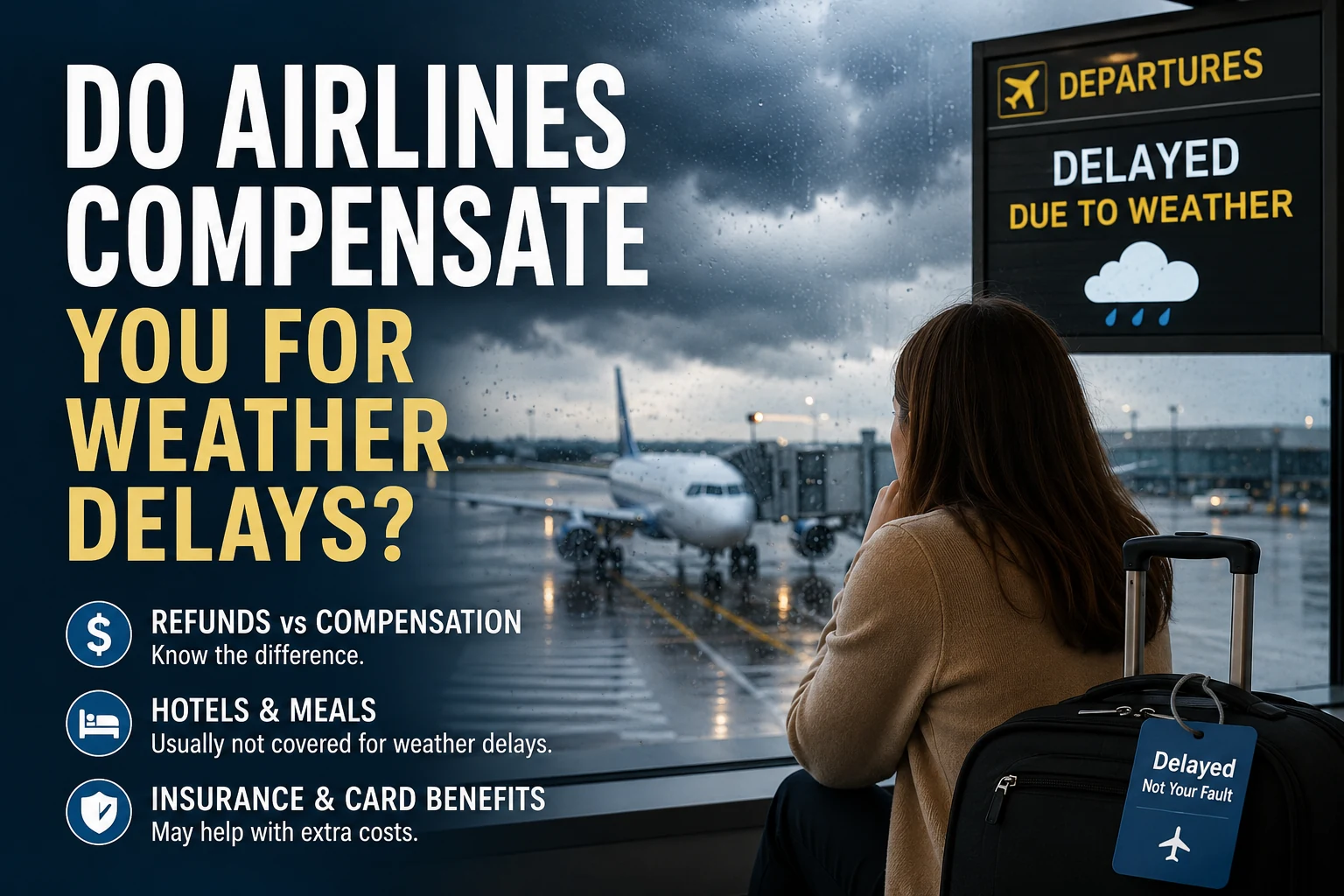
Usually, no. Airlines generally do not owe extra compensation, hotels, or meals when a flight delay is caused by weather because weather is considered outside the airline’s control. The airline will usually try to rebook you, but additional support depends on the airline’s policy, availability, and the exact situation.
A weather delay can still create refund or travel insurance questions. If the flight is canceled or significantly changed and you do not accept the alternative, a refund may be available. If you continue traveling, meals, hotels, and extra costs are more likely to depend on airline goodwill, travel insurance, or credit card trip delay benefits.
System Insight
Weather delays change the airline’s responsibility, not just the traveler’s schedule.
- Cause matters because airlines treat weather differently from mechanical, staffing, or operational issues.
- Compensation is limited because weather is usually considered outside the airline’s control.
- Rebooking is still important because the airline may move you to another flight, but options can disappear quickly during widespread weather events.
- Refunds are a separate question because a canceled or significantly changed flight may create refund options even when the delay was weather-related.
- Out-of-pocket costs may shift to you unless the airline voluntarily helps, travel insurance applies, or a credit card benefit covers the delay.
Why Weather Delays Are Treated Differently
Weather delays are treated differently because the airline usually is not considered responsible for the cause.
That does not mean the delay is minor. A weather delay can strand travelers overnight, cause missed connections, trigger rebooking problems, and create real expenses.
But airline responsibility is usually based on why the disruption happened, not just how long it lasted.
A delay caused by aircraft maintenance, crew scheduling, or another airline-controlled issue may lead to more support. A delay caused by thunderstorms, hurricanes, snow, high winds, airport weather restrictions, or air traffic flow problems is usually treated as outside the airline’s control.
That distinction changes what the airline is expected to provide.
For U.S. domestic flights, DOT notes that airlines are generally not required to compensate passengers for delayed or canceled flights, except in specific situations such as involuntary denied boarding. DOT’s customer service dashboard also focuses airline meal and hotel commitments on controllable delays and cancellations, which is why weather usually falls into a different category.
That is why two travelers can experience similar delays and receive very different support.
One passenger delayed by a mechanical issue may receive meal vouchers, a hotel, or more flexible rebooking help. Another passenger delayed by severe weather may receive rebooking only — even if the delay is just as disruptive.
The key is not just the delay.
It is whether the airline caused it.
What Are You Entitled to During a Weather Delay?
During a weather delay, your options are usually more limited than they would be during an airline-controlled disruption.
In most cases, you should expect the airline to help with rebooking, but not necessarily with extra compensation, meals, hotels, transportation, or reimbursement for out-of-pocket costs.
You may still have options, but they usually fall into different categories.
Rebooking:
The airline will usually try to rebook you if the delay causes a missed connection, cancellation, or major schedule issue. During widespread weather, available seats can disappear quickly, so rebooking may be delayed or limited.
Cash compensation:
Cash compensation is usually not required for weather delays because weather is treated as outside the airline’s control.
Meals and hotels:
Meals, hotel rooms, and ground transportation are usually not required for weather delays. Some airlines may help as a goodwill gesture, but you should not rely on it.
Refunds:
Refunds are a separate question. If the airline cancels the flight or significantly changes it and you do not accept the alternative offered, DOT says a refund may be due, even when the original ticket was non-refundable.
Travel insurance or credit card benefits:
If you have trip delay, trip interruption, or credit card travel protection, those benefits may help with meals, hotels, transportation, or other extra costs. Coverage depends on the policy, reason, delay length, and documentation.
The practical takeaway is simple:
For weather delays, the airline may help you continue the trip, but it usually will not cover every cost caused by the disruption.
How the Cause Changes the Outcome
Weather Delays vs Airline-Controlled Delays
The same delay length can lead to different outcomes depending on whether the airline caused the problem or the disruption was outside its control.
Limited airline responsibility
- Usually treated as outside the airline’s control
- Cash compensation is usually not required
- Hotels and meals are usually not provided
- Rebooking may be offered, but options can be limited
- Travel insurance or card benefits may matter more
More support may be available
- Often tied to maintenance, crew, staffing, or operations
- Meal or hotel commitments may apply depending on the airline
- Rebooking options may be more flexible
- Reimbursement or vouchers may be more realistic in some situations
- Airline policy and availability still matter
Quick rule: do not judge the outcome only by how long the delay lasts. First confirm whether the disruption was weather-related, airline-controlled, or mixed.
What Airlines May Still Do During Weather Delays
A weather delay does not mean the airline will do nothing.
It means the airline’s responsibility is usually more limited.
In most weather disruptions, the airline’s main role is to help you continue the trip. That usually means rebooking you on another available flight, updating your itinerary, or helping you protect a connection if the flights are on the same ticket.
But during widespread weather events, even rebooking can become difficult.
Storms, snow, high winds, hurricanes, and airport restrictions can affect many flights at once. When that happens, seats disappear quickly, standby lists grow, and hotel rooms near the airport may sell out before travelers realize they need one.
The airline may still offer help, such as:
- Rebooking on the next available flight
- Same-day standby or alternate routing
- Waiving certain change fees during a weather waiver
- Allowing travel date changes within a limited window
- Offering app-based rebooking options
- Providing goodwill vouchers in limited situations
- Explaining whether the flight is delayed, canceled, or significantly changed
But meals, hotels, transportation, and cash compensation are usually much less certain when weather is the cause.
That is why the smartest move is to check options early instead of waiting for the airline to solve everything automatically.
Traveler Risk
Waiting for the airline to provide weather-delay support can leave you with fewer options.
The risk is assuming a long weather delay will automatically trigger meals, a hotel, compensation, or reimbursement. In many weather disruptions, the airline may focus on rebooking while travelers are left to manage food, lodging, transportation, and extra costs on their own.
During a large weather event, seats and hotel rooms can disappear quickly. If you wait too long, the best rebooking options may be gone, nearby hotels may be sold out, and the cost of solving the problem yourself may be much higher.
Check the Fine Print
Not sure what the airline owes you after a weather delay?
The Travel Fine Print Risk Checker can help you sort the issue: weather delay, airline-controlled delay, missed connection, cancellation, refund question, hotel cost, meal voucher, insurance claim, or credit card benefit.
What To Do During a Weather Delay
When weather is involved, act early.
Do not wait for the airline to offer every option. Weather disruptions can affect many flights at once, and the best rebooking options may disappear quickly.
Start by confirming the cause of the delay. Ask whether the disruption is coded as weather, air traffic control, airport conditions, crew, maintenance, or another operational issue. The cause matters because it affects what the airline may be required to provide.
Then check your rebooking options in more than one place. Look in the airline app, check airport monitors, speak with an agent, and search alternate flights on your own. If you are on a connecting itinerary, ask whether your full trip is protected on one ticket.
If the delay is likely to stretch overnight, check hotel availability early. During storms or regional disruptions, nearby hotels can sell out quickly, even if the airline is not providing vouchers.
Also check whether a weather waiver is active. Airlines sometimes allow travelers to change dates or routes within a limited window when major weather is expected.
Before spending money, save proof of the delay and the cause. Keep screenshots, airline notifications, boarding passes, hotel receipts, meal receipts, transportation receipts, and any written denial of vouchers or reimbursement.
Even if the airline does not owe compensation, documentation may still matter for travel insurance, credit card trip delay coverage, or later refund questions.
Action Step
Confirm the Cause, Rebook Early, and Save Proof
During a weather delay, your best move is to separate what the airline may do from what you may need to handle yourself. Ask early, document everything, and do not assume hotels, meals, or reimbursement will be automatic.
Quick win: Ask, “Can you confirm the delay reason in writing, show me my rebooking options, and tell me whether any hotel, meal, refund, waiver, insurance, or card-benefit documentation is available?”
Before You Leave the Airport
Save the Delay Proof Before It Disappears
Weather-delay claims often depend on documentation. Save the delay reason, rebooking details, cancellation notices, receipts, hotel costs, meal costs, transportation charges, airline messages, and any voucher or reimbursement denial before the app or airport screen updates.
❓Frequently Asked Questions
Weather delays create confusion because the disruption can be serious, but the airline’s responsibility is usually limited by what caused the delay.
Do airlines compensate you for weather delays?
Usually, no. Weather is generally treated as outside the airline’s control, so airlines usually do not owe extra cash compensation for weather-related delays.
The airline may still rebook you, and some airlines may offer help as a goodwill gesture, but meals, hotels, and reimbursement are usually not guaranteed when weather is the cause.
Do airlines have to pay for hotels during weather delays?
Usually, no. Hotel accommodations are much more likely when the disruption is within the airline’s control, such as certain maintenance or staffing issues.
If the delay is caused by weather, you may need to arrange and pay for your own hotel, then check whether travel insurance or credit card trip delay coverage may reimburse the cost.
Can you get a refund if your flight is delayed because of weather?
A weather delay by itself does not automatically mean you get a refund if you still take the flight.
But if the airline cancels the flight or significantly changes your itinerary and you do not accept the alternative, a refund may be available even if the disruption was weather-related.
What are you entitled to during a weather delay?
You are usually entitled to information about the delay and help with rebooking if the disruption affects your travel. Beyond that, support is more limited.
Meals, hotels, transportation, and extra compensation usually depend on the airline’s policy, availability, goodwill, travel insurance, or credit card benefits.
Can travel insurance cover weather delay expenses?
Sometimes. Trip delay or trip interruption coverage may help with meals, hotels, transportation, or other extra costs if the delay meets the policy’s requirements.
Coverage usually depends on the reason for the delay, how long the delay lasts, what expenses are covered, and whether you save the required documentation.
Bottom Line
Airlines usually do not compensate travelers for weather delays the same way they may respond to airline-controlled disruptions.
That is because weather is generally treated as outside the airline’s control. The airline may still rebook you, but meals, hotels, cash compensation, transportation, and reimbursement are usually not guaranteed.
The key distinction is not just how long the delay lasts.
It is what caused it.
If the delay is weather-related, act early. Confirm the reason, check rebooking options, look for weather waivers, save receipts, and check whether travel insurance or credit card benefits may help with extra costs.
And if the airline cancels or significantly changes the flight and you do not accept the alternative, do not assume weather eliminates every refund option. Refunds are a separate question from delay compensation.
Related Guides
Weather delays often create follow-up questions about rebooking, missed connections, refunds, and proof for insurance or card benefits. These guides help travelers understand what to check next when the airline says the disruption was outside its control.
Flight Delays and Rebooking
- Do Airlines Compensate You for Delayed Flights? — Explains how airline responsibility changes depending on the cause of the delay.
- What Happens If You Miss a Connecting Flight? — Helpful if a weather delay causes a missed connection or forces rebooking across multiple flights.
Refunds and Credits
- Airline Refund vs Travel Credit: What’s the Difference? — Useful when a delay or cancellation leads to a choice between taking a credit or asking for money back.
- Flight Canceled: Refund or Credit? How to Know What You’re Owed — Helps travelers understand refund options when a flight is canceled and they do not continue traveling.
Insurance and Documentation
- Does Travel Insurance Cover Flight Delays?
See when trip-delay benefits may reimburse meals, lodging, transportation, and other costs—and which waiting periods, limits, and claim requirements apply. - Travel Insurance Claim Proof: What Documents You May Need — Useful if weather-related costs need to be submitted to travel insurance or credit card benefits.