
Airline Passenger Rights
Bumped From a Flight? Denied Boarding Compensation & What Airlines Owe
You checked in on time, reached the gate, and had a confirmed reservation — but the airline still says there is no seat for you. What happens next depends heavily on one distinction: did you agree to give up your seat, or is the airline forcing you off an oversold flight?
The decision: Are you choosing to give up your seat for an airline offer — or are you being involuntarily denied boarding from an oversold flight?
About This Guidance
This guide focuses on oversold flights, voluntary bumping, involuntary denied boarding, U.S. compensation rules, international passenger-rights differences, and what to document before you leave the gate. For broader guidance on airline booking rules, boarding issues, and flight disruptions, see our Flights & Airlines guidance.
On This Page
- Quick Answer
- The Decision in 30 Seconds
- Three Different Boarding Situations
- How an Oversold Flight Escalates
- U.S. Denied Boarding Compensation
- When U.S. Compensation May Not Apply
- Before You Accept a Volunteer Offer
- International Passenger-Rights Rules
- What to Get in Writing
- Who Gets Bumped First?
- The Fine Print That Matters
- TFP Recommendation
- Before You Go
- FAQ
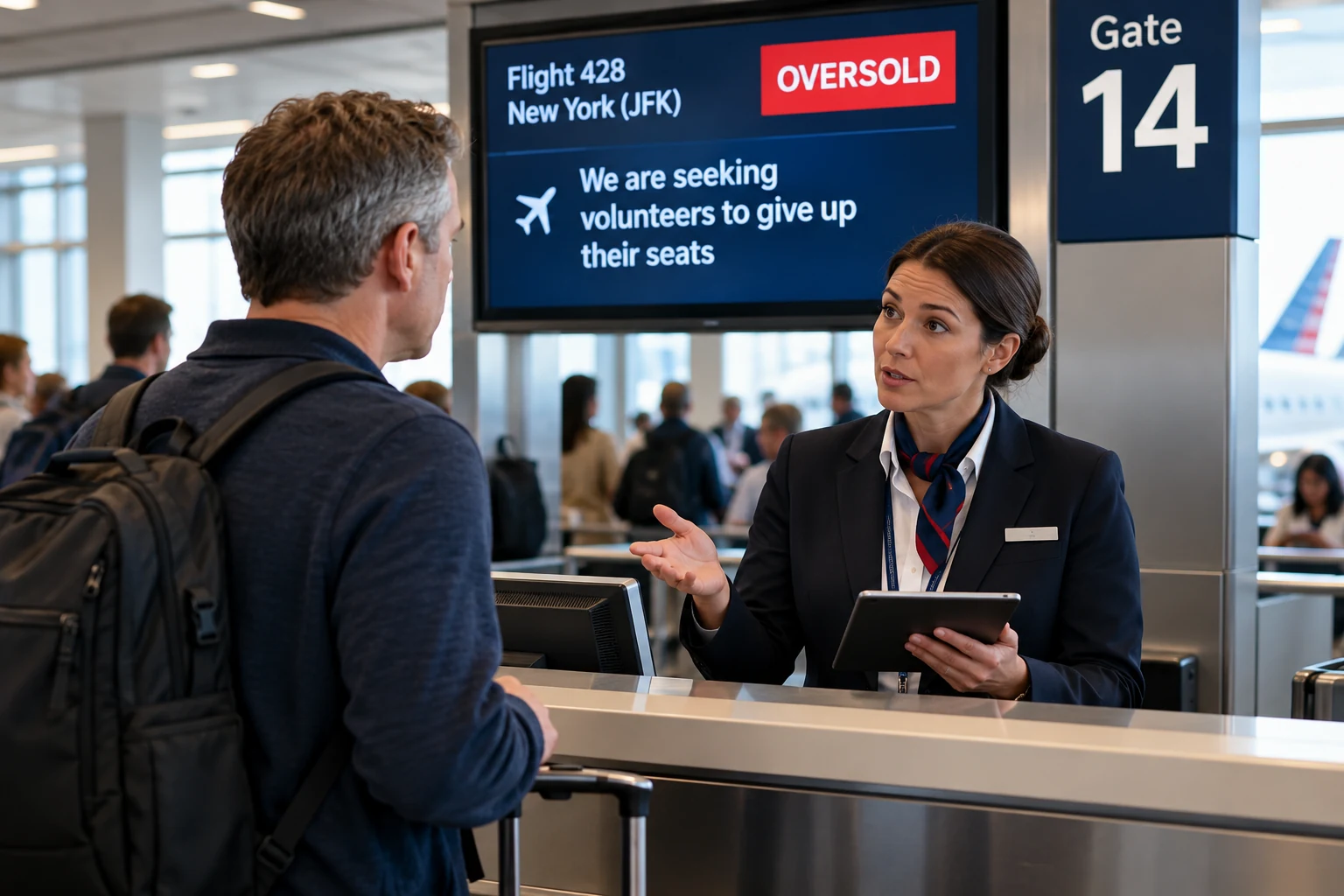
On an oversold flight, the airline normally asks for volunteers before moving to involuntary denied boarding. That distinction can change what compensation rules apply.
Quick Answer
What compensation can you get if you are bumped from a flight?
If you volunteer to give up your seat, the airline’s offer is generally a negotiation. You may be offered money, a voucher, travel credit, miles, meals, a hotel, or another arrangement.
If you do not volunteer and the airline involuntarily denies you boarding because a flight departing a U.S. airport is oversold, federal denied-boarding compensation rules may apply if you met the reservation, check-in, and gate requirements. For a qualifying case, the current U.S. maximum is $1,075 for the shorter compensation tier and $2,150 for the longer tier.
The key distinction: a voluntary gate offer is a negotiation. Involuntary denied boarding can trigger legal compensation rights. The amount then depends largely on the one-way fare and how late the airline’s replacement transportation gets you to your destination.
What “denied boarding compensation” means
Denied boarding compensation is payment an airline may be required to provide when it involuntarily bumps an eligible passenger from an oversold flight. It is not automatically owed every time a traveler is prevented from boarding.
The Decision in 30 Seconds
Which situation are you actually in?
| What is happening? | What it means |
|---|---|
| The airline is asking for volunteers | You can negotiate. Confirm the compensation, restrictions, and confirmed replacement flight before saying yes. |
| You did not volunteer, but the airline will not let you board an oversold flight | This may be involuntary denied boarding, where statutory compensation can apply. |
| You missed the cutoff or have a document, ticket, or travel-rule problem | You may still be denied boarding, but the same oversales-compensation rules may not apply. |
| Your flight is covered by another passenger-rights regime | EU, Canadian, Turkish, or other rules may produce a different compensation path. |
Start With the Reason
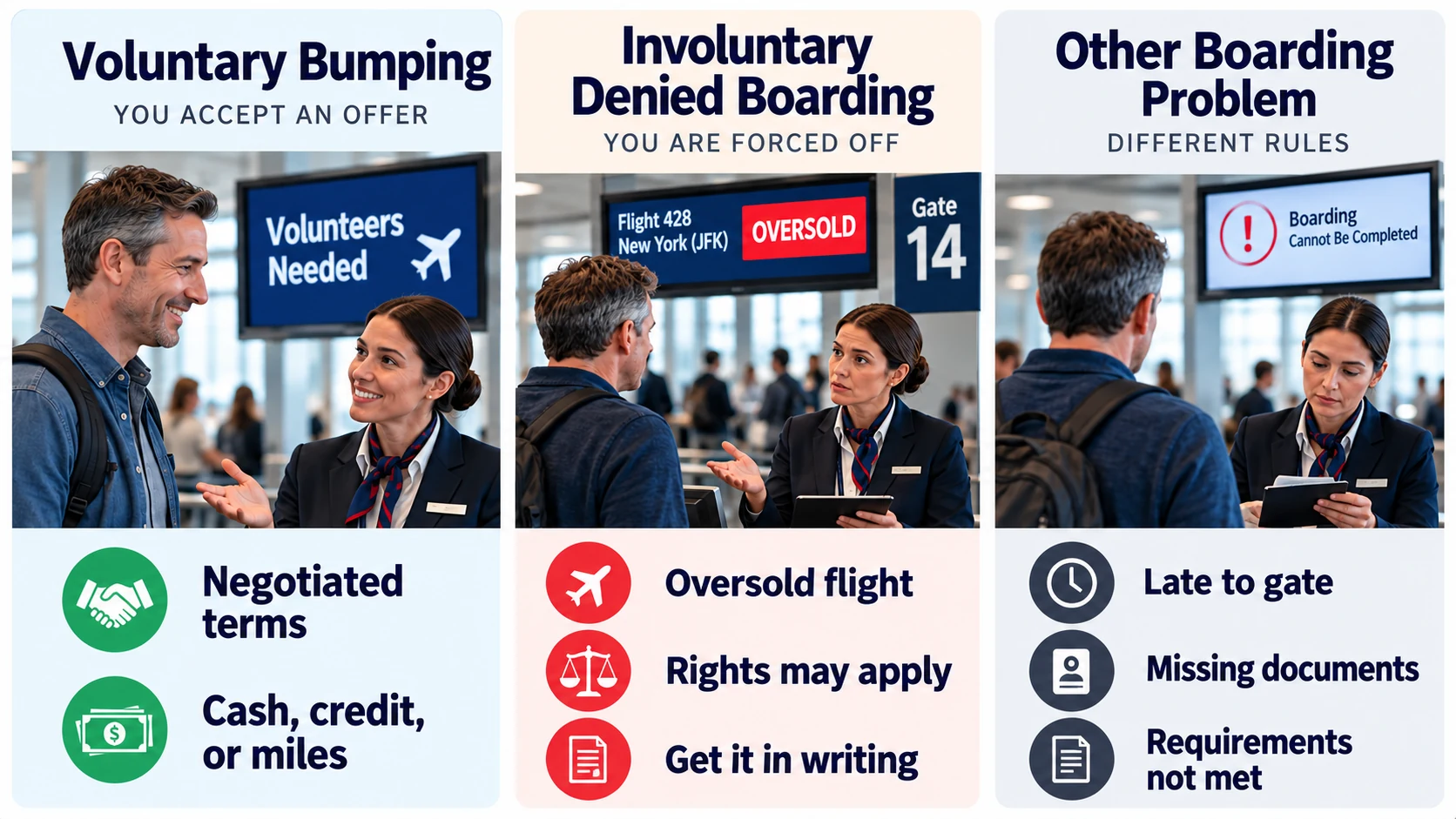
“Bumped from a flight” can describe three different situations.
The fact that you did not board is not enough by itself to determine what the airline owes. The reason matters.
Voluntary bumping
You agree to give up your confirmed seat in exchange for an offer. The value and terms are usually negotiated at the gate.
Involuntary denied boarding
The flight is oversold, not enough passengers volunteer, and the airline selects you even though you did not agree to give up your seat.
Another boarding problem
You arrive late, miss the boarding cutoff, lack required documents, fail a travel requirement, or face another issue unrelated to oversales.
The first question to ask at the gate
“Am I being involuntarily denied boarding because this flight is oversold?”
How Overbooking Works
An oversold flight usually moves from negotiation to forced selection.
Airlines may sell more tickets than available seats because they expect some passengers not to show. When more passengers arrive than expected, the gate has to resolve the oversale.
1. The airline asks for volunteers
Passengers are offered money, vouchers, credits, miles, or other benefits to take a later flight.
2. The offer may increase
If too few people accept, the airline can improve the offer until enough seats are freed.
3. If there still are not enough volunteers
The airline may select passengers for involuntary denied boarding according to its boarding priorities.
4. The legal question changes
At that point, the issue is no longer what you negotiated voluntarily, but whether denied-boarding compensation rules apply.
U.S. Rules
How U.S. denied boarding compensation is calculated
For eligible passengers involuntarily bumped from oversold flights departing a U.S. airport, compensation is tied to the one-way fare and how late the airline gets you to your destination after rebooking.
| Replacement arrival delay | Domestic flight | International flight departing the U.S. |
|---|---|---|
| 0–1 hour | No compensation | No compensation |
| 1–2 hours domestic / 1–4 hours international | 200% of one-way fare, subject to a $1,075 maximum | 200% of one-way fare, subject to a $1,075 maximum |
| More than 2 hours domestic / more than 4 hours international | 400% of one-way fare, subject to a $2,150 maximum | 400% of one-way fare, subject to a $2,150 maximum |
The arrival time after rebooking matters.
The statutory amount is not simply based on how long you sit at the gate. It depends on how late the airline’s replacement transportation gets you to your destination compared with the original scheduled arrival.
Under current U.S. DOT rules, eligible passengers generally must have a confirmed reservation, check in on time, arrive at the gate on time, depart from a U.S. airport, and be involuntarily denied boarding because of oversales. The airline must be unable to get the passenger to the destination within one hour of the original arrival time.
When compensation is owed, the airline must generally offer it at the airport the same day; if substitute transportation leaves before payment can be made, DOT says payment must be made within 24 hours.
A voucher is not the same as the compensation you may be legally owed.
For a voluntary bump, the airline can negotiate with you and may offer cash, vouchers, miles, or other value. If you are involuntarily bumped and denied-boarding compensation is due, DOT guidance says you can insist on a check instead of accepting a free ticket or travel voucher.
If you paid separately for services on the original flight — such as a seat assignment or checked bag — and you do not receive those services on the substitute flight, or you have to pay for them again, DOT says the airline that bumped you must refund those payments.
Current as of October 2026. U.S. figures and eligibility rules: U.S. Department of Transportation — Bumping & Oversales. Additional DOT guidance on payment form and optional-service refunds: Fly Rights.
Important Exceptions
Not every forced boarding problem creates U.S. bumping compensation.
The DOT lists situations where denied-boarding compensation does not apply in the same way, even when a passenger loses a seat.
Aircraft substitution
A smaller aircraft may replace the original plane for operational or safety reasons.
Certain weight-and-balance restrictions
Specific operational restrictions on smaller aircraft can fall outside standard denied-boarding compensation.
Downgrade instead of denied boarding
If you are moved from a higher cabin to a lower one, the issue is generally the fare difference rather than denied-boarding compensation.
Charter or very small-aircraft cases
DOT’s standard bumping rules have exceptions for charter flights and scheduled aircraft with fewer than 30 passengers.
International flight departing a foreign airport for the U.S.
The U.S. denied-boarding compensation framework does not automatically apply simply because the destination is the United States.
Before You Volunteer
Do not judge a gate offer only by the headline number.
A voluntary bump can be a very good deal if your schedule is flexible. But the real value depends on what happens after you surrender the seat.
Is the replacement seat confirmed?
A confirmed seat on the next flight is very different from being placed on standby.
What form is the compensation?
Cash, check, travel credit, voucher, miles, and other benefits are not equivalent.
What restrictions apply?
Check expiration, blackout dates, transferability, route limits, and other voucher restrictions before accepting.
What happens while you wait?
Ask whether meals, hotel accommodations, and transportation are included if the delay becomes long or overnight.
What happens if you do not volunteer?
Ask whether you are actually at risk of involuntary denied boarding and what compensation would apply if that occurs.
One of the most valuable questions you can ask
“If I do not volunteer, what happens next?”
DOT says airlines must tell prospective volunteers whether they are in danger of being involuntarily bumped and disclose the compensation they would receive if involuntarily denied boarding. There is no federal cap on what an airline may offer a volunteer, and passengers are free to negotiate. If a voucher or free/reduced ticket is offered, the airline must disclose material restrictions before you surrender your confirmed seat.
Outside the U.S. Framework
Your route can change the passenger-rights rules.
Do not assume the U.S. compensation table applies to every international trip. European, Canadian, Turkish, and other passenger-rights regimes can use different eligibility tests and compensation formulas.
For example, Compensair says it handles denied-boarding claims for certain flights covered by EU, Canadian, and Turkish passenger-rights rules. Eligibility depends on the itinerary, operating airline, cause of the disruption, and the law that applies.
Flying on a route that may fall under international passenger-rights rules?
A specialist claims service may be able to check whether your denied-boarding case falls under an eligible European, Canadian, or Turkish regime.
Compensair describes its supported denied-boarding frameworks as EU, Turkish, and Canadian passenger-rights legislation. Eligibility is not guaranteed and depends on the specific flight and circumstances.
Build the Record
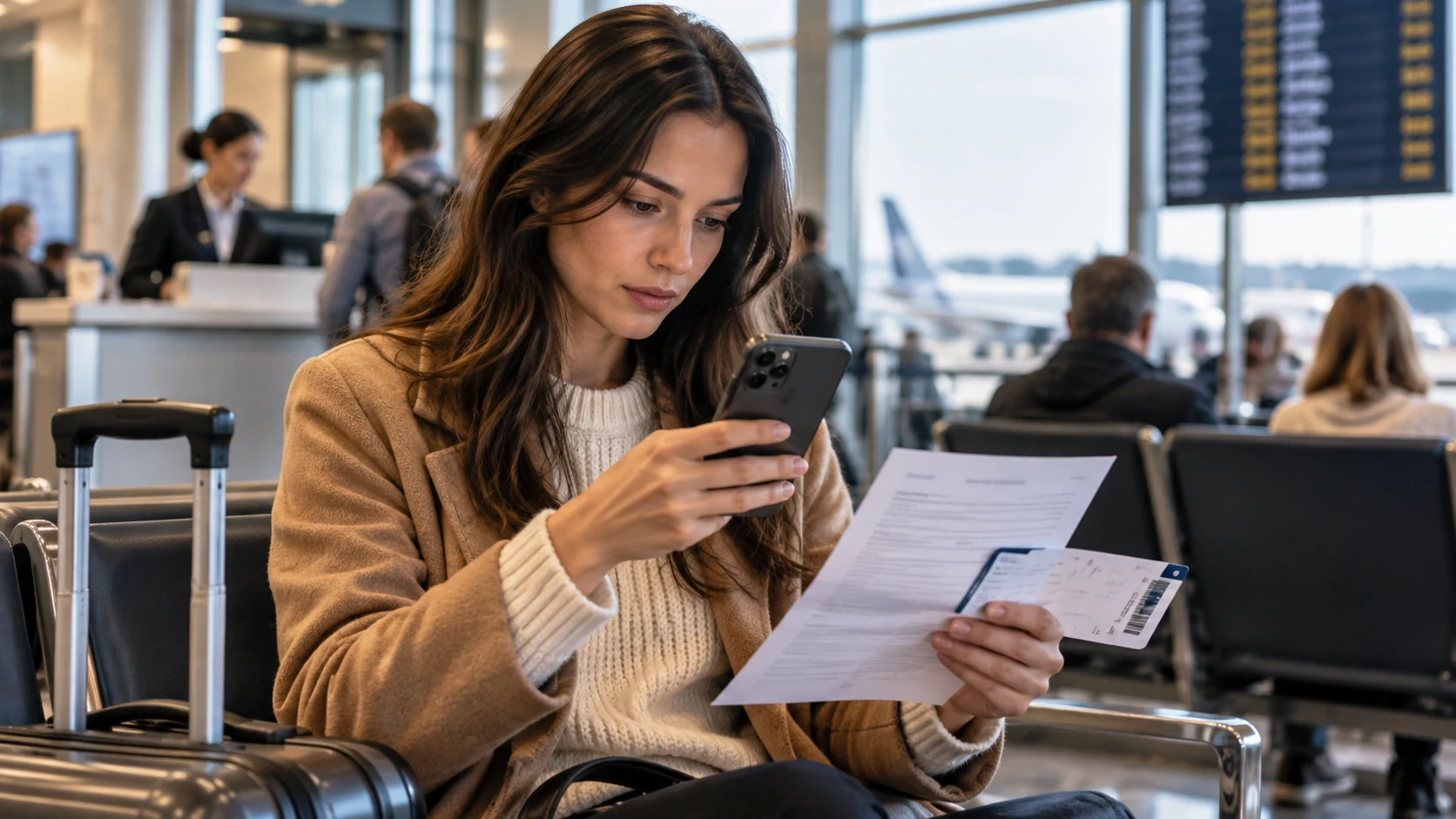
Get the boarding decision and rebooking details in writing.
If you are involuntarily bumped, do not rely only on what was said verbally at the gate. DOT requires airlines to provide involuntarily bumped passengers a written statement describing their rights and explaining the carrier’s boarding priorities.
Why you were denied boarding
Ask whether the flight was oversold and whether the airline classifies the situation as involuntary denied boarding.
Your replacement itinerary
Save the new flight number, routing, confirmation, and expected arrival time.
The compensation calculation
Ask what amount applies and how the airline calculated it.
The form of value
Clarify whether the offer is money, a check, travel credit, voucher, miles, or another benefit.
Meals, hotel, and transportation
If the new itinerary creates a long or overnight wait, ask what additional support is being provided.
Your own evidence
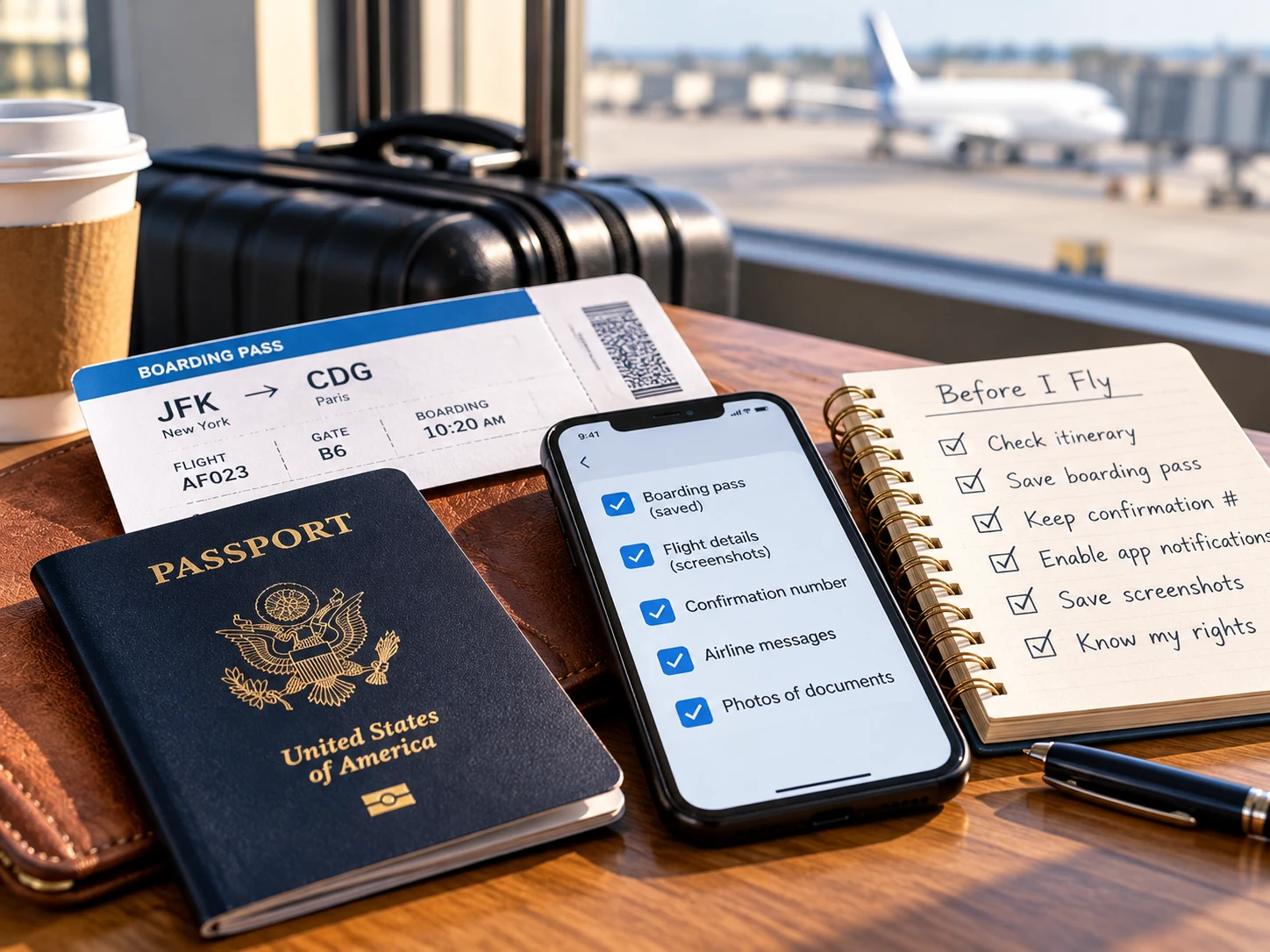
Save the original boarding pass, screenshots of the flight status, gate messages, receipts, and any written offer or rebooking confirmation while the details are still easy to capture.
Boarding Priority
Who gets bumped first on an oversold flight?
There is no single universal passenger order across every airline. U.S. airlines establish their own boarding priorities, which can include factors such as check-in time, fare paid, and frequent-flyer status.
The practical lesson is to remove avoidable risk: check in before the deadline, arrive at the gate on time, keep your boarding pass active, and stay close enough to hear oversale announcements.
A confirmed ticket does not erase boarding-priority rules.
If too many confirmed passengers show up, the airline still has to determine who flies and who is moved.
The Fine Print That Matters
The first offer at the gate and the compensation the airline legally owes are not necessarily the same thing.
Volunteering changes the situation
Once you agree to surrender the seat, the arrangement is generally treated as a voluntary bargain rather than involuntary denied boarding.
The replacement arrival time matters
For U.S. statutory compensation, the key timing measure is how late the replacement transportation gets you to the destination.
Voucher value is not the same as cash value
Expiration dates, blackout periods, route restrictions, and other conditions can make a large headline offer less useful than it sounds. A voluntary voucher offer should not be confused with the form of compensation you may be entitled to after a qualifying involuntary bump.
A boarding denial is not automatically an oversales case
Late arrival, missed cutoffs, document problems, safety issues, and other conditions can produce a different set of rules.
The country and route matter
The U.S. framework may not control a flight departing another country, and another passenger-rights regime may apply instead.
Get the airline’s classification in writing
The written reason and rebooking details can be more valuable later than a memory of what the gate agent said.
My Take
I would never decide whether to volunteer based only on the dollar amount being announced at the gate.
The number can sound attractive when everyone is standing around the gate, but I would first want to know whether my replacement seat is confirmed, when I will actually arrive, what form the compensation takes, and whether I am paying for my own hotel or meals while I wait.
I would also ask what happens if I do not volunteer. That tells me whether I am simply considering a good voluntary offer or potentially giving up an involuntary denied-boarding claim.
The value of the offer is not just the number. It is the number minus the delay, restrictions, uncertainty, and out-of-pocket costs that come with accepting it.
TFP Recommendation
Clarify the category first. Then decide whether the offer is actually good.
The Recommendation
Before agreeing to give up your seat, know whether you are volunteering, what happens if you decline, and exactly how you will be rebooked.
If the airline involuntarily denies boarding, shift from negotiation to documentation: get the written reason, replacement itinerary, expected arrival time, compensation calculation, and any meal, hotel, or transportation support before leaving the gate.
Your Next Step
Use your situation to decide what to do now.
Smarter travel, straight to your inbox
Booking choices, hidden costs, travel rules and useful fine print — explained clearly.
Before You Go
Understand the other airline rules that can look like a denied-boarding problem.
These related guides help separate oversales compensation from delays, boarding cutoffs, overbooking practices, and insurance documentation.
Why Airlines Overbook Flights
See why oversales happen and how a full flight can turn into a volunteer request or involuntary bump.
Understand overbooking →Do Airlines Compensate for Delays?
Understand why ordinary flight-delay compensation and denied-boarding compensation follow different rules.
Compare the rules →Airline Refund vs Travel Credit
See why money back and future-use value are not equivalent when an airline offers a voucher or credit.
Compare refund vs credit →What Happens If You Miss Your Flight?
Use this when the problem is a missed flight, no-show, or boarding-time issue rather than an oversold-flight bump.
Check the missed-flight rules →FAQ
Bumped flights and denied boarding compensation: common questions
What is denied boarding compensation?
Denied boarding compensation is payment an airline may owe when an eligible passenger is involuntarily denied boarding from an oversold flight. Under U.S. rules, eligibility depends on factors including the departure airport, confirmed reservation, check-in and gate timing, and how late the replacement transportation gets you to your destination.
How much compensation do you get if you are bumped from a flight?
For eligible involuntary denied boarding from a flight departing a U.S. airport, current DOT rules generally provide 200% of the one-way fare up to $1,075 for shorter qualifying arrival delays and 400% up to $2,150 for longer qualifying delays. The timing thresholds differ for domestic and international departures.
What is the difference between voluntary and involuntary denied boarding?
Voluntary bumping happens when you agree to surrender your seat in exchange for an airline offer. Involuntary denied boarding happens when the airline selects you after not getting enough volunteers. Voluntary offers are generally negotiated; involuntary bumping may trigger statutory compensation.
Can I negotiate when an airline asks for volunteers?
Yes. DOT says there is no limit on what an airline may offer volunteers, and passengers are free to negotiate. Before agreeing, confirm the replacement seat, arrival time, payment form, voucher restrictions, and whether meals, hotel accommodations, or transportation are included.
Do airlines have to tell me my rights if they involuntarily bump me?
Yes. U.S. DOT rules require airlines to provide involuntarily bumped passengers a written statement describing their rights and explaining how the carrier decides who is bumped.
Do I have to accept a voucher if I am involuntarily bumped?
No. A voucher may be part of a voluntary deal, but if you are involuntarily bumped and U.S. denied-boarding compensation is owed, DOT guidance says you can insist on a check instead of accepting a free ticket or travel voucher. Ask what you are legally owed before accepting a restricted form of value.
Can an airline bump me after I have already boarded?
Generally not for an ordinary oversales bump once the airline has accepted or scanned your boarding pass and told you that you may proceed to board, assuming you checked in on time. Safety, security, health, or unlawful/disruptive behavior can create exceptions.
Who gets bumped first on an oversold flight?
There is no universal order across every airline. Airlines establish their own boarding priorities and may consider factors such as check-in time, fare paid, or frequent-flyer status, subject to legal limits on discriminatory treatment.
Does the U.S. denied-boarding rule apply to a flight departing Europe for the United States?
Not automatically. The U.S. DOT denied-boarding compensation framework described here applies to qualifying oversold flights departing U.S. airports. A flight departing Europe may instead fall under European passenger-rights rules depending on the itinerary and operating carrier.
Can a service help me claim compensation for being bumped from a flight?
Sometimes. If your itinerary falls under supported international passenger-rights rules, a claims service may be able to review the disruption and pursue an eligible claim. Compensair handles certain denied-boarding claims under European, Canadian, and Turkish rules. Coverage depends on the route, airline, and circumstances. Check whether your flight may qualify with Compensair.
What should I get in writing if I am involuntarily denied boarding?
Keep the airline’s written rights notice, the reason you were denied boarding, your new itinerary and expected arrival time, the compensation amount and form, and any meal, hotel, or transportation support. Save your boarding pass and booking confirmation too.
Free Travel Guide
Avoid the travel mistakes that can cost you money, flexibility, or time.
Get 27 Travel Mistakes That Cost Travelers Thousands — a practical guide to booking mistakes, hidden costs, travel rules and decisions worth understanding before they become a problem.
- Spot booking details that are easy to overlook
- Understand where hidden costs can appear
- Recognize when a cheaper option comes with a tradeoff
- Make travel decisions with fewer surprises
You’ll also receive occasional practical guidance from Travel Fine Print on booking choices, hidden costs, travel rules and the fine print worth understanding. Unsubscribe anytime.