
You land in another country and need local cash.
Right near baggage claim, there it is: a currency exchange counter promising convenience before you even leave the airport.
Now you want to know whether it is better to exchange money at the airport, use a bank, withdraw from an ATM, or pay by card instead.
Airport currency exchange is convenient, but that convenience usually comes at a cost. Exchange desks often make money through weaker exchange rates, service fees, commissions, or a mix of all three. Even when a sign says “no commission,” the cost may already be built into the rate you are offered.
The real question is not just:
“Can I get local currency here?”
It is:
“How much value am I losing for the convenience?”
This guide explains whether airport currency exchange is usually a good deal, why airport rates may be worse, when exchanging a small amount can still make sense, and what to compare before converting money.
Quick Answer
Is airport currency exchange a bad deal?
Airport currency exchange is usually a bad deal because the rate is often less favorable than what you could get through an ATM, bank, or low-fee card. The difference may look small, but it can add up quickly when exchanging larger amounts.
Airport exchange counters are convenient, but that convenience is often built into the rate, fees, or both. You are not just exchanging money — you are paying for speed, location, and convenience.
The posted exchange rate is not always the real cost of getting foreign currency.
Is Airport Currency Exchange More Expensive?
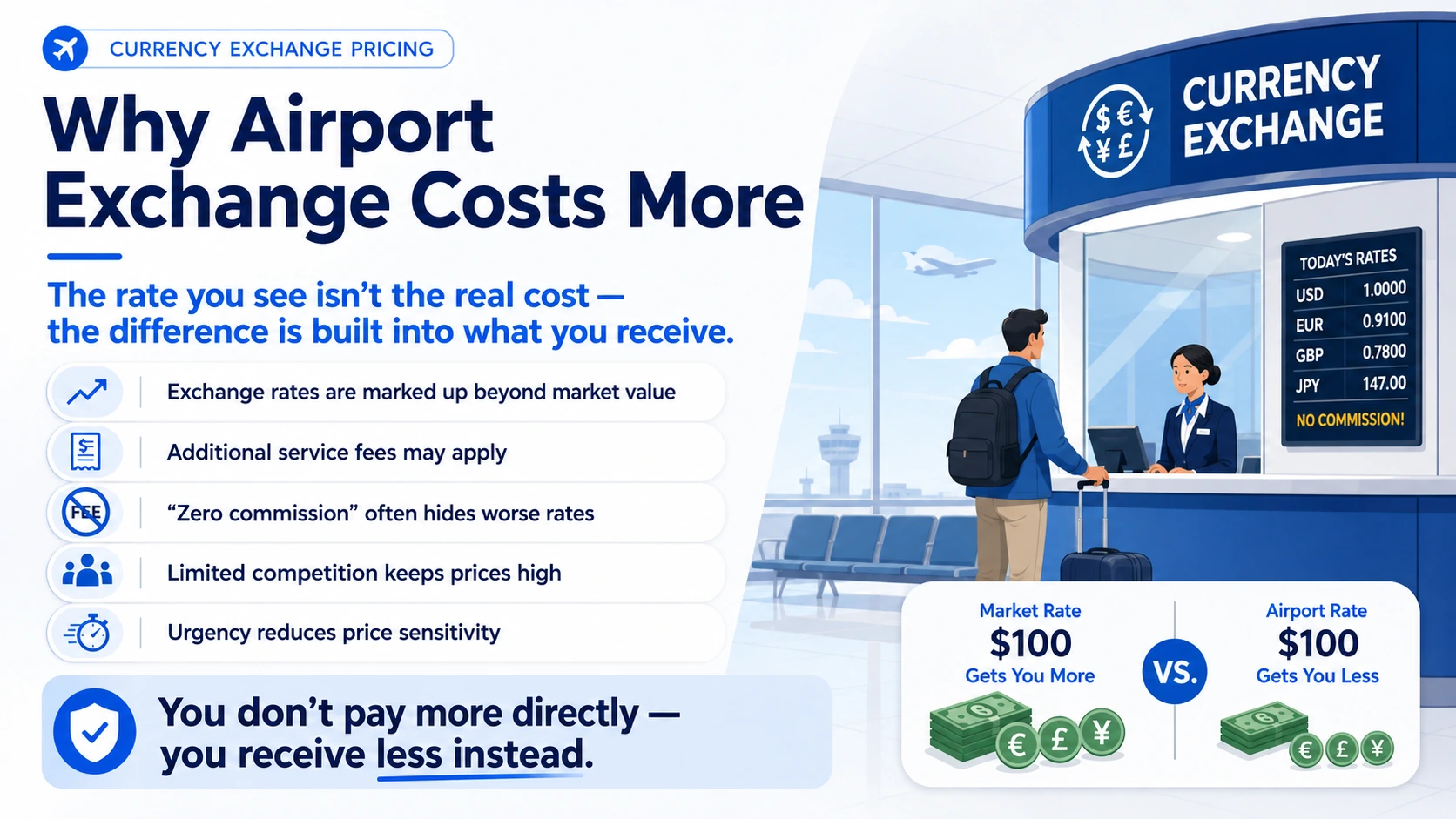
Airport currency exchange is often more expensive because the provider may use a weaker exchange rate, add a service fee, charge a commission, or build the cost into the rate itself.
That means the price is not always shown as a separate fee. You may simply receive less foreign currency for the same amount of money.
The smaller the exchange, the less the difference may matter. But if you exchange a few hundred dollars or rely on airport counters repeatedly, the hidden cost can become much more noticeable.
Most travelers focus on fees when exchanging money.
But the real cost isn’t always visible.
Exchange counters in airports charge higher rates because they operate in high-demand, convenience-driven environments.
To understand why airport exchange is so expensive, you need to look at how exchange rates are actually set.
System Insight
The airport exchange fee is not always the fee you can see.
- The posted rate matters because a weaker exchange rate can cost more than a visible service fee.
- “No commission” does not always mean no cost because the provider may build profit into the rate instead of listing a separate charge.
- Convenience changes the value because airport counters are priced for travelers who need cash quickly and have fewer nearby options.
- The payout matters most because the real comparison is how much foreign currency you receive after the rate, fees, and markup are applied.
What Actually Happens When You Exchange at the Airport
You hand over your money and receive the local currency.
The transaction looks straightforward.
But behind the scenes, the exchange rate you’re given has already been adjusted.
Instead of charging obvious fees, many providers adjust the exchange rate to include their profit.
That adjustment means you receive less than the true value of your money.
There’s no separate charge — no obvious fee.
Just a smaller payout.
What feels like a simple exchange is actually a priced transaction where convenience replaces value.
Exchange Outcomes
Best Value
Bank or Low-Fee Card
- Often closest to the market exchange rate.
- Lower or more transparent fees.
- Usually better total value than airport counters.
- Best when you can plan before the trip.
What this means: you usually keep more of your money’s value.
Moderate Value
Local Exchange Provider
- Some markup may still apply.
- Rates vary by provider and location.
- Often better than airport exchange counters.
- Worth comparing before exchanging larger amounts.
What this means: you may lose some value, but usually less than at the airport.
Worst Value
Airport Exchange Counter
- Higher markup may be built into the exchange rate.
- Extra service fees may apply.
- Limited alternatives reduce price pressure.
- Convenience can cost more than travelers realize.
What this means: you may receive less foreign currency for the same amount of money.
The same money can give you different value depending on where you exchange it. The airport may be convenient, but convenience can be built into the rate you receive.
When Airport Exchange Feels “Necessary”
Travelers often use airport exchange services because they assume it’s the safest or easiest option.
Airport exchange isn’t always a mistake — it’s often a reaction to timing and access.
Arriving Without Local Currency
You need cash immediately for transport or tips.
👉 Convenience outweighs cost in the moment.
Not Planning Ahead
You didn’t exchange money before traveling.
👉 The airport becomes the default option.
Avoiding ATM Fees
Some travelers try to avoid withdrawal fees.
👉 They unknowingly accept worse exchange rates instead.
Unfamiliar Destination
You’re unsure where to exchange money safely outside the airport.
👉 The airport feels like the safest choice.
Airport exchange isn’t chosen because it’s better — it’s chosen because it’s available.
Traveler Risk
“It’s just a small fee” is the risky assumption.
A few dollars may not seem like a big deal when you are tired, landing soon, or trying to get cash quickly. But airport exchange costs are often hidden in the rate you receive, not shown as a separate fee.
That means the cost can add up without feeling obvious, especially when exchanging larger amounts or relying on airport counters more than once during a trip.
You may not notice the cost because you do not see it leave your wallet. You simply receive less foreign currency.
What To Do Instead
The goal isn’t avoiding exchange — it’s choosing where you exchange.
If possible, withdraw cash from an ATM at your destination using a debit card — this often provides a better rate than exchange counters.
Credit cards can also offer favorable exchange rates for purchases, especially when used without foreign transaction fees.
This is part of a broader pattern in travel where convenience often comes at a hidden cost.
If you must exchange at the airport, limit the amount — just enough to get through immediate needs.
The key is reducing how much money is exposed to the worst rates.
Where you exchange matters more than when you exchange.
Action Step
Use airport exchange only when convenience matters more than value.
Airport exchange counters can be useful in a pinch, but they are rarely the best place to exchange larger amounts. Before converting money, compare the real amount of foreign currency you will receive, not just whether the counter says “no commission.”
- Avoid exchanging large amounts at the airport when possible.
- Use ATMs, banks, or low-fee cards when they offer better total value.
- Exchange only a small emergency amount if you need cash right away.
- Compare the amount you receive after fees and rate markups.
- Watch for “zero commission” offers with weaker exchange rates.
- Use credit cards for purchases when accepted and when foreign transaction fees are reasonable.
The easiest way to save money is to avoid the worst exchange point. Airport counters are convenient, but convenience can quietly reduce how much currency you receive.
Why Airport Exchange Is Priced This Way
Airport exchange providers operate in high-convenience, low-competition environments.
Travelers arriving need immediate access to local currency, and alternatives are limited.
This allows providers to charge higher margins through exchange rate markups.
It’s not about offering the best rate — it’s about capturing demand at the moment it’s highest.
❓Frequently Asked Questions
Airport currency exchange can feel convenient, but the real cost is not always obvious. These questions explain when airport exchange may cost more, how “no commission” offers can still be expensive, and what to compare before converting money.
Is it better to exchange money at the airport?
Usually, no. Airport currency exchange is often more expensive than using a bank, ATM, or low-fee card because the exchange rate may be weaker and fees may be included in the transaction. Airport exchange is usually best for small emergency amounts, not large exchanges.
Is airport currency exchange more expensive?
Often, yes. Airport exchange counters may use a less favorable exchange rate, charge a service fee, add a commission, or build the cost into the rate itself. You may not see a separate fee, but you may receive less foreign currency for the same amount of money.
Is it cheaper to exchange currency at a bank or airport?
A bank, ATM, or low-fee card is often cheaper than an airport exchange counter, especially for larger amounts. The best comparison is not just the posted fee. Compare the actual amount of foreign currency you receive after the exchange rate and any fees are applied.
Is “no commission” currency exchange a good deal?
Not always. “No commission” only means the provider may not charge a separate commission fee. The cost can still be built into a weaker exchange rate, which means you may receive less foreign currency even though no separate commission appears on the receipt.
Should I exchange money before I travel?
It can make sense to have a small amount of local currency before arrival if you need cash for transportation, tips, or immediate expenses. But you do not always need to exchange your full travel budget in advance. Many travelers use a mix of ATM withdrawals, low-fee cards, and small emergency cash amounts.
How much money should I exchange at the airport?
If you must exchange money at the airport, consider exchanging only enough for immediate needs, such as transportation, tips, or a small cash backup. Larger exchanges can cost more because airport rates may be weaker than banks, ATMs, or low-fee card options.
What is the best way to get foreign currency while traveling?
The best option often depends on the destination, your bank, your card fees, and how much cash you need. ATMs, banks, and low-fee cards often provide better total value than airport exchange counters. Before traveling, check foreign transaction fees, ATM fees, withdrawal limits, and whether your card works at your destination.
Bottom Line
Airport currency exchange is usually convenient, not usually the best value.
The problem is not only a visible fee or commission. The bigger cost is often the exchange rate itself. A counter can advertise “no commission” and still give you less foreign currency because the markup is already built into the rate.
That does not mean airport exchange is always a mistake. If you need a small amount of local cash right after landing, it may be worth paying for convenience. But it is usually not the best place to exchange larger amounts.
Before exchanging money at the airport, compare the actual payout: how much foreign currency you receive after the rate, fees, and markup are applied. If the amount is small and solves an immediate problem, the convenience may be worth it. If the amount is larger, a bank, ATM, or low-fee card may protect more of your money’s value.
Airport currency exchange may seem convenient — but understanding how pricing works can help you avoid unnecessary costs and make better financial decisions while traveling.
The travel fine print is simple: you may not see the cost as a separate charge. You may just receive less.
Related Guides
If you are trying to understand currency exchange, travel payment costs, airport convenience fees, or hidden travel charges, these related guides may help:
Booking and Payment Fine Print
- Why the Price You See at Checkout Isn’t Always the Price You Pay
Compare how taxes, fees, currency conversion, add-ons, and payment rules can change the final trip cost. - Booking Hotels Through Third-Party Sites
See how booking channels, merchant names, payment paths, and refund rules can affect what shows on your card. - Pay Now vs Pay at Hotel: Which Option Is Safer?
Compare how payment timing, deposits, currency conversion, and hotel-collect bookings can affect flexibility and final cost.